
Search for "budget SEO" or "cheap search engine optimization" right now, and you will immediately hit a wall of identical landing pages. Most of them prominently feature the exact same phrase: An Affordable SEO Company You Can Trust. They promise top Google rankings, guaranteed traffic, and hundreds of backlinks, all for a flat rate of $99 or $199 a month.
For a bootstrapped SaaS founder or an indie hacker watching their burn rate, that price point is incredibly tempting. But here is the uncomfortable reality of SEO in 2026: human-led SEO services cannot be both high-quality and cheap. If an agency is charging $99 a month, they are not doing deep competitor analysis or writing expert-level, answer-first content optimized for ChatGPT and Perplexity. They are likely running your site through a cheap spinner and blasting it with toxic Private Blog Network (PBN) links.
True affordable SEO is not about finding the cheapest agency. It is about applying high-leverage strategies, ruthless prioritization, and intelligent automation. When you stop looking for humans to do complex work for pennies and start building a lean, systemized organic growth engine, you can compete with enterprise competitors who outspend you ten to one.
If you want to build a compounding traffic engine without draining your runway, you need to rethink the traditional playbook. Here are five affordable SEO strategies for lean startups that actually work in today’s AI-driven search landscape.
What Defines "Affordable" SEO in 2026?
Before detailing the strategies, we have to separate "affordable SEO" from "cheap SEO." These two concepts are entirely different operational models.
Many founders turn to community forums looking for agency recommendations, asking questions like: "Any affordable SEO agencies that actually work for small businesses?". The answers in those threads usually reveal a harsh truth. Small business owners who hire ultra-cheap providers typically spend six months paying monthly retainers only to receive automated PDF reports showing vanity metrics, while their actual revenue from organic traffic remains flat or drops due to algorithmic penalties.
The "Cheap SEO" Trap
Cheap SEO relies on volume-based, low-quality inputs to maintain a margin.
- The Model: Outsourced, generic content written without subject matter expertise.
- The Backlinks: Spammy blog comments, low-tier directory submissions, and dangerous PBN links that will eventually trigger a Google manual action.
- The Strategy: Targeting high-volume, impossible-to-rank keywords just to show "activity."
- The Result: Stagnant traffic, potential domain penalties, and a complete waste of capital.
If you want to avoid these traps, start by learning how to spot Hiring SEO Services in Phoenix? 5 Red Flags (2026)—the lessons apply regardless of your geography.
The "Affordable SEO" Mindset
Affordable SEO relies on systems, software, and highly specific targeting.
- The Model: Internal execution combined with automated, AI-driven content platforms.
- The Backlinks: Earned naturally through free tools, founder-led digital PR, and highly shareable data.
- The Strategy: Hyper-specific, long-tail, and zero-volume keywords that have high commercial intent.
- The Result: Slow but highly targeted initial growth, leading to a compounding asset that generates consistent demo requests or signups.
 To see this shift in perspective, look at the difference between traditional agency models and modern software solutions. As highlighted in our breakdown of SEO Charges UK: Agency Rates vs Automation (2026), a mid-tier agency charges between $3,000 and $5,000 monthly for a standard content and technical roadmap. For a lean startup, that is a massive expense. By utilizing the five strategies below, you can achieve better results for a fraction of that cost.
Strategy 1: The "Answer-First" Long-Tail Content Play
One of the biggest mistakes SaaS startups make is trying to rank for their core category term right out of the gate. If you launch a project management tool and immediately try to rank for "best project management software," you will fail. You are competing against multi-billion dollar companies with teams of link builders and domain ratings in the 90s.
Instead, affordable SEO dictates that you play a different game: the hyper-specific, long-tail query.
Targeting the "Zero-Volume" Illusion
Keyword research tools often show specific, niche queries as having "0-10 searches per month." Lean startups should actively target these terms. Why? Because keyword tools are notoriously bad at estimating long-tail volume, and enterprise competitors ignore these keywords because the projected ROI is too small for their massive budgets.
If you write an incredibly detailed article targeting "how to migrate from Jira to Notion for a remote creative agency," the search volume might look nonexistent. But the user typing that query is highly motivated, frustrated with their current solution, and ready to buy. Ranking for 50 of these hyper-specific, "zero-volume" keywords is far more profitable than ranking on page 3 for a broad term.
Structuring for AEO (Answer Engine Optimization)
In 2026, you aren't just optimizing for Google. You are optimizing for AI engines like ChatGPT, Perplexity, and Google's Gemini. These platforms don't want 3,000 words of fluff. They want direct, structured answers they can instantly extract and serve to users.
To execute an affordable Answer-First strategy:
- Lead with the BLUF (Bottom Line Up Front): Answer the core search query in the first two sentences of the article. Do not bury the answer below a massive introductory paragraph.
- Use Quotable Sections: Create distinct, beautifully formatted callout boxes that summarize key data points. AI engines love extracting clean, clearly labeled data.
- Implement Schema Markup: Use proper FAQ, Article, and SoftwareApplication schema so search engines understand exactly what your page is about without having to guess.
 This structural discipline costs nothing to implement, but it drastically improves your chances of being cited by AI search engines, driving highly qualified referral traffic without needing thousands of backlinks.
Strategy 2: Programmatic SEO and End-to-End Automation
If you want to scale your organic presence affordably, you cannot rely entirely on human freelance writers charging $0.20 a word. To publish the necessary volume of content to build topical authority, you need automation.
Programmatic SEO historically meant spinning up thousands of low-quality location pages (e.g., "Plumber in Austin," "Plumber in Dallas"). Today, it means using sophisticated automation to generate highly relevant, structured content at scale.
The Problem with Fragmented Tools
Many founders try to build their own "affordable" automation stack. They use an AI writer to draft a post, run it through a separate SEO optimization tool, copy-paste it into WordPress, manually find stock images, and schedule it.
While cheaper than an agency, this process still requires hours of manual oversight. You haven't eliminated the cost; you've just shifted it to your own time, which is the most expensive resource a startup founder has.
True Automation: The BeVisible Approach
This is where end-to-end automation platforms change the economics of SEO. At BeVisible, we built our platform specifically for SaaS founders, indie hackers, and lean startups who need the output of an SEO agency without the headcount or the $3,000 monthly retainer.
Instead of managing a fragmented stack, you connect BeVisible to your CMS (WordPress, Webflow, Notion, Ghost, or Shopify via API). From there, the platform takes over the entire production pipeline:
- Automated Research: It analyzes your niche and competitors to build a complete 30-day content map tailored to your specific market.
- Daily Production: It automatically writes, polishes, and publishes one highly optimized article every 24 hours.
- Technical Optimization: Every post includes the answer-first structures, quotable sections, schema markup, and internal links necessary for both traditional Google SERPs and AI extraction.
- Visual Assets: The platform generates branded cover images optimized for your content, completely removing the need to hunt for stock photos.
For a $199/month launch discount, startups receive 30 fully published, AI-optimized articles a month—including unlimited revisions, metadata, tagging, and Google Search Console analytics integration. This is the definition of affordable SEO: using software to achieve the daily publishing cadence of a media company, completely hands-free.
Strategy 3: Nailing Technical SEO Internally (Especially for SPAs)
Technical SEO sounds expensive. Agencies often sell "Technical Audits" for thousands of dollars, delivering massive spreadsheets filled with minor warnings that have little impact on actual rankings.
For most lean startups, technical SEO is affordable because it is entirely within your control. If your site is fast, mobile-friendly, and logically structured, you are 90% of the way there. However, there is one major technical hurdle specific to SaaS startups: the Single Page Application (SPA).
The SPA Indexing Problem
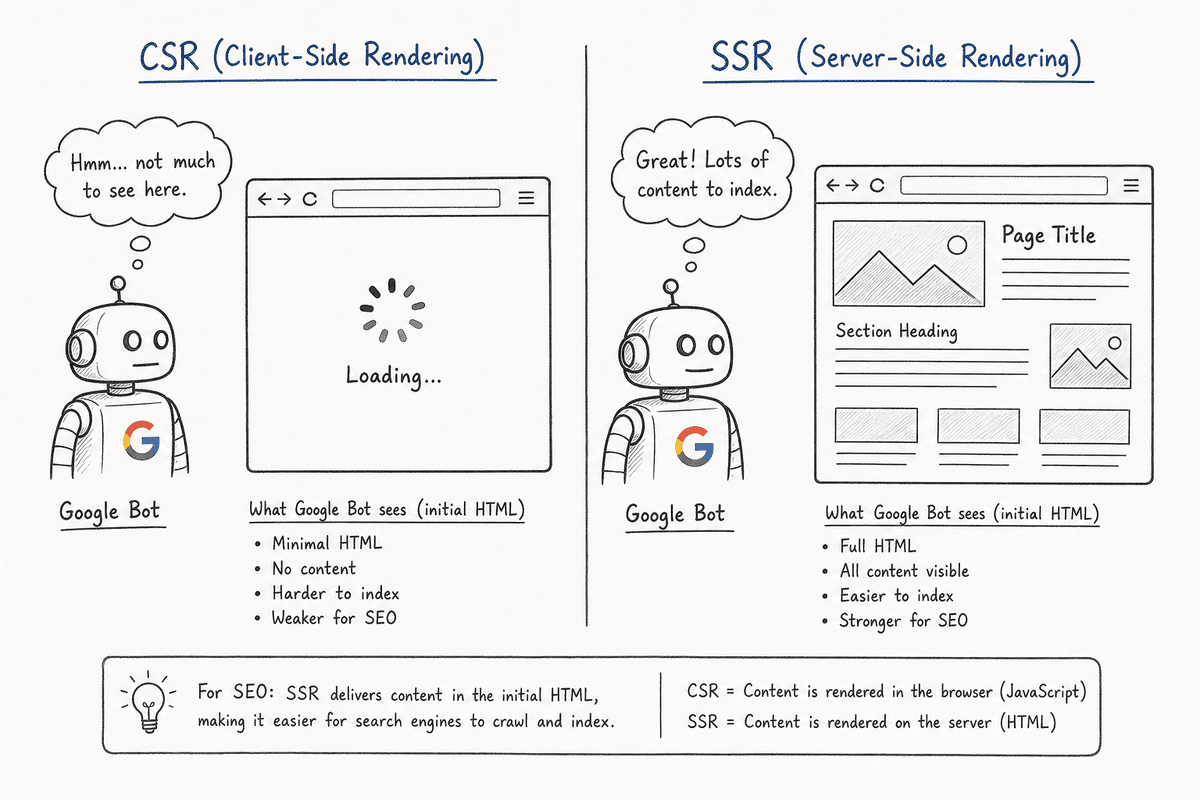
Many SaaS products and startup websites are built using modern JavaScript frameworks like React, Vue, or Angular. These create Single Page Applications (SPAs) that offer incredibly fast, app-like experiences for users.
However, SPAs are notoriously difficult for search engine bots to crawl. Because the content is rendered dynamically in the browser (Client-Side Rendering), a Google bot might simply see a blank page and move on. If Google cannot see your content, you cannot rank, no matter how good your content is.
The Affordable Fix: Prerendering and SSR
You do not need an expensive consultant to fix this; you just need your dev team to implement the right rendering strategy.
Instead of relying solely on Client-Side Rendering (CSR), implement Server-Side Rendering (SSR) or Static Site Generation (SSG) for your public-facing marketing pages and blog. Frameworks like Next.js (for React) or Nuxt.js (for Vue) make this relatively straightforward.
By ensuring the server sends a fully rendered HTML page to the bot, you instantly solve the biggest technical SEO roadblock for SaaS companies. For a deeper technical checklist on getting this right, review our guide on SEO for Single Page Applications: The Technical Checklist, and understand the broader strategy in Single-Page Application SEO: What Works in 2026?.
Strategy 4: High-ROI Landing Page Optimization
Blogging drives top-of-funnel awareness, but landing pages drive revenue. One of the most affordable and effective SEO strategies a startup can deploy is building a comprehensive suite of feature, integration, and alternative landing pages.
Feature and Use-Case Pages
Don't just have one broad "Features" page. Break down every single capability of your software into its own dedicated landing page.
If you offer an email marketing tool, create distinct pages for:
/features/drag-and-drop-email-builder/features/automated-drip-campaigns/features/email-analytics-dashboard
Each of these pages should be optimized for transactional search intent. They are easier to rank than broad blog posts and convert at a significantly higher rate.
"Alternative To" Pages (The Comparison Strategy)
Searchers looking for "[Competitor] alternatives" are at the absolute bottom of the funnel. They know the problem, they know the market leader, and they are actively looking to switch.
Building comparison pages (e.g., "YourBrand vs. GiantCompetitor") is incredibly cost-effective. You already know why your product is better for your specific target audience.
When building these pages, avoid generic marketing speak. Be painfully honest. Say exactly who the competitor is best for, and who you are best for.
- Competitor X is best for massive enterprise teams that need complex permissions.
- Our Software is best for lean startups that need to move fast without bloated onboarding.
Google—and users—reward this level of specific, helpful honesty. To learn exactly how to structure these assets for maximum conversion, follow our How to Build an SEO Landing Page (7-Step Guide).
Strategy 5: Lean Link Building (Digital PR & Founder-Led Growth)
Link building is usually the most expensive part of any SEO campaign. Buying high-quality links can cost upwards of $300 to $800 per link. Cheap SEO services will offer 100 links for $50, but as discussed, those will actively harm your domain.
So, how does a startup build authority affordably? You stop trying to build links, and you start trying to build attention. When you earn attention, links follow naturally.
The "Free Tool" Strategy
Engineering as marketing is one of the highest-ROI SEO strategies available. Take a small, useful feature of your core product and release it for free as a standalone tool on your website.
For example, if you build accounting software for e-commerce, create a free "Etsy Profit Margin Calculator." (If you are actually in the Etsy space, check out our roundup of 7 Best Etsy SEO Tools to Boost Sales in 2026).
Free tools act as link magnets. Bloggers, industry publications, and 11 Best SEO Blogs Every SaaS Founder Needs (2026) are far more likely to link to a genuinely useful free calculator than they are to link to your latest generic blog post.
Founder-Led Digital PR
Your story as a founder is an asset. Appearing on industry podcasts, contributing guest columns to niche publications, and sharing transparent data on platforms like Indie Hackers or X (formerly Twitter) generates high-quality, natural backlinks.
When a podcast publishes your interview, they will link to your homepage in the show notes. When you write a guest post detailing how you solved a specific technical challenge, you earn a powerful backlink from a highly relevant domain. This costs nothing but your time and expertise, yet it produces a backlink profile that competitors cannot simply buy.
The Real Cost of SEO: Agency vs. In-House vs. Automation
To truly understand what affordable SEO looks like, we have to look at the numbers. Let's compare the three main paths a SaaS startup can take to execute an SEO strategy over a 12-month period.
 Lists of generic services like the 11 Affordable SEO Services for Small Businesses often point out that pricing varies wildly based on deliverables. But the math for a lean startup is clear. Paying an agency $42,000 a year is rarely feasible pre-Series A. Paying a "cheap" provider $1,188 a year is setting money on fire.
Leveraging a platform like BeVisible gives you the output volume of a massive content team for less than the cost of a single freelance article. That is the leverage required to win in modern search.
Frequently Asked Questions About Budget SEO
Can you really do SEO for under $500 a month?
Yes, provided you are investing in tools and automation rather than cheap human labor. You can secure a premium CMS, a fast hosting environment, and an automated publishing platform like BeVisible for well under $500 a month. However, if you are paying humans $500 a month to do your SEO, you are almost certainly receiving dangerously low-quality work.
How long does affordable SEO take to show results?
Whether you spend $5,000 a month or $199 a month on automation, SEO is a compounding channel. It typically takes 3 to 6 months to see meaningful traction from new content, and 9 to 12 months to see significant revenue impact. The advantage of affordable automation is that you can sustain the strategy for those 12 months without draining your operational budget.
Should we focus on local SEO or national/global SEO?
For most SaaS and e-commerce startups, your product is available globally. You should focus on niche, long-tail queries that your target customer searches for, regardless of their location. Local SEO is generally reserved for brick-and-mortar businesses or service area providers (e.g., if you are looking for Top 7 Agencies for SEO in Durham (Ranked 2026)).
The Shift to High-Leverage Growth
The era of throwing cheap human labor at search engine algorithms is over. The web is too crowded, and AI engines are too smart to be fooled by spun content and purchased links.
For lean startups, affordable SEO means being smarter, not just cheaper. It means understanding technical hurdles like SPA rendering (Implementing SEO in Single Page Applications (3 Ways)), targeting zero-volume keywords with Answer-First structures, and using engineering as marketing to earn links naturally.
Most importantly, it means utilizing end-to-end automation to maintain a relentless publishing velocity. When you automate the repetitive heavy lifting of content generation, formatting, and publishing, you free up your limited time to focus on what actually matters: building a great product that your new organic traffic will actually want to buy.