
You just ran a new draft through your favorite optimization tool. It hits a 90 out of 100. The primary keywords are perfectly distributed in the H2s, the entity density is spot on, and the word count exactly matches the top-ranking competitors. By traditional metrics, it is a flawless article.
But when you actually read it, the text feels hollow.
Sentences march in a monotonous rhythm. Every paragraph opens with a predictable transition word. The phrasing feels simultaneously overly formal and entirely empty. This is the reality of scaling content in 2026: tools like Surfer SEO are excellent for mapping topical relevance, but relying on them to generate the actual prose often results in robotic text that fails the human tone test.
Search engines, and more importantly, the AI assistants that increasingly mediate search (like ChatGPT, Perplexity, and AI Overviews), have evolved. They no longer just parse keyword density; they analyze semantic depth, originality, and conversational naturalness. Passing human tone standards requires bypassing predictable AI patterns—specifically monotonous sentence lengths and frequent, formulaic transitions.
The best method to achieve this is two-fold: use top-tier base language models heavily guided by custom brand and voice instructions, or run raw AI drafts through specialized "humanizer" tools.
If your goal is to build an audience, earn citations from Large Language Models (LLMs), and turn visibility gaps into published work, your generation stack needs to move beyond basic SEO editors. Here is how to build a content generation engine that actually sounds human.
The Core Problem: Why Most AI Content Fails the Tone Test
To fix robotic writing, you have to understand why LLMs produce it in the first place. AI models generate text by predicting the next most statistically probable word (or token) based on their training data. When an LLM aims for the mathematical average of human language, the result is exactly that: average.
This statistical averaging leads to two major stylistic tells: a lack of burstiness and remarkably low perplexity.
Burstiness refers to the variance in sentence length and structure. Human writers naturally mix very short, punchy sentences with longer, complex thoughts. We use fragments for emphasis. We occasionally start sentences with conjunctions. AI, left to its own devices, prefers a steady, droning rhythm where almost every sentence runs between 12 and 17 words.
Perplexity measures the unpredictability of word choices. Human writers will occasionally use a slightly unusual verb or an idiomatic phrase that doesn't perfectly align with the immediate context but makes perfect sense to the reader. AI models optimize for low perplexity, selecting the most obvious, expected word every single time.
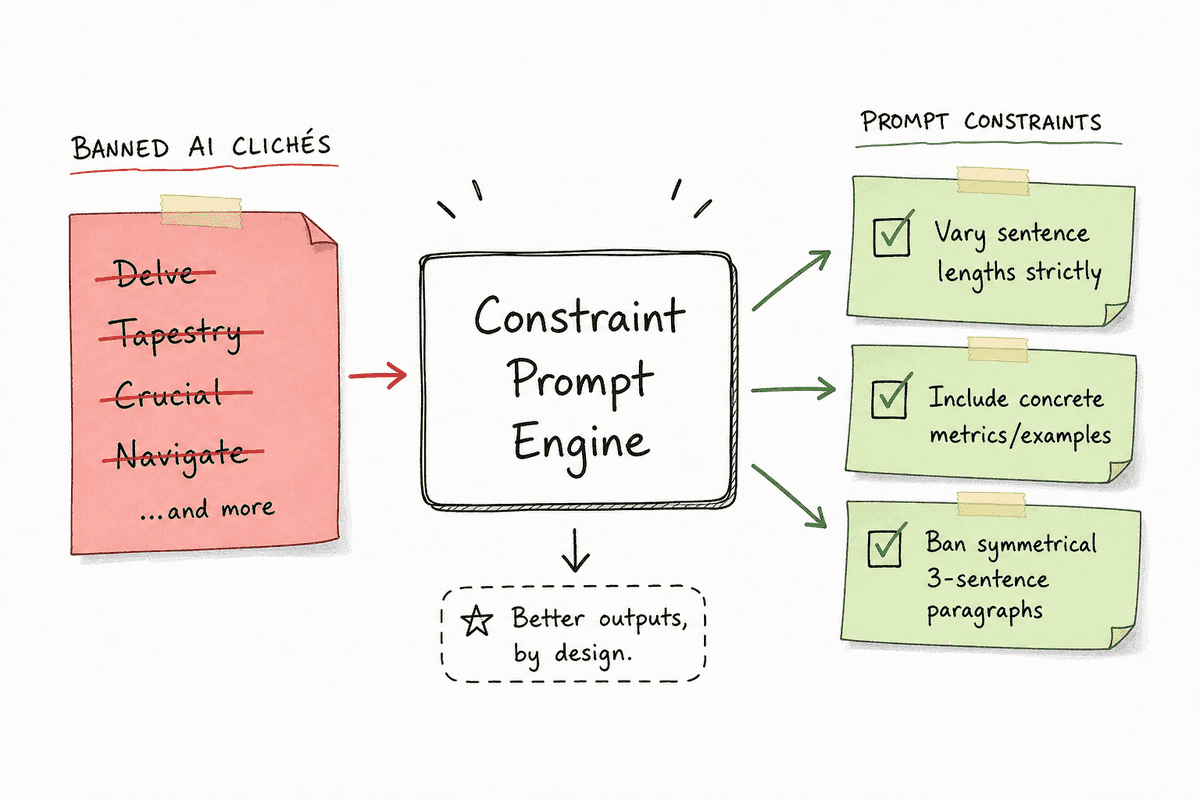
 When you combine low burstiness with low perplexity, you get the classic ChatGPT voice. As highlighted in discussions on how to make ChatGPT sound human, default AI writing is notoriously stiff, overly formal, and relies heavily on a specific set of crutch words ("delve," "tapestry," "navigating," "seamless").
Surfer SEO and similar optimization platforms are built to ensure you cover specific entities and phrases. When you ask an AI to write an article while forcing it to include a strict checklist of 45 specific terms, you restrict the model's natural language pathways even further. The model shoehorns the keywords in, sacrificing narrative flow and human tone to achieve a high optimization score.
Top Base LLMs That Natively Pass Tone Standards
The most efficient way to generate content that passes human tone standards is to start with a model that natively excels at nuance. Instead of relying entirely on post-generation editing, you can leverage base models that have been tuned for conversational and context-aware writing.
Not all models are created equal when it comes to tone. Here are the leaders for human-sounding drafts.
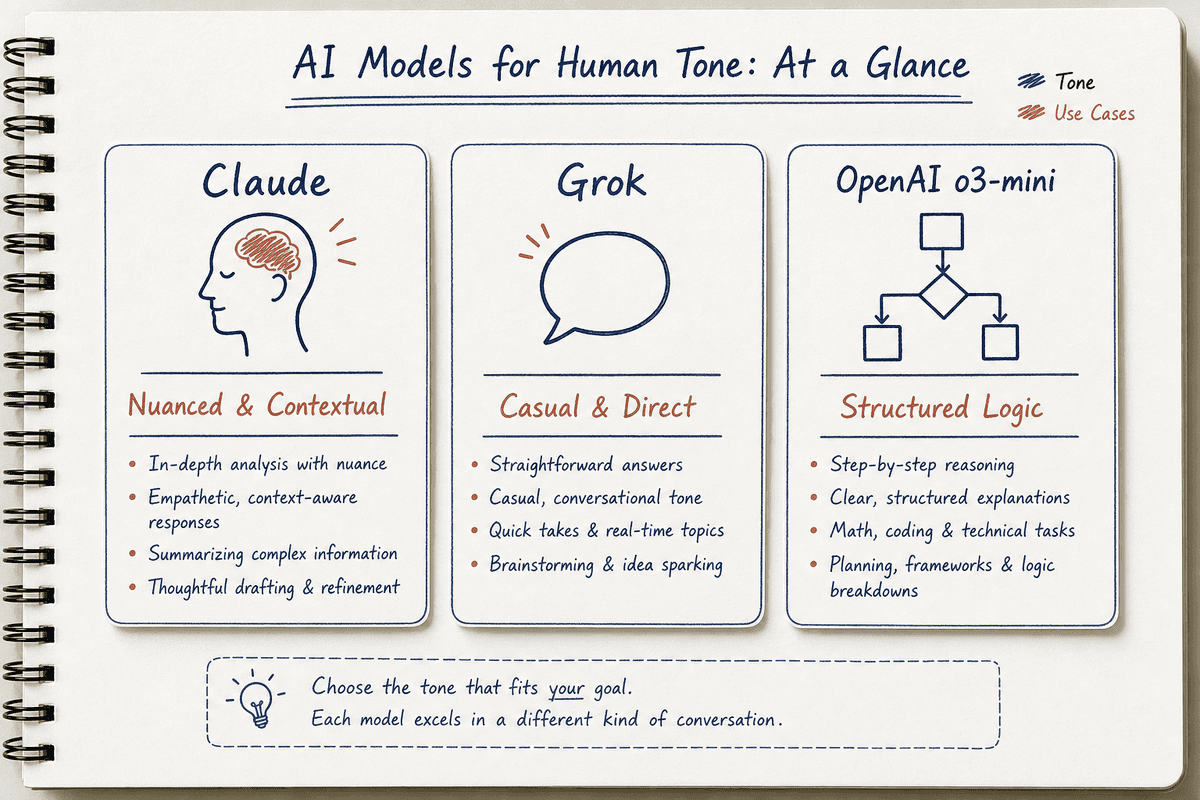
Claude (by Anthropic): The Nuance Leader
Claude consistently scores the highest for natural, nuanced, and human-like writing. Unlike early iterations of ChatGPT that tended to preach or summarize aggressively at the end of every response, Claude's default tone is remarkably conversational.
Anthropic trained Claude with a focus on constitutional AI, which inadvertently made the model much better at recognizing nuance, admitting when things are complex, and avoiding sweeping, generic statements. When you ask Claude to write a blog post, it is much less likely to rely on the standard five-paragraph essay structure. It naturally incorporates better burstiness, varying its sentence lengths without being explicitly prompted to do so.
For B2B marketing teams trying to write complex, authoritative content—like building an SEO landing page or explaining technical infrastructure—Claude is currently the strongest starting point. It explains difficult concepts without talking down to the reader or sounding like a textbook.
Grok: The Conversational & Casual Alternative
Grok takes a different approach. Developed by xAI, Grok was intentionally tuned to be slightly more rebellious and casual. It ranks highly for a witty, relaxed tone, often reading like a clever human colleague rather than a corporate assistant.
This model shines when you are writing top-of-funnel content, newsletters, or opinion pieces where personality is the primary differentiator. Grok struggles slightly more with highly rigid, structured formatting than Claude, but if your goal is purely to pass human tone standards and avoid the robotic sheen of corporate AI, Grok provides a fantastic baseline. It naturally avoids words like "furthermore" and prefers a much more direct, active voice.
OpenAI o3-mini: Context-Rich and Detailed
While default ChatGPT (using standard GPT-4o) still suffers from the stylistic tells mentioned earlier, the o3-mini reasoning model is capable of producing highly detailed, context-rich outputs that easily score as human—if prompted correctly.
The advantage of o3-mini is its internal reasoning process. Because it spends time "thinking" before generating the output, it is much better at tracking narrative logic across long-form content. If you are writing a 4,000-word guide on seo for single page application development, o3-mini will remember the specific angle you established in the introduction and weave it logically into the conclusion.
However, o3-mini still requires aggressive prompting to break its habit of formal, symmetrical paragraph structures.
Dedicated AI Humanizers to Refine Drafts
Even with the best base models, you will occasionally produce a draft that feels stiff, especially if you are passing it through an SEO tool to hit specific keyword targets. When your generated text feels rigid, dedicated AI humanizer tools can strip away the robotic formatting and inject natural variance.
If you already generated text inside an optimization tool like Surfer, routing it through a specialized humanizer is the best way to bypass predictable patterns.
WriteHuman (Bypassing Detectors)
WriteHuman is built specifically to address the stylistic watermarks left by LLMs. As noted by users looking to bypass AI detectors, tools that identify AI content are simply looking for low burstiness and low perplexity. WriteHuman works by restructuring sentences, swapping out mathematically predictable token chains for more idiomatic, natural phrasing.
This tool is particularly useful for agencies scaling client content. If you have a rigid workflow that requires using a specific generation tool to meet client keyword requirements, running the final output through WriteHuman acts as an editorial safety net. It ensures the final deliverable doesn't sound like a machine-generated commodity.
Grammarly's AI Humanizer (Clarity & Expression)
Grammarly has expanded far beyond basic spellcheck. Grammarly's AI humanizer takes a slightly different approach than tools built strictly to bypass detectors. Its focus is on making text sound clear, genuine, and expressive.
Instead of intentionally introducing odd phrasing to trick a detector, Grammarly analyzes the emotional tone and clarity of the draft. It suggests rewrites that remove passive voice, eliminate redundant transitional adverbs, and tighten up the prose. For in-house content teams, Grammarly is often the preferred choice because it integrates directly into existing editorial workflows and focuses on readability rather than just algorithmic evasion.
Jotform's AI Humanizer Reviews
The landscape of these tools is expanding rapidly. Recent testing of the best AI humanizer tools highlights that the most effective platforms do not just run a basic synonym swap (often called "article spinning"). True humanization requires an LLM that understands the semantic meaning of the paragraph and rewrites it from scratch using different syntactic structures.
When evaluating an AI humanizer, always run a test piece of complex, industry-specific content through it. Poor humanizers will destroy the technical accuracy of the text in their attempt to make it sound conversational. The best tools maintain the factual integrity while fixing the cadence.
Prompting Strategies to Enforce Human Tone Standards
You cannot rely on the software alone. A humanizer can only do so much if the initial draft is conceptually shallow. To generate content that truly passes tone standards, your prompting strategy must shift from telling the AI what to write, to constraining how it writes.
Most users still use prompts like: "Write a 1,500-word blog post about the best SEO blogs for SaaS founders, optimized for the keyword 'best seo blogs'."
This guarantees a robotic output. The AI will pull the most generic structure imaginable. Instead, you need to use constraint-based prompting.
Constraint-Based Prompting Rules
When building your generation prompts, include explicit instructions on what the AI is not allowed to do.
- Ban specific words: explicitly forbid the model from using words like "delve," "navigate," "tapestry," "crucial," "vital," "realm," and "moreover." Forcing the model away from its favorite tokens dramatically increases perplexity.
- Mandate sentence variance: Instruct the model: "Vary your sentence length strictly. Follow every complex, multi-clause sentence with a sentence of fewer than eight words. Use fragments occasionally for impact."
- Forbid symmetrical paragraphs: AI loves to write three sentences per paragraph. Tell it: "Do not write paragraphs of equal length. Mix single-sentence paragraphs with longer explanatory paragraphs."
- Demand concrete examples: Tell the model: "Do not explain concepts abstractly. Every time you introduce a strategy, immediately provide a specific, named example, a realistic dollar amount, or a plausible timeframe."
If you apply these constraints to a highly capable model like Claude, the output will immediately read more like a seasoned practitioner than a generic robot. For example, if you are generating a listicle about the top SEO blogs, constraint-based prompting ensures the AI actually critiques the blogs rather than just pasting generic summaries of their about pages.
Measuring Your Success: AI Visibility & The Feedback Loop
Why does human tone matter so much? Because the end goal of SEO is shifting. Ranking blue links on standard search engine results pages is no longer the only objective. Today, B2B buyers are asking AI assistants like Perplexity, ChatGPT, and Gemini for recommendations.
These Retrieval-Augmented Generation (RAG) systems do not just pull the article with the highest keyword density. They pull from sources that offer unique semantic value, high authority, and clear, distinct perspectives. If your content sounds exactly like the mathematically average AI draft, it gets grouped into the cluster of generic information and is rarely cited as a primary source.
This is exactly why tracking your AI visibility is paramount. BeVisible helps teams monitor how AI assistants answer buyer questions, which brands they recommend, and which sources they cite. It tracks ChatGPT, Gemini, Perplexity, AI Mode, and AI Overviews across buyer prompts, then turns visibility gaps into evidence-backed opportunities, articles, review, scheduling, and publishing work.
When you use tools and prompts that pass human tone standards, your content stands out to the parsing algorithms of RAG systems. Distinct phrasing, specific examples, and authoritative tone signal to AI assistants that your content is an original source worth citing, rather than a regurgitated summary.
By monitoring this with BeVisible, you can actively see the feedback loop: you publish a highly nuanced, human-sounding article on a topic where competitors are using generic, Surfer-optimized AI content, and you watch as ChatGPT and Perplexity begin citing your brand instead of theirs.
A Mini-Story: The Cost of Robotic Content
Consider a mid-sized B2B SaaS marketing team that attempted to scale their glossary section last year. They identified 150 high-volume terms related to their software. They ran every term through a traditional SEO optimization tool, generated the text using default GPT-4, hit an average optimization score of 85, and published the lot in two weeks.
Traffic trickled in initially, but conversions remained flat. More concerning, when the team checked how AI assistants were summarizing their core industry terms, their brand was nowhere to be found.
The content was technically accurate but entirely devoid of perspective. It read like an encyclopedia, offering no distinct viewpoint or practical, lived experience. AI Overviews simply ignored it in favor of forum discussions on Reddit and highly opinionated blogs from smaller competitors.
The team decided to pivot. They took the 20 highest-value glossary terms and rewrote them using Claude, heavily constrained by a prompt that demanded a conversational tone, specific failure modes for each concept, and a strict ban on transitional filler. They ran the final drafts through a humanizer for a final polish.
Within six weeks of republishing, BeVisible tracking showed their brand was suddenly being recommended by Perplexity when users asked questions related to those 20 terms. The difference was not the keyword targeting—that remained identical. The difference was the tone. It sounded like an expert was actually answering the question, which made the content highly citeable.
3 Common Myths About "Humanizing" AI Content
As the demand for human-sounding AI content has skyrocketed, several unhelpful myths have populated marketing forums. Falling for these can actively harm your brand authority.
Myth 1: Adding Typos Makes it Sound Human
Some early advice suggested that to bypass AI detectors, you should intentionally inject typos, grammatical errors, or poor formatting into your text. This is a disastrous strategy. While it might temporarily trick a basic detector by raising perplexity, it destroys your credibility with actual human readers. A potential customer reading your guide on comparing SEO agency rates will immediately bounce if the article is riddled with spelling errors. True human tone is about pacing, rhythm, and nuance—not sloppiness.
Myth 2: AI Detectors Are 100% Accurate
Many content teams obsess over getting a "0% AI" score on detection tools. The reality is that AI detection is fundamentally flawed. These tools measure statistical predictability. Highly technical human writers who naturally write in very structured, predictable patterns frequently get flagged as AI. Conversely, well-prompted AI text often bypasses detectors completely. Do not use AI detection scores as your primary metric of quality. Your primary metric should be: "Does this read like a smart colleague explaining something to me?"
Myth 3: You Can Automate 100% of the Editing Process
While humanizer tools are excellent, they are not a replacement for a human editor. The ideal workflow involves automation for the heavy lifting (outlining, drafting, initial tone correction) but requires a human to inject proprietary data, lived experience, and brand-specific opinions. An AI can generate a beautifully written paragraph about a marketing strategy, but only a human can add the specific anecdote about how that strategy played out for a client last Tuesday.
Structuring the Ideal Tone-First Workflow
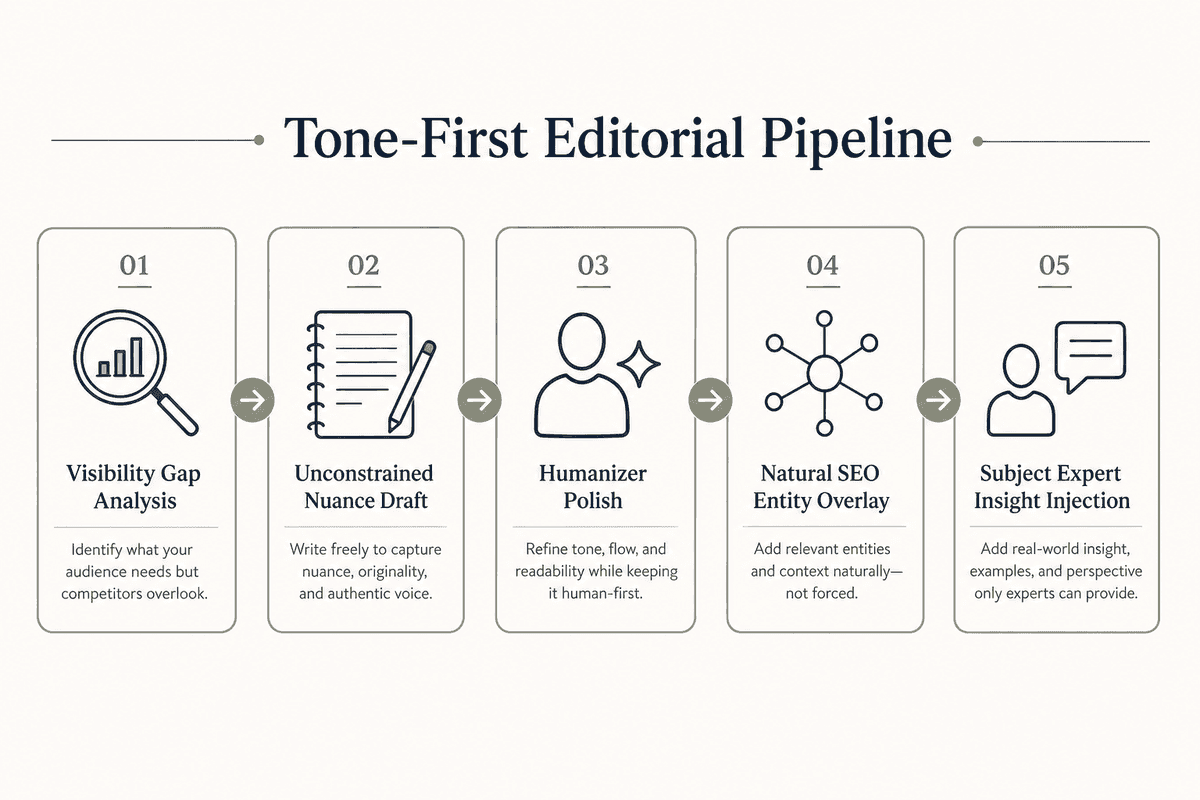
To move beyond the robotic outputs of standard SEO editors, your team should adopt a structured, tone-first workflow. Here is how top growth teams are executing this today.
Step 1: Ideation and Gap Analysis Use visibility monitoring to find exactly where AI assistants are failing to cite your brand. Identify the buyer questions that are currently generating generic, unhelpful answers from ChatGPT or Gemini.
Step 2: Base Generation with Nuance Select a highly capable base model like Claude or o3-mini. Feed it a prompt that outlines the specific visibility gap you are trying to fill. Include your constraint-based rules (banned words, sentence variance, formatting demands). Do not restrict the model with a strict SEO keyword checklist during this first draft; let it write naturally.
Step 3: The Human Polish If the output feels slightly rigid, pass the draft through a tool like Grammarly's AI Humanizer to smooth out the phrasing and improve emotional expression.
Step 4: Strategic Optimization Once the prose sounds human, bring it into your SEO tool. Look for natural places to weave in semantic entities without breaking the conversational flow. If inserting a keyword makes a sentence sound clunky, skip the keyword. The loss in optimization score is heavily outweighed by the retention of human tone.
Step 5: Brand Injection Have a subject matter expert review the draft and insert one or two highly specific, proprietary insights. This acts as the final "human watermark" that no AI model can fake.
FAQs on AI Content Generators and Tone
What is burstiness in AI writing? Burstiness refers to the variation in sentence length and structure within a piece of text. Human writing is naturally "bursty," mixing short, punchy sentences with longer, complex ones. AI defaults to a uniform, predictable sentence length, which makes it sound robotic.
Do humanized AI articles rank better in Google and AI Overviews? Yes, but not because search engines explicitly penalize AI. They penalize unhelpful, generic, mathematically average content. Humanized content tends to be more engaging, holds user attention longer, and contains the unique semantic depth that RAG systems (like AI Overviews) look for when deciding which sources to cite.
Which tool requires the least prompting to sound human? Currently, Claude (developed by Anthropic) requires the least amount of aggressive prompt engineering to produce conversational, natural-sounding text. It naturally avoids many of the structural clichés that default ChatGPT relies heavily upon.
Should I stop using SEO optimization tools altogether? No. Tools that map entity relevance are still incredibly valuable for understanding the topical landscape of a keyword. The mistake is using them as text generators or treating their optimization scores as the ultimate measure of quality. Use them for research and outlining, but rely on advanced LLMs and humanizer workflows for the actual writing.
By shifting your focus from hitting an arbitrary optimization score to mastering human tone standards, you position your brand to win the next era of search. Content that sounds like it was written by an experienced practitioner will always outperform content that sounds like a machine checking boxes. Monitor the visibility gaps, generate with nuance, and refine with dedicated tools to build an organic growth engine that truly connects with your buyers.