
You load up your favorite language model, type in a brief prompt for a new landing page, and watch as paragraphs of perfectly grammatical text appear on your screen in seconds. You copy, paste, hit publish, and wait for the leads to roll in.
A week later, your traffic has spiked mildly, but your conversion rate has plummeted from 3.5% to 0.8%.
What happened?
Generative artificial intelligence has completely altered how marketers produce content, but it has also introduced a dangerous illusion: the idea that grammatically correct text equals persuasive copy. Writing that is technically flawless can still be completely hollow, lacking the psychological friction, specific constraints, and brand personality required to make a reader take action.
If your AI-generated copy is failing to convert, you are likely treating a powerful editing and ideation engine like a senior copywriter.
Let's examine the five most common AI copywriting mistakes tanking your conversion rates, why they happen, and how to fix them for better ROI in 2026.
Does AI Copywriting Actually Work? Limitations and How to Use AI Copywriting
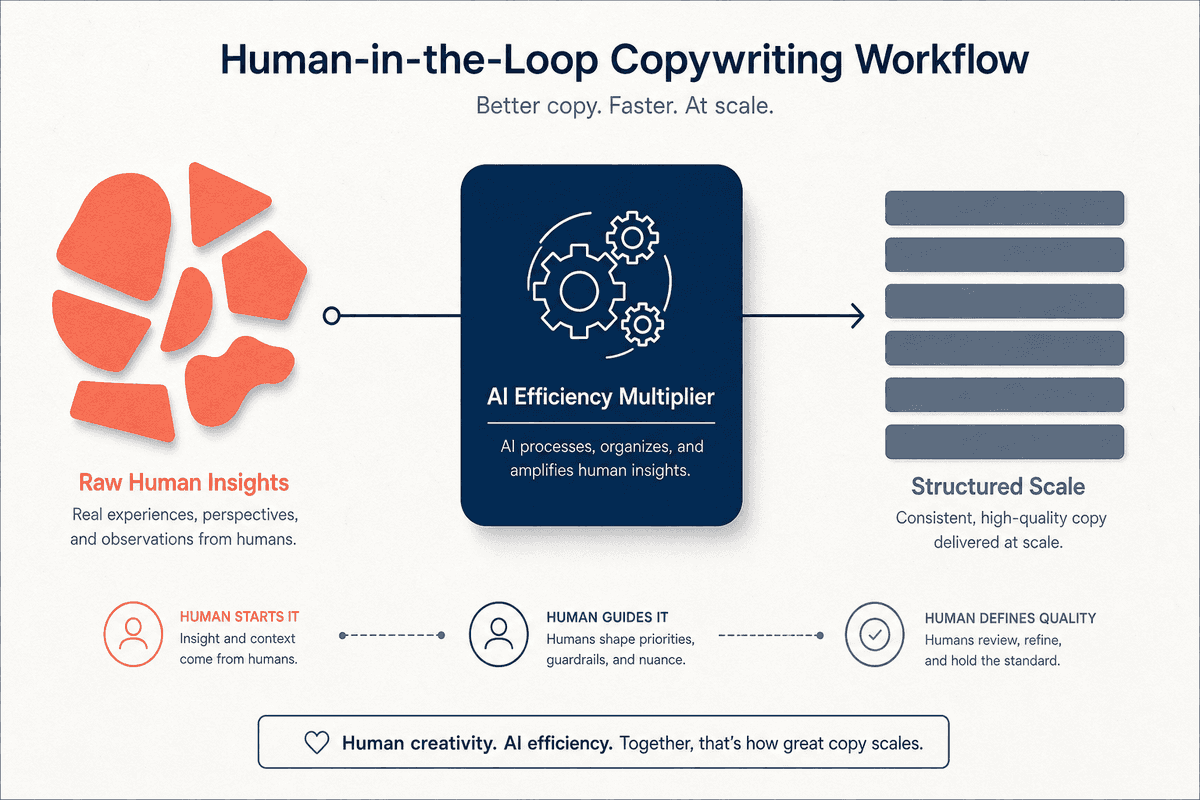
Before detailing the mistakes, we need to address the skepticism in the room. Does AI copywriting actually work?
The short answer is yes. The longer answer is that it works as an efficiency multiplier, not as an autonomous employee.
A contrarian but accurate way to view generative models is that they are surprisingly bad at writing original copy from scratch, but they are world-class at editing, restructuring, and scaling ideas that you provide.
When you ask an AI to "write a sales page for my SaaS product," it averages out the millions of sales pages it has ingested. The result is regression to the mean—generic marketing speak that sounds like everyone else. When you sound like everyone else, you compete purely on price.
To make AI copywriting work, you must operate within its limitations:
- AI cannot experience your product: It does not know what your software interface feels like or why your onboarding process frustrates users.
- AI defaults to verbosity: Unless constrained, models will write 500 words to say what could be said in 50.
- AI lacks taste: It cannot distinguish between a clever hook and a cheesy cliché without explicit rules.
The successful implementation of AI in copywriting requires a "Human-in-the-Loop" workflow. You provide the raw, jagged insights, the unique angles, and the factual constraints. The AI then organizes, rephrases, and scales those inputs across different formats.
Mistake 1: Relying on General LLMs Instead of Purpose-Built Marketing Apps
The most common error SaaS founders and marketers make is expecting a general-purpose chat interface to understand the nuances of a high-converting Facebook ad or a complex email sequence out of the box.
General models are trained to be helpful, polite assistants. Copywriting requires persuasion, brevity, and sometimes a bit of edge.
When you use a general chat interface without heavy prompting, you miss out on intelligent features purpose-built for copywriting. This is why professionals lean toward specialized solutions. For instance, Jasper's AI for copywriting includes 90+ purpose-built marketing apps designed explicitly for tasks like AIDA (Attention, Interest, Desire, Action) frameworks, PAS (Problem, Agitate, Solution) formulas, and structured blog writing.
General AI vs. Purpose-Built AI Copywriting Tools
If you want to create integrated campaigns across social media, SEO content strategy, and email marketing, you need tools that understand those specific formats.
Mistake 2: Ignoring Brand Voice and Tonal Training
If your recent blog posts start with "Navigating the complexities of..." or "A symphony of features...", your audience already knows an AI wrote it.
Monotonous, generic writing is a conversion killer. When writing starts feeling monotonous, readers disengage. They buy from brands they trust, and trust is built through a consistent, recognizable brand voice.
Failing to establish a Brand Voice within your AI workflow guarantees your copy will lack personality. Top-tier tools now allow you to ingest your best-performing emails, your style guide, and your specific vocabulary to train the AI.
How to Force Brand Voice Consistency
If you are not using a platform with built-in voice training, you must establish a strict prompting framework. Never let the AI guess your tone.
Poor Prompt: "Write an email about our new feature launch."
High-Converting Prompt Framework:
- Role: Act as a senior B2B SaaS copywriter.
- Task: Write a 200-word product update email.
- Audience: Existing users who have not logged in for 30 days.
- Tone: Direct, slightly irreverent, data-backed. No fluff. Do not use words like "seamless," "robust," or "innovative."
- Context: [Paste your raw notes about the feature here].
Mistake 3: The Zero-Draft Fallacy (Skipping "Rephrase & Rewrite")
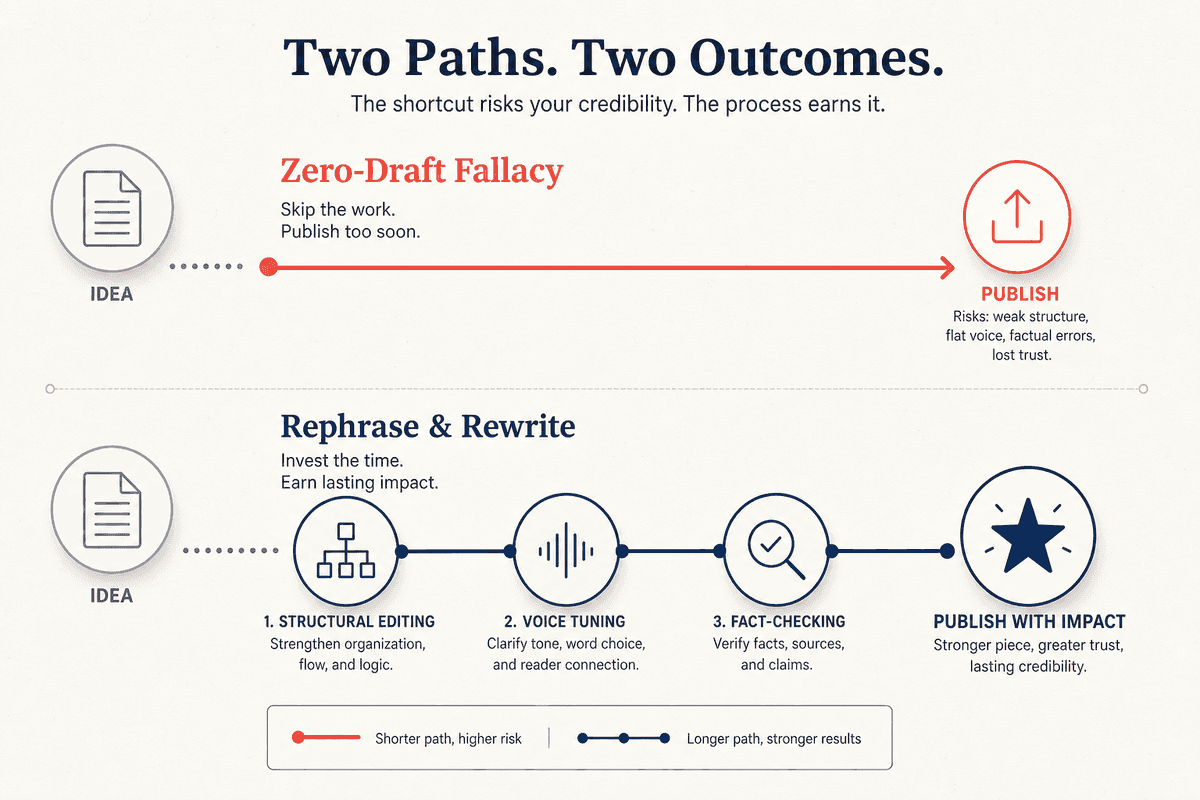
Many marketers sit down at a blank screen, ask the AI to write a blog post, and publish the first output. This is the zero-draft fallacy.
The most effective way to use AI is to treat it as a powerful editor. Write the "ugly first draft" yourself. Dump your bullet points, your messy thoughts, the specific customer quote you heard on a sales call, and the proprietary data only you own onto the page.
Then, use the AI to structure it. The true power of these systems lies in their "Rephrase & rewrite" capabilities.
If you have a paragraph that feels clunky but contains the exact right information, feed it into a free AI copywriter or paraphraser to polish the delivery without losing the substance. This approach guarantees your content remains wholly original in thought, but professional in execution.
The High-Conversion AI Workflow
- Idea Generation: You provide the unique angle and the data.
- Brain Dump (Human): Write out the core arguments, features, and benefits without worrying about grammar or structure.
- Drafting (AI): Ask the AI to turn your brain dump into a specific copywriting framework (e.g., a PAS landing page section).
- Rephrase & Polish (AI + Human): Iterate on specific headlines or calls-to-action that feel weak.
- Fact-Check (Human): Verify all claims and remove any hallucinated features.
Mistake 4: Missing the "Freshness" Factor in 2026
Search intent evolves rapidly. A piece of copy that converted beautifully in 2023 might fall flat in 2026 because the market has shifted, competitors have caught up, or the features you are highlighting are now considered baseline expectations.
AI models have a cutoff date for their training data. If you ask a standard model to write competitive analysis copy, it might position you against a competitor that went out of business two years ago, or it might completely miss a new entrant disrupting your niche.
To combat this, your copywriting workflow must be grounded in real-time SERP (Search Engine Results Page) data and current market context. Never rely on the AI's internal memory for facts, competitor features, or current trends. Always provide the AI with up-to-date research documents or use tools connected to live search data to ensure your copy reflects the current reality of your industry.
Mistake 5: Publishing Without SEO and Structural Constraints
Great copy is visual. It relies on short sentences, punchy bullet points, readable headings, and strategic bolding. Left to its own devices, AI will output massive blocks of text that terrify readers and cause them to bounce instantly.
Furthermore, for organic content strategy, simply generating the words is only 20% of the battle. If you publish an AI-generated blog post without optimizing the structure, it will not rank.
Effective SEO copywriting requires:
- Answer-First Structures: Putting the direct answer at the top of the post to satisfy search intent immediately.
- Proper Headings (H2s and H3s): Organizing information logically for both readers and search engine crawlers.
- Internal Linking: Connecting the new piece of copy to existing relevant content on your site.
- Schema Markup: Helping AI search engines (like Perplexity or ChatGPT search) understand the entities in your text.
If your AI copywriting process stops at "generating the text," you are actively sabotaging your organic growth.
The 12 Best AI Copywriting Tools in 2026
If you want to avoid these mistakes, you need the right stack. When you look at what tools copywriters are actually paying for, you realize professionals prioritize platforms that offer workflow integrations, brand voice controls, and SEO data over raw generative capabilities.
Based on recent industry roundups and market performance, here are the 12 best AI copywriting tools currently dominating the landscape:
Comprehensive Marketing Editors
1. Jasper: Often considered the industry benchmark. Dave Gerhardt famously noted: “I recommend Jasper to every marketer in my B2B SaaS community because it’s the best AI tool for creating campaigns.” It excels at maintaining brand voice across 90+ purpose-built marketing apps. 2. Copy.AI: An excellent suite of free AI writing generators and tools that handles everything from email sequences to social media posts, specifically geared toward sales teams and marketers. 3. Copysmith: Tailored heavily toward e-commerce teams needing to generate bulk product descriptions and catalog copy. 4. WriteSonic: Known for integrating real-time search data to keep content factually grounded and fresh.
SEO and Content Strategy Focus
5. Surfer SEO: Not a pure copy generator, but an essential content editor that scores your copy against top-ranking SERP competitors to ensure you hit the right entities and word counts. 6. Article Forge: Focuses on generating complete, long-form articles with a single click, though it requires heavy human editing for conversion optimization. 7. AI Writer: A solid option for generating SEO-focused blog drafts based on specific keyword inputs.
Rewriting and Rephrasing Specialists
8. Wordtune: A brilliant chrome extension for highlighting a clunky sentence and rewriting it to be more casual, professional, or concise. 9. Quillbot: A powerful paraphraser that helps you refine your "ugly first drafts" without losing the core meaning. 10. WordAI: Specializes in completely restructuring sentences and paragraphs to improve readability and flow.
Niche and Specialized Copy
11. Snazzy AI (Now part of Unbounce): Perfect for generating quick landing page copy, Google Ads, and brief promotional assets. 12. AdZis: Specifically designed for e-commerce store owners to generate hundreds of product descriptions from a single catalog upload.
Questions about Copywriting (FAQs)
What is an AI copywriter?
An AI copywriter is a software application powered by Large Language Models (LLMs) designed to generate, edit, or optimize persuasive text for marketing purposes. Unlike general chatbots, specialized AI copywriters are pre-trained on high-converting frameworks (like AIDA or PAS) and often include features for managing brand voice, SEO guidelines, and team collaboration.
What kind of copy does an AI copywriting tool generate?
Depending on the tool, AI can generate nearly any format, including blog writing, SEO meta descriptions, social media captions, email marketing sequences, landing page headers, and ad copy. However, its effectiveness varies by format; it is generally better at structured, short-form copy (like meta descriptions) than deeply emotional, long-form sales letters without heavy human guidance.
Next Steps: Automating the Right Way with BeVisible
Fixing these five mistakes—shifting from general chat tools to purpose-built workflows, training your brand voice, embracing the editing process, maintaining freshness, and enforcing strict SEO structures—will immediately improve your conversion rates.
But managing that entire pipeline manually across multiple tools takes hours of dedicated work every single day.
If you are a SaaS founder, indie hacker, or agency owner looking for organic growth without managing a large editorial team, you need a system that handles the end-to-end production pipeline correctly.
This is why we built BeVisible.
BeVisible is an automated SEO content generation and publishing platform that transforms your website into a daily source of ranked answers for Google and AI search engines like ChatGPT and Perplexity.
Instead of just generating raw text and leaving the rest to you, BeVisible handles the entire workflow:
- SERP & Competitor Analysis: We connect to your site URL, analyze your niche, and build a strategic 30-day content map.
- High-Conversion Formatting: Articles feature answer-first structures, quotable sections, and scannable layouts.
- Technical SEO Built-In: We automatically generate schema markup, optimize metadata, insert internal links, and create branded cover images optimized for both traditional SEO and AI extraction.
- Daily Auto-Publishing: BeVisible writes, polishes, and publishes fresh articles every 24 hours, integrating seamlessly via API with WordPress, Webflow, Notion, Ghost, and Shopify.
Stop settling for generic AI outputs that tank your conversions. Get the content engine that actually drives organic traffic.
[Try BeVisible today] with our 3-day free trial. Our Professional plan offers 30 fully optimized articles a month for just $199 (launch discount), complete with unlimited revisions and Google Search Console analytics tracking.