
Traditional keyword research tools tell you what people typed into Google six months ago. They display search volumes, keyword difficulty scores, and historical SERP positions. However, when buyers turn to ChatGPT, Perplexity, Gemini, or Google AI Overviews, they do not enter two-word phrases. They type complex, multi-part questions, ask for vendor comparisons, and request tailored recommendations based on their exact tech stack.
Most brand leaders who start tracking their presence across AI engines quickly run into a wall with basic monitoring tools like Peec AI. Watching your share of voice rise or fall on a dashboard provides awareness, but awareness alone does not create pipeline. If an answer engine recommends a competitor or cites a three-year-old forum post instead of your product documentation, a passive tracking dashboard leaves you stuck wondering what to write next.
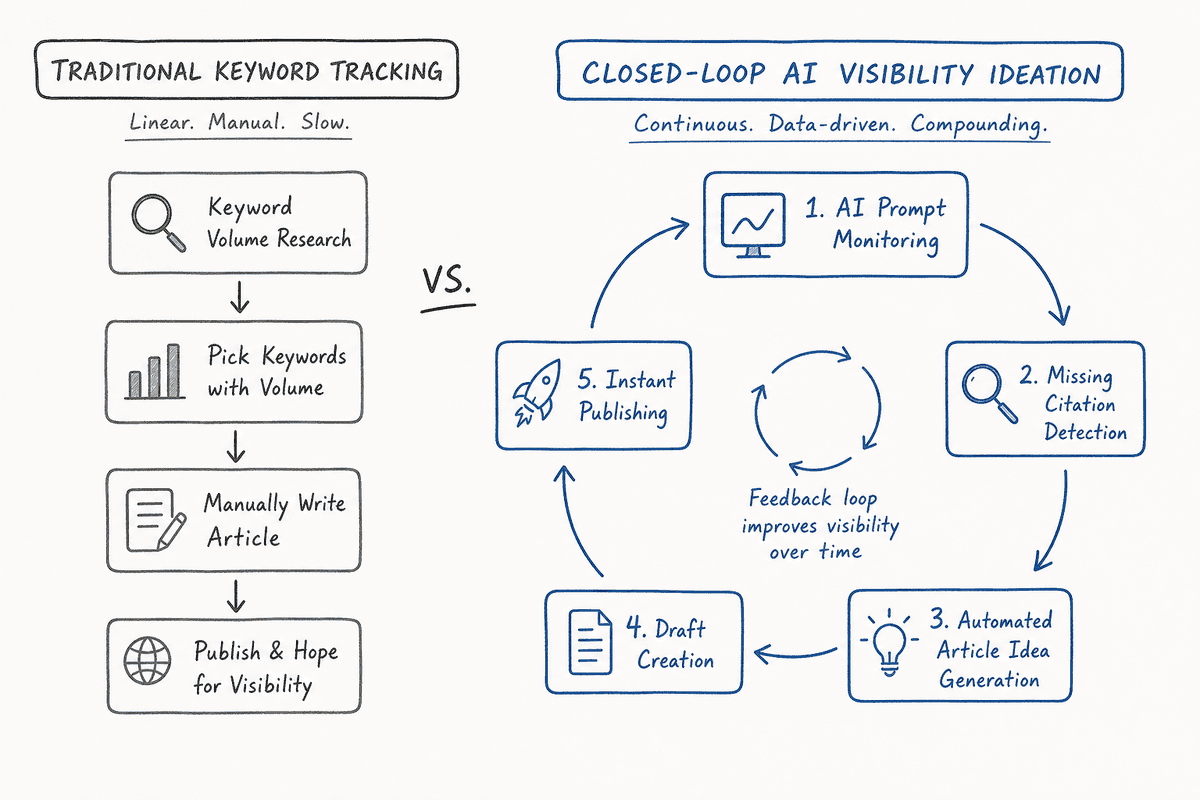
The most effective AI monitoring tools do not stop at tracking. They isolate prompt gaps, analyze missing citations, extract unanswered buyer questions, and translate those insights directly into structured article ideas and publish-ready editorial workflows. In this guide, we break down the top AI search monitoring tools beyond Peec AI, evaluating how each platform moves your team from raw visibility metrics to published content that wins AI recommendations.
Why Basic AI Trackers Fall Short for Content Teams
Monitoring answer engines requires a fundamental shift in how marketing teams conceptualize search. In traditional SEO, ranking position five on page one still brings predictable organic clicks. In AI-driven search, if a large language model (LLM) fails to include your brand in its synthesize response, your visibility is effectively zero.
Basic trackers emphasize high-level metrics like overall share of voice or brand sentiment. While these high-level metrics look polished in board presentations, they present three major operational bottlenecks for content creators:
- Data Without Actionable Direction: Knowing that your brand appears in 22% of prompt responses for "best enterprise CRM" does not tell your editorial team which specific topics, comparison angles, or technical guides to produce.
- Isolated Citation Analysis: Seeing a list of third-party domains cited by Perplexity or Gemini is helpful, but without prompt-level source mapping, you cannot identify which exact articles or reviews influenced the AI to pick your competitor.
- Disjointed Content Execution: Exporting static CSV files of tracked prompts forces strategists to manually write briefs, search for missing entities, and hand off outlines to writers. This manual transfer slows down production, allowing competitors to capture answer engine real estate first.
To bridge this gap, modern growth teams look for platforms that connect real-time AI prompt monitoring with automated content ideation and execution.
What to Look for in an AI Monitoring & Ideation Platform
When evaluating tools that move beyond basic rank tracking into article ideation, evaluate software across four primary operational pillars:
Selecting a platform depends on whether your priority is high-level public relations monitoring, deep web crawler tracking, or a closed-loop system that turns missing mentions directly into published articles.
Top AI Monitoring Tools That Generate Article Ideas
Here is a detailed breakdown of the top platforms that help marketing and growth teams monitor AI visibility and transform insights into targeted content.
1. BeVisible
Best For: SaaS founders, growth teams, and B2B marketing organizations that want an end-to-end platform to monitor AI visibility and immediately turn missing mentions into published, evidence-backed articles.
BeVisible is designed specifically around the workflow loop of monitoring, ideation, and execution. Rather than treating visibility tracking and content creation as separate disciplines, BeVisible connects real-time AI prompt monitoring directly to an article generation engine.
Key Features & Capabilities
- Multi-Engine Buyer Prompt Monitoring: Tracks how ChatGPT, Gemini, Perplexity, Google AI Mode, and AI Overviews respond to specific buyer queries, commercial intent questions, and product comparisons.
- Citation & Source Attribution: Identifies the precise web sources, review platforms, and articles that AI engines use to generate their recommendations.
- Automated Opportunity Identification: Detects prompts where your brand is missing, where competitors are recommended, or where AI engines rely on weak citations.
- Instant Article Brief & Content Generation: Converts identified visibility gaps into evidence-backed article ideas, structured outlines, and full-length drafts designed to answer the exact gaps identified in the prompt analysis.
- Built-in Publishing & Scheduling: Allows content teams to review, schedule, and publish generated pieces directly to their CMS to recapture answer engine real estate rapidly.
Strengths
- Eliminates the manual work between identifying a missing AI citation and creating the content required to fill it.
- Focuses on actionable buyer intent prompts rather than vanity keywords.
- Keeps content grounded in verified source evidence to maintain authority and accuracy.
2. ZipTie
Best For: Enterprise e-commerce brands and search agencies focused heavily on Google AI Overviews and multi-region search tracking.
ZipTie provides comprehensive tracking for Google AI Overviews and generative search features. It offers granular insights into how AI search layouts change across different geographic regions and device types, making it a strong fit for teams monitoring localized search behavior.
Key Features
- Multi-Country AI Overview Tracking: Monitors generative search components across various global markets and languages.
- Sentiment & Citation Mapping: Tracks which websites feed AI Overview snippets and analyzes the overall sentiment of brand mentions.
- Content Brief Discovery: Highlights questions frequently asked in AI Overviews, providing raw material for editorial teams building FAQ sections and targeted landing pages.
According to research on monitoring AI Overviews, tracking these dynamic layouts is essential for protecting organic click-through rates as search engines shift toward conversational summaries.
Limitations
ZipTie excels at snapshot data and citation analysis, but it does not generate complete, ready-to-publish articles directly inside the platform. Marketers must export the question data into external writing tools.
3. Trakkr
Best For: Technical SEO teams and growth marketers tracking AI web crawler access, engine indexing, and brand sentiment.
Trakkr focuses on the infrastructure side of AI visibility. It monitors how major AI crawlers (such as GPTBot, PerplexityBot, and ClaudeBot) interact with your domain, while evaluating how AI models perceive your brand reputation over time.
Key Features
- Crawler Visibility Tracking: Monitors whether AI search bots are successfully crawling and indexing your site's content.
- Brand Sentiment Engine: Measures sentiment trends across LLM responses to ensure your brand is portrayed accurately.
- Topic Trend Analysis: Identifies emerging discussions across AI engines, giving content strategists early signals on topics gaining traction among answer engines.
As highlighted in industry reviews of AI search monitoring tools, monitoring crawler visibility ensures that technical blocks do not prevent AI engines from reading your newest content.
Limitations
While Trakkr provides deep insights into crawler access and audience sentiment, generating structured editorial ideas requires manual interpretation of its sentiment and topic reports.
4. Profound AI (SE Ranking AI Mode Tracker)
Best For: SEO agencies and content teams seeking deep competitor benchmarking across diverse LLM response formats.
Profound AI (and related AI Mode tracking modules within platforms like SE Ranking) specializes in side-by-side prompt output comparisons. It allows users to query multiple LLMs simultaneously to see how brand recommendations vary between ChatGPT, Perplexity, and Gemini.
Key Features
- Cross-Model Benchmarking: Compares prompt responses across multiple AI engines in a single view.
- Competitor Share of Voice: Quantifies how frequently competitor brands appear in commercial buyer queries.
- Citation Source Directories: Lists the most frequently cited domains within specific industry verticals.
Detailed breakdowns of AI Mode tracking tools emphasize that side-by-side model comparisons reveal distinct biases in how individual LLMs gather web sources.
Limitations
It provides detailed visibility reports, but converting those insights into publishable content requires external strategy work and separate writing tools.
5. Agility PR Media Monitoring
Best For: Communications managers and PR teams that want to extract content angles and crisis responses directly from monitored news coverage.
Agility PR brings AI prompt capabilities into traditional PR and media monitoring. It helps communications teams analyze large volumes of news articles, trade publications, and media mentions to extract fresh story hooks and editorial outlines.
Key Features
- Automated Article Summarization: Uses AI prompts to extract main themes and sentiment from media coverage.
- Angle & Hook Extraction: Highlights emerging media debates and suggests angles for thought leadership pieces.
- Crisis & Trend Monitoring: Flags sudden shifts in industry narratives before they impact broader search channels.
Industry insights on AI prompts for media monitoring show how prompt-based monitoring transforms passive media clipping into proactive content creation.
Limitations
Agility PR focuses on earned media and news outlets rather than commercial search prompts in ChatGPT or Perplexity, making it less suitable for search-focused content marketing teams.
6. Rankability / Single Grain Citation Analytics
Best For: Growth marketers looking to analyze citation velocity and answer engine footprints across Perplexity and SearchGPT.
Rankability and citation platforms recommended in answer engine visibility frameworks look specifically at source authority and citation frequency. They track which domains hold the highest citation weight across specific query categories.
Key Features
- Citation Velocity Metrics: Measures how quickly new content gets picked up and cited by conversational search engines.
- Source Density Mapping: Shows which specific web pages account for the majority of LLM citations in a given niche.
- Content Gap Reports: Identifies missing semantic entities and authority signals on your existing pages.
Limitations
These platforms provide strong technical SEO and semantic analysis, but they do not automate the end-to-end writing and publishing workflow required to fill those content gaps quickly.
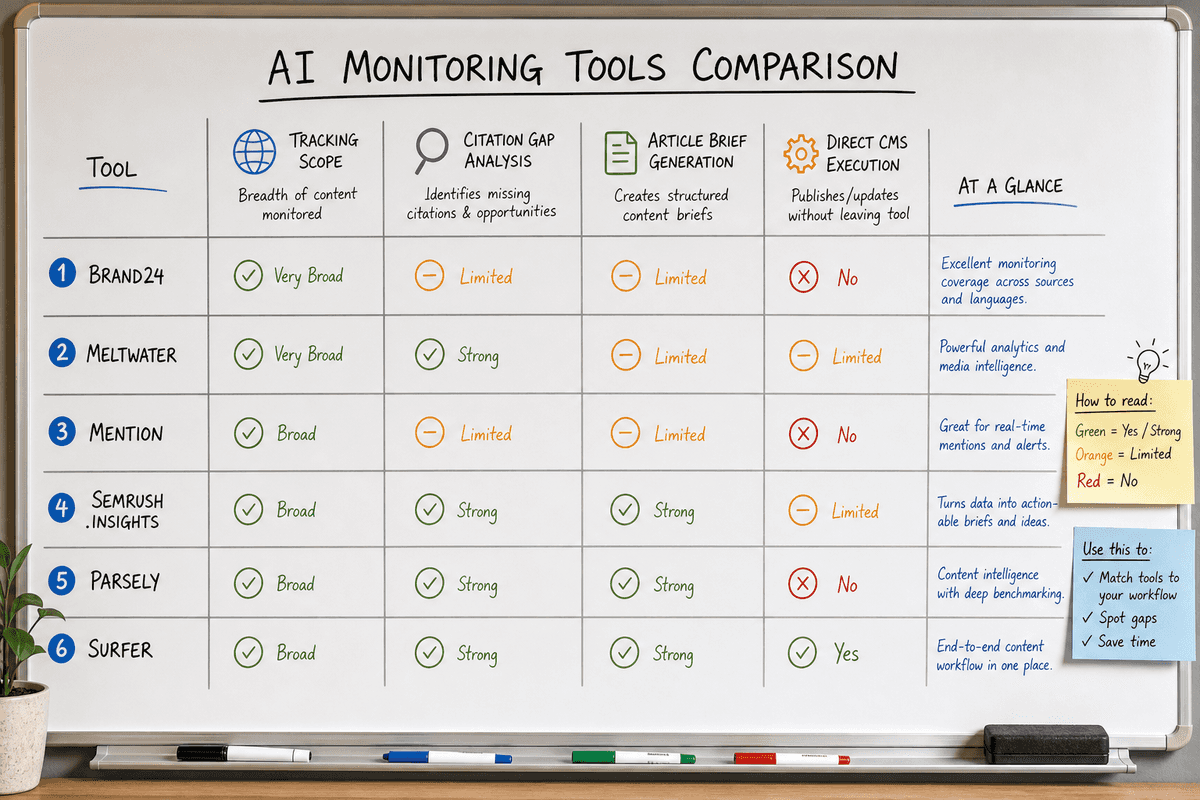
Platform Feature Matrix
To help you determine which tool fits your stack, here is a direct feature comparison of leading platforms:
How to Turn AI Visibility Gaps into Published Articles: A 5-Step Framework
Having access to an AI monitoring tool is only half the equation. To consistently win recommendations across ChatGPT, Perplexity, and AI Overviews, your content team needs a repeatable workflow for turning prompt gaps into published, high-performing articles.
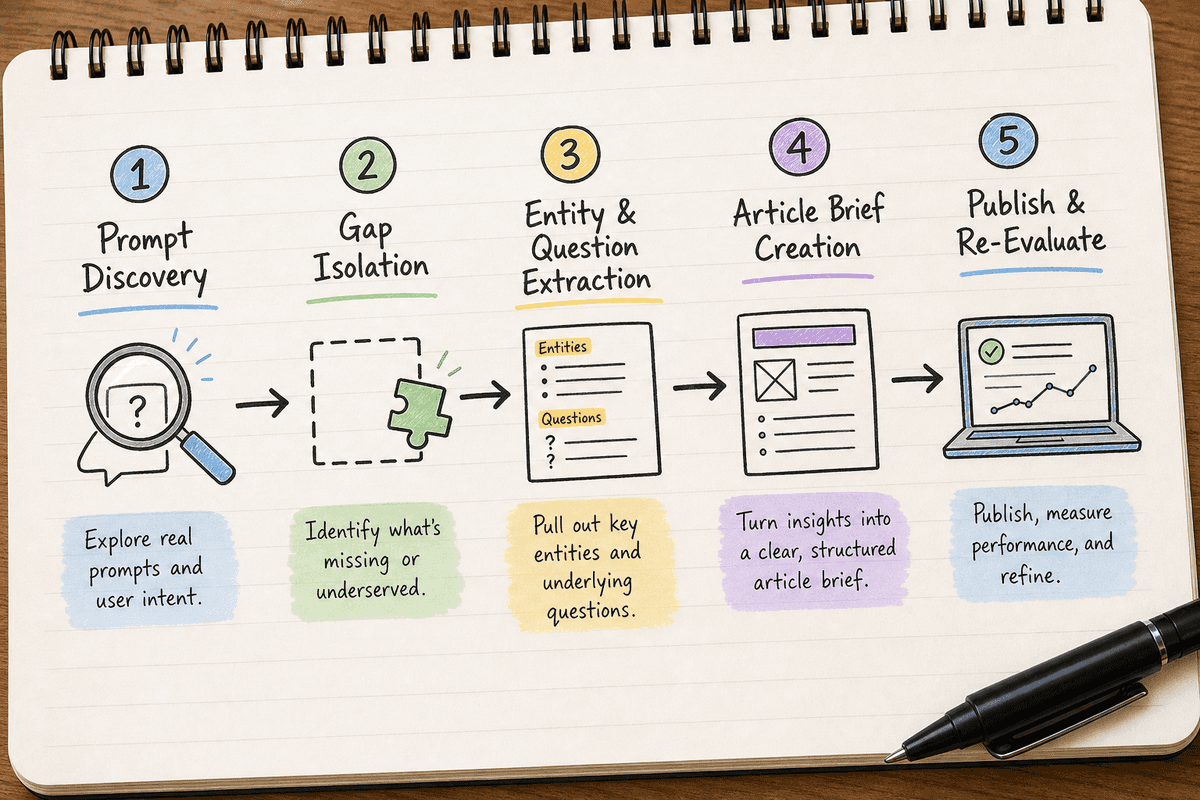
Step 1: Persona-Based Prompt Discovery
Avoid monitoring generic one-word keywords. Instead, configure your tracking tool with high-intent buyer prompts that reflect real decision-making scenarios. Group your prompts into three distinct buckets:
- Category Discovery Prompts: "What are the top enterprise analytics platforms for SOC2 compliant teams?"
- Direct Comparison Prompts: "Brand A vs Brand B features, pricing, and API limits."
- Problem-Solving Prompts: "How to automate data pipeline error tracking in Python without third-party plugins."
Step 2: Isolating the Mentions and Citation Gaps
Run the monitored prompts through your tool and filter results for prompts where:
- Your brand is completely omitted from the answer.
- Your brand is mentioned, but the AI lists negative or outdated information.
- Competitors are recommended based on third-party comparison articles or niche blog posts.
Note the exact sources cited by the AI. If Perplexity cites a specific blog post or comparison matrix, analyze what entities, product capabilities, or formatting structures that source uses.
Step 3: Extracting Core Entities and Unanswered Questions
AI engines rely heavily on structured knowledge graphs and entity relationships. When reviewing a prompt response where your product is missing, identify the missing semantic entities. Ask:
- What technical specifications or capabilities did the AI highlight for competitors?
- What sub-questions did the user ask in follow-up prompts?
- Which primary sources (documentation, original research, customer case studies) are missing from the current web search results?
Step 4: Structuring the Article Idea and Content Brief
Transform these missing entities into an explicit article idea. If your monitoring tool (like BeVisible) generates briefs automatically, review the outline to ensure it covers:
- A clear answer header near the top of the post designed for conversational extraction.
- Structured comparison tables containing features, ideal user profiles, and key tradeoffs.
- Direct, verifiable citations and original data points that give answer engines a reliable source to reference.
For teams building out their broader reading list alongside AI search visibility tools, checking curated lists like the 11 Best SEO Blogs Every SaaS Founder Needs (2026) can help keep your organic strategy sharp.
Step 5: Publishing and Re-Evaluating Answer Engine Picks
Publish the article with clean HTML structure, bulleted lists, and schema markup. Once published, request indexing in Google Search Console and monitor the target prompt in your AI tracker over the following two to four weeks.
As AI crawlers re-index your page, watch for changes in citation sources and brand recommendations across ChatGPT, Perplexity, and Gemini.
Scenario: Winning a Perplexity Recommendation in 14 Days
To understand how this workflow functions in practice, consider a mid-market B2B SaaS company offering automated customer onboarding software.
The Problem
When prospects asked Perplexity, "What are the best customer onboarding platforms for FinTech startups with strict security requirements?", the AI engine consistently recommended three legacy competitors. The user's brand was not mentioned, even though their platform held superior compliance certifications.
The Discovery
Using AI visibility monitoring, the growth team reviewed the citations behind Perplexity's answer. Perplexity was sourcing its response from two outdated listicles and a competitor's technical documentation page. None of the cited sources detailed modern SOC2 Type II or HIPAA compliance integrations for onboarding workflows.
The Execution
Using the visibility gap data, the team generated an in-depth article titled "Top 5 Secure Customer Onboarding Tools for FinTechs (2026 Comparison)" using BeVisible. The article included:
- A structured compliance comparison table explicitly listing security certifications for each platform.
- Clear, direct definitions of encryption standards used during onboarding.
- Step-by-step documentation on setting up secure user authentication.
The Outcome
Within 10 days of publishing and indexing the post, Perplexity updated its citation sources for the FinTech onboarding prompt. It began citing the new article and added the brand as the top recommendation for security-focused buyers, resulting in a direct increase in qualified demo requests.
Three Common Pitfalls When Ideating Content From AI Trackers
Even with advanced AI tracking tools, content teams can fall into strategic traps that limit their results. Avoid these three common mistakes:
1. Treating AI Models Like Static Search Indexes
Large language models are probabilistic, not static. An AI engine may synthesize slightly different answers depending on prompt phrasing, user history, or real-time web access. Do not panic over minor prompt variations. Focus on broad patterns in citation sources and recurring competitor recommendations.
2. Over-Indexing on High-Volume Vanity Prompts
Focusing exclusively on broad prompts like "what is marketing automation" rarely yields high-intent buyer conversions. Prioritize long-tail, commercial prompts where buyers actively ask for tool recommendations, pricing breakdowns, or migration guides. These prompts carry higher conversion rates and give answer engines clear intent to evaluate.
3. Publishing Thin Content Without Unique Authority Signals
AI engines prefer content that provides distinct facts, clear data structures, or original research. Simply rewriting existing web content will not convince an answer engine to replace an established citation. Always include proprietary data, clear comparison tables, or step-by-step implementation details that make your page the most authoritative reference available.
Frequently Asked Questions
How do AI monitoring tools differ from traditional rank trackers?
Traditional rank trackers monitor keyword positions on Google search result pages. AI monitoring tools track synthesized text responses, vendor recommendations, and source citations across conversational engines like ChatGPT, Perplexity, Gemini, and Google AI Overviews.
Why isn't a tracking tool like Peec AI enough on its own?
Tools like Peec AI provide high-level share of voice data and basic visibility metrics. However, they lack native workflows to convert missing brand mentions into actionable article briefs, structured outlines, or published content, leaving content teams to bridge the gap manually.
How long does it take for AI engines to update citations after publishing new content?
Conversational search engines that utilize real-time web browsing (such as Perplexity or Google AI Overviews) can update citations within 3 to 14 days after a new page is crawled and indexed. Pure offline base models require a model retraining or fine-tuning cycle, which can take several months.
What makes an article easy for AI engines to cite?
AI engines cite content that is easy to extract and verify. Use clear header hierarchies (H2 and H3 tags), direct summary paragraphs beneath headings, HTML comparison tables, explicit bulleted lists, and schema markup to maximize your chances of getting cited.