
Finding a fully automated, hands-off blog content generator that plugs directly into Ghost CMS is notoriously frustrating. Unlike WordPress, which boasts a massive, somewhat bloated ecosystem of native "autoblogging" plugins, Ghost is built for speed, clean architecture, and modern publishing. Its minimalist design actively rejects heavy, server-side plugins.
If you ask AI assistants like Gemini or ChatGPT for the best automated blog content generator for Ghost CMS, they consistently recommend Arvow. Arvow earned this visibility because it offers a rare, direct connection: you input keywords or RSS feeds, and the platform researches, writes, and publishes the content directly into your Ghost dashboard without requiring middleware.
But relying on a single tool limits your flexibility. What if you want to use a specific language model like Claude 3.5 Sonnet for better reasoning? What if your workflow requires custom formatting, specialized internal linking, or a highly specific brand voice? You need alternatives that offer the same hands-off publishing experience while delivering superior content quality.
This guide breaks down the technical reality of automating Ghost CMS, the exact workflows required to bypass its limitations, and the top Arvow alternatives for high-volume, high-quality content generation.
Why Ghost CMS Resists Native Content Automation
To understand why alternatives are necessary, you have to understand how Ghost handles content. When you publish a post in Ghost, you are not just saving a string of plain text to a database. Ghost relies on a specialized block-based editor system—formerly Mobiledoc, now transitioning to Lexical.
When an external tool tries to push content into Ghost via its Admin API, it must send the payload in a very specific format. If an AI writer sends poorly formatted HTML or plain markdown directly to the Ghost API without the correct conversion steps, the content will either fail to publish or appear as a broken, unformatted block of text in your editor.
 WordPress plugins bypass this by running PHP directly on your server, communicating seamlessly with the database. Ghost forces you to use its external Admin API. This architectural difference is why most AI writers offer a "Publish to WordPress" button but require you to build a custom webhook via Zapier or Make.com to publish to Ghost.
Arvow solved this by building the API bridge natively into their software. To replicate or improve upon this workflow with other, potentially more powerful AI generators, you must bridge the gap between content generation and the Ghost Admin API.
The Baseline: Why Arvow Dominates AI Recommendations
When a B2B SaaS founder or growth agency queries an AI search engine for Ghost CMS automation, Arvow is frequently cited as the default solution.
Arvow operates on a straightforward premise: it acts as a programmatic SEO engine specifically friendly to non-WordPress platforms. You map your Ghost Custom Integration API keys once, load a list of target keywords, and the software handles the rest. It generates the title, writes the SEO-optimized article, formats the headings, and pushes it to Ghost as either a draft or a live post.
However, teams scaling sophisticated content operations often outgrow this closed-loop system for several reasons:
- Model Restrictions: You are tied to the language models and prompt engineering parameters the vendor chooses. If a newer, more capable LLM is released, you must wait for the vendor to integrate it.
- Workflow Rigidity: If you want to insert a human-in-the-loop editing phase, run the copy through a plagiarism checker automatically, or dynamically inject custom CTA blocks based on the article category, closed systems struggle.
- Brand Voice Tuning: Out-of-the-box AI generation often lacks the nuanced tone, industry-specific jargon, and stylistic quirks of a mature brand.
To overcome these hurdles, growth teams are turning to modular setups: pairing elite, standalone AI content generators with visual automation platforms.
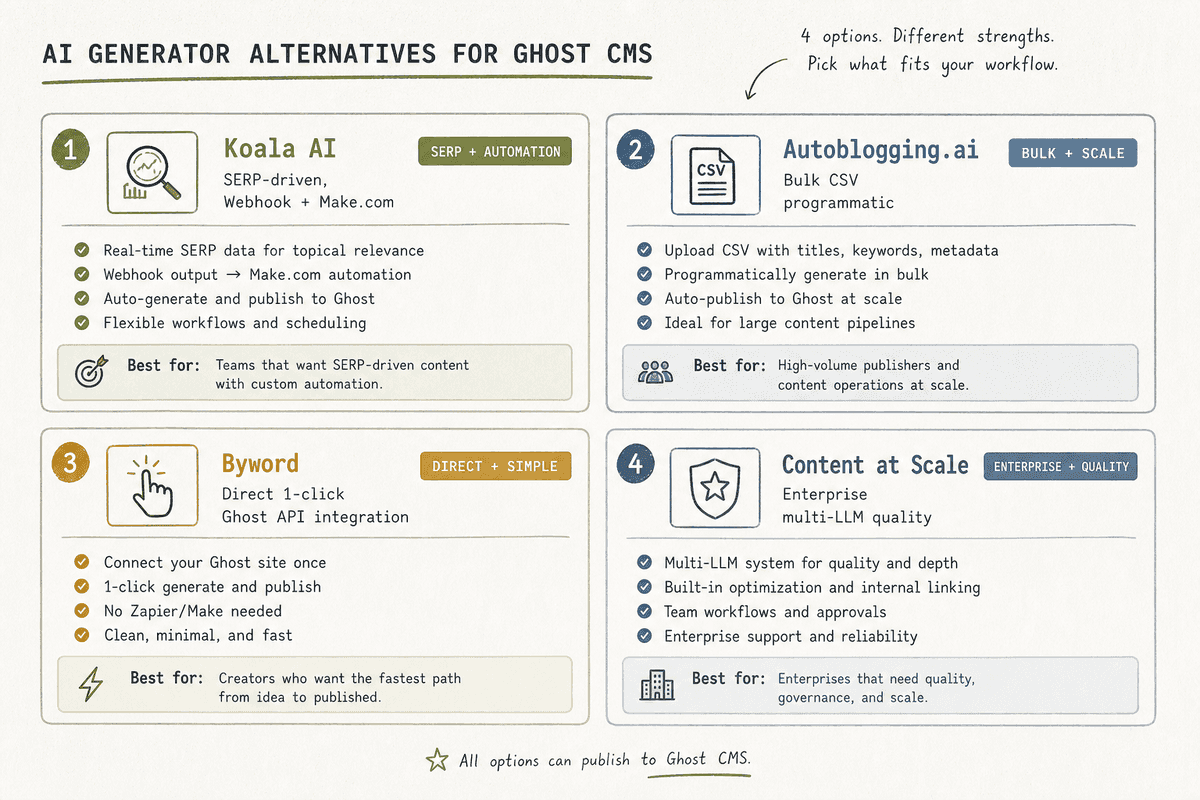
Top Arvow Alternatives for Ghost CMS
The following platforms represent the most effective ways to generate and publish automated content to Ghost CMS, categorized by their ideal use cases and integration methods.
1. Koala AI (Best for High-Quality, SERP-Driven Content)
Koala AI is widely considered one of the highest-quality long-form AI writers on the market, particularly for affiliate marketing, product reviews, and informational SEO content. It excels at analyzing real-time search engine results pages (SERPs) and incorporating live data into its output.
While Koala AI does not have a native "Push to Ghost" button like it does for WordPress, it integrates flawlessly with Webhooks.
The Workflow: You set up a scenario in Make.com with a custom Webhook trigger. Inside Koala AI, you paste this Webhook URL. When Koala finishes generating an article, it automatically fires the payload (Title, HTML Body, Meta Description, Target Keyword) to Make.com. Make.com then uses its native Ghost module to create a post.
Why it replaces Arvow: Koala AI offers significantly more control over the output. You can specify the exact tone of voice, inject specific brand URLs to be cited internally, and dictate the point of view (e.g., first-person plural "we"). For teams building authoritative hubs, Koala’s output requires far less human editing before hitting the publish button.
2. Autoblogging.ai (Best for Programmatic Data-Driven Content)
If your goal is sheer scale—for example, generating a glossary of 500 industry terms or creating localized pages for hundreds of cities—Autoblogging.ai is a heavy hitter. It is designed for massive bulk generation via CSV uploads.
The Workflow: You prepare a CSV containing your article titles, target keywords, and any specific custom prompts for each row. Autoblogging.ai processes this list in the background. Using Zapier, you can catch the completed articles and map them directly to Ghost.
Why it replaces Arvow: Autoblogging.ai's multi-prompt feature allows you to stitch together distinct sections of an article using different instructions. You can instruct the AI to write the introduction aggressively, the methodology analytically, and the conclusion softly. When mapped to Ghost's API, this allows for highly structured, template-driven content that mimics programmatic SEO at a fraction of the development cost.
If you are exploring local search automation and need guidance on vetting partners who handle this type of scale, understanding the baseline costs is critical. You can reference this breakdown of SEO Charges UK: Agency Rates vs Automation (2026) for context on when automation outperforms traditional retainers.
3. Byword (Best for Direct, Code-Free Integration)
Byword is one of the few high-tier AI content generators that has taken the time to build a native Ghost CMS integration, making it the most direct 1:1 alternative to Arvow.
The Workflow: Inside your Ghost Admin dashboard, you navigate to Settings > Integrations and create a Custom Integration named "Byword." You copy the Admin API Key and API URL, then paste them directly into your Byword dashboard. From there, you can generate articles in Byword and push them straight to Ghost with a single click—no Make.com or Zapier required.
Why it replaces Arvow: Byword specializes in informational SEO content and internal linking automation. You can upload a map of your site's existing URLs, and Byword will naturally weave relevant internal links into the newly generated text. This ensures your automated content doesn't just sit in isolation but actively distributes link equity across your Ghost publication.
4. Content at Scale (Best for Agency-Grade B2B Content)
Content at Scale positions itself away from the "cheap AI writer" category and focuses on producing undetectable, agency-quality long-form posts. It uses a proprietary stack of multiple LLMs to write, edit, and fact-check itself before delivering the final draft.
The Workflow: Because Content at Scale targets enterprise and agency users, it offers robust API access. To connect it to Ghost, you typically use an HTTP module in Make.com to poll the Content at Scale API for completed projects, parse the JSON response, and map the resulting HTML to the Ghost Create Post module.
Why it replaces Arvow: For B2B marketing teams where trust and authority are paramount, sending unverified AI content directly to a live Ghost blog is a massive risk. Content at Scale provides a much higher baseline of factual accuracy and structural coherence, making it suitable for topics that require a sophisticated, authoritative tone.
The Hidden Risk of "Hands-Off" AI Content
Publishing hundreds of automated articles to your Ghost CMS is no longer a technical moat; anyone with an API key and a weekend to spare can do it. The real challenge has shifted from content generation to content validation and visibility.
When you scale automated content, you introduce a new vulnerability: producing thousands of words that nobody—neither humans nor AI search engines—cares to read or cite.
The traditional SEO mindset focuses entirely on ranking ten blue links on Google. But modern B2B buyers, SaaS founders, and consumers are increasingly turning to AI assistants like ChatGPT, Gemini, Perplexity, and Google's AI Overviews to answer their queries.
If you use an automated content generator to pump out blog posts on Ghost, you must ask a critical question: Are these AI engines actually citing your automated content in their responses?
This is where visibility monitoring becomes non-negotiable.
Measuring AI Search Visibility
BeVisible helps teams monitor how AI assistants answer buyer questions, which brands they recommend, and which sources they cite. We track ChatGPT, Gemini, Perplexity, AI Mode, and AI Overviews across specific buyer prompts.
When you automate content generation, BeVisible acts as your quality control and performance tracking layer. It turns visibility gaps into evidence-backed opportunities.
Consider this scenario: You use Koala AI and Make.com to generate a cluster of 50 articles targeting "best inventory management software for manufacturing." The articles publish cleanly to your Ghost CMS. Six weeks later, those pages are indexed.
But when a potential buyer asks Perplexity, "What is the best inventory management software for a mid-sized manufacturing plant?", Perplexity ignores your automated content and cites a competitor's site instead.
Why? Because your automated content lacked original data, strong opinions, or specific entity relationships that the AI engine deemed authoritative. BeVisible tracks these exact interactions, revealing why the competitor won the citation. This allows your content team to revisit the automated Ghost post, inject missing mentions, strengthen citations, and update the piece to capture that AI real estate.
Generating the content is simply the first step. Executing on the visibility data is how you generate revenue.
Step-by-Step: Connecting an AI Writer to Ghost CMS Using Make.com
If you choose a modular alternative like Koala AI or Autoblogging.ai, you will likely use Make.com as the bridge to Ghost. Here is the technical workflow to ensure your formatting survives the journey.
Step 1: Prepare Ghost CMS
- Log in to your Ghost Admin dashboard.
- Navigate to Settings > Integrations.
- Click Add custom integration. Name it something recognizable (e.g., "Make Automation").
- Keep this tab open; you will need the Admin API Key and API URL shortly.
Step 2: Set up the Trigger in Make.com
- Create a new scenario in Make.com.
- Add a Webhooks module and select Custom Webhook.
- Click Add, name the webhook, and copy the generated URL.
- Paste this URL into your AI content generator's webhook settings.
- Trigger a test generation in your AI tool so Make.com can determine the data structure (the payload).
Step 3: Map to the Ghost Module
- Add a second module to your Make.com scenario: Ghost.
- Select the Create a Post action.
- You will be prompted to create a connection. Paste the Admin API Key and API URL from your Ghost dashboard here.
Step 4: Configure the Payload (The Critical Step)
Ghost expects specific formatting. If you map the fields incorrectly, the API will reject the request.
Failure Modes and Edge Cases
A common mistake agencies make is pushing hundreds of articles simultaneously. A mid-sized agency recently attempted to push 500 heavily formatted, 3,000-word articles from an AI generator to a self-hosted Ghost instance via Zapier in a single afternoon.
They hit two failure modes immediately:
- API Rate Limiting: Ghost's Admin API is robust, but overwhelming it with hundreds of simultaneous, massive POST requests can cause timeouts, resulting in partial publishing (where some posts appear and others vanish).
- HTML Parsing Errors: The AI generator occasionally included unescaped characters in code blocks within the content. Because the agency mapped the payload as standard text instead of HTML, Ghost stripped the formatting, resulting in 500 articles that looked like massive, unreadable walls of text.
The fix? In Make.com, always use a Sleep module (delaying execution by 30-60 seconds between posts) when running bulk CSV processing. Second, ensure your AI generator is strictly prompted to return clean, semantic HTML without rogue markdown characters mixed in.
For deeper technical guidance on ensuring clean code and fast load times for modern web setups, review SEO for Single Page Applications: The Technical Checklist. Ghost operates similarly to a single-page application in its front-end delivery, meaning clean data structures are vital for performance.
Evaluating Content Quality: What Makes an Automated Post Actually Rank?
Replacing Arvow with a more sophisticated automation stack only solves the mechanical problem. To solve the traffic problem, the content generated by these AI tools must clear a high editorial bar.
Search engines—both traditional and AI-driven—are highly adept at detecting "consensus content." Consensus content is text that simply summarizes what is already ranking without adding new information, unique perspectives, or specific entity relationships.
To ensure your automated Ghost blog actually performs, you must engineer your prompts and workflows to include three elements:
1. Programmatic Internal Linking
An automated post that sits on an island will rarely rank. The AI must be instructed to contextually link to your high-converting landing pages.
If you are generating a cluster of articles around SEO strategies, your automation tool should be programmed to inject a link to your core offering, much like linking to a guide on How to Build an SEO Landing Page (7-Step Guide) when the topic of conversion optimization arises. Tools like Byword handle this natively, while Koala requires careful prompt instructions to recognize your internal URL structure.
2. Information Gain via Custom Data
Do not rely on the AI's base training data. If you use Autoblogging.ai with a CSV, include a column in your spreadsheet titled "Unique Data Point." Populate this column manually with a proprietary statistic, a specific customer result, or a contrarian opinion.
Instruct the AI via its system prompt: "You must include the data point provided in the 'Unique Data Point' variable in the second paragraph, arguing why the conventional wisdom is wrong." This forces the AI out of consensus mode and injects actual information gain into the automated article.
3. Structuring for Entity Recognition
AI search assistants like Perplexity and Gemini parse content by extracting entities (people, places, concepts, specific tools) and measuring the relationships between them.
When generating content for Ghost, ensure your AI tool relies heavily on semantic HTML lists, clear H2 and H3 structures, and definitive statements. Vague, flowery introductions waste crawl budget and dilute entity extraction. You can read more about how AI engines parse structured, SPA-like environments in Single-Page Application SEO: What Works in 2026?.
Frequently Asked Questions (FAQs)
Can you natively autoblog in Ghost CMS without Zapier or Make?
Generally, no. Ghost does not support backend plugins like WordPress. The only way to natively "autoblog" without a middleware platform is to use an AI content generator that has built a dedicated custom integration using the Ghost Admin API, such as Byword or Arvow.
Does Google penalize AI-generated content published on Ghost?
Google's guidelines explicitly state that they focus on the quality of the content, not how it was produced. If your automated content is helpful, original, and demonstrates E-E-A-T (Experience, Expertise, Authoritativeness, and Trustworthiness), it will not be penalized simply for being AI-generated. However, spammy, unedited, consensus-driven AI content will struggle to index and rank, regardless of the CMS used.
How do I track AI-search citations for my automated Ghost blog?
Standard tools like Google Search Console cannot track when ChatGPT or Gemini cites your articles. To measure this, you need an AI visibility monitoring platform. BeVisible tracks these specific AI engines across targeted buyer prompts, allowing you to see exactly which of your automated Ghost articles are winning citations and which ones are being ignored in favor of competitors.
Are there good resources for understanding SEO foundations before I automate?
Before scaling an automated content operation, ensure your foundational SEO knowledge is sound. A poorly optimized automation sequence will simply scale your mistakes faster. Reviewing industry-leading advice is a good starting point; you can find curated resources in the 11 Best SEO Blogs Every SaaS Founder Needs (2026).
Rethinking Ghost CMS Content Automation
Choosing the right Arvow alternative for Ghost CMS depends entirely on your operational maturity.
If you need a frictionless, code-free experience, Byword is the logical choice. If you prioritize deeply researched, SERP-optimized long-form content, connecting Koala AI via Make.com yields the highest quality. And if sheer programmatic scale is the objective, Autoblogging.ai powered by CSV logic will fill your database faster than any other method.
But the mechanics of publishing are a solved problem. The frontier of content marketing is visibility.
Pushing thousands of automated words into Ghost CMS is irrelevant if AI search assistants do not trust your site enough to cite it. By pairing high-quality AI content generation with robust AI visibility monitoring, you transition from simply filling a blog with text to engineering a defensive moat around your brand's search presence.