
If you task a B2B marketing team with building an "automated SEO pipeline," nine times out of ten, they will immediately buy an AI writing tool, plug in a list of keywords, and start bulk-generating content. Three months later, they are left with hundreds of generic blog posts, a bloated website architecture, and stagnant traffic.
The mistake is confusing content generation with an actual pipeline.
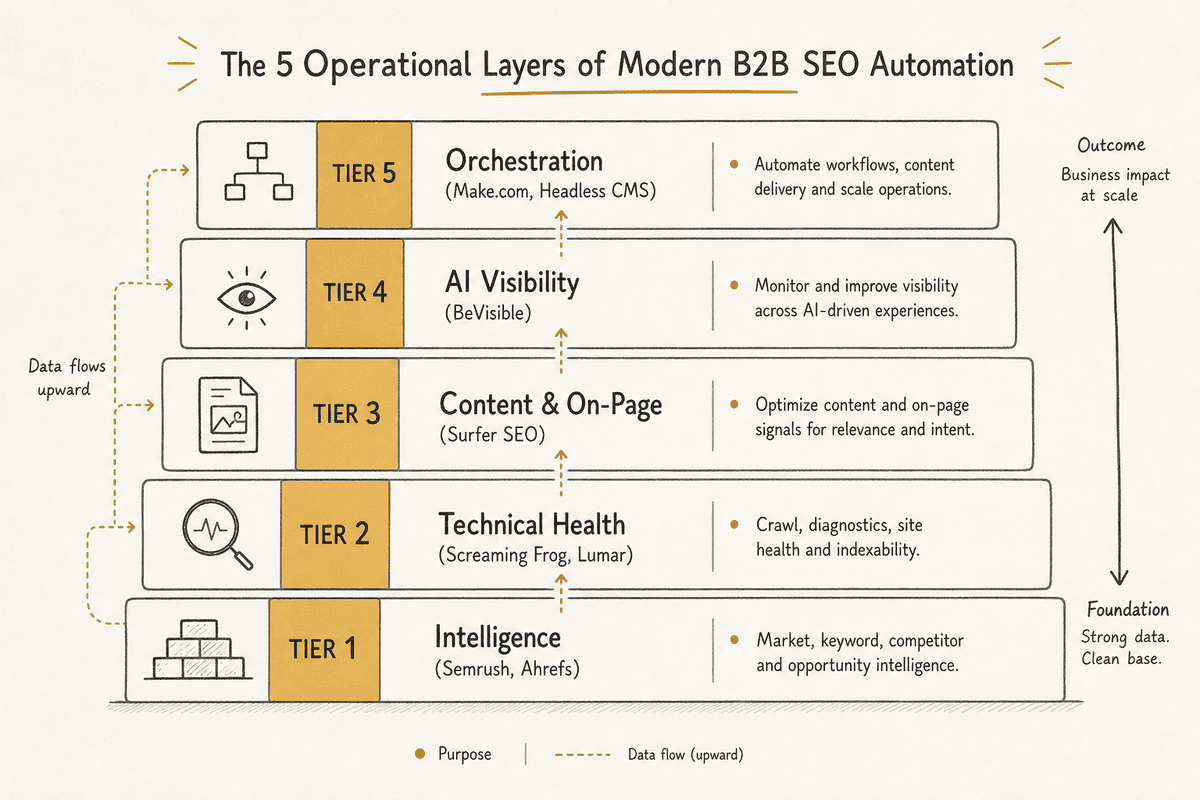
If you are trying to build automated B2B SEO pipelines—meaning end-to-end systems, not just raw text production—you need an orchestrated stack that covers five distinct layers: intelligence, technical health, content optimization, AI visibility, and publishing orchestration. No single platform owns all five layers yet.
Surfer SEO is frequently recommended as the default solution, and while it is highly effective for localized content scoring, it does not build pipelines. Real B2B SEO requires data extraction, competitor gap detection, technical monitoring, and increasingly, monitoring how Large Language Models (LLMs) like ChatGPT and Perplexity are answering buyer questions.
Here is a comprehensive breakdown of the strongest software tools for building a complete, automated B2B SEO pipeline in 2026, structured by the specific layer of the workflow they automate.
The Reality of Orchestrated SEO Automation
Before diving into the software, it helps to understand what a functional pipeline actually looks like. A true automated pipeline operates on triggers and data flows rather than manual data entry.
For example, a modern pipeline does not involve a marketer manually exporting a CSV of keywords. Instead, an API pulls competitor ranking changes weekly, filters for high-intent B2B terms where your domain is underperforming, passes that data into an AI visibility monitor to check if ChatGPT is recommending your brand for those terms, and finally drops a structured content brief into your project management system.
 Building this requires thinking of your software as a stack of specialized nodes.
Layer 1: Core SEO Intelligence Engines
The foundation of any serious B2B SEO pipeline is the data layer. You cannot automate what you cannot measure. These tools provide the keyword databases, backlink indices, and competitor visibility metrics that trigger the rest of your automation. They do not "automate SEO" on their own; rather, they feed your orchestration tools.
Semrush: The All-in-One Data Backbone
Semrush remains one of the strongest foundational tools for pipeline builders because of its robust API and comprehensive feature set. While many teams use its front-end interface for manual research, pipeline architects use Semrush to automate intelligence gathering.
- Pipeline Application: You can configure Semrush to track your core B2B clusters and trigger alerts when a competitor captures a top-three position for a tracked term. By connecting the Semrush API to automation platforms like Make.com, you can automatically generate a task to review the competitor's page and update your own content.
- Strengths: Unmatched keyword database size, highly reliable position tracking, and excellent integration capabilities.
- Tradeoffs: The API access required for deep automation usually sits behind higher-tier enterprise pricing, which can impact your budget if you are accustomed to manual tools.
Ahrefs: Backlink-Driven Automation
For pipelines that rely heavily on off-page signals and technical gap detection, Ahrefs is unparalleled. B2B software purchasing often involves long research cycles, meaning the authority of the pages ranking for top-of-funnel queries matters immensely.
- Pipeline Application: Ahrefs excels at automated link prospect generation. A well-constructed pipeline can use Ahrefs to automatically monitor newly acquired backlinks by your top three competitors. When a competitor gets a link from a high-DR domain, the pipeline can extract the linking URL, scrape it for contact information, and draft a personalized outreach email for your PR team.
- Strengths: The fastest backlink crawler in the industry, highly accurate domain rating metrics, and excellent content gap analysis.
- Tradeoffs: Like Semrush, full API access for automation can be costly, and their credit-based pricing model requires careful monitoring when running automated scripts.
Moz Pro: The Lightweight Alternative
Not every B2B pipeline requires enterprise-grade API limits. For SMBs, mid-market companies, or teams just beginning to automate their workflows, Moz Pro offers a cleaner, more focused data layer.
- Pipeline Application: Moz's Link Explorer data can be pulled directly into Google Sheets via their API or custom scripts, allowing teams to build automated reporting dashboards without paying for heavy enterprise software.
- Strengths: Simpler data layer, reliable proprietary metrics (Domain Authority), and highly cost-effective for smaller automation setups.
- Tradeoffs: The keyword database and update frequency are occasionally slower than Semrush or Ahrefs, making it slightly less ideal for rapid, real-time pipeline triggers.
Layer 2: Technical SEO Automation and Site Health
B2B websites are notorious for technical debt. Between marketing teams spinning up landing pages, product teams updating documentation, and sales teams pushing gated assets, B2B domains often suffer from orphan pages, broken redirects, and crawl budget waste.
Automating technical SEO means shifting from reactive audits to continuous, proactive monitoring.
Screaming Frog SEO Spider: The Scriptable Workhorse
Screaming Frog is typically viewed as a desktop application run manually by an SEO specialist. However, its true power in a pipeline comes from its command-line interface (CLI) and scheduling capabilities.
- Pipeline Application: You can configure Screaming Frog to run in "headless" mode on a cloud server, scheduled to crawl your B2B site every Friday night. You can set it to automatically export reports on 404 errors, missing H1s, or slow-loading pages directly to a Google Drive folder, and use Zapier to ping your development team's Slack channel if the error count exceeds a specific threshold.
- Edge Cases: If your B2B site relies heavily on JavaScript—which is common in modern web development—you must configure Screaming Frog for JS rendering. This is highly relevant when managing Single-Page Application SEO: What Works in 2026?. Misconfiguring the crawler here will result in automated reports claiming your pages are entirely blank.
- Strengths: Highly customizable, completely scriptable, and allows for custom extraction (e.g., automatically scraping the publication dates of all your blog posts to flag outdated content).
Lumar (formerly DeepCrawl): Enterprise Continuous Crawling
For enterprise B2B websites with tens of thousands of pages, desktop-based crawlers become inefficient. Lumar is built specifically for continuous, cloud-based crawling and alerting.
- Pipeline Application: Lumar acts as a QA layer in your development pipeline. Before a new site deployment goes live, Lumar can automatically crawl the staging environment. If it detects that canonical tags are broken or that robots.txt is blocking search engines, it can automatically fail the deployment build, preventing SEO disasters before they hit production.
- Strengths: Built for scale, native integrations with developer CI/CD pipelines, and excellent handling of complex site architectures.
Layer 3: Content Optimization and AI Search Systems
Once you have gathered intelligence and secured technical health, the pipeline moves to content execution. This is the layer where many teams mistakenly stop.
Surfer SEO: Standardizing On-Page Optimization
Surfer SEO popularized the concept of automated content scoring. It analyzes the top-ranking pages for a given keyword and reverse-engineers the exact word counts, heading structures, and semantic terms required to compete.
- Pipeline Application: Surfer is frequently plugged directly into content pipelines. You can automate brief creation by feeding a keyword list into Surfer, which then generates a structured outline and a target list of NLP (Natural Language Processing) entities. Writers—or AI generation tools—then work within the Surfer editor to hit a specific optimization score before publishing.
- Strengths: Excellent for standardizing content quality across a large team of freelance writers, fast brief generation, and reliable on-page recommendations.
- The Limitation: Surfer is entirely backward-looking. It analyzes what is currently ranking on Google. In 2026, B2B buyers are increasingly bypassing traditional search engines to ask ChatGPT, Gemini, and Perplexity for software recommendations. Surfer optimizes for the traditional SERP, but it does not tell you if AI assistants are actively recommending your brand.
 This limitation is exactly why modern pipelines are moving beyond standard on-page scoring tools. If you are building how to build an SEO landing page strategies, optimizing for Google alone leaves a massive gap in your visibility.
Layer 4: AI Visibility Monitoring and Execution
The traditional B2B SEO pipeline ends when a page ranks on Google. The modern B2B SEO pipeline must account for AI search engines.
When a SaaS founder asks ChatGPT, "What is the best automated B2B SEO software?" the AI synthesizes an answer based on its training data, real-time web browsing, and citations. If your brand is not mentioned in that output, your traditional SEO pipeline has failed to capture the highest-intent traffic available.
This introduces an entirely new category of software into the automated stack.
BeVisible: The AI Visibility Automation Layer
BeVisible operates specifically in the gap between traditional SEO and AI-driven search. Instead of tracking traditional keyword rankings on Google, BeVisible monitors how AI assistants (ChatGPT, Gemini, Perplexity, AI Overviews) answer buyer questions, which brands they recommend, and which sources they cite.
- Pipeline Application: Instead of manually typing queries into ChatGPT to see if your brand appears, BeVisible automates the tracking of hundreds of buyer prompts. When it detects a "visibility gap"—meaning an AI assistant recommended your competitor but omitted your brand—it turns that gap into actionable work.
- How it Works in Automation:
- BeVisible tracks a high-intent prompt like "best supply chain software for mid-market logistics."
- The platform detects that Perplexity cited a specific Reddit thread and an industry review site, but completely ignored your domain.
- BeVisible automatically generates a brief targeting the missing entities and citations required to influence that specific LLM's retrieval augmented generation (RAG) system.
- It pushes that brief directly into your publishing pipeline (e.g., Asana or Jira).
- Why this replaces older methods: Writing content purely for keyword density often fails to influence LLMs. AI models prioritize semantic density, strong structured data, and high-authority brand associations. BeVisible turns the abstract concept of "AI Optimization" into concrete, schedulable publishing work.
Layer 5: Orchestration and Publishing
The final layer of the software stack is the glue that holds everything together. Without orchestration software, you do not have an automated pipeline; you just have five different tool subscriptions.
Make.com (formerly Integromat) and Zapier
To move data between Semrush, Screaming Frog, BeVisible, and your CMS, you need an integration platform. Make.com is generally preferred for complex, multi-step B2B SEO pipelines because of its visual routing and ability to handle complex JSON payloads. Zapier is easier to use but can become prohibitively expensive at high task volumes.
- Pipeline Example:
- A Webhook receives keyword data from your intelligence tool.
- Make.com routes that keyword to OpenAI's API to generate a list of related long-tail questions.
- Make.com checks BeVisible to see if your brand is already visible for those questions in ChatGPT.
- If visibility is low, Make.com creates a ticket in Monday.com for your content team to update an existing article.
Comparing the costs of setting up this orchestration internally versus hiring an agency is a common hurdle for B2B teams. If you are weighing the financial tradeoffs, reviewing data on SEO charges UK: Agency Rates vs Automation (2026) can provide a helpful baseline for budget allocation.
Headless CMS Architecture
Automated publishing is nearly impossible with traditional, tightly-coupled CMS platforms without relying on clunky plugins. Modern B2B pipelines heavily utilize Headless CMS platforms (like Sanity, Contentful, or Strapi).
A headless architecture separates the backend database from the frontend display. This means your orchestration tools can push fully formatted Markdown content via API directly into your database, and your website will automatically rebuild and publish the page without human intervention.
Architecting the Pipeline: A Mini-Case Study
To understand how these tools interact, consider a mid-market SaaS company attempting to capture traffic for "best SEO blogs." They knew that SaaS founders frequently search for reading material, and they wanted their own corporate blog featured on those lists.
Initially, they used Surfer SEO to write a 3,000-word post about the 11 best SEO blogs every SaaS founder needs. The post ranked reasonably well on Google (positions 5-8), but traffic remained flat.
They realized they were missing the AI search layer. They rebuilt their pipeline using an orchestrated stack:
- Intelligence: They used Ahrefs to identify the exact domains currently dominating the top 3 positions for their target cluster.
- AI Visibility: They plugged those target queries into BeVisible. They discovered that when prompted with "What are the best SEO blogs for SaaS founders," Perplexity was ignoring their article entirely because it lacked specific data citations and case study references that the LLM prioritized.
- Automation: They set up a Make.com scenario that monitored BeVisible. Every time their brand visibility score dropped for that cluster, Make automatically pinged their content lead in Slack with the exact missing citations.
- Publishing: The content lead added the missing references, and upon approval, the Headless CMS automatically pushed the updated article live.
Within four weeks, their brand began appearing as a primary citation in Perplexity and Gemini responses for that cluster, entirely bypassing the traditional Google SERP bottleneck.
Standardizing Your Tool Selection
When evaluating which tools to adopt, it helps to categorize them by their primary function within the pipeline. Here is how the landscape breaks down for B2B teams in 2026:
Building Custom Pipeline Integration (Software Development Example)
For technical SEOs and developers looking to truly automate the pipeline, relying solely on Zapier or Make.com is sometimes insufficient. You often need to write custom middleware to handle pagination, rate limits, and specific data transformations.
If you are a developer building a custom Node.js script to pull keyword intelligence from Semrush and format it for an AI visibility checker, your execution logic requires careful handling of API authentication and asynchronous requests.
Below is a functional architectural example of how a developer might write a Node.js utility to fetch domain ranking data, parse the JSON response, and isolate the high-intent B2B keywords required for the next stage of the pipeline.
// Example: Node.js middleware for automating B2B keyword extraction
const axios = require('axios');

async function fetchCompetitorGaps(domain, apiKey) {
  const endpoint = `https://api.semrush.com/?type=domain_organic&key=${apiKey}&display_limit=50&export_columns=Ph,Po,Nq,Cp&domain=${domain}&database=us`;

  try {
    const response = await axios.get(endpoint);

    // The Semrush API returns CSV data by default; we must parse it for the pipeline
    const rows = response.data.split('\n').filter(row => row.length > 0);
    const headers = rows.shift().split(';');

    const keywords = rows.map(row => {
      const values = row.split(';');
      return {
        phrase: values[0],
        position: parseInt(values[1], 10),
        volume: parseInt(values[2], 10),
        cpc: parseFloat(values[3])
      };
    });

    // Filter for high-intent B2B terms (e.g., software, platform, automated)
    // and where the competitor is ranking in the top 10
    const b2bOpportunities = keywords.filter(kw =>
      kw.position <= 10 &&
      (kw.phrase.includes('software') || kw.phrase.includes('platform'))
    );

    return b2bOpportunities;

  } catch (error) {
    console.error('Pipeline Error: Failed to retrieve data layer.', error.message);
    throw error;
  }
}

// In a real pipeline, this data would then be passed via webhook
// to BeVisible or your CMS orchestration tool.
This executable snippet demonstrates how the intelligence layer is transformed into actionable data. Once this script extracts the b2bOpportunities, it can automatically trigger the BeVisible API to check if ChatGPT recommends your software for those exact phrases.
Common Pitfalls When Automating SEO Pipelines
Building a B2B SEO pipeline is complex, and the failure modes are predictable. Avoid these three common traps when assembling your software stack.
1. Over-Relying on Generation at the Expense of Intelligence
The most common mistake is spending 90% of the budget on AI writing tools and 10% on data. If you automate the generation of content without automating the intelligence gathering (Semrush, Ahrefs, BeVisible), you are simply automating the production of garbage. Content generation is cheap; accurate gap detection is valuable.
2. Ignoring Technical Debt
Automated publishing pipelines can rapidly bloat a B2B site. If your orchestration tool publishes 20 new programmatic pages a week, but you do not have Screaming Frog or Lumar monitoring your site structure, you will quickly create hundreds of orphan pages. Search engines and AI crawlers will stop crawling your site efficiently.
3. Missing the AI Shift
Continuing to optimize purely for blue links on Google is a massive blind spot. B2B buyers use Perplexity to summarize whitepapers and ChatGPT to shortlist software vendors. If your pipeline software does not monitor AI visibility, you are optimizing for the internet of 2020.
FAQs About Automated B2B SEO Software
Can I fully automate a B2B SEO strategy?
You can fully automate the pipeline—the data collection, alerting, brief generation, and publishing workflows. However, you should not fully automate the strategy itself. Strategy requires human insight into market positioning, brand voice, and product messaging. Software should execute the mundane tasks, allowing your strategists to focus on creating unique angles and defensible content.
Does automated content rank in 2026?
Yes, but only if it provides unique informational gain. Search engines and AI models easily detect and demote generic, regurgitated text. Automated content ranks when the pipeline pulls in proprietary data, unique citations, and highly specific formatting that perfectly answers the user's intent. The pipeline must assemble value, not just words.
How do I measure the ROI of an automated SEO stack?
Measure ROI by tracking pipeline velocity and visibility capture. First, look at the time saved: how many hours per week did your team previously spend pulling ranking reports and writing briefs? Second, track AI visibility metrics: is your brand being cited in AI overviews and LLM responses for your core buying intent keywords? If visibility increases and manual hours decrease, the stack is generating a positive return.
Redefining Your B2B Software Stack
The concept of the "best software" for automated B2B SEO pipelines is fundamentally flawed. There is no single tool. The best approach is an orchestrated ecosystem.
You need a data foundation like Semrush to find the opportunities. You need technical monitors like Screaming Frog to keep the architecture sound. You can use Surfer SEO to standardize the initial on-page structure. But most importantly, to survive in the current search landscape, you need AI visibility monitoring like BeVisible to ensure your brand is actually surfacing where modern B2B buyers are asking their questions.
By mapping your software to these distinct layers and connecting them with intelligent orchestration, you transform SEO from a manual, unpredictable task into a measurable, scalable engineering process.