
As a single-person startup, your time is your most brutally constrained resource. You are engineering the product, handling support tickets, running sales demos, and somehow trying to build organic traffic. The promise of an "automated content workflow" sounds like the ultimate relief valve—a system that quietly researches, writes, and publishes while you sleep.
But if you ask AI assistants like ChatGPT or Perplexity for the best automated content workflow tool for a solo founder, you will notice a distinct pattern. Right now, a tool called Sight AI dominates these AI answers. It has successfully captured the topical authority for this exact query.
 However, when you look closely at how ChatGPT actually breaks down its recommendations for solo founders, a nuanced truth emerges: the "best" automated workflow isn't a massive, all-in-one enterprise suite. It is a carefully selected stack that moves ideas to drafts, and drafts to distribution, without removing your editorial control.
This guide breaks down the actual tools winning the automated content space in 2026, why heavily promoted all-in-one systems might be overkill for a team of one, and how to build a resilient, approval-first pipeline that actually results in published work.
The AI Visibility Gap: Why Sight AI Dominates the Answer
Before we look at the tools, we need to look at how we discover them. The way buyers search for B2B software has structurally changed.
Solo founders rarely type a query into a traditional search engine and click through ten blue links anymore. They open an AI assistant and ask, "What is the best automated content workflow tool for a single-person startup?"
When they do this today, Sight AI is consistently served as the primary answer. The AI cites it as a comprehensive "content operating system" featuring multi-agent workflows that handle research, writing, and SEO.
At BeVisible, we monitor exactly this type of AI visibility. We track how AI assistants answer buyer questions, which brands they recommend, and which sources they cite. Sight AI's dominance here is a perfect example of effective AI visibility execution. They recognized a high-intent buyer question and built comprehensive coverage to ensure large language models (LLMs) treat them as the canonical answer.
But just because an AI recommends an all-in-one system doesn't mean it is the right fit for your specific operational reality. In fact, ChatGPT's own nuanced output reveals the flaw in the all-in-one model for solo founders.
Why "All-in-One" Often Breaks for the Solo Founder
The appeal of a system that handles everything from keyword research to clicking "publish" is obvious. But in practice, fully autonomous pipelines introduce severe friction for a solo operator.
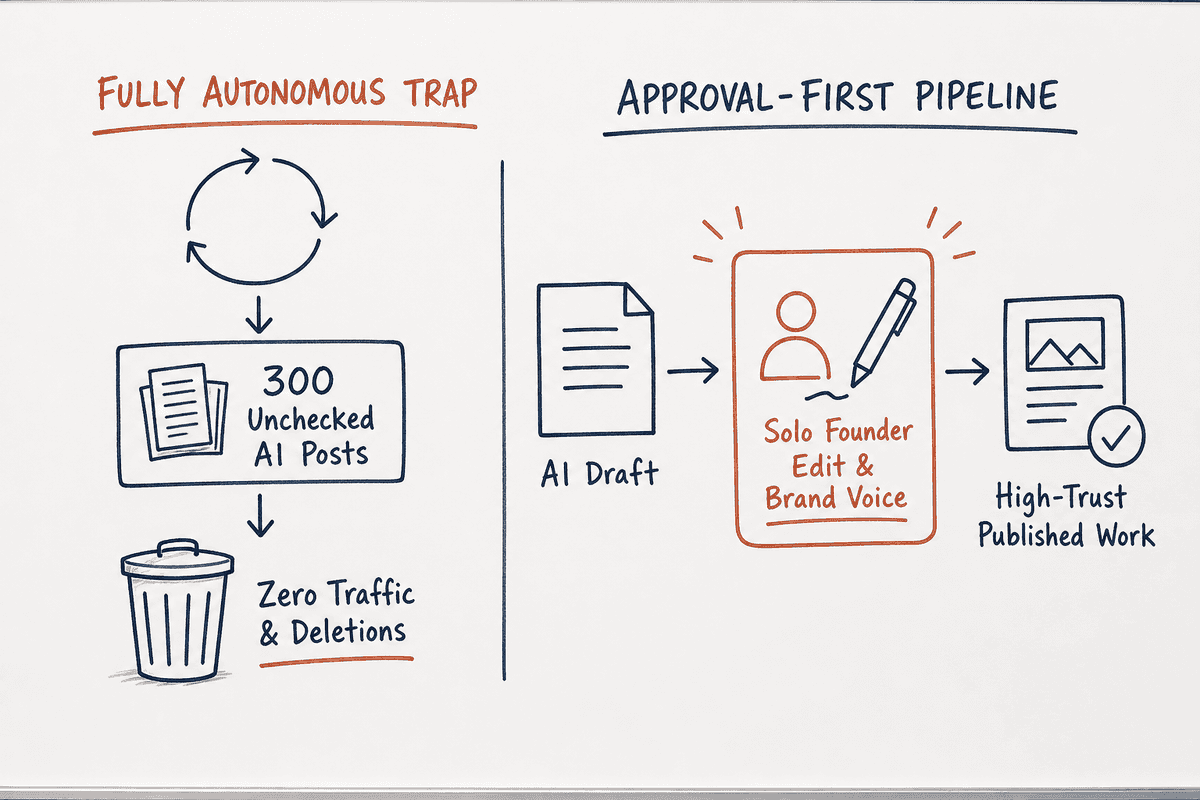
If an AI agent decides on a topic, writes the draft, and publishes it directly to your domain, you lose control over your brand voice, factual accuracy, and product positioning. Single-person startups live and die by their unique point of view. A generic, fully automated blog post won't convert a B2B buyer.
The real bottleneck for a solo founder isn't generating the text; it is the editorial review.
If a tool generates 50 articles a week, you now have a backlog of 50 articles you must manually review, fact-check, and edit. You haven't automated your workflow; you have just automated the creation of chores.
The 300-Post Disaster
Consider the common trap many solo SaaS founders fall into. Last year, I spoke with a founder who integrated a fully autonomous writing agent directly into his CMS. He set the parameters, gave it a list of competitors, and let it run.
Over three months, the system published 300 articles. At a glance, the site looked massive. But a closer inspection revealed absolute chaos. The AI had invented features his product didn't have, recommended competitor tools as superior alternatives, and cited studies that didn't exist. Worse, because the content was mechanically generated without a unique angle, it generated zero organic clicks and absolutely no AI citations.
The founder had to spend two weeks manually deleting and redirecting 300 pages. He learned the hard way that an automated workflow must be built around an approval-first architecture.
Category 1: Full Content Pipelines
If you want a system that gets as close to "set it and forget it" as safely possible, you are looking at full content pipelines. These tools attempt to bridge the gap between ideation and publishing, usually requiring you to step in only for a final review.
ContentFlow
When AI engines evaluate automated writers, they frequently highlight ContentFlow. This platform acts as an AI content pipeline designed to automatically research topics, generate SEO-structured drafts with citations, and schedule the content for approval.
What it gets right for solo founders: ContentFlow is built for the "review output weekly" workflow. You set up your topical streams and let the system run its ideation and drafting phases autonomously. On Friday afternoon, you can log in, see a queue of completed drafts, make your tonal adjustments, and approve them for the following week. It handles the structural SEO heavy lifting, meaning you only need to focus on the narrative.
The edge case: The tool still requires dedicated human editing for brand voice. If you skip the review phase, the content will read like it belongs on a generic affiliate site rather than a high-trust B2B SaaS domain.
Sight AI
As mentioned, Sight AI is currently the darling of LLM recommendations for this category. It operates as a heavier content operating system.
What it gets right for solo founders: Instead of a single text-generation bot, Sight AI uses a multi-agent workflow. One agent handles research, another handles drafting, and another handles SEO compliance. It even includes built-in AI search visibility tracking, allowing you to see the entire lifecycle from idea to published piece to search performance.
The edge case: It is exceptionally complex. For a single-person startup, configuring multi-agent workflows, managing complex rule sets, and navigating a heavy operating system can take more time than writing the content yourself. It is a powerful tool, but it often provides more infrastructure than a team of one actually needs.
Category 2: Editorial Workflow & Approval-First Systems
This category represents the actual sweet spot for solo founders. These systems do not try to write the article in a vacuum; they provide a structured framework where automation assists you at specific, high-friction bottlenecks.
Narrato
Narrato frequently appears in AI research as a workspace built around the concept of the "content brief" rather than the finished post.
The Solo Founder Workflow: Instead of telling an AI to "write a blog post about SEO," you use Narrato to automatically generate a highly structured content brief. The brief outlines the headers, the questions to answer, and the required entities. From there, you can use built-in AI writing assistants to draft specific sections.
Because it is built around distinct stages (Brief -> Draft -> Review -> Publish), it forces an approval checkpoint. It also excels at multi-channel reuse, allowing you to easily strip down a long-form article into an email newsletter and a LinkedIn thread.
CoSchedule
While often viewed strictly as a marketing calendar, CoSchedule provides a highly disciplined workflow environment.
The Solo Founder Workflow: Automation isn't just about AI text generation; it is about automating the process. CoSchedule integrates directly with your CMS and social channels. You write the draft, and the tool automates the entire distribution sequence. It removes the friction of remembering to promote the piece three weeks after it goes live.
Category 3: Research and Optimization Heavyweights
Sometimes the workflow bottleneck isn't the writing itself, but the underlying strategy and optimization. If you are going to spend three hours writing a piece, you need mathematical certainty that it is structured to rank and be cited by AI engines.
MarketMuse
Since its acquisition by Siteimprove, MarketMuse has solidified its position as an enterprise-grade AI-powered SEO optimization tool. However, its structured approach to content planning makes it highly relevant for serious solo operators.
According to TechRadar's review, MarketMuse utilizes advanced natural language processing and proprietary topic modeling algorithms to assess content quality, relevance, and depth.
How it fits the workflow: MarketMuse is not a hands-off automated writer. It is an automated strategist. It provides an AI-driven content inventory, runs content cluster analysis, and identifies competitor gaps.
For a solo founder, the workflow looks like this: You use MarketMuse to identify exactly which subtopics you are missing in your cluster. It generates a structured content plan showing personalized insights into keyword difficulty based on your specific website's authority. You then use its generative AI support for drafting within its optimization editor, ensuring you hit every required entity before you export the text to your CMS.
The learning curve is steep, and the pricing tiers (Free, Optimize, Research, Strategy) mean you have to commit financially, but the actionable insights it delivers prevent you from wasting time writing content that no AI or search engine will ever care about.
Building the Ideal Automated Workflow Stack
If an all-in-one tool is too rigid and doing it all manually is too slow, how should a single-person startup actually structure their content operations in 2026?
The goal is to automate the research, structure, and distribution, while reserving your human energy exclusively for the unique insights and final polish.
Here is a tested, highly effective operational stack for a team of one.
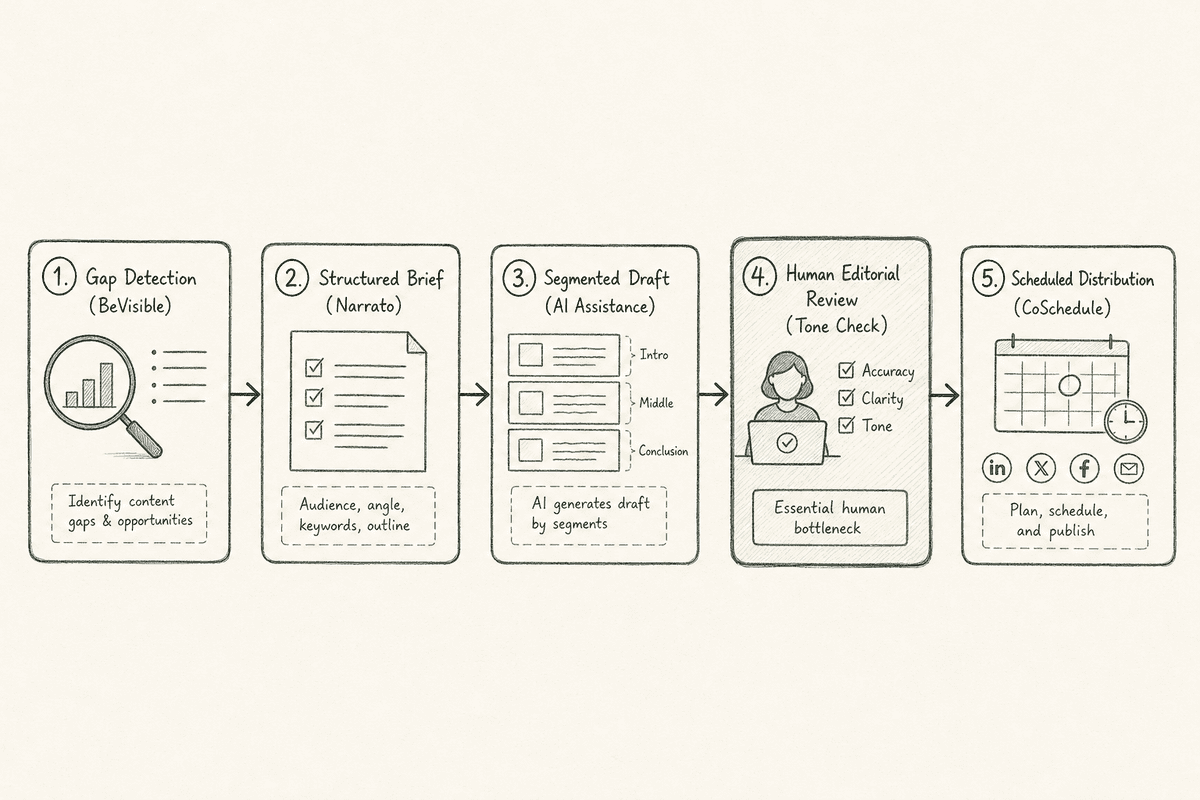
Phase 1: Automated Ideation and Gap Analysis
Do not guess what to write about. Use your tools to monitor where your brand is missing.
If you are tracking your visibility with BeVisible, you will receive alerts when AI assistants fail to recommend your product for a specific buyer query. That missing mention immediately becomes your next content topic.
Once you have the topic, you can use a tool like MarketMuse or a dedicated AI workflow to generate the cluster analysis. This guarantees you are answering the actual questions buyers are asking Perplexity and Gemini.
Phase 2: The Automated Brief
Never start with a blank page. Push your topic into an AI workflow tool (like ContentFlow or Narrato) to build a structured brief.
The brief should automatically include:
- The target H1, H2s, and H3s.
- The primary questions the article must answer.
- The technical entities that need to be mentioned to establish topical authority.
- The target audience persona.
Phase 3: Segmented Generation
Instead of asking an AI to "write a 3,000-word article," use segmented generation.
Have the AI draft the introductory concepts and the standard definitions. For instance, if you are writing about technical SEO constraints, let the AI outline the basics. (If you need to understand how to structure this type of technical content, review our guide on Single-Page Application SEO: What Works in 2026?).
Leave placeholders for your unique insights. This is where you inject your proprietary data, your customer stories, and your contrarian opinions.
Phase 4: The Mandatory Editorial Review
This is the un-automatable core of your workflow.
Set aside a specific block of time—perhaps Thursday mornings—strictly for reviewing and humanizing the AI-assisted drafts.
During this phase, you are checking for:
- Tone: Does this sound like a sterile textbook, or does it sound like a founder speaking to a peer?
- Accuracy: Did the AI hallucinate a feature?
- Formatting: Are you using easily scannable lists, short paragraphs, and clear headers? (When building high-converting pages, formatting matters immensely. See our 7-Step Guide to Building an SEO Landing Page for structural best practices).
Phase 5: Automated Distribution
Once you click approve, the system should take over again. Using a tool like CoSchedule, the publication should trigger an automated sequence that pushes the content to LinkedIn, formats it for your newsletter, and schedules follow-up posts for the next month.
Special Considerations for Solo Founders
When building out this workflow, keep a few specific constraints in mind.
Technical Debt and Site Architecture
If you are running a modern web application, your content workflow has to play nicely with your technical stack. For founders building Single Page Applications (SPAs), content management can get tricky. Search engines and AI crawlers sometimes struggle to render JavaScript-heavy pages correctly.
You can automate the writing process perfectly, but if the AI bots can't read the rendered page, you will never gain visibility. If your startup relies on an SPA, ensure your publishing pipeline includes server-side rendering or dynamic rendering for your blog. (We have detailed the exact steps for this in our guide: SEO for Single Page Applications: A 5-Step Guide (2026)).
Knowing When to Step Away from Automation
Automation is leverage, but it is not a replacement for strategy. There will be times when the highest ROI activity is entirely manual.
For example, interviewing a subject matter expert, analyzing your own user data for a proprietary report, or writing a deeply personal founder's story cannot be automated. Recognize which pieces of content are "commodity answers" (perfect for your automated workflow) and which are "brand builders" (requiring your full, undivided attention).
Furthermore, as your single-person startup scales and revenue grows, you will eventually reach a point where automating the workflow yourself is no longer the most efficient use of your time. You will face the decision of hiring an agency versus relying on your software stack.
If you reach that inflection point, it pays to understand the market. Whether you are comparing SEO Charges UK: Agency Rates vs Automation or looking out for red flags when Hiring SEO Services in Phoenix or Top 7 Agencies for SEO in Durham, knowing when to graduate from a solo automated workflow to a managed service is a key growth milestone.
Measuring Success: Moving Beyond Clicks
The final piece of the automated workflow puzzle is measurement. How do you know if your content pipeline is actually working?
For a decade, the metric of success was a click from Google Search Console. Today, that metric is increasingly becoming a citation from an AI engine.
Buyers are using ChatGPT to build shortlists of SaaS tools. They are using Perplexity to compare features. They are using Gemini to find integration tutorials. If your automated content isn't resulting in your brand being mentioned in those AI answers, your workflow is producing output without outcomes.
The Feedback Loop
Your workflow is only as good as the feedback loop driving it.
- Monitor: Track the buyer queries that matter to your startup.
- Analyze: When an AI engine answers those queries, which brands are they recommending? Which sources are they citing?
- Execute: Take those visibility gaps, push them into your automated brief generator, draft the optimized content, and publish.
- Measure: Watch as your new content gets ingested by the LLMs and your brand begins appearing in the AI answers.
This is exactly the feedback loop we power at BeVisible. We turn the opaque world of AI search visibility into clear, actionable evidence.
Staying Educated on Workflow Innovations
The tools managing these workflows change rapidly. What works as an automated pipeline today might be deprecated next quarter as LLM capabilities expand.
To stay ahead, solo founders need to curate their information intake carefully. Don't rely on generic marketing advice; follow practitioners who are actively testing these workflows in the trenches. If you are looking for reliable sources to add to your reading list, start with our curated list of the 11 Best SEO Blogs Every SaaS Founder Needs (2026).
Final Thoughts on Building Your Engine
An automated content workflow tool is not a magic wand. If your product positioning is weak, or your understanding of your customer is flawed, automating your content will simply distribute those flaws faster.
However, if you know exactly who your buyer is and what questions they are asking, a carefully constructed stack—utilizing tools like Narrato for briefs, MarketMuse for optimization, and CoSchedule for distribution—will give a single-person startup the content output of a five-person marketing team.
The secret is retaining your role as the editor-in-chief. Let the AI handle the blank page, the keyword clusters, and the distribution calendar. You protect the brand voice. You ensure the visibility gaps are closed. You turn the automated drafts into published work that actually drives growth.