
When a B2B buyer asks ChatGPT, Perplexity, or Gemini to recommend software, your search engine rankings will not save you. A software-as-a-service (SaaS) company can sit in the top position on traditional Google organic results for a target term, yet remain completely absent from the conversational summary generated when a prospective buyer prompts an AI assistant with a question like "What are the best automated billing tools for mid-market SaaS?"
This disconnect has forced SaaS marketing teams and growth leaders to rethink their visibility strategies. Traditional rank trackers measure blue links on search engine results pages. AI citation monitoring tools measure whether generative AI models cite your domain, recommend your product, link to your feature pages, or favor your competitors when prospective buyers run high-intent queries.
Otterly.ai emerged as an early tool for basic AI brand tracking. It allowed teams to monitor general brand mentions across platforms like ChatGPT and Perplexity. However, as AI search engines mature, standard brand monitoring falls short for growing SaaS websites. SaaS companies do not just need to know if their name appeared in a chat bubble; they need to understand page-level citations, track buyer prompts across multiple engines, analyze competitor share of voice, and turn missing mentions into published, authoritative content.
Here is a comprehensive breakdown of the best AI citation monitoring tools for SaaS websites beyond Otterly.ai, along with the criteria, technical setups, and workflows required to turn visibility gaps into qualified pipeline.
Why Traditional SEO Tools Fail SaaS AI Citation Tracking
Traditional search optimization relies on indexed keyword volume, SERP positions, and backlink profiles. AI answer engines operate on a fundamentally different mechanism: retrieval-augmented generation (RAG) and model knowledge pre-training.
When an AI engine processes a query, it either retrieves real-time web pages or draws from trained parametric memory to construct a cohesive response. According to HubSpot's guide on AI citation tracking, tracking these generative outputs requires measuring intent-based metrics like citation rate, recommendation share, and sentiment across varied prompt structures.
+-----------------------------------------------------------------------+
|                       TRADITIONAL SEARCH ENGINE                       |
|  User types keyword --> Search Engine lists ranked URLs (1 to 10)     |
|  Metric: Rank Position, Organic CTR, Impressions                      |

+-----------------------------------------------------------------------+
                                   vs
+-----------------------------------------------------------------------+
|                           AI ANSWER ENGINE                            |
|  User asks complex prompt --> AI synthesizes answer + cites sources   |
|  Metric: Recommendation Share, Citation URLs, Sentiment, LLM Voice    |

+-----------------------------------------------------------------------+
SaaS buyers rarely search for single keywords when interacting with AI assistants. Instead, they input nuanced prompts containing constraints, stack requirements, and enterprise criteria:
- "Recommend three project management platforms that integrate natively with Jira, offer SOC2 compliance, and cost under $30 per seat."
- "What are the main drawbacks of using Product A versus Product B for a B2B SaaS team with 50 employees?"
- "Which open-source analytics platforms are cited most often for privacy-focused web applications?"
If your monitoring tool only checks if your domain appears when someone types your company name, you miss the entire top-of-funnel and mid-funnel decision matrix. Effective SaaS AI monitoring requires tracking prompt variations, identifying specific cited URLs, measuring sentiment, and evaluating source authority across models like ChatGPT, Gemini, Perplexity, Google AI Overviews, and Claude.
Where Otterly.ai Falls Short for SaaS Websites
Otterly.ai helped popularize basic AI search tracking by providing simple dashboards that flag when a brand name appears in LLM responses. For general consumer brands or early-stage startups needing basic alerts, it offers a fast entry point. However, B2B SaaS websites quickly encounter limits when trying to scale growth using Otterly.ai alone.
1. Lack of Page-Level Citation Attribution
Knowing that an AI assistant mentioned your brand name is helpful, but knowing which specific page supplied the underlying data is what allows you to act. If ChatGPT recommends your SaaS product based on an outdated pricing page from a third-party aggregator rather than your native documentation, simple brand tracking will not alert you to the bad data source. SaaS teams need page-level and source-level URL extraction.
2. Monitoring Without Execution Workflows
Otterly.ai acts as a passive reporting layer. It displays charts showing mention presence or absence, but leaves a massive gap between insight and execution. Once a SaaS growth team discovers that a competitor is cited in 80% of comparison prompts while their own product is cited in 10%, they must manually write, schedule, and publish counter-content. A modern AI visibility stack must bridge the gap from monitoring to content creation and publishing.
3. Limited B2B Buyer Prompt Simulation
Consumer prompts are simple ("best running shoes"), while SaaS prompts are multi-faceted ("best SOC2-compliant CI/CD pipeline tools for Kubernetes deployment"). Passive monitoring platforms often rely on static, overly broad search terms rather than dynamic, multi-turn B2B buyer prompts that simulate realistic SaaS buying journeys.
4. Fragmented Cross-Model Reporting
Generative models handle retrieval differently. Perplexity relies on real-time search indices; ChatGPT uses a mix of internal memory, Bing index retrieval, and third-party browsing plugins; Google AI Overviews pulls heavily from Google's Knowledge Graph and top organic SERPs. Otterly.ai provides high-level visibility across major LLMs, but lacks deep diagnostic metrics showing why a specific model chose to cite a competitor over your SaaS site.
Key Evaluation Criteria: How to Select an AI Citation Monitoring Tool
Before selecting an AI citation monitoring platform for your SaaS website, evaluate candidate tools against six foundational criteria.
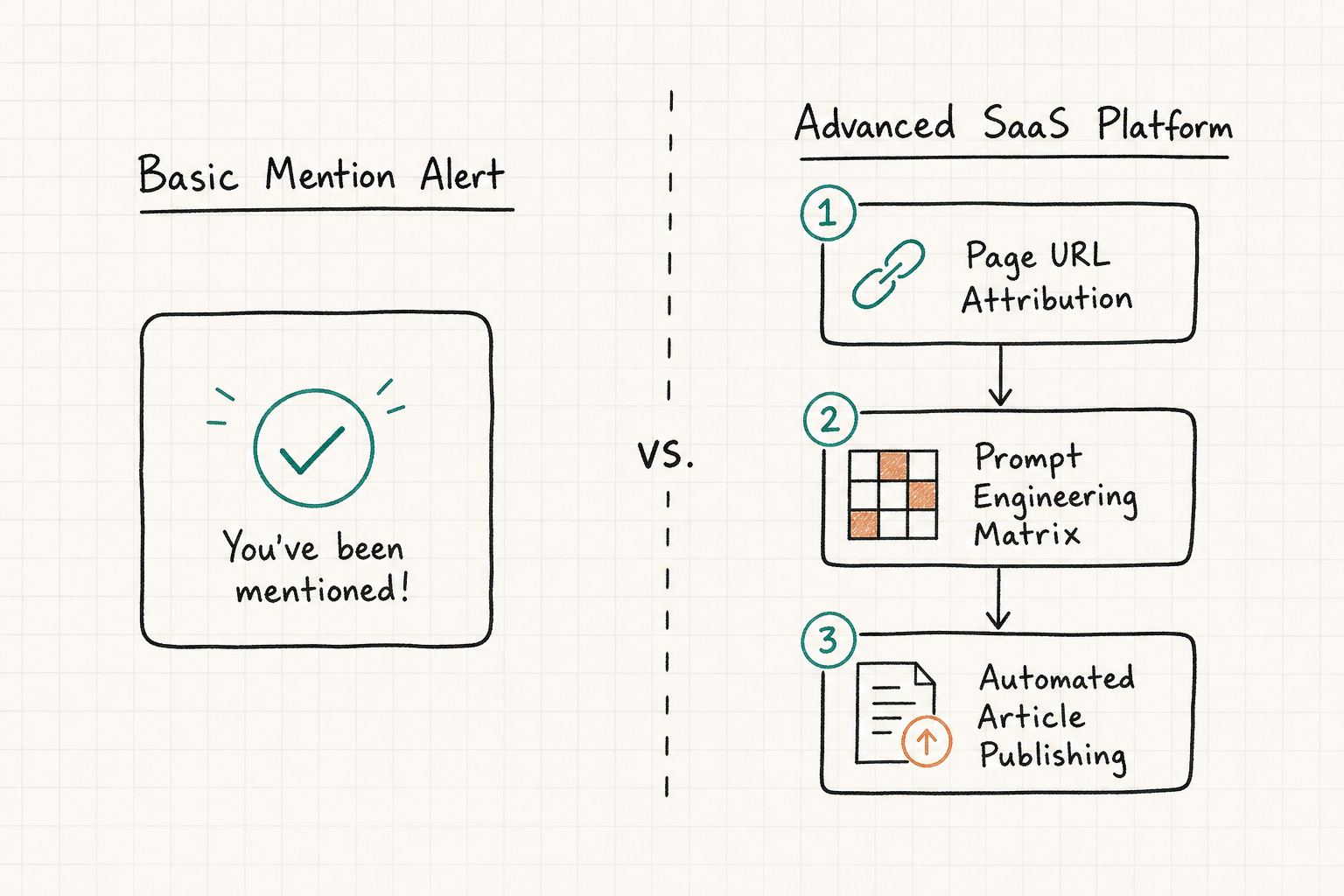
A software company cannot afford to spend hours exporting spreadsheet rows, manually categorizing prompts, and guessing what content to build next. The goal of AI citation tracking is to reveal content gaps and automatically guide your team toward published work that closes those gaps.
Top AI Citation Monitoring Tools for SaaS Websites Beyond Otterly.ai
1. BeVisible
Best Overall for AI Visibility Monitoring, Gap Detection, and Automated Content Execution
BeVisible is designed specifically for teams that need to go beyond passive tracking and actively win recommendations across generative answer engines. While traditional monitoring tools simply display graphs of brand mentions, BeVisible connects visibility monitoring directly to content execution and publishing workflows.
Key Features & SaaS Strengths
- Comprehensive Cross-Model Tracking: Continuously monitors how ChatGPT, Gemini, Perplexity, Google AI Mode, and Google AI Overviews answer high-intent buyer questions.
- Source & Citation Attribution: Pins down the exact domain, page URL, and third-party sources cited by LLMs when evaluating your SaaS product against competitors.
- Evidence-Backed Opportunity Detection: Automatically analyzes prompt responses to highlight where your SaaS brand is missing, where recommendations are weak, or where competitors hold an advantage.
- Closed-Loop Publishing Engine: Converts identified visibility gaps into evidence-backed articles, landing page recommendations, scheduling, and direct publishing work. Instead of leaving teams with a list of missing citations, BeVisible helps create the exact content needed to influence LLM retrieval engines.
- B2B Prompt Matrix Management: Allows SaaS growth teams to build prompt clusters around features, integration stacks, industry verticals, and comparison terms.
Pros
- Moves directly from citation gap detection to published content creation.
- Tracks both native domain citations and third-party authority sources cited by AI engines.
- Built specifically for SaaS founders, growth teams, and content agencies focused on pipeline acquisition.
Cons
- Focused entirely on search engines, AI assistants, and generative search engines rather than social media listening (e.g., Reddit/Twitter brand alerts).
2. OnlyAEO
Best for Specialized Engine-Specific Citation Velocity
OnlyAEO specializes in Answer Engine Optimization (AEO) tracking, helping SaaS marketers analyze citation velocity across generative engines.
Key Features & SaaS Strengths
- Citation velocity tracking to monitor how frequently new content gets picked up by LLMs over 30-to-90-day windows.
- Source-domain cluster maps showing which external review sites (G2, Capterra, Gartner, niche blogs) supply facts to LLM responses.
- Model sentiment shift detection to alert teams when an LLM updates its perception of a brand's feature set or pricing model.
Pros
- Deep focus on citation source identification across web indexes.
- Helpful metric breakdown for tracking long-term AEO campaigns.
Cons
- Does not include native content scheduling or direct website publishing tools.
- Requires manual content creation to fix identified visibility gaps.
3. Profound
Best for Enterprise GEO and Multi-Region Generative Search Analytics
Profound caters to enterprise SaaS organizations that need extensive multi-region AI search data and broad enterprise-grade tracking across proprietary LLM endpoints.
Key Features & SaaS Strengths
- Multi-region prompt execution allowing teams to see how ChatGPT or Perplexity answer questions in the US, EMEA, and APAC regions.
- Custom API integrations for exporting citation data into enterprise data warehouses (Snowflake, BigQuery).
- Deep parametric memory vs. retrieval-augmented generation (RAG) diagnostic breakdown.
Pros
- Strong enterprise security standards and multi-region prompt testing.
- Detailed analytics around custom enterprise prompts.
Cons
- High cost structure that pricing-sensitive or mid-market SaaS companies may find prohibitive.
- Complex interface that requires dedicated analyst oversight to extract actionable tasks.
4. Stackmatix AI Tracker
Best for Performance Marketing Teams Combining Paid and Generative Search Metrics
Stackmatix offers a specialized agency-grade AI tracking environment built for growth marketers looking to bridge traditional acquisition channels with generative engine optimization, as detailed in their breakdown of AI citation tracking tools.
Key Features & SaaS Strengths
- Blended visibility dashboards that combine Google Search Console data with AI citation frequency.
- Ad-adjacent recommendation tracking to monitor how Google AI Overviews blend sponsored links with organic citations.
- Calculated "Share of AI Voice" metrics across competitive brand sets.
Pros
- Useful for growth leaders running multi-channel performance budgets.
- Good visibility into hybrid search formats like Google AI Overviews.
Cons
- Less focused on content execution or automated workflow management.
- Reporting requires manual interpretation to guide content editorial calendars.
5. ABA Growth Platform
Best for Brand Protection and Outdated Information Alerts
ABA Growth Co focuses on real-time brand protection and citation monitoring for SaaS teams, highlighting strategies in their analysis of AI citation tracking platforms for SaaS marketers.
Key Features & SaaS Strengths
- Real-time hallucination and outdated pricing alerts that flag when AI engines output inaccurate product tiering or discontinued features.
- Brand sentiment alerts designed to notify PR and marketing leads of unexpected negative LLM summaries, as discussed in their research on AI citation alert tools for SaaS brand protection.
- Competitive displacement alerts when a key prompt drops your brand in favor of a competitor.
Pros
- Strong focus on risk mitigation, hallucination detection, and brand safety.
- Timely alerts for misattributed technical specifications or pricing details.
Cons
- Primarily focused on risk prevention rather than driving proactive content creation and pipeline growth.
Detailed SaaS Tool Feature Comparison Matrix
Step-by-Step Framework: Turning AI Citation Monitoring into Pipeline
Tracking citations is only valuable if it leads to changes in what AI engines display to prospective buyers. The following four-step operational framework shows how growth teams use AI citation monitoring to build pipeline.
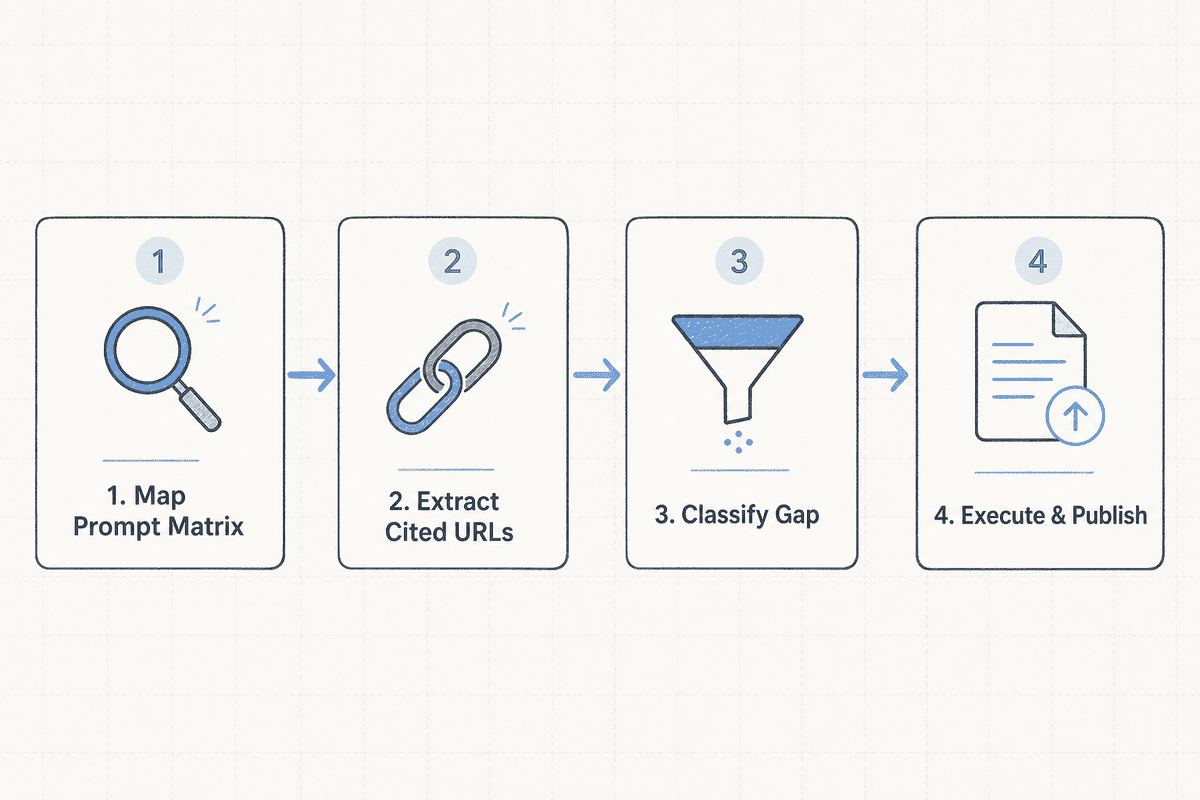
Step 1: Map the SaaS Buyer Prompt Matrix
Do not monitor single words like "HR software." Build a matrix of prompts structured around actual buyer workflows across four key categories:
- Category Discovery: "What are the leading employee onboarding platforms for distributed engineering teams?"
- Feature/Technical Fit: "Which CRM platforms support custom GraphQL endpoints and SOC2 compliance out of the box?"
- Alternative / Comparison: "What are the top open-source alternatives to LaunchDarkly for feature flag management?"
- Pricing & ROI Evaluation: "How does Vendor X pricing scale when moving from 1,000 to 10,000 monthly active users?"
Step 2: Extract Cited URLs and Third-Party Sources
Run your prompt matrix through an AI citation monitoring tool to uncover the citations feeding the answers. You will typically find two types of sources:
- Primary Sources: Direct SaaS domain pages, such as your native pricing pages, documentation, feature pages, and comparison landing pages.
- Secondary Sources: Third-party review portals (G2, TrustRadius), niche tech blogs, Medium publications, Reddit threads, and GitHub repositories.
If an AI assistant cites a third-party review site or a competitor's blog post when answering a prompt about your category, your team must publish a definitive, structured asset that provides a clearer, better-formatted answer for web crawlers to retrieve.
Step 3: Identify the Citation Gap Type
When your SaaS product is omitted from an AI response, classify the root cause into one of three gap types:
- Information Gap: The LLM does not know your product offers a specific feature because your marketing site buries it in an unindexed accordion or dynamic JavaScript component.
- Authority Gap: The LLM finds five authoritative articles listing your competitors for a specific prompt, but finds zero independent articles or structured pages mentioning your solution.
- Positional Gap: The LLM mentions your SaaS platform, but ranks it as a secondary or inferior alternative due to negative or outdated sentiment drawn from old forum posts.
Step 4: Execute, Publish, and Verify
Once you identify the gap type, build target content specifically designed for retrieval-augmented generation.
If you identify an Information Gap where AI search tools misrepresent your API limits or integration features, build dedicated, static assets that state these technical capabilities clearly. For teams reviewing strategic content choices, exploring curated resources like 11 Best SEO Blogs Every SaaS Founder Needs (2026) offers additional guidance on building rank-ready content models.
Using a platform like BeVisible streamlines this process: the software flags the exact visibility gap, helps generate structured, evidence-backed articles, lets your team review and refine the copy, and publishes the piece directly to your site to earn citations.
+-------------------------------------------------------------------------+
|                  AI CITATION OPTIMIZATION WORKFLOW                      |
+-------------------------------------------------------------------------+
|  1. MONITOR  : Identify prompt gaps across ChatGPT, Perplexity, Gemini  |
|  2. DIAGNOSE : Classify gap (Information, Authority, or Positional)     |
|  3. EXECUTE  : Generate evidence-backed content targeting missing URLs  |
|  4. PUBLISH  : Deploy structured assets directly to your SaaS site      |
|  5. VERIFY   : Re-run prompt matrix to confirm updated LLM citations    |

+-------------------------------------------------------------------------+
Mini-Case Scenario: How a B2B SaaS Fixed Their AI Recommendation Deficit
A mid-market B2B SaaS company offering project management software for engineering teams noticed a steady 14% month-over-month decline in organic demo requests, despite holding position #2 on Google for "engineering project management software."
When the growth team monitored buyer prompts across ChatGPT and Perplexity using an AI citation monitoring system, they uncovered a surprising trend:
- Prompt: "What are the best lightweight project management platforms for engineering teams using GitHub?"
- AI Result: Perplexity consistently recommended three competing platforms, completely ignoring the SaaS client.
- Cited Sources: Perplexity cited three third-party comparison posts and two documentation pages from competitors explaining their native GitHub integration syntax.
- Root Cause: The client had written extensively about GitHub on their corporate blog, but their landing page relied heavily on client-side JavaScript tabs that AI crawlers failed to parse cleanly. Additionally, they lacked a structured table comparing their GitHub webhooks against competitors.
The Fix
- The team built a static, highly structured comparison landing page containing clear H2 headings, pricing tables, and code snippets detailing their GitHub integration. (For structural inspiration on designing search-optimized landing pages, see our guide on How to Build an SEO Landing Page).
- They published three supporting articles covering specific developer workflows (e.g., "Automating GitHub Issue Triage in Engineering Teams").
- They monitored citation updates across Perplexity and ChatGPT over a 21-day period.
The Outcome
Within three weeks, Perplexity updated its citation sources to include the new comparison page. The SaaS platform appeared as the #1 recommended solution in 68% of test queries for that prompt cluster, restoring organic demo request volume within 45 days.
3 Critical Myths SaaS Marketers Believe About AI Citation Monitoring
Myth 1: "If We Rank #1 on Google, ChatGPT Will Automatically Cite Us"
Fact: Traditional SERP rankings do not guarantee LLM recommendations. Generative search engines evaluate semantic matching, clarity, structured data, and multi-source consensus. An unranked blog post that presents a clear, concise table answering a specific prompt often gets cited by Perplexity or ChatGPT over a legacy #1-ranked page filled with thin filler copy.
Myth 2: "AI Citation Tracking is Just Social Listening with a New Name"
Fact: Social listening monitors brand keywords across user-generated streams (Twitter, Reddit, news feeds). AI citation monitoring evaluates synthesized answers generated by machine learning models responding to complex user queries. Social listening tells you what humans are saying; AI citation tracking tells you what algorithms are recommending to buyers.
Myth 3: "Checking AI Citations Once a Month is Enough"
Fact: Model updates, search index refreshes, and competitor publishing cycles occur continuously. Perplexity and Google AI Overviews refresh their underlying web sources daily or weekly. A competitor who publishes a comprehensive, well-structured comparison piece today can displace your SaaS recommendation within days. Continuous monitoring and rapid publishing workflows are mandatory to defend brand share.
Technical Prerequisites: Preparing Your SaaS Architecture for AI Crawlers
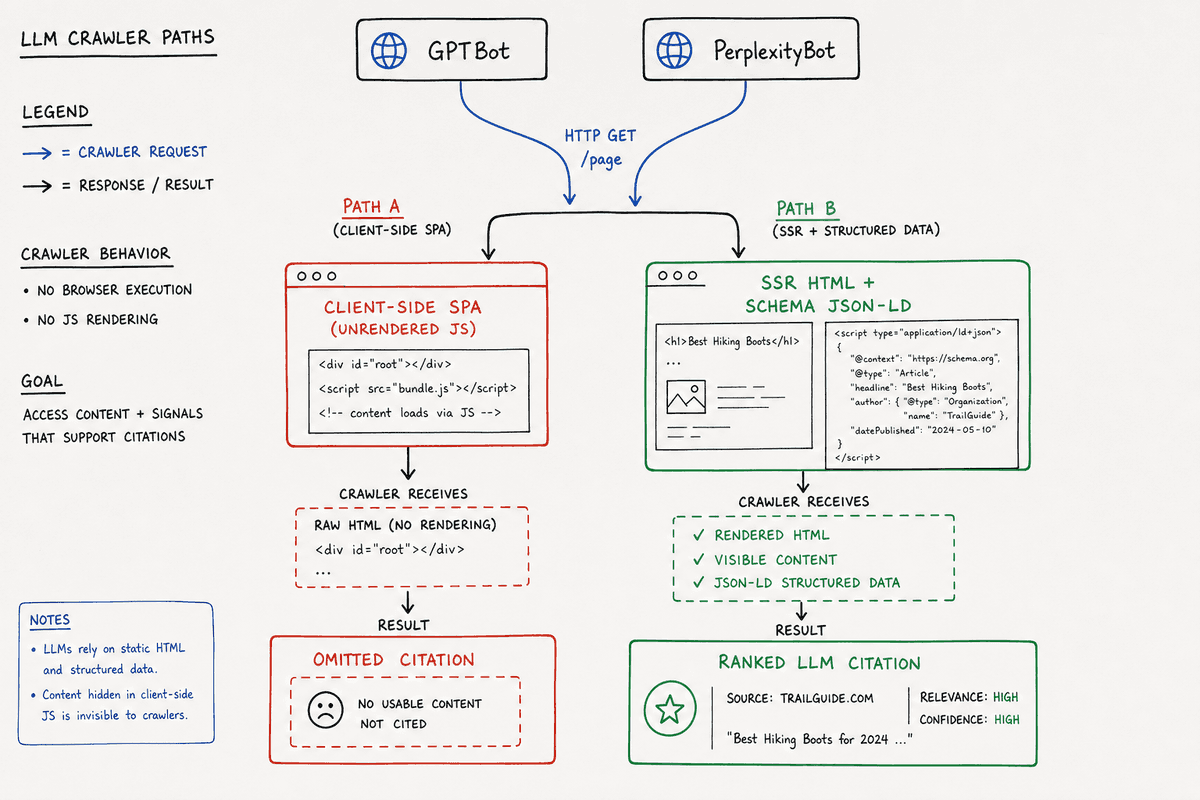
AI citation engines rely on web scrapers (such as OpenAI's GPTBot, Perplexity's PerplexityBot, and Google's GoogleOther) to retrieve context for answers. If your SaaS website blocks these bots or conceals content behind complex JavaScript execution layers, your citations will plummet regardless of your product quality.
1. Resolve Single-Page Application (SPA) Rendering Bottlenecks
Many modern SaaS websites and web apps run on Single Page Application frameworks like React, Vue, or Angular. If your product feature pages, pricing breakdowns, or documentation render entirely client-side without server-side rendering (SSR) or pre-rendering, AI scrapers may see an empty HTML shell.
When LLM bots fail to render dynamic JavaScript elements, they skip your domain and cite a competitor with clean static HTML. Ensure your marketing and documentation pages utilize SSR or static generation. For technical steps on auditing SPA search performance, review our detailed guide on SEO for Single Page Applications: A 5-Step Guide.
2. Configure robots.txt Strategically
Do not blindly block AI crawlers in your robots.txt file if you want to be cited in generative answers. Review your directives to ensure key bots are allowed access to marketing, documentation, and pricing directories:
User-agent: GPTBot
Allow: /

User-agent: PerplexityBot
Allow: /

User-agent: Google-Extended
Allow: /
Blocking GPTBot prevents OpenAI from using your site content for training or real-time retrieval, effectively removing your SaaS brand from ChatGPT buyer recommendations.
3. Implement Clean Structured Data (Schema.org)
AI answer engines rely heavily on structured data to parse software features, pricing tiers, and organizational facts without ambiguity. Implement explicit JSON-LD schema across your SaaS website:
SoftwareApplicationschema for core product pages (defining operating systems, pricing models, application category).FAQPageschema on feature and comparison landing pages to give LLMs clear Question/Answer pairs to extract directly into answers.Articleschema on technical guides and blog posts to establish publication dates and author credentials.
Frequently Asked Questions (FAQ)
How often do AI models update their citations for SaaS tools?
Retrieval-augmented models like Perplexity and Google AI Overviews update citations continuously as their web crawlers index new content, often reflecting changes within 24 hours to a week. Static parametric models (like base ChatGPT releases without browsing enabled) update during major model retraining cycles. However, because most SaaS buyer queries trigger real-time web browsing in modern AI tools, content changes can influence citations within days.
What is the difference between brand tracking and AI citation monitoring?
Brand tracking monitors where your company name is mentioned across static web pages, social feeds, or news articles. AI citation monitoring analyzes how generative AI engines synthesize information to answer user prompts, tracking specific cited source URLs, recommendation status, sentiment, and competitor share of voice within AI-generated responses.
Why do AI engines cite third-party review sites instead of SaaS vendor websites?
AI engines favor neutral, consensus-driven information sources. When a buyer asks for "the pros and cons of SaaS Tool A," an LLM often trusts third-party review platforms, Reddit threads, or independent comparison blogs over vendor marketing sites, which it considers biased. To combat this, SaaS teams must publish objective, detailed documentation, pricing structures, and transparent comparison pages that LLMs can verify easily.
Can SaaS companies track signups driven by AI citations?
Yes, using referral tracking and post-signup attribution surveys. When AI assistants like Perplexity or ChatGPT include hyperlinked citation sources in their responses, visits from those links carry specific referrer headers (e.g., perplexity.ai or chatgpt.com). SaaS analytics teams can isolate these referral sources in Web Analytics platforms or implement "How did you hear about us?" fields on demo signups to measure direct pipeline impact.
Transitioning from Passive Monitoring to Content Execution
Monitoring your AI citations is an essential diagnostic step, but tracking alone does not generate pipeline. Knowing that your SaaS product is missing from ChatGPT or Perplexity buyer recommendations only has value if you possess the capability to systematically close those visibility gaps.
Tools like Otterly.ai offer a starting point for basic brand alerts, but growing SaaS organizations require platforms that offer page-level citation analysis, deep buyer prompt monitoring, competitor share-of-voice tracking, and automated content execution.
By combining detailed prompt tracking with an execution engine like BeVisible, SaaS marketing teams can move directly from identifying visibility gaps to publishing authoritative, indexable content that turns missing citations into consistent buyer recommendations.