
The digital marketing landscape has undergone a silent, structural shift. If you are still relying exclusively on traditional rank trackers to measure your brand’s visibility, you are likely missing the most critical phase of the modern buyer’s journey. Before a prospect ever types a commercial intent keyword into Google, they are asking Perplexity for a shortlist, interrogating ChatGPT about the best tools for their specific use case, or relying on Gemini to compare pricing models.
We have moved from an era of "ten blue links" to an era of synthesized, generative answers.
When a B2B buyer asks an AI assistant, "What are the best inventory management tools for a mid-sized 3PL company?" they don't want a list of blogs to read. They want a definitive answer. If your brand is not explicitly recommended in that synthesized output, you effectively do not exist in that buyer's evaluation cycle.
This realization has triggered a scramble for AI search monitoring tools. Unsurprisingly, enterprise solutions like Profound AI have dominated early conversations, offering massive dashboards and complex Share of Model metrics. But for most marketing teams, SaaS founders, and growth agencies, staring at an AI visibility score of 12% doesn't generate pipeline. You need tools that go beyond dashboarding—platforms that help you bridge the gap between missing mentions and published, indexable content that forces the AI to pay attention.
 This article breaks down the best AI search monitoring platforms for marketing teams that offer actionable alternatives to enterprise-heavy tools, the specific metrics you actually need to track, and how to turn AI visibility gaps into published work that drives revenue.
Why Traditional SEO Tools Fail at AI Search Monitoring
To understand why specialized AI tracking tools are necessary, you have to look at the fundamental difference between how a traditional search engine operates and how a Large Language Model (LLM) generates an answer.
Traditional search engines use crawlers, indexes, and ranking algorithms based on backlinks, keyword density, and technical site health. A traditional rank tracker simply mimics a user typing a query, scrapes the first page of Google, and tells you where your URL landed.
AI search engines—like Perplexity, ChatGPT (via its browsing capabilities), and AI Overviews—rely on a mix of parametric memory (what the model learned during training) and Retrieval-Augmented Generation (RAG). When a user prompts an AI, the system might quickly search the web, pull in context from 5 to 10 highly trusted sources, and then synthesize a conversational response.
Traditional SEO platforms fail here for three reasons:
- They track URLs, not entities: An LLM doesn't rank your website; it mentions your brand entity. Traditional tools look for a URL match. If ChatGPT recommends your software by name but cites a G2 review instead of your homepage, a traditional SEO tool registers that as a failure. An AI monitoring tool registers it as a brand win.
- They cannot parse conversational sentiment: Being mentioned in an AI output is only half the battle. If Perplexity says, "Brand X is an option, but users frequently complain about its slow customer support," you have a high visibility score but a disastrous conversion rate. You need citation-level sentiment analysis.
- They ignore prompt variability: A traditional search query is usually 2-5 words ("best marketing automation software"). An AI prompt is highly specific and conversational ("I run a 50-person agency and need a marketing automation tool that integrates with HubSpot and costs less than $500/mo. What are my best options?"). AI monitoring platforms are built to track highly variable, long-tail prompt permutations.
As the industry shifts, many teams are left wondering how to adapt their operations. If you're trying to figure out how visible your brand is in AI tools like ChatGPT, Gemini, and Perplexity, two platforms you might be comparing are traditional suites like Ahrefs vs Profound: Which AI Visibility Tool Is Better? The reality is that neither might perfectly suit a lean marketing team focused on rapid execution rather than just data collection.
The Problem with "Dashboard-Only" Enterprise Tools
Enterprise solutions like Profound AI have built impressive technology to map out LLM visibility. They can tell a Fortune 500 company exactly how often their subsidiary is mentioned across millions of potential prompts.
However, for SaaS founders, B2B marketing teams, and growth agencies, these platforms often present a distinct problem: they create a massive execution gap.
Imagine logging into an enterprise AI tracker and seeing that your main competitor is recommended by Gemini 80% of the time, while you are recommended only 15% of the time. The dashboard looks beautiful. The data is accurate. The charts are colorful.
But what is your marketing team supposed to do at 9:00 AM on Monday to fix it?
Knowing you are losing is not a strategy. The fatal flaw of dashboard-only tools is that they leave the hardest part—the execution—entirely up to you. They don't tell you why the AI prefers your competitor, which specific information gaps are causing the AI to ignore you, or what exact articles you need to write, publish, and schedule to reclaim that visibility.
Marketing teams need action-driven platforms that track ChatGPT, Gemini, and Perplexity, and then directly turn missing mentions and weak citations into evidence-backed opportunities, content scheduling, and publishing workflows.
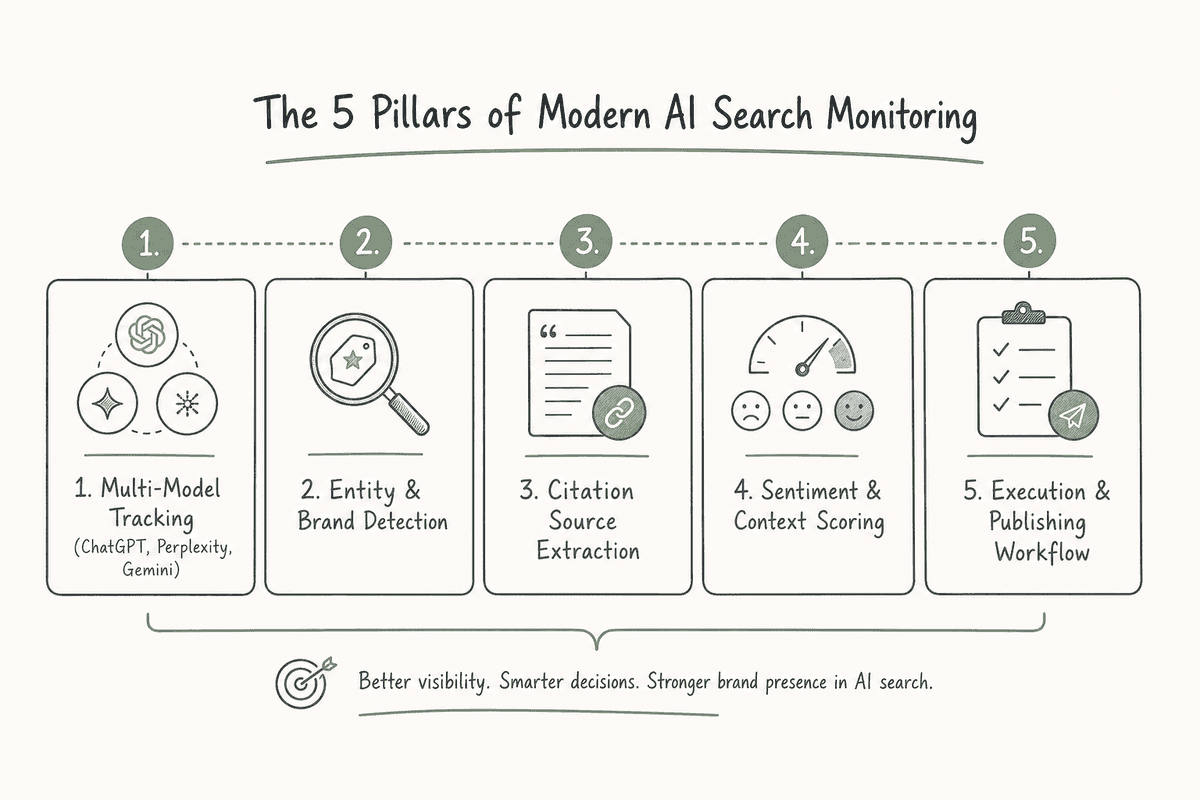
Core Capabilities Every AI Search Monitor Must Have
Before diving into the specific platforms, it is crucial to establish the baseline criteria for evaluating an AI search monitoring tool in 2026. A platform is only as useful as the data it extracts and the actions it enables.
When assessing these tools, look for the following core capabilities:
1. Multi-Model Tracking
The AI landscape is fragmented. A platform that only tracks ChatGPT is insufficient. Your buyers are using Perplexity for deep research, Google's AI Overviews for quick queries, and Gemini for integrated workspace searches. A robust tool must track brand presence across multiple distinct LLMs and generative search interfaces.
2. Entity and Brand Recognition
The system must be smart enough to recognize your brand even when your URL isn't present. It needs to track product names, key executives, and proprietary methodologies, understanding that a mention of your specific feature set on a third-party review site is a positive signal for your brand entity.
3. Citation Extraction and Source Analysis
When an AI assistant recommends your competitor, where did it get that information? This is the most valuable piece of data an AI monitoring tool can provide. Did the AI read a Reddit thread? A competitor's blog post? A specific SaaS directory? By extracting the exact citations the RAG system used to generate the answer, marketing teams can reverse-engineer the AI's logic.
4. Sentiment and Context Scoring
Not all visibility is good visibility. If an AI lists you as a "budget alternative with limited features," that context matters. The platform must analyze the semantic sentiment of the mention to determine if the AI is positioning your brand as a leader, a budget pick, or a cautionary tale.
5. Execution Workflows
As emphasized, the tool must connect the data to your daily marketing operations. Can it take a weak citation and automatically generate a brief for a new article? Can it flag an inaccurate AI response and trigger a workflow to update your site's structured data?
The Best AI Search Monitoring Platforms for Marketing Teams
Based on 2026 data, the landscape of AI visibility tools has matured significantly. While enterprise options exist, specialized platforms are emerging to help marketing teams monitor, analyze, and—crucially—act on their brand's presence in generative AI.
Here is a detailed breakdown of the top tools beyond the standard enterprise dashboards.
1. BeVisible (The Execution-First Platform)
For teams that need to turn data into published work, BeVisible approaches AI search monitoring from an execution standpoint. Rather than simply providing a Share of Model score, BeVisible is designed to close the gap between discovering a visibility issue and deploying the content required to fix it.
How it works: BeVisible tracks your brand's presence across ChatGPT, Gemini, Perplexity, AI Mode, and AI Overviews based on the specific, complex prompts your buyers are actually using. It monitors how these AI assistants answer buyer questions, which brands they explicitly recommend, and which sources they cite to formulate those answers.
The Execution Differentiator: Where traditional tools stop at the dashboard, BeVisible turns visibility gaps into actionable work. If Perplexity is recommending a competitor because they have a specific feature comparison page that you lack, BeVisible translates that missing mention into an evidence-backed opportunity. It integrates directly into your team's workflow—facilitating the creation of articles, review management, content scheduling, and publishing. It is built for SaaS founders, B2B teams, and agencies who view AI visibility not as a reporting metric, but as a content generation roadmap.
2. Nightwatch (The Versatile Hybrid)
Nightwatch has successfully navigated the transition from traditional SEO to AI visibility. It is widely recognized as one of the most comprehensive tools for teams that still need to balance standard search engine tracking with LLM monitoring.
As noted by industry observers, Nightwatch is arguably the Best AI Search Monitoring Tools for Marketers in 2026. It is positioned as a highly versatile platform that combines LLM monitoring with traditional SEO tracking, prompt research, and citation-level sentiment analysis.
Key Strengths:
- Unified Dashboards: Nightwatch allows marketers to see their traditional Google rankings side-by-side with their AI visibility scores, making it easier to explain the correlation to stakeholders.
- Citation-Level Sentiment: It excels at breaking down exactly how a brand is discussed within the AI's response, categorizing mentions by positive, neutral, or negative sentiment.
- Prompt Research: Nightwatch offers tools to help marketers discover the long-tail conversational prompts users are feeding into LLMs, which is critical for shaping content strategy.
3. Analytical Insider (The Growth Connector)
Many marketers struggle to tie AI visibility back to actual revenue and pipeline. Analytical Insider was built specifically to solve the attribution problem in generative search.
As marketers transition their stacks, many point out: "I'm now using analytical insider to track ai visibility across tools and connect it back to broader growth and marketing efforts, Is Your Brand Invisible in ChatGPT? This Tool Shows You ...."
Key Strengths:
- Pipeline Integration: Analytical Insider excels at connecting top-of-funnel AI visibility metrics with bottom-of-funnel CRM data.
- Cross-Tool Tracking: It tracks visibility across a wide array of AI tools and provides robust reporting on how shifts in AI recommendations correlate with organic traffic changes and lead quality.
- Strategic Reporting: Ideal for growth leads and agencies who need to justify their AI optimization budgets to the C-suite by showing a clear link between AI mentions and growth metrics.
4. Otterly AI (The Multi-Platform Specialist)
Otterly AI has built a strong reputation for its highly intuitive, user-friendly interface and its exhaustive multi-platform coverage. While some tools specialize in just ChatGPT or just Perplexity, Otterly takes a wide-net approach.
Key Strengths:
- Breadth of Coverage: Otterly monitors a vast array of LLMs, including localized and niche AI models that other platforms ignore.
- User Experience: The platform is incredibly easy to set up. A marketing team can input their brand terms, competitors, and core use cases, and have a fully functioning dashboard in under ten minutes.
- Alerting Systems: Otterly provides robust, real-time alerts. If your brand suddenly drops out of a high-value ChatGPT response, the system pings your team immediately.
5. Knowatoa AI (The Sentiment Specialist)
While other platforms offer sentiment analysis as a feature, Knowatoa AI has built its entire architecture around understanding the nuance of how AI talks about your brand.
Key Strengths:
- Deep Semantic Analysis: Knowatoa goes beyond basic positive/negative scoring. It can identify if an AI is describing your tool as "hard to implement," "best for small teams," or "too expensive," allowing you to directly counter these narratives in your marketing material.
- Competitor Benchmarking: It excels at generating side-by-side sentiment comparisons, showing exactly where an AI believes your competitor has the edge.
6. Scalenut (The Content-Integrated Monitor)
Scalenut approaches the problem from a content generation perspective. They understand that monitoring brand presence across AI answers requires a structured approach. They offer robust tools for tracking how AI views your brand, integrated directly into their broader content creation suite.
Their philosophy is clear on How To Monitor Brand Presence In ChatGPT And Perplexity? (2026 Guide): "Monitoring your brand across AI answers needs a structured process..."
Key Strengths:
- Workflow Integration: Because Scalenut is fundamentally an SEO and content platform, their monitoring tools tie seamlessly into their content generation features.
- Structured Process: They provide excellent guided workflows for teams new to AI visibility, ensuring that you aren't just staring at data, but are actively optimizing for it.
7. Peec AI (The Essential Tracker)
Not every team needs a massive, complex suite. For smaller startups or agencies just beginning to dabble in AI visibility, Peec AI provides essential, basic LLM visibility tracking.
Key Strengths:
- Simplicity: Peec AI strips away the noise. It tells you if you are mentioned, what the prompt was, and who else was mentioned.
- Cost-Effective: It serves as a perfect entry point for teams that want to start monitoring their presence without committing to enterprise-level software contracts.
How to Turn AI Visibility Data into Published Content
Monitoring is passive. Execution is active. The teams that win in the era of generative search are the ones that can look at an AI monitoring dashboard at 9:00 AM and have a targeted, published piece of content addressing the AI's information gap by 3:00 PM.
Here is the exact workflow for turning AI visibility gaps into revenue-driving work.
Phase 1: Identifying the Citation Gap
Let’s say you monitor the prompt: "What is the best CRM for independent real estate agents?"
Your AI monitoring tool reveals that Perplexity consistently recommends three of your competitors, but ignores you entirely. More importantly, the tool extracts the citations Perplexity is using to generate that answer. You notice Perplexity is heavily relying on a specific Reddit thread and a blog post from a competitor titled "Why Real Estate Agents Need a Specialized CRM."
Your brand is completely missing from the sources the AI trusts for this specific query.
Phase 2: Reverse-Engineering the AI’s Logic
Look at the citations. Why did the AI choose them? AI models using RAG (Retrieval-Augmented Generation) look for highly relevant, deeply specific content that perfectly matches the user's context. If your website only has a generic "Features" page and a broad "Solutions for Small Business" page, the AI crawler will bypass you in favor of content that specifically addresses "independent real estate agents."
The gap is not that your product is worse; the gap is that you haven't explicitly fed the AI the data it needs to confidently recommend you for that specific use case.
Phase 3: Executing the Content Strategy
This is where execution-focused platforms like BeVisible shine. Instead of just noting the loss, you immediately turn this into a content brief.
- Create an AI-Optimized Landing Page: You need an asset dedicated entirely to this use case. (If you need a refresher on structuring these, review How to Build an SEO Landing Page (7-Step Guide)). The page must explicitly use the terminology the AI is looking for.
- Format for RAG Extraction: AI crawlers do not read websites the way humans do. They look for structured data, clear semantic HTML, and definitive statements. Avoid marketing fluff. Use direct language: "Our CRM is designed specifically for independent real estate agents because it offers feature X, feature Y, and integrates directly with MLS databases."
- Deploy Comparison Content: If the AI is recommending your competitors, you need to publish content that compares your tool to theirs. When the AI goes looking for information on your competitor, you want it to find your evaluation of them.
- Publish and Resubmit: Once the content is live, ensure it is properly indexed. If your site relies heavily on JavaScript, ensure you aren't blocking AI bots from reading the content (see SEO for Single Page Applications: The Technical Checklist to ensure your technical foundation is sound).
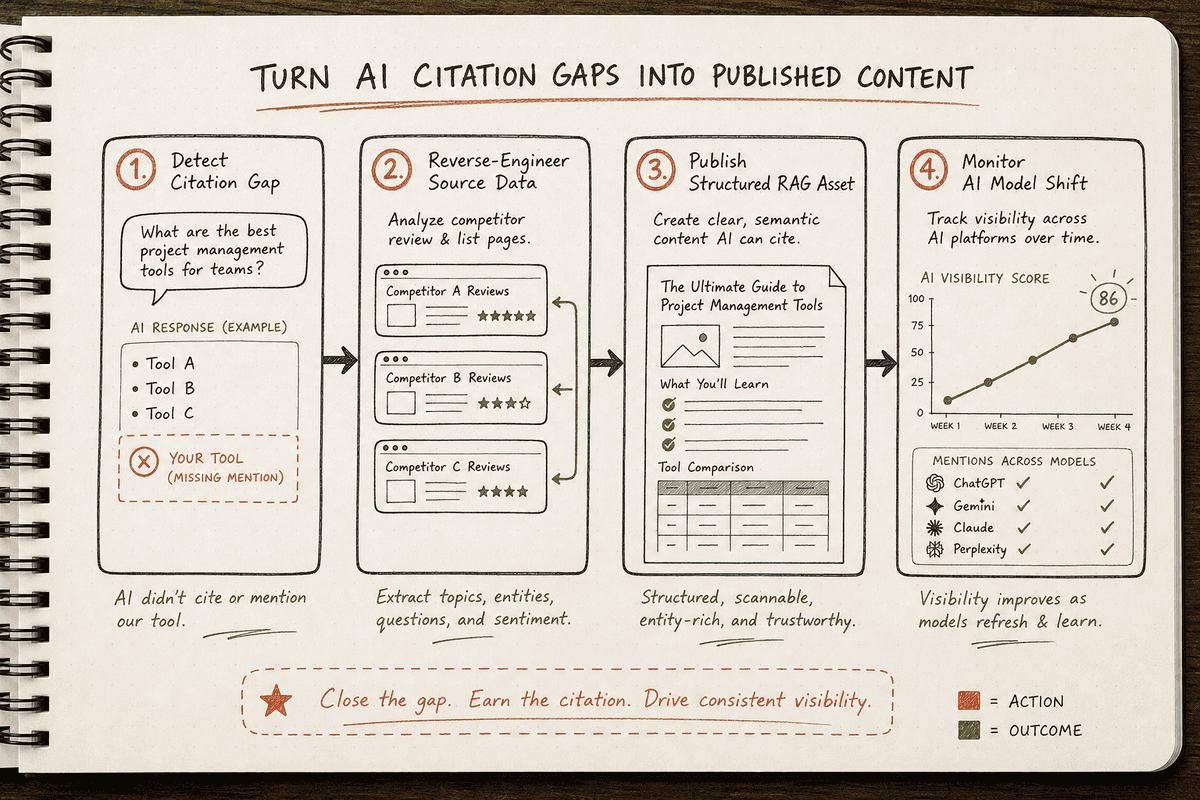
Phase 4: Monitoring the Shift
Wait 7 to 14 days and run the exact same prompt through your monitoring platform. You should see a shift. As the AI ingests your new, highly specific content, it will begin to incorporate your brand entity into its synthesized answers.
The Challenge of Single-Page Applications and AI Crawlers
One of the most overlooked aspects of AI search visibility is technical accessibility. Marketing teams will spend weeks crafting the perfect content to feed an LLM, only to find that the AI still isn't citing their brand.
Often, the problem is technical. Many modern SaaS websites are built as Single-Page Applications (SPAs) using frameworks like React or Angular. While these provide excellent human user experiences, they can be incredibly difficult for AI crawlers (like OpenAI's OAI-Bot or Perplexity's bot) to parse if not configured correctly.
If an AI bot hits your site and only sees a blank HTML shell waiting for JavaScript to execute, it will leave and cite your competitor instead.
If your monitoring tool shows zero visibility despite having great content, you likely have a rendering issue. You must implement server-side rendering (SSR) or dynamic rendering to ensure AI bots get fully formed HTML instantly. (For a deep dive on fixing this, read Implementing SEO in Single Page Applications (3 Ways)).
If the AI cannot read your site, you cannot win in generative search. It is that simple.
The Role of Third-Party Validation in LLM Answers
A critical insight that specialized tracking tools provide is the outsized importance of third-party validation in generative AI.
When you ask ChatGPT for a recommendation, it rarely relies solely on a brand's own website. It cross-references the brand's claims with third-party directories (like G2, Capterra, or Trustpilot), prominent industry blogs, and user forums (like Reddit or Quora).
If you want to know How to Track Your Brand's AI Search Visibility in 2026, you must track your presence not just on your own domain, but across the entire ecosystem the AI trusts.
If your AI monitoring tool shows that you are losing visibility because the AI is citing a "Top 10" listicle on a prominent industry blog that excludes you, your execution task is not to write a blog post on your own site. Your execution task is to run a digital PR campaign to get added to that third-party listicle.
Generative Engine Optimization (GEO) is heavily reliant on digital PR. You must surround the AI with positive signals from domains it already inherently trusts. Keeping up with industry shifts via the 11 Best SEO Blogs Every SaaS Founder Needs (2026) can provide ongoing tactical advice for securing these third-party mentions.
Real-World Scenario: Reclaiming Visibility in Perplexity
To solidify how these platforms are used in practice, consider a realistic scenario for a B2B SaaS company selling remote team collaboration software.
The Trigger: The marketing director logs into their AI tracking platform on a Tuesday morning. The platform alerts them that for the high-intent prompt, "Best collaboration tools for asynchronous remote engineering teams," their Share of Model has plummeted from 60% to 15% in Perplexity.
The Investigation: Using the tool's citation analysis, the director looks at the sources Perplexity is now using to answer the prompt. They discover that a major tech publication just released a massive, highly authoritative guide on "Asynchronous Engineering." The publication heavily featured three competitors, but omitted this company. Perplexity immediately indexed this high-authority guide and adjusted its answers accordingly.
The Execution Workflow: The team cannot force the tech publication to rewrite their article, but they can dilute its impact on the AI by flooding the zone with superior, highly specific information.
- Immediate Content Creation: The team uses their execution platform to spin up a comprehensive guide titled: "The Complete Guide to Asynchronous Collaboration for Remote Engineering Teams." They include specific schema markup, direct Q&A formats that mimic user prompts, and original data on engineering productivity.
- Strategic Distribution: They syndicate parts of this guide to trusted developer forums and secure a guest post on a high-authority engineering blog, pointing back to their new resource.
- Review Generation: They launch a targeted email campaign asking their current engineering clients to leave reviews specifically mentioning "asynchronous workflows" on G2 and Trustpilot.
The Result: Two weeks later, the AI monitoring tool shows the Share of Model climbing back up to 65%. Perplexity's RAG system found the new, highly relevant, heavily corroborated content across multiple trusted sources and adjusted its synthesis to feature the brand prominently again.
This is the difference between a dashboard and an execution strategy.
Common Pitfalls When Implementing AI Search Monitoring
As teams rush to adopt these tools, several predictable failure modes emerge. Avoid these common mistakes when integrating AI search monitoring into your marketing operations.
1. Obsessing Over Vanity Metrics
A 90% Share of Model for your own branded keywords is useless. Of course ChatGPT knows who you are when asked directly. The value of AI monitoring lies in unbranded, problem-aware, and solution-aware prompts. Track the questions your buyers ask before they know your name.
2. Ignoring Prompt Engineering in Tracking
If you set up your monitoring tool to track "marketing software," you will get garbage data. LLM responses are highly sensitive to prompt phrasing. You must track complex, long-tail personas. Track "What marketing software should a B2B agency use if they have a $1000 budget and need native Salesforce integration?" This is how real buyers use AI.
3. Treating AI Bots Like Googlebot
Do not assume that because you rank #1 on Google, you will be the #1 recommendation in ChatGPT. Google ranks based on authority and links. AI synthesizes based on relevance, context, and entity relationships. The optimization strategies are entirely different.
4. Siloing the Data
AI search data cannot live exclusively with the SEO team. The insights generated by these tools—what objections the AI raises, what features the AI highlights, what competitors the AI prefers—are goldmines for the product team, the sales enablement team, and the customer success team.
Frequently Asked Questions
How often should I monitor my brand's AI search visibility?
Unlike traditional SEO, which can take months to fluctuate, AI visibility can change overnight. Every time an LLM undergoes a minor model update, or every time a RAG system crawls a new high-authority source, the synthesized answers can shift. Continuous, daily monitoring for core commercial prompts is highly recommended, with a deep-dive analysis conducted weekly to generate execution tasks.
Are AI search monitoring platforms completely accurate?
Accuracy in AI tracking is a complex concept. Because LLMs operate with a degree of "temperature" (randomness), asking the exact same prompt twice might yield slightly different results. The best tools account for this by running multiple prompt variations and simulating different user contexts to provide an aggregate confidence score, rather than a single binary data point.
How is tracking Perplexity different from tracking ChatGPT?
Perplexity is fundamentally designed as an answer engine heavily reliant on real-time web search (RAG). It cites its sources directly and visibly in every query. ChatGPT, while it has browsing capabilities, relies much more heavily on its internal parametric memory (its training data) for general queries. Tracking Perplexity requires a focus on getting your content indexed quickly and cited by authoritative sources. Tracking ChatGPT requires a longer-term strategy of building broad brand entity association across the web over time.
Does AI search monitoring replace traditional SEO rank tracking?
Not entirely. While generative search is rapidly claiming market share for informational and complex research queries, traditional search still drives massive volume for navigational and highly transactional queries. The most sophisticated marketing teams run a hybrid approach, using tools that integrate both datasets to provide a complete picture of the digital buyer's journey.
The Shift to Execution
The era of merely tracking digital presence is over. Identifying that you have an AI visibility problem is no longer a competitive advantage; it is the absolute bare minimum baseline for survival in a generative search landscape.
Enterprise dashboards and complex metrics look great in quarterly reports, but they do not influence Large Language Models. LLMs are influenced by specific, highly relevant, expertly structured, and widely validated content.
The marketing teams that will dominate their niches over the next three years are the ones that reject passive observation. They will adopt platforms that combine rigorous, multi-model AI search monitoring with immediate, frictionless execution workflows. They will track ChatGPT, Gemini, and Perplexity across complex buyer prompts, identify exactly why they are losing, and turn those visibility gaps into published, undeniable proof that the AI cannot ignore.