
When searching for AI search tools with source citation analysis, buyers usually hit an immediate wall of confusion. Search queries for citation tools lump two completely different software categories together:
- Research and Discovery Tools: AI assistants built for academics, analysts, and students to search documents, evaluate scientific claims, and verify text using traceable inline citations (such as Scite.ai, Atlas, and Sourcely).
- AI Search Visibility and Citation Analytics Platforms: Intelligence platforms built for B2B marketers, SaaS founders, and growth agencies to monitor which sources major AI search engines (like ChatGPT, Gemini, Perplexity, and Google AI Overviews) cite across buyer queries (such as BeVisible and Profound).
While early pioneers like Profound brought enterprise awareness to AI search share-of-voice, modern marketing and growth teams frequently hit its limitations. Tracking high-level brand metrics is useless if you cannot identify exact cited domain URLs or turn those visibility gaps into published work.
This comprehensive guide breaks down the best AI search tools with source citation analysis across both categories, highlights why teams are looking beyond Profound, and demonstrates how to turn citation intelligence into defensible organic growth.
Understanding Source Citation Analysis in AI Search
Before evaluating individual platforms, it helps to understand how modern generative engines select and display citations. Unlike traditional search engines that display ten organic blue links ranked by PageRank and keyword matching, AI search engines run complex Retrieval-Augmented Generation (RAG) pipelines.
 When a potential buyer asks an AI assistant a question, the engine executes several distinct steps:
- Prompt Parsing & Intent Extraction: The LLM rewrites the user query into multiple sub-queries.
- Retrieval & Index Search: The assistant searches its index or live web search APIs for high-density informational content.
- Source Selection & Filtering: The algorithm filters potential sources based on recency, topical depth, entity clarity, and third-party authority.
- Synthesis & Citation Generation: The engine drafts its synthesized response, injecting explicit footnotes or inline hyperlinked citations directly attached to specific claims or brand recommendations.
If your content is missing from the underlying retrieval pool, or if your competitors are cited as the primary authority across third-party review sites, your brand remains invisible in AI responses. Citation analysis tools allow you to diagnose why an AI assistant recommended a competitor, which specific blog post or documentation page it cited, and what sources you must create or optimize to win that citation.
Category 1: AI Search Visibility & Brand Citation Platforms (Beyond Profound)
For marketing directors, SaaS founders, and growth teams, citation analysis is not about verifying a term paper. It is about revenue, brand share-of-voice, and buyer acquisition. Here are the leading platforms tracking AI citations across commercial prompts.
1. BeVisible
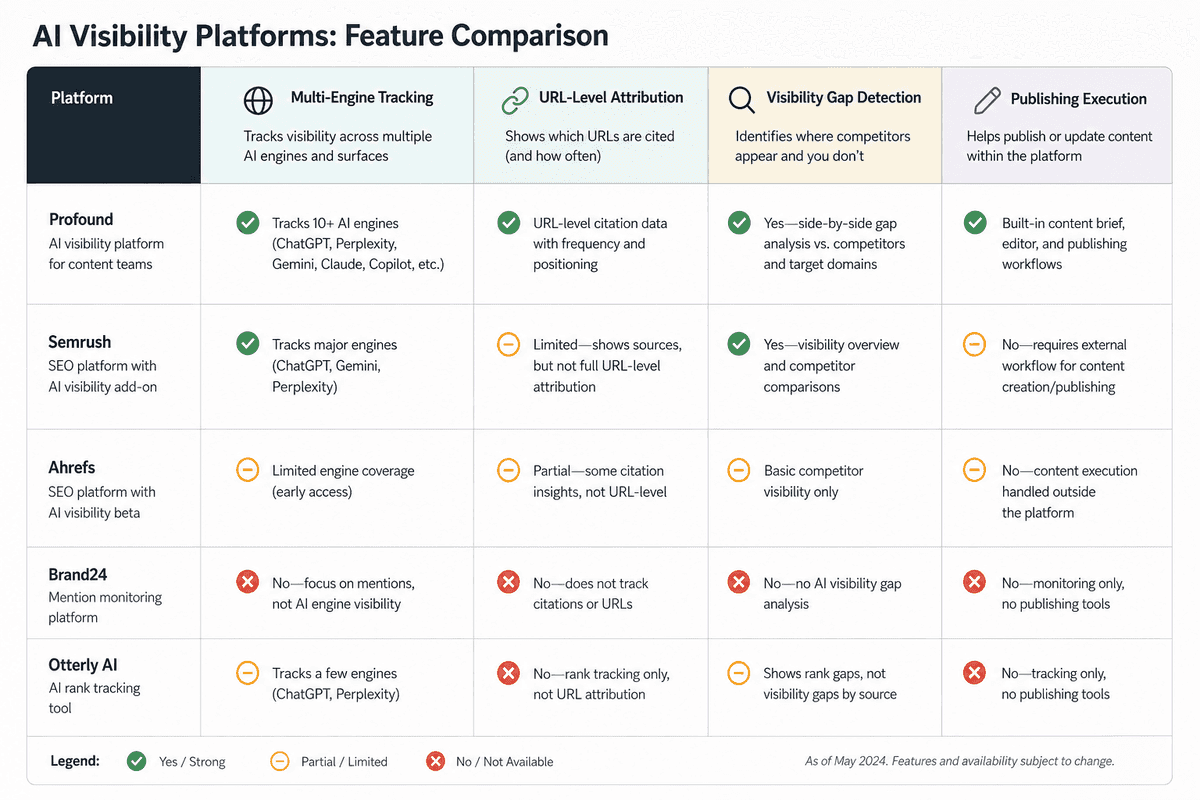
BeVisible is a modern AI search visibility and execution platform built for B2B growth teams, SaaS founders, and agencies. While legacy trackers focus purely on reporting static share-of-voice percentages, BeVisible bridges the gap between AI citation tracking and active publishing execution.
Key Features & Citation Analysis Capabilities
- Multi-Engine Citation Tracking: Monitors buyer prompts simultaneously across ChatGPT, Google Gemini, Perplexity, Google AI Overviews, and AI Mode.
- Granular Source Attribution: Identifies exact URL-level citations, mapping whether AI engines cite your owned domain, competitor blogs, industry publications, or community threads on Reddit, G2, or Quora.
- Visibility Gap Detection: Pinpoints high-value buyer prompts where your brand is absent while competitors capture the primary citation nodes.
- Evidence-Backed Publishing Engine: Automatically converts identified citation gaps into structured editorial briefs, articles, landing page updates, and publishing workflows directly within your content calendar.
Why Choose BeVisible Beyond Profound?
Profound provides macro-level enterprise metrics, but growth teams often find themselves stranded after looking at a dashboard of missing citations. BeVisible provides exact citation domain breakdowns and gives you the tools to create, review, schedule, and publish the specific content required to capture those cited positions.
For SaaS founders exploring strategic growth reading, combining citation monitoring with trusted guides from our list of 11 Best SEO Blogs Every SaaS Founder Needs provides a clear blueprint for content authority.
2. Profound
Profound was one of the early software platforms built specifically for enterprise AI search monitoring. It focuses primarily on enterprise brand tracking, prompt tracking, and share-of-voice reporting.
Key Features & Citation Capabilities
- Enterprise Share-of-Voice Tracking: Tracks brand mentions across major LLMs over time.
- Prompt Sentiment Analysis: Measures whether AI responses present your brand in a positive, neutral, or negative context.
- Competitive Benchmarking: Displays macro-level charts comparing your brand's presence against enterprise competitors.
Potential Limitations
- High Cost Barrier: Enterprise pricing models often place Profound out of reach for seed-to-Series-B SaaS startups and mid-market growth agencies.
- Lack of Direct Content Execution: Identifies citation metrics but offers no integrated workflow to publish or update content to fix those gaps.
- Static Reporting Focus: Operates more like a traditional enterprise reporting dashboard rather than an action-driven SEO workflow platform.
3. Peec AI
Peec AI is an analytics tool designed to help digital marketers monitor brand mentions and citation frequencies across emerging conversational AI engines.
Key Features & Citation Capabilities
- Conversational AI Monitoring: Tracks prompt outputs across ChatGPT and Claude.
- Citation Domain Aggregation: Lists top domain names appearing in response context windows.
- Simple Dashboarding: Offers clean, accessible chart displays for non-technical marketing teams.
Best For
Small teams that require basic, high-level brand tracking without deep URL-level attribution or automated content generation.
Category 2: Research & Discovery Citation Tools (For Verification & Scholars)
If your goal is verifying document accuracy, writing academic literature reviews, or grounding custom datasets in verifiable citations, the following discovery tools excel at sentence-level source attribution.
1. Scite.ai
Scite.ai stands out in academic and scientific research through its proprietary Smart Citations technology. Instead of treating all citations equally, Scite analyzes the context of every citation across millions of scientific publications.
Key Capabilities
- Smart Citation Classifications: Categorizes citations by whether subsequent research supports, mentions, or contrasts the original claim.
- Contextual Passage Extraction: Displays the exact paragraph from citing articles, showing how subsequent authors evaluated the research.
- Literature Visualizer: Builds visual graphs connecting research papers based on citation agreement and disagreement.
Best For
Biotech researchers, academics, medical writers, and technical analysts requiring rigorous peer-review citation validation.
2. Atlas
Atlas is a source-grounded research workspace designed for analysts, legal teams, and knowledge workers who need to analyze proprietary document libraries with absolute factual precision.
Key Capabilities
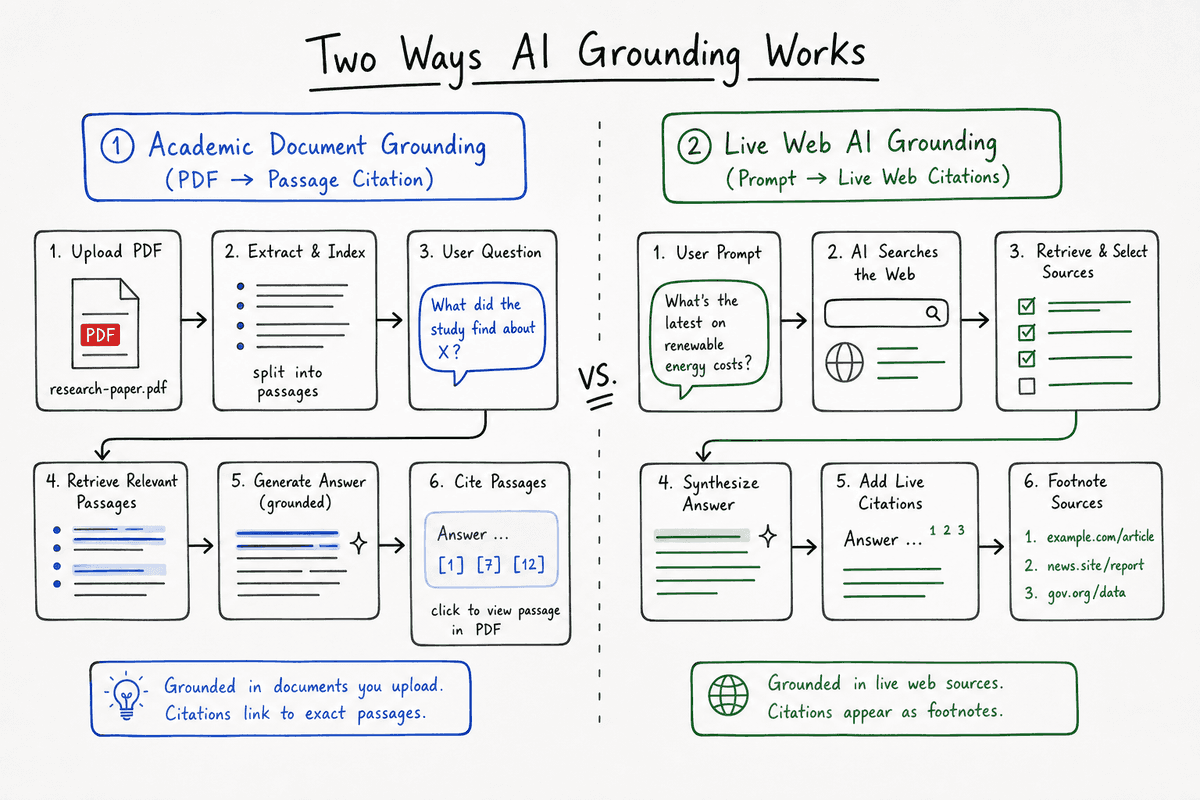
- Private Workspace Grounding: Synthesizes answers exclusively from uploaded PDFs, technical spec sheets, meeting notes, and research papers.
- Passage-Level Citation Mapping: Hyperlinks every generated sentence back to the exact line and page in your original source document.
- Zero Hallucination Guardrails: Prevents the underlying LLM from making external web claims outside your uploaded repository.
Best For
Legal teams, financial analysts, and corporate research departments conducting internal document reviews.
3. Sourcely
Sourcely is a research assistant built specifically to streamline academic literature reviews, essay citations, and source matching.
Key Capabilities
- Text-to-Citation Matching: Analyzes pasted text or thesis statements and queries a database of over 200 million academic papers to find matching sources.
- Automatic Bibliography Generation: Formats citations automatically into APA, MLA, Chicago, Harvard, and hundreds of custom journal styles.
- Abstract Summarization: Provides concise source summaries with direct DOI links.
Best For
Students, university researchers, and academic writers building structured bibliographies quickly.
4. Perplexity Pro
Perplexity Pro functions as an AI-native search engine that replaces traditional web search with grounded, conversational answer summaries.
Key Capabilities
- Live Web Citation Footnotes: Every statement in Perplexity's synthesized answer includes explicit, numbered inline citations linking to live web pages.
- Pro Search Deep Research: Executes multi-step web searches, querying multiple databases and cross-referencing information before presenting a final answer.
- Source Filtering: Allows users to restrict search domains to Academic papers, YouTube transcripts, Reddit discussions, or the open web.
Best For
Daily web research, competitive intelligence gathering, and quick fact verification.
Evaluation Criteria: What Makes a Great Citation Analysis Tool?
When selecting an AI search citation analysis tool beyond Profound, keep these core technical capabilities in mind:
When evaluating platforms for marketing performance, ensure the software does not rely solely on simple domain-level reporting. Knowing that your domain was cited is helpful; knowing that a specific long-form comparison post captured the citation on a high-intent buyer query gives you an actionable blueprint. If you are building dedicated landing pages to capture those citation nodes, our guide on How to Build an SEO Landing Page details the exact layout patterns search algorithms favor.
How to Conduct an AI Source Citation Audit (Step-by-Step)
To systematically improve your brand's presence across AI search assistants, run this five-step citation audit framework.
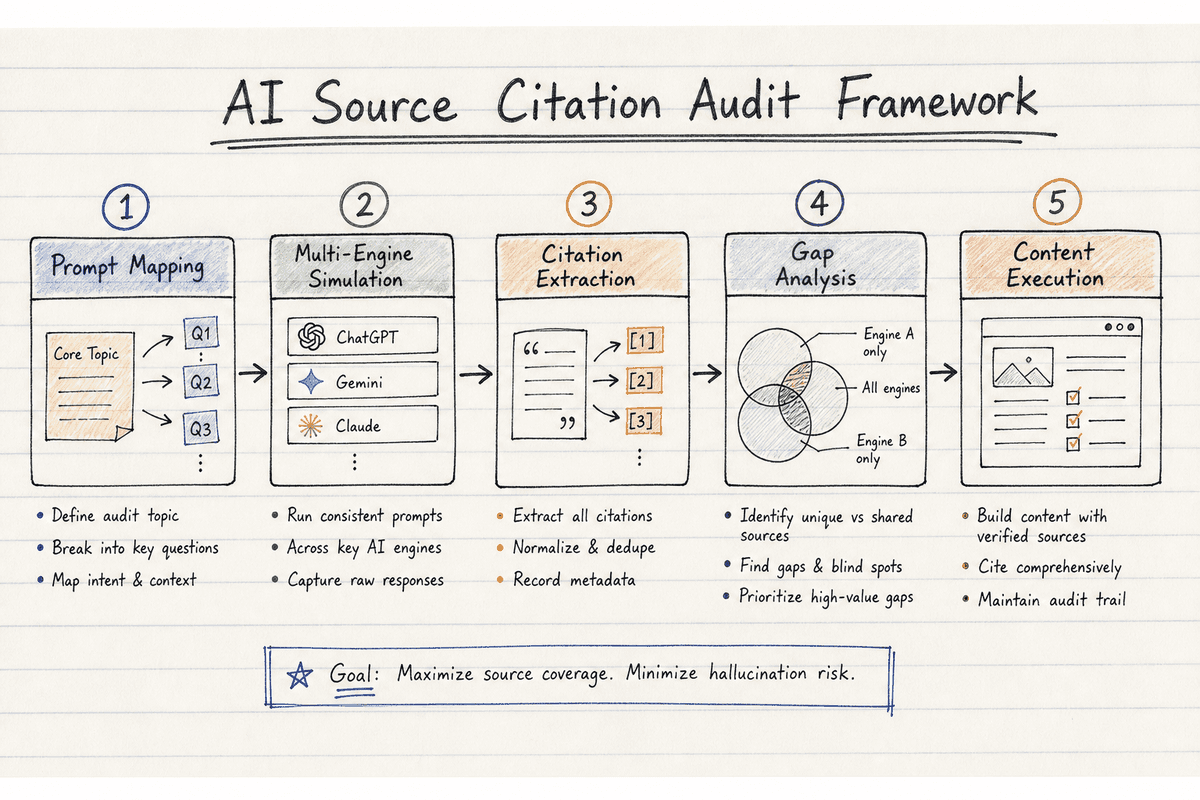
Step 1: Define High-Intent Buyer Prompts
Identify 20 to 50 prompts that your ideal buyers ask when researching solutions. Avoid simple head keywords. Instead, focus on natural language buyer questions:
- "What are the top enterprise alternatives to [Competitor]?"
- "Which software tool offers the best source citation analysis for AI search?"
- "How do growth teams track ChatGPT mentions in 2026?"
Step 2: Track Prompts Across Multiple AI Engines
Run your prompt set across ChatGPT, Google Gemini, Perplexity, and Google AI Overviews. Because LLM outputs fluctuate based on temperature and search context, run prompt simulations multiple times to capture average output consistency.
Step 3: Extract and Categorize Cited Source URLs
Record every domain and full URL cited in the answers. Group citations into clear content types:
- Owned Media: Your official website, documentation, or engineering blog.
- Competitor Owned Media: Direct competitor landing pages or comparison hubs.
- Third-Party Review Sites: G2, Capterra, Trustpilot, or Software Advice.
- Community & UGC Platforms: Reddit threads, Quora answers, Stack Overflow, or personal Medium blogs.
- Industry Editorial Outlets: TechCrunch, Forbes, specialized trade publications.
Step 4: Map Your Citation Gap Matrix
Identify prompts where competitors or third-party publications are cited while your brand is completely missing. Analyze why the LLM selected those specific URLs. Are those pages providing structured comparison tables? Do they feature clear schema markup? Are they frequently discussed on Reddit?
Step 5: Execute Targeted Content & Publishing Workflows
Close the gap. If an AI engine repeatedly cites a Reddit thread discussing software alternatives, participate authentically in that community. If Perplexity constantly cites a competitor's detailed feature comparison post, publish a superior, highly structured comparison page on your own site and distribute it.
3 Common Myths About AI Citations and GEO
As Generative Engine Optimization (GEO) matures, several persistent misconceptions mislead marketing teams.
Myth 1: High Traditional Google Rankings Automatically Guarantee AI Citations
Many marketers assume that ranking high on traditional Google SERPs guarantees inclusion in ChatGPT or Gemini responses. In reality, RAG pipelines prioritize informational density, direct entity definitions, and consensus across multiple sources. An unranked niche blog post with clear technical structure often gets cited over a top-ranked, generic SEO post.
Myth 2: AI Search Engines Only Cite Homepage Domains
Over 85% of citations generated by Perplexity and Google AI Overviews point to deep, granular content nodes: specific product documentation pages, comprehensive comparison guides, and specialized technical articles. Optimizing your homepage alone will not win prompt-level citations.
Myth 3: Enterprise Citation Tracking Requires High-Five-Figure Contracts
Early tools like Profound positioned AI citation tracking as a complex enterprise-only metric requiring massive annual commitments. Modern platforms like BeVisible democratize source citation analysis, offering accessible, actionable tracking combined with direct content creation workflows.
Frequently Asked Questions
What is AI search source citation analysis?
AI search source citation analysis is the process of tracking, evaluating, and mapping the web pages, articles, and databases that artificial intelligence models cite when generating answers to user prompts. Marketers use it to measure brand visibility, while researchers use it to verify factual accuracy.
How do AI engines like ChatGPT and Perplexity decide which sources to cite?
AI search engines rely on Retrieval-Augmented Generation (RAG). They convert user prompts into search queries, retrieve relevant documents, evaluate page structure, authority, and freshness, and then summarize the findings while appending inline citations to the selected URLs.
Why look beyond Profound for AI search visibility tracking?
While Profound offers enterprise share-of-voice reporting, growth teams often require deeper URL-level attribution, affordable pricing, and integrated content execution workflows that convert citation gaps directly into published articles and landing pages.
How does technical site architecture affect AI citation crawling?
If your website relies heavily on client-side rendering without proper server-side rendering or pre-rendering, search bots and AI crawlers may fail to parse your content correctly. Reviewing our technical guide on SEO for Single Page Applications ensures your technical architecture allows AI crawlers to discover and cite your pages effortlessly.
Elevate Your AI Search Visibility with BeVisible
Understanding which sources AI search engines cite is only half the battle. Real organic growth happens when you turn those citation insights into evidence-backed, high-performing content that secures your brand's presence across every major AI assistant.
With BeVisible, you can track buyer prompts across ChatGPT, Gemini, Perplexity, and AI Overviews, uncover your hidden citation gaps, and seamlessly publish content designed to win recommendations.
Ready to capture your share of AI search visibility? Explore BeVisible today and turn missing mentions into your unfair growth advantage.