
Agency client meetings look drastically different than they did two years ago. Clients are no longer satisfied seeing their primary keyword in position three on standard desktop search results. Instead, their marketing executives paste screenshots from ChatGPT or Perplexity asking why their flagship product was excluded from an AI-generated shortlist of top solutions, or why a competitor with lower domain authority is repeatedly recommended as the market leader.
Standard rank trackers cannot answer these questions. They monitor static search engine results pages, capture deterministic blue links, and parse traditional SERP features. Generative search engines operate on an entirely different mechanism. When a prospective buyer enters a complex query into an AI assistant, the model synthesizes answers from semantic vector databases, retrieves live web citations through dynamic search sub-queries, and generates personalized responses on the fly.
Profound emerged as an early enterprise name in this space, building brand recognition around AI crawler telemetry and large-scale prompt indexing. However, many agencies managing multiple client retainers quickly hit friction points with Profound: enterprise-level contract minimums, opaque data workflows, and a heavy bias toward passive monitoring rather than actionable, execution-focused remediation.
Agencies require specialized platforms built for multi-tenant account management, repeatable client reporting, prospecting audits, and closed-loop workflows that turn missing brand mentions into published assets. This guide analyzes the technical demands of generative search tracking for agencies and reviews the best tools available beyond Profound.
Why Traditional Rank Tracking Fails in Generative Search
Tracking generative engines like ChatGPT Search, Perplexity, Google AI Overviews, Gemini, and Claude requires abandoning several assumptions embedded in traditional SEO software.
Traditional SERP Tracking          Generative Engine Tracking
┌───────────────────────┐          ┌───────────────────────────┐
│ Fixed Keyword List    │          │ Multi-Intent Buyer Prompts│
│ Deterministic Ranking │          │ Synthetic AI Answers      │
│ Universal URL Results │   ───►   │ Dynamic Inline Citations  │
│ Position 1 to 10      │          │ Brand Mention Sentiment   │
│ Static SERP Scraping  │          │ Engine Recommendation Rate│
└───────────────────────┘          └───────────────────────────┘
Traditional SEO tools send automated requests to Google search endpoints, parse the returned HTML, and assign a numerical rank based on the position of a specific URL. This works because standard search results are largely uniform for a given geographic region and device type.
Generative search disrupts this paradigm in four distinct ways:
- Non-Deterministic Outputs: LLMs generate responses token by token. Even when temperatures are set low, identical prompts can yield subtle variations in sentence structure, cited sources, and brand ordering depending on the prompt framing and retrieval freshness.
- The Separation of Citations and Recommendations: In traditional search, appearing on page one guarantees an impression. In an AI-generated response, an engine might cite a client's website in a footnote reference while explicitly recommending two competitor brands in the narrative body text. Tracking tools must distinguish between being referenced as a source and being endorsed as a solution.
- Dynamic Sub-Query Generation: When a user enters a complex buyer prompt like "Compare the top three warehouse management systems for Shopify Plus brands doing over $10M in revenue," the engine may execute three or four invisible background search queries across web indices before compiling the answer. Tracking requires understanding which third-party review sites, industry blogs, and documentation pages informed that synthesis.
- Sentiment and Contextual Framing: Being mentioned in an AI answer is not automatically positive. An AI model might mention a software platform while highlighting known integration bugs, pricing complaints, or customer support limitations extracted from public forum discussions. Agencies must track sentiment polarity and attribute extraction, not just raw visibility.
 Tracking AI visibility requires simulating real browser-level buyer interactions, running structured prompt variations, evaluating entity extraction, and analyzing citation graphs across multiple LLM providers simultaneously.
What Makes an AI Search Tracking Tool Agency-Grade?
Software built for in-house enterprise teams rarely aligns with the day-to-day operations of an agency. When evaluating tools to replace or supplement Profound across an agency roster, several operational criteria determine whether a platform scales or creates administrative overhead.
Multi-Tenant Architecture and Client Segregation
Agencies cannot afford shared workspaces where client data, prompt sets, and competitor lists cross-contaminate. An agency-grade tool requires isolated client workspaces, role-based access control, and the ability to invite client stakeholders into dedicated, read-only portals without exposing agency-wide account settings or other client projects.
Pitch Modes and Prospective Audits
Winning new retainers requires demonstrating clear visibility deficits before signing a contract. The best agency tools offer prospective audit features: the ability to run on-demand visibility scans on a prospect's domain against their top three competitors across dozens of industry-specific prompts. Presenting a prospective client with concrete proof that ChatGPT recommends their chief rival across 70% of high-intent buyer queries provides an undeniable sales narrative.
Multi-Engine and Multi-Model Coverage
Google AI Overviews represent only one slice of modern AI discovery. Buyers looking for enterprise software, legal services, agencies, and high-consideration consumer goods increasingly rely on ChatGPT Search, Perplexity, Gemini, and Claude. A tool that only scrapes Google AI Overviews misses the fast-growing conversational discovery channels where purchasing decisions originate.
Source Attribution and Citation Provenance
Knowing that a client is omitted from an answer is only the first step. To fix the issue, an agency must know why the model selected competitor pages. The tool must map every cited URL, categorizing whether citations stem from direct brand websites, third-party review platforms (G2, Capterra, Trustpilot), editorial listicles, Reddit discussions, or niche trade publications. This citation provenance provides the blueprint for agency PR and content strategies.
The Execution Loop: From Insights to Published Content
Passive dashboards that display declining share of voice without providing a remediation path create client anxiety without offering a solution. Leading agencies favor platforms that bridge monitoring with execution. When a platform flags a critical prompt cluster where a client is missing, it should assist the agency in scoping, outlining, and producing the specific content required to capture that citation footprint.
Comprehensive Comparison of Leading Agency AI Search Tracking Tools
The following platforms represent the leading software options for agencies managing generative engine visibility, answering different operational needs across data depth, client reporting, and workflow execution.
Detailed Tool Breakdowns: Beyond Profound
1. BeVisible: AI Visibility Monitoring and Full Execution
Website: https://bevisible.app
BeVisible is built specifically for SaaS marketing teams, B2B growth units, and agencies that need to move directly from visibility measurement to tangible client deliverables. While legacy tools treat tracking as a passive analytics exercise, BeVisible is designed around an active execution model: monitoring how AI assistants answer buyer questions, identifying which brands they recommend, and turning those intelligence gaps into evidence-backed content work.
┌─────────────────────────────────────────────────────────────┐
│                     BeVisible Engine                         │
└──────────────────────────────┬──────────────────────────────┘
                               │
       ┌───────────────────────┼───────────────────────┐
       ▼                       ▼                       ▼
┌──────────────┐       ┌──────────────┐        ┌──────────────┐
│ Prompt Track │       │ Source Graph │        │ Execution Hub│
│ ChatGPT      │       │ Citations    │        │ Gap Scoping  │
│ Gemini       │  ──►  │ Sentiment    │  ───►  │ Draft Gen    │
│ Perplexity   │       │ Competitor   │        │ Review Flow  │
│ AI Overviews │       │ Mentions     │        │ Publishing   │
└──────────────┘       └──────────────┘        └──────────────┘
Core Capabilities for Agencies
- Cross-Engine Buyer Prompt Tracking: BeVisible continuously monitors ChatGPT, Gemini, Perplexity, AI Mode, and Google AI Overviews across custom matrices of real-world buyer prompts, measuring exact brand mention rates, recommendation sentiment, and footnote citations.
- Evidence-Backed Opportunity Detection: Rather than providing raw, unstructured text exports, BeVisible isolates the precise citations and structural patterns AI engines use to answer category-specific queries, highlighting the exact third-party sites and content structures responsible for competitor wins.
- Closed-Loop Workflow from Gap to Published Asset: When BeVisible discovers a prompt cluster where a client is omitted, it converts that data into an actionable content opportunity. Agency teams can move seamlessly from monitoring to scoping, drafting, internal reviewing, scheduling, and publishing targeted content designed to secure AI citations.
- Multi-Brand Client Management: Agencies can organize multiple client accounts into distinct workspaces, allowing account managers to run comparative visibility benchmarks and present clients with clear progress reports showing month-over-month increases in AI recommendation share.
Best Fit
Agencies that want a platform capable of handling both monitoring and client fulfillment, eliminating the friction between identifying a missing mention and publishing the content needed to capture it.
2. ZipTie.dev: Deep Technical Google AI Overview Diagnostics
ZipTie.dev focuses on granular analysis of Google AI Overviews and generative search features. Built by technical SEO practitioners, the platform approaches generative tracking through a diagnostic lens, rendering search results via real browser automation rather than backend API requests.
┌──────────────────────────────────────────────────────────┐
│                   ZipTie Diagnostics                     │
└────────────────────────────┬─────────────────────────────┘
                             │
     ┌───────────────────────┴───────────────────────┐
     ▼                                               ▼
┌──────────────────────────┐   ┌───────────────────────────┐
│ Browser Simulation       │   │ Page-Level Diagnostics    │
│ Real User Render         │   │ Structural Content Audits │
│ AIO Trigger Verification │   │ Schema & Entity Analysis  │
└──────────────────────────┘   └───────────────────────────┘
Core Capabilities for Agencies
- Browser-Level Simulation: ZipTie renders search queries using headless browser technology that matches actual consumer screen rendering. This ensures that dynamic client-side JavaScript rendering and dynamic UI components are evaluated accurately.
- Pixel-Level Attribution: The tool measures the exact visual layout of Google AI Overviews, tracking whether a client’s link appears above the fold in the primary carousel, within a collapsible drop-down card, or as an inline text link.
- Page-Level Optimization Suggestions: ZipTie evaluates the specific structural elements of cited pages (e.g., table formats, list schema, concise definition paragraphs) to help agencies optimize existing client landing pages for AI citation capture.
Best Fit
Technical SEO agencies that specialize in enterprise Google AI Overview optimization and require page-level structural diagnostics to adjust technical markup and on-page HTML architecture.
3. Otterly.ai: Streamlined Multi-Engine Dashboards and Client Reporting
Otterly.ai provides an accessible, visually intuitive interface designed for agencies that want fast setup, multi-model monitoring, and clean client-facing reporting without complex enterprise onboarding cycles.
┌──────────────────────────────────────────────────────────┐
│                   Otterly.ai Monitoring                  │
└────────────────────────────┬─────────────────────────────┘
                             │
     ┌───────────────────────┴───────────────────────┐
     ▼                                               ▼
┌──────────────────────────┐   ┌───────────────────────────┐
│ Multi-Model Monitoring   │   │ Automated Reporting       │
│ ChatGPT, Gemini, Perplex │   │ Looker Studio Connector   │
│ Share of Voice Tracking  │   │ Client-Ready PDF Exports  │
└──────────────────────────┘   └───────────────────────────┘
Core Capabilities for Agencies
- Broad Model Coverage: Tracks brand mentions, sentiment, and cited URLs across ChatGPT, Google AI Overviews, Perplexity, and Gemini simultaneously.
- Looker Studio and BI Integration: Otterly provides prebuilt connectors for Google Looker Studio, enabling agencies to combine generative search metrics with traditional Google Analytics 4 and Google Search Console performance data in unified client dashboards.
- Competitor Share of Voice Graphs: Visualizes competitor mention share across target categories, giving account managers clear chart assets for monthly retainer presentations.
Best Fit
Mid-market digital marketing agencies that need reliable multi-engine monitoring and white-label reporting integrations to plug directly into their existing client reporting pipelines.
4. Semrush (AI Overview Tracking Suite): Traditional Scale
For agencies already managing client campaigns inside the Semrush ecosystem, Semrush has integrated AI Overview tracking into its existing Position Tracking and Sensor toolsets.
Core Capabilities for Agencies
- Massive Keyword Database Integration: Leverages Semrush’s existing database to identify which tracked keywords trigger AI Overviews across thousands of client campaigns automatically.
- Unified Keyword and AIO Reporting: Allows agencies to view standard organic rankings alongside AI Overview inclusion in a single dashboard, showing whether an organic drop coincided with the introduction of an AI Overview.
- Familiar Agency Workspaces: Fits directly into existing Semrush agency growth kit workflows, client portals, and automated PDF delivery schedules.
Best Fit
Large agencies managing high-volume traditional SEO retainers that want high-level Google AI Overview tracking without adding a completely separate software subscription.
5. SE Ranking (AI Visibility Tracker): Cost-Effective Multi-Client Expansion
SE Ranking offers an accessible AI visibility monitoring suite designed to help boutique agencies expand their traditional SEO services into generative search optimization without incurring enterprise software overhead.
Core Capabilities for Agencies
- Integrated Workspace Architecture: Manages multiple client projects within a structured interface with flexible user permission settings.
- ChatGPT and AIO Prompt Monitoring: Allows users to track target prompt matrices and monitor when and how their clients appear in generative answers.
- Budget-Friendly Pricing: Structured for growing agencies that need predictable SaaS pricing without long-term annual contract commitments.
Best Fit
Boutique agencies, freelancers, and small digital marketing teams transitioning their service catalog from standard rank tracking to generative engine optimization.
The Profound Dilemma: Enterprise Telemetry vs Agency Execution
Profound made significant strides in raising awareness around enterprise AI search monitoring. It built a reputation for tracking AI bot crawler activity and monitoring broad prompt indexes for enterprise corporations. However, many agency executives face distinct practical challenges when deploying Profound across a diverse client roster:
- Enterprise Pricing Minimums: Profound is primarily architected and priced for Fortune 500 in-house teams. When an agency needs to onboard 15 to 40 SMB or mid-market clients, enterprise pricing tiers quickly make agency margins unsustainable.
- Telemetry Without Content Workflows: Knowing an AI crawler indexed your domain or that a prompt mention dropped by 4% is only useful if the agency has a concrete mechanism to produce the exact editorial or technical assets that reverse that decline. Platforms focused exclusively on passive telemetry leave the entire execution burden disconnected from the data.
- Complex Multi-Tenancy: Enterprise software is generally built around a single enterprise organization rather than the multi-account, fast-switching workflows required by account managers running multiple brands in parallel.
For agencies looking to provide strategic value, tracking tools must bridge the gap between data collection and retainer execution.
Agency Playbook: Monetizing AI Search Tracking as a Retainer Service
Adding generative engine optimization (GEO) to your agency service catalog requires more than sending clients a monthly PDF of prompt rankings. Successful agencies package AI search tracking into a structured, four-phase recurring retainer.
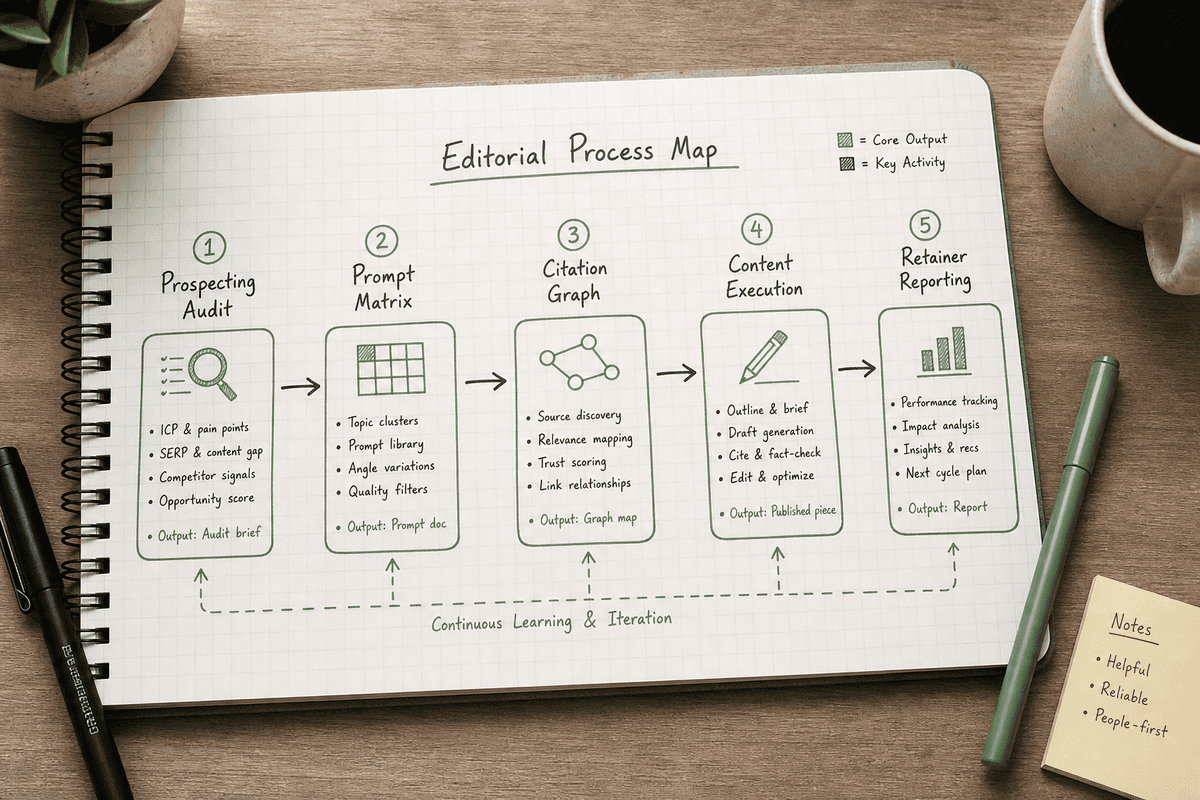
┌─────────────────────────────────────────────────────────────┐
│                 Agency GEO Retainer Pipeline                │
└──────────────────────────────┬──────────────────────────────┘
                               │
 ┌───────────────┬─────────────┴─┬───────────────┬──────────┐
 │               │               │               │          │
 ▼               ▼               ▼               ▼          ▼
Phase 1         Phase 2         Phase 3         Phase 4    Phase 5
Audit & Pitch   Prompt Matrix   Citation Graph  Execution  Reporting
Scan Visibility Build 100+      Map G2, Reddit, Publish    Track SoV
Vs Competitors  Buyer Prompts   Blogs, Reviews  Citations  & Sentiment
Phase 1: The Prospecting Audit (Closing New Retainers)
Before onboarding a client, use your AI tracking software to run a competitive baseline audit. Identify 30 high-intent purchasing prompts in the prospect’s vertical. Run them across ChatGPT, Gemini, and Perplexity.
Document every instance where competitors are recommended while the prospect is omitted. Present this data during the sales pitch:
- Share of AI Voice: The percentage of commercial prompts where the prospect is visible compared to their top three rivals.
- Citation Dependency: The specific third-party pages (e.g., industry comparison sites, software directories, media reviews) that AI engines cite when recommending competitors.
- Revenue at Risk: The commercial value of high-intent queries that are completely bypassing the prospect’s domain.
Showing a CMO that their brand is invisible on conversational search interfaces creates an immediate mandate for your agency's services. If you are structuring new service packages, review our breakdown of agency service rates and automation models to price your generative optimization retainers competitively.
Phase 2: Building the Buyer Prompt Matrix
Unlike traditional keyword research, which focuses on two-to-four-word search strings, AI tracking requires constructing detailed prompt matrices that reflect how human buyers converse with generative assistants.
Organize prompt sets into four distinct intent layers:
- Category Definition & Discovery:
- "What are the best enterprise alternatives to [Legacy Competitor] for mid-sized teams?"
- "Who are the top SOC-2 compliant vendors for automated vendor risk management?"
- Direct Product Comparisons:
- "Compare [Client Brand] vs [Competitor A] for high-volume B2B commerce."
- "What are the primary pros and cons of using [Client Brand] according to user reviews?"
- Feature & Integration Queries:
- "Which billing platforms support native multi-entity consolidation in NetSuite?"
- "Top-rated headless CMS platforms with built-in localization for European markets."
- Pricing and Value Inquiries:
- "How much does enterprise implementation cost for [Client Brand] compared to industry averages?"
- "Is [Client Brand] worth the price for an early-stage startup?"
Phase 3: Mapping the Citation Graph and Digital PR Ecosystem
When an AI model synthesizes an answer, it relies on a web of authoritative sources. Track every citation generated across your prompt matrix and categorize them into actionable buckets:
- Third-Party Review Directories: G2, Capterra, TrustRadius, Gartner Peer Insights.
- Community Discussions: Reddit threads, Quora answers, specialized developer forums.
- Editorial Roundups and Media Reviews: Digital trade magazines, niche blogs, authoritative industry publications.
- Direct Domain Documentation: Case studies, technical documentation, whitepapers, pricing pages.
If an AI assistant repeatedly cites a specific round-up article on an industry blog when recommending a competitor, your agency’s action item is clear: conduct targeted outreach to secure inclusion or update that publication’s comparison data. For broader reading on how digital marketing workflows are evolving, explore our list of the best SEO blogs for marketing teams.
Phase 4: Tactical Execution and Citation Engineering
Once citation gaps are isolated, the agency must produce the exact content assets required to capture inclusion. This involves two parallel initiatives:
- On-Domain Content Optimization: Create structured, entity-dense landing pages that provide unambiguous answers to commercial prompts. Use clear comparison tables, concise definitions, and verifiable data points that AI scrapers can parse easily. If you are designing focused conversion pages for search engines, follow our guide on how to build an SEO landing page.
- Off-Domain Authority Building: Seed high-authority community discussions and secure digital PR placements on the specific domains the LLM's retrieval-augmented generation (RAG) system uses as reference anchors.
Phase 5: Monthly Reporting and Retainer Defense
Presenting traditional organic traffic charts does not demonstrate GEO success. Your monthly client reporting deck should focus on four distinct generative metrics:
- AI Share of Voice (SoV): The percentage of target prompts that mention or recommend the client across ChatGPT, Perplexity, Gemini, and Google AI Overviews.
- Citation Growth Rate: The number of unique URLs from the client's domain cited across monitored prompt matrices.
- Sentiment Polarity Score: The proportion of positive vs neutral or critical statements generated about the client in conversational answers.
- Competitor Displacement: Specific high-value prompts where the client successfully displaced a competitor in primary recommendation lists.
Scenario: How an Agency Recovered Lost AI Visibility for a B2B SaaS Client
To understand how tracking translates into revenue-generating client work, consider a mid-sized B2B fintech company offering automated accounts payable software.
The Problem
The client had maintained strong organic rankings for standard keywords like "accounts payable automation software." However, their inbound pipeline began declining.
When the agency conducted an AI search audit across 60 commercial prompts in ChatGPT and Perplexity (such as "What are the best AP automation tools for mid-market manufacturing companies using Sage Intacct?"), the client appeared in 0% of AI-generated shortlists. Three direct competitors dominated every response.
The Diagnostic
Using citation mapping, the agency discovered that Perplexity and ChatGPT were retrieving data primarily from three specific sources:
- Two specific Reddit threads in the
r/accountingcommunity discussing real-world ERP integration hurdles. - A comprehensive comparison guide published on a specialized manufacturing finance blog.
- A third-party software review roundup that omitted the client’s recent Sage Intacct integration release.
The Execution
The agency implemented a four-week remediation sprint:
- Off-Page Remediation: They engaged in the relevant accounting community discussions with technical implementation guides and secured an updated review placement on the manufacturing finance publication.
- On-Page Optimization: They published an in-depth integration guide on the client’s domain detailing exact API capabilities, supported file formats, and customer case studies for Sage Intacct users.
- Entity Structuring: They updated the site’s schema markup to explicitly define the software’s compatibility parameters.
The Result
Within six weeks of continuous monitoring:
- The client’s AI Share of Voice across the Sage Intacct prompt cluster increased from 0% to 78% on Perplexity and 65% on ChatGPT.
- The client became the second recommended brand on primary B2B comparison prompts.
- Inbound demo requests from generative search referrals increased by 34% over the following quarter.
Common Misconceptions About AI Search Tracking
As agencies adopt AI search tracking, several common myths can derail client expectations and reporting accuracy.
Myth 1: "AI search answers are completely random and cannot be tracked accurately."
While large language models possess generative variability, their retrieval systems operate on mathematical principles of semantic similarity and authority weighting. When an AI search engine executes a retrieval-augmented search query, it consistently queries a specific cluster of high-confidence web pages.
By testing prompt matrices across structured intervals, agencies capture statistically reliable patterns of brand visibility, citation frequency, and recommendation share.
Myth 2: "Domain Rating and Backlink Quantity Determine AI Citations."
In traditional search, a domain with massive domain authority can often rank for competitive terms despite mediocre content. In generative search, models prioritize information density, topical relevance, and semantic consensus.
A niche blog with lower domain authority that provides a concise, structured comparison table is frequently cited by AI engines over a generic enterprise whitepaper. AI engines look for direct, verifiable answers that resolve the prompt's explicit constraints.
Myth 3: "Tracking Google AI Overviews is Sufficient for Measuring AI Visibility."
Google AI Overviews are designed to complement traditional search. However, power buyers, developers, software evaluators, and executive decision-makers increasingly treat ChatGPT and Perplexity as primary research engines.
Restricting agency tracking strictly to Google AI Overviews leaves clients blind to conversational platforms where high-intent buyers evaluate purchasing decisions.
Selecting the Right Tool for Your Agency
When choosing an AI search tracking platform to power your agency’s operations, evaluate your agency's primary operational focus:
- If your agency offers full-funnel content marketing and execution: Platforms like BeVisible offer the most direct path from intelligence to client fulfillment, letting your team monitor multi-model buyer prompts and convert missing citations into published content workflows.
- If your agency is strictly focused on technical Google SEO: ZipTie.dev provides deep, pixel-level rendering and structural diagnostic audits tailored for Google AI Overviews.
- If your agency needs standardized BI dashboards for mid-market clients: Otterly.ai delivers clean Looker Studio integrations and multi-engine tracking dashboards.
- If your agency relies entirely on an existing enterprise SEO suite: Semrush provides high-level Google AI Overview tracking inside familiar project workflows.
By moving beyond passive monitoring tools and integrating active AI visibility tracking into your agency retainers, you position your agency as an indispensable strategic partner in the generative search era.
Frequently Asked Questions
How often should an agency refresh AI search tracking data?
Tracking frequencies depend on the client’s industry volatility and publishing cadence. For most B2B and SaaS clients, a weekly or bi-weekly refresh across target prompt matrices provides reliable trend lines without generating excessive data noise. High-velocity consumer verticals or brands undergoing active PR crises benefit from daily tracking refreshes to monitor immediate sentiment shifts across generative answers.
What is the primary difference between AEO/GEO tracking and traditional rank tracking?
Traditional rank tracking measures the fixed numeric position of a specific URL on a static search engine results page. Generative Engine Optimization (GEO) and Answer Engine Optimization (AEO) tracking evaluate conversational responses generated by large language models. This includes measuring brand mention occurrence, recommendation sentiment, contextual positioning, and the third-party web citations used by the model to synthesize the final answer.
How should agencies price AI search tracking and optimization services?
Most agencies package generative search tracking into existing monthly SEO retainers or offer standalone GEO retainers. Pricing typically ranges from $2,500 to $7,500 per month depending on the number of monitored prompt clusters, the number of competitor brands tracked, and whether the scope includes content execution, digital PR outreach, and client portal access. Standalone initial audits are commonly priced between $1,500 and $4,000 as an initial discovery engagement.