
The era of relying solely on "ten blue links" is over. B2B software buyers, agency clients, and consumers are increasingly bypassing traditional search engines to ask ChatGPT, Perplexity, Gemini, and Google’s AI Overviews directly for recommendations. When a high-intent buyer types, "What is the most reliable inventory management software for manufacturing?" into an AI assistant, the resulting answer often bypasses standard ranking algorithms entirely.
If your brand isn’t cited in that response, you do not exist in that buyer's journey.
This shift has given rise to a new discipline: Answer Engine Optimization (AEO) and AI visibility tracking. Marketers are scrambling to measure their "citation share" instead of just their search volume. First-generation tools like Peec AI paved the way by allowing teams to see what Large Language Models (LLMs) know about their brand. However, as the discipline matures into 2026, finding out you are missing from an AI answer is no longer enough. Marketing and growth teams need tools that bridge the gap between identifying a missing citation and executing the content work required to fix it.
In this guide, we will examine the mechanics of AI visibility, explore why tracking alone falls short, and evaluate the best AI SEO tools for citation tracking available today.
The Shift: Why Citation Tracking is Replacing Rank Tracking
To understand why citation tracking tools are necessary, you have to understand how generative AI assistants compile their answers. Modern AI search engines rely on a process called Retrieval-Augmented Generation (RAG).
When a user submits a prompt, the AI does not simply rely on its static, pre-trained data. Instead, it runs a background search, retrieves the top relevant documents from the live web, and synthesizes that information into a coherent answer. It then appends citations—footnotes or linked brackets—pointing back to the sources it used to generate the claim.
 Traditional SEO rank trackers are blind to this process. A rank tracker tells you that you rank #3 on Google for a specific keyword. An AI citation tracker tells you whether ChatGPT actually selected your page, trusted your information, and recommended your brand to the user.
Consider a mid-sized SaaS company we recently observed. They ranked #1 organically for "best employee scheduling software." Yet, when you asked Perplexity the exact same question, the AI recommended three competitors and completely ignored the ranking leader.
Why? Because the LLM was prioritizing high-density comparison matrices from G2, Reddit threads, and specific authoritative blogs over the company’s heavily SEO-optimized, thin-content landing page. The company had the search rank, but zero AI citation share.
The Core Problem with First-Generation AI Visibility
When the industry realized AI search was threatening traditional traffic, tools like Peec AI emerged to solve the immediate panic. Peec AI functions essentially as a "search console for AI." As noted by users evaluating the platform, it successfully reverse engineers what LLMs know about your brand across different platforms.
These platforms excel at diagnostics. They simulate thousands of buyer prompts, monitor the outputs, and present you with a dashboard showing exactly where your competitors are being mentioned and where you are being ignored.
But diagnostics are only half the battle.
The failure mode for most teams adopting these tools is "dashboard fatigue." A marketing team logs into their AI visibility tool and sees that their brand was cited in only 12% of high-intent prompts, while their top competitor was cited 45% of the time.
The immediate question is: Now what?
If a traditional SEO tool tells you a page is missing a title tag, the fix is obvious. If an AI visibility tool tells you ChatGPT doesn't recommend your product for "enterprise data compliance," the fix is complex. Does the AI not understand your product? Is it trusting a third-party review site that gave you a bad rating? Is your content structured poorly for RAG ingestion?
The best tools in 2026 go beyond simple citation tracking. They offer deep source analysis, entity mapping, and most importantly, workflow execution to help teams turn visibility gaps into published, corrective work.
Core Capabilities to Demand from AI SEO Software
Before evaluating specific platforms, you need a framework for what makes a citation tracker genuinely useful. Relying on simple keyword scrapers will result in false positives, as LLMs frequently hallucinate or mention brands negatively.
When vetting AI SEO tools, evaluate them against these criteria:
1. Multi-Model Support
Tracking ChatGPT alone is insufficient. Different models weigh sources differently. Perplexity heavily indexes recent news and academic sources. Gemini is tightly integrated with Google’s ecosystem and favors Google Business Profiles and highly structured data. AI Overviews rely on Google's core ranking systems but apply a different threshold for consensus. A robust tool must track citations across the entire ecosystem.
2. Entity Mapping vs. String Matching
Basic tools search the AI's output text for your brand name. This is flawed. If ChatGPT says, "While Brand X is an option, it is outdated and lacks modern features," a string-matching tool counts this as a successful brand mention. Advanced tools use entity mapping and natural language processing to understand the context. They differentiate between a passing mention, a direct recommendation, and a negative critique.
3. Source Attribution Analysis
This is arguably the most critical feature. When an AI recommends your competitor, why did it do so? What URL did it read to reach that conclusion? A top-tier tool doesn't just show you the AI's answer; it shows you the exact URLs the AI retrieved to formulate that answer. If ChatGPT is consistently citing a specific listicle to answer a buyer prompt, your goal is no longer to rank your own site—it is to get your brand added to that specific listicle.
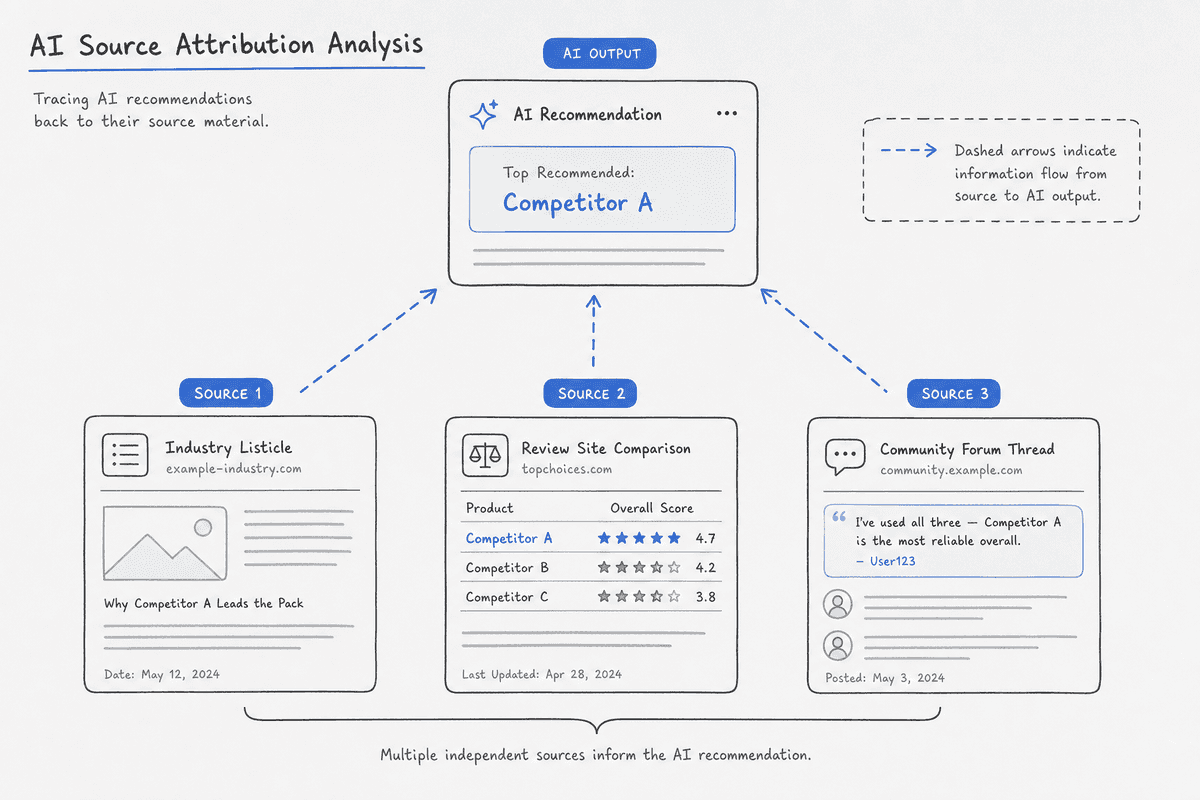
4. Workflow and Execution Integration
Identifying a missing citation is useless if your content team doesn't act on it. The platform should allow you to flag a missing recommendation, assign it to a writer, and tie it to a specific brief—whether that means writing a net-new article, updating a knowledge base, or pursuing a PR placement.
The 7 Best AI SEO Tools for Citation Tracking in 2026
Based on the criteria above, here is a detailed breakdown of the top tools available for monitoring and improving your AI visibility.
1. BeVisible (The Visibility and Execution Engine)
While many tools stop at reporting, BeVisible is designed for execution. It is built specifically for SaaS founders, B2B marketing teams, and agencies that need to monitor how AI assistants answer buyer questions and actively turn those gaps into published work.
How it works: BeVisible tracks AI models—including ChatGPT, Gemini, Perplexity, AI Mode, and AI Overviews—across your specific buyer prompts. It monitors which brands the AI recommends and, crucially, which sources it cites to make those recommendations.
Where it excels: BeVisible's primary differentiator is its focus on the "next step." When you discover a visibility gap—for example, your brand is entirely missing from the prompt "best AI tools for inventory forecasting"—BeVisible helps you operationalize the fix. It turns missing mentions and competitor wins into evidence-backed opportunities, content briefs, and publishing workflows. Instead of just staring at a dashboard, your content team gets clear instructions on what articles to write, what reviews to pursue, or how to restructure an existing page to feed the LLM exactly what it needs.
Best for: Teams that want to close the gap between data and execution. If you need to translate AI visibility metrics into a tangible content calendar, BeVisible is the strongest choice.
2. Peec AI (The LLM Reverse-Engineering Specialist)
Peec AI remains a powerful, highly technical tool for understanding the underlying data of Large Language Models. It approaches citation tracking from a diagnostic perspective, acting as an audit tool for your brand's digital footprint.
How it works: Peec AI runs complex analyses to reverse engineer what a model inherently "knows" about your brand, tracking citation frequency and helping to detect hallucinations where the AI might be inventing features or integrations you don't actually have.
Where it excels: It is exceptional for deep-dive technical audits. If your brand is frequently misunderstood by AI—perhaps it thinks you are a B2C company when you are strictly B2B—Peec AI gives you the granular data needed to see how widespread the hallucination is across different foundation models.
Best for: Technical SEOs and data analysts who want to understand the raw mechanics of model comprehension and frequency tracking.
3. Omnia (The 10-Point Evaluation Leader)
Omnia focuses heavily on the qualitative side of AI citations. They recognize that a citation is not a binary metric, offering specialized analysis services that dive deep into how a brand is portrayed.
How it works: Omnia provides a 10-point evaluation checklist for citation analysis. This includes URL-level tracking, sentiment analysis, and entity mapping to carefully separate neutral brand mentions from strong, buyer-ready recommendations.
Where it excels: The precision of its sentiment analysis is its standout feature. Omnia can tell you not just if you were mentioned, but if the AI positioned you as the "budget option," the "enterprise leader," or the "legacy system."
Best for: Enterprise brands and PR teams that are highly protective of brand positioning and need to measure the exact sentiment and context of their AI mentions.
4. Semrush AI Visibility Toolkit (Broad Brand Appearance)
As traditional SEO software providers adapt to the AEO landscape, Semrush has introduced its AI Visibility Toolkit. It leverages Semrush's massive existing database and infrastructure to bring AI metrics into a familiar interface.
How it works: The toolkit tracks broad citation patterns and brand appearances in AI answers. It is heavily integrated with Semrush’s existing keyword tracking, allowing users to see a side-by-side view of their traditional Google rankings and their AI visibility for the same queries.
Where it excels: Consolidation. If your team is already heavily invested in the Semrush ecosystem, adding their AI toolkit prevents you from having to onboard and learn an entirely new software suite. It provides a solid, high-level overview of broad citation patterns.
Best for: Agencies and in-house teams looking for an all-in-one platform that balances traditional search volume metrics with emerging AI visibility data.
5. Ahrefs Brand Radar (Competitive Benchmarking)
Similar to Semrush, Ahrefs has entered the AEO space with Brand Radar. Industry practitioners frequently cite it as a pragmatic choice when traditional SEO and AI visibility need to live in the same dashboard.
How it works: Brand Radar is a specialized tool for tracking brand mentions and citations specifically within AI answers. It excels at competitive benchmarking, allowing you to stack your brand directly against three or four competitors across platforms like ChatGPT, and also tracks cited sources originating from social platforms.
Where it excels: Ahrefs is known for its backlink index, and Brand Radar uses similar logic to track "AI backlinks" (citations). It makes it incredibly easy to see exactly which third-party sites are feeding the AI recommendations that favor your competitors.
Best for: Competitive analysis. If your primary goal is to steal market share from a specific rival by analyzing where the AI gets its information about them, Ahrefs offers a familiar and powerful workflow.
6. RadarKit (Real-Time Simulated Searches)
RadarKit takes a slightly different technical approach by focusing on live, real-time data capture rather than relying on cached or periodic indexing.
How it works: RadarKit captures real-time data from AI interfaces by simulating actual user searches. It offers insights into which websites AI models currently trust, competitor citations, and the immediate sentiment of brand mentions across six different LLMs.
Where it excels: Because it simulates live searches, RadarKit is excellent for tracking highly volatile queries. If you are running a short-term PR campaign or a major product launch and need to see how quickly the AI models adapt to the news, RadarKit provides immediate feedback.
Best for: News-driven organizations, rapid-response PR teams, and growth marketers executing high-velocity product launches.
7. The Hybrid Stack (AlsoAsked + Webmaster Tools + GA4)
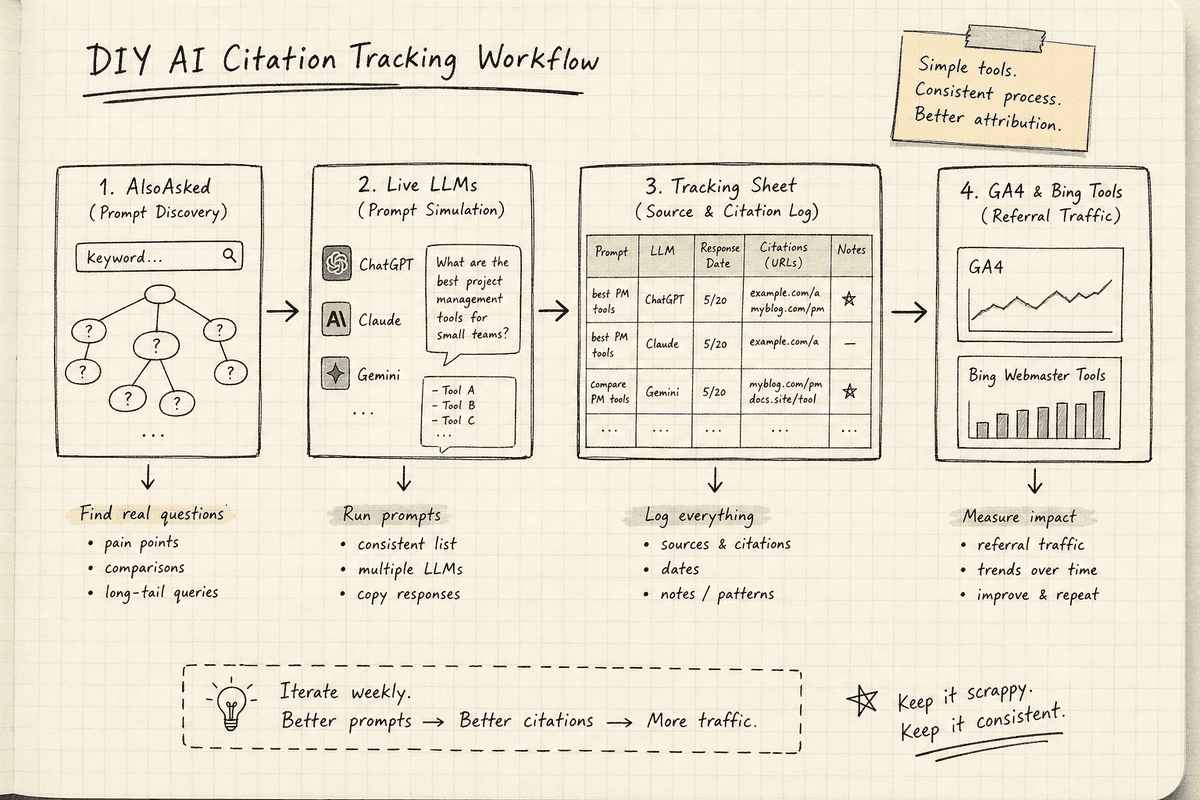
Not every team needs a dedicated, enterprise-level AI visibility tool immediately. Many scrappy growth teams and solo founders rely on a hybrid stack of existing tools to track AEO manually.
How it works: This approach requires stitching together different data sources. As discussed by practitioners building their own workflows, you can use AlsoAsked, GSC, Bing Webmaster Tools and Ahrefs to do the prompt research; GA4 to track the traffic.
Where it excels:
Cost and prompt discovery. AlsoAsked is brilliant for figuring out the conversational, long-tail questions users are naturally asking. By taking those questions, manually feeding them into Perplexity or ChatGPT, and checking the citations, you can build a manual tracking sheet. You then use Bing Webmaster Tools and GA4 to track referral traffic coming from perplexity.ai or chatgpt.com.
Best for: Bootstrapped startups, niche content creators, or teams just beginning to explore AEO before committing budget to a dedicated platform.
Key Metrics: How to Measure AI Visibility
Once you select a tool, you must configure it to track the right KPIs. Traditional SEO relies on metrics like Search Volume, Keyword Difficulty, and Click-Through Rate. AI visibility requires an entirely different scorecard.
1. Citation Rate (The Baseline KPI)
The foundational metric of AEO is your citation rate. Industry experts define this as the baseline KPI: % of tracked prompts where your brand appears.
If you are tracking 100 core buyer questions, and your brand is recommended in 22 of them, your citation rate is 22%. Your primary goal month-over-month is to increase this percentage by targeting the prompts where you are missing.
2. Source Diversity
When an AI cites you, what is the source? If ChatGPT recommends your brand 50 times, but all 50 recommendations stem from a single article on a third-party review site, your visibility is incredibly fragile. If that review site alters its content or loses authority, your citation rate will plummet overnight. A healthy AEO profile requires high source diversity—meaning the AI is pulling information about you from your own domain, from news outlets, from Reddit, from G2, and from industry blogs.
3. Prominence and Positioning
Being mentioned at the bottom of a generated response as an "alternative option" is less valuable than being the first bullet point in a list of "top recommendations." Prominence tracking evaluates where in the output your brand appears and how thoroughly the AI describes your features.
4. Co-Occurrence
Which brands are consistently mentioned alongside yours? If your target audience considers you a premium, enterprise solution, but the AI consistently groups you with cheap, entry-level tools, you have an entity alignment problem. Tracking co-occurrence helps you understand the neighborhood the LLM has placed you in.
Moving from Citation Tracking to Citation Building
Tracking metrics is only the prerequisite. The real work of Answer Engine Optimization is execution. Once BeVisible or another tool alerts you to a missing citation, how do you actually force the AI to notice you?
You cannot optimize for an AI the way you optimize for a Google crawler. Keyword density and traditional backlink profiles matter less than information gain, entity clarity, and consensus.
Step 1: Analyze the Retrieval (RAG) Sources
When you find a prompt where your competitor wins, look at the citations the AI used. Did it pull from their pricing page? Did it pull from a specific technical blog post?
LLMs prioritize content that is highly structured, factual, and easy to parse. If your competitor is winning because their page is structured better, you need to revisit your own architecture. (For guidance on this, review our comprehensive guide on How to Build an SEO Landing Page (7-Step Guide), which covers the structural requirements necessary for both search crawlers and AI ingestion).
Step 2: Maximize Information Gain
LLMs are designed to summarize consensus. If you write an article that says the exact same thing as the top ten Google results, the AI has no reason to cite you; it already has that information.
To earn citations, you must introduce net-new information to the internet. This is called information gain. It can take the form of:
- Original data and survey results.
- Strong, contrarian opinions backed by experience.
- Unique case studies with specific financial or operational metrics.
- Proprietary frameworks.
When you publish unique data, AI assistants are forced to cite you because you are the only source of that specific insight. Reading the 11 Best SEO Blogs Every SaaS Founder Needs (2026) can give you excellent examples of content creators who consistently publish high-information-gain research.
Step 3: Influence the Third-Party Consensus
Often, the easiest way to increase your citation rate isn't to publish on your own domain, but to intercept the sources the AI already trusts.
If BeVisible reveals that Perplexity consistently uses a specific software roundup on an industry blog to answer your target prompts, reach out to the author of that blog. Offer them an exclusive quote, an updated feature list, or a guest contribution. If you get added to the source document, the AI will naturally pick you up in its next retrieval cycle.
Common Failure Modes in AI Citation Tracking
As you build your AEO tech stack, be aware of the pitfalls that trap inexperienced teams.
Tracking Vanity Prompts: Do not waste your subscription limits tracking broad, generic prompts like "What is CRM software?" Even if you secure a citation there, it rarely converts. Focus your tracking on high-intent, long-tail buyer questions like, "What is the best CRM software for a 50-person manufacturing company using SAP?"
Ignoring Hallucinations: Sometimes, an AI will confidently state that your product has a native integration with a specific tool when it does not. Do not celebrate these mentions. False citations lead to churn and angry customers. When you spot a hallucination, you must aggressively publish corrective content on your site, update your schema markup, and clarify your messaging so the LLM updates its understanding.
Treating AI as a Monolith: What works for ChatGPT will not automatically work for Gemini. ChatGPT heavily favors web search results via Bing, while Gemini leans on Google's Knowledge Graph, YouTube transcripts, and Google Business data. Your tracking and execution strategies must be model-specific.
FAQs about AI SEO Citation Tracking
What is the difference between traditional SEO tracking and AI visibility tracking? Traditional SEO tracking monitors where a specific URL ranks on a static search engine results page (SERP). AI visibility tracking monitors whether a brand, product, or entity is recommended within the synthesized text of a generative AI response, regardless of which underlying URL the AI used to find that information.
Can I track AI engine traffic in Google Analytics?
Yes, but with caveats. You can easily track referral traffic from domains like chatgpt.com or perplexity.ai in GA4. However, much of AI usage happens in mobile apps or desktop applications where referral headers are stripped, resulting in that traffic being categorized as "Direct." Therefore, referral traffic in GA4 will underreport your true AI visibility, making dedicated citation trackers necessary.
How often should I monitor AI engine recommendations? Because LLMs update their retrieval sources in real-time, AI answers are highly volatile. A prompt that recommends you on Tuesday might recommend a competitor on Thursday if a new news article drops. High-priority, high-converting prompts should be monitored weekly. Broader brand sentiment queries can be monitored monthly.
Building Your AEO Tech Stack
The transition from search engines to answer engines is fundamentally changing how buyers discover software, services, and brands. Relying solely on traditional rank trackers leaves you blind to a massive and growing segment of your audience.
Tools like Peec AI, Omnia, and Semrush offer vital insights into what the models know, how they perceive your brand, and where you are missing out. But data without a workflow is just noise.
The ultimate goal of citation tracking isn't to build a prettier dashboard—it's to direct your content resources efficiently. By utilizing a platform like BeVisible, you can move beyond simple observation, actively mapping your visibility gaps to concrete publishing tasks, and ensuring that when the next buyer asks an AI for a recommendation, your brand is the clear, heavily-cited answer.