
You just received your first AI visibility report. You open the dashboard, and the data is glaring: ChatGPT recommends your biggest competitor for your primary use case, Perplexity cites a three-year-old blog post when asked about your pricing, and Google's AI Overviews pretend your brand doesn't exist.
You now have a list of visibility gaps. What you don't have is a way to fix them.
Most AI visibility platforms on the market today are built for monitoring. They scrape large language models (LLMs), parse the responses, and give you a share-of-voice score. But for growth teams, B2B marketers, and SaaS founders, knowing you have a problem is only half the battle. If your platform doesn't help you execute the content required to reclaim that visibility, you are just paying for an expensive mirror.
While tools like Peec AI have set the standard for monitoring AI recommendations, modern teams need more than a tracking dashboard. They need a platform that bridges the gap between identifying a missing mention and publishing the exact evidence-backed content required to win it back.
Here is a deep dive into why the industry is shifting from passive AI monitoring to active content execution, how the top tools compare, and why BeVisible represents the next generation of AI search optimization.
The Dashboard Dilemma: Why Tracking AI Isn't Enough
The initial wave of AI optimization tools focused entirely on observability. When ChatGPT, Gemini, and Perplexity began reshaping how B2B buyers conduct research, brands panicked. They needed to know what the bots were saying about them.
This led to a proliferation of tracking-first tools. These platforms run automated prompts against various LLMs and return a spreadsheet of mentions, sentiment analysis, and competitor share of voice.
But there is a fundamental difference between traditional SEO tracking and AI visibility tracking. If an SEO tool tells you that you rank #12 for a keyword, you generally know the playbook: improve the content, build some links, optimize the internal linking structure.
If an AI tracking tool tells you that ChatGPT prefers a competitor, the path forward is much less obvious. LLMs don't rely on traditional backlinks; they rely on training data, retrieval-augmented generation (RAG) processes, entity relationships, and real-time citation availability.
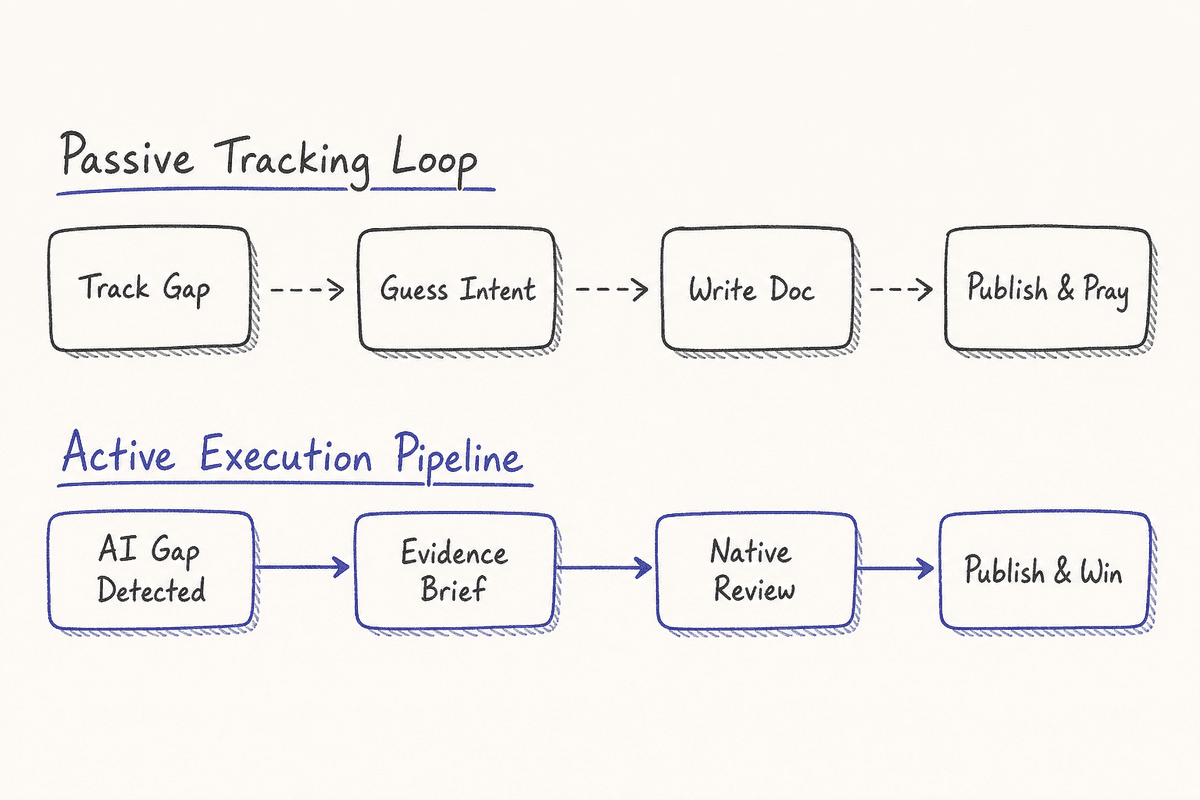
When your visibility platform only provides a dashboard, your workflow looks like this:
- Identify a prompt where your brand is missing.
- Guess why the AI didn't recommend you.
- Manually brief a writer to create a new page.
- Hope the new page contains the specific semantic entities the AI is looking for.
- Publish the page.
- Wait weeks to see if the LLM picks it up.
This disconnected workflow is slow, expensive, and prone to error. It separates the intelligence (the AI visibility platform) from the action (the content execution).
Peec AI: The Benchmark for Enterprise Tracking
When evaluating the market, Peec AI frequently emerges as a top contender for visibility tracking. It has built a strong reputation for its model-specific breakdowns and detailed sentiment analysis.
According to a review by Brainlabs, Peec is most effective for established brands that already have demand and want to expand or defend their presence in AI recommendations. If you are a Fortune 500 company trying to ensure that Claude doesn't hallucinate a scandal about your CEO, or that ChatGPT accurately reflects your latest enterprise pricing tier, Peec AI is a robust defense mechanism.
However, video reviews comparing tools like Peec AI and Developer Marketing Hub highlight a common friction point: identifying specific content gaps and outdated topics without a direct bridge to fixing them YouTube. The intelligence is there, but the execution pipeline is not.
For SaaS founders, agile marketing teams, and agencies, merely defending existing demand isn't enough. These teams are trying to create visibility. They need a platform that doesn't just say, "You are missing from this ChatGPT response," but instead says, "You are missing from this ChatGPT response because you lack a technical comparison page—click here to draft and publish it."
Evaluating the AI Visibility Landscape
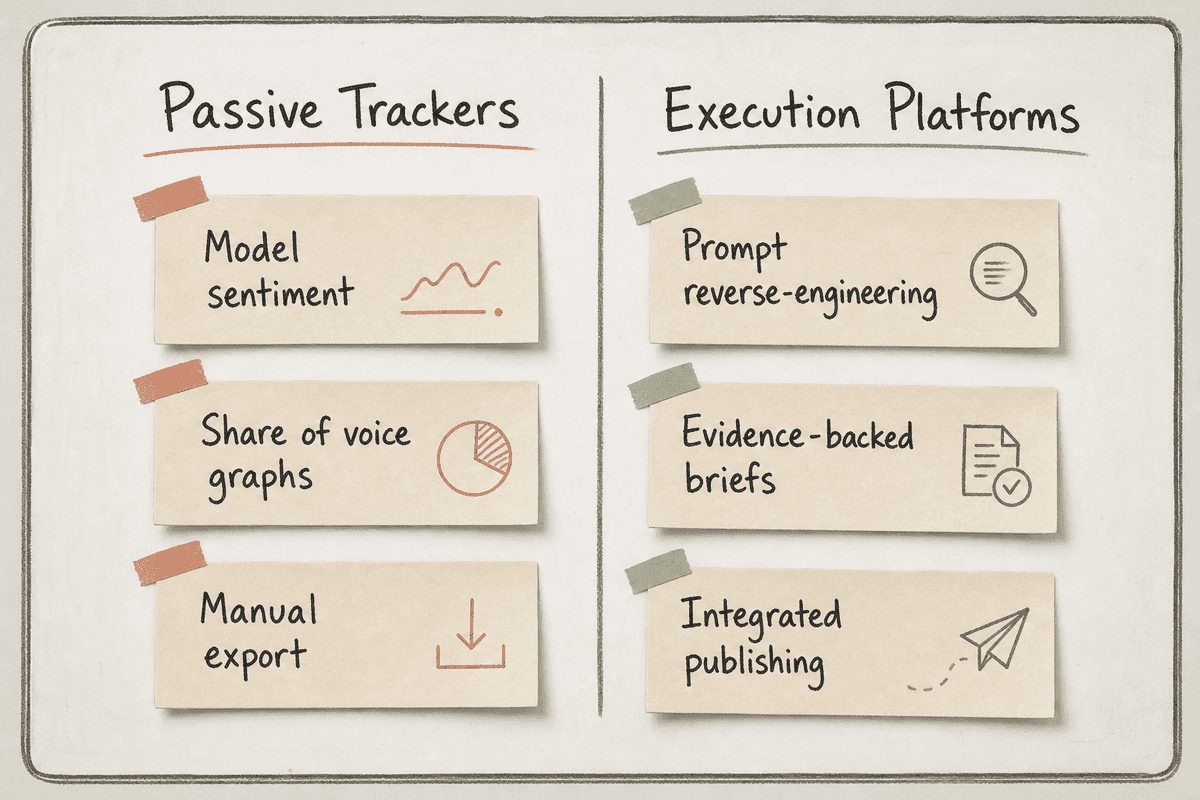
The market is currently split into two distinct categories: passive trackers and execution-oriented platforms. Understanding the nuances between them is critical for allocating your software budget effectively.
Passive Tracking Platforms
These tools are built for data analysts and SEO managers who want raw data to feed into their own custom workflows.
Profound and Ahrefs Many SEOs are trying to figure out how legacy search tools adapt to the AI era. Comparisons between traditional giants like Ahrefs and new AI-focused trackers like Profound are common as teams try to determine how visible their brand is in ChatGPT, Gemini, and Perplexity YouTube. Profound provides deep analytics on AI share of voice, but it remains a reporting layer.
OtterlyAI Another tracking-heavy platform, OtterlyAI is designed to track brand visibility across AI search engines, giving marketers a pulse on their digital footprint YouTube. It's excellent for compiling monthly reports on brand sentiment, but it leaves the actual work of creating cited content entirely up to the user.
Execution-Oriented Platforms
This newer category recognizes that the output of an AI visibility tool shouldn't be a PDF report; it should be a published piece of content.
Vismore In digital marketing communities, professionals are actively discussing the need to move beyond tracking. Reddit users testing several AI visibility platforms have noted that tools like Vismore (by SE Ranking) attempt to act as a comprehensive monitoring layer connecting AI visibility with traditional SEO metrics, positioning themselves as slightly more execution-oriented Reddit.
BeVisible BeVisible was built explicitly for the execution gap. Instead of stopping at monitoring, BeVisible helps teams track ChatGPT, Gemini, Perplexity, AI Mode, and AI Overviews, and then directly turns those visibility gaps into evidence-backed opportunities, articles, review, scheduling, and publishing work. It is an end-to-end pipeline from AI insight to published asset.
Essential Features of a Content Execution Platform
If you are upgrading from a basic tracking tool to a platform with content execution capabilities, you need to look for specific features that directly influence how LLMs retrieve and cite information.
1. Reverse-Engineering Buyer Prompts
You cannot optimize for a generic keyword in AI search. LLMs respond to specific, conversational prompts. An execution platform must monitor the exact phrasing your buyers use. Instead of tracking the keyword "CRM software," it needs to track prompts like, "Which CRM software integrates best with custom single-page applications for healthcare?"
2. Citation Weakness Analysis
When Perplexity answers a prompt, it cites sources. A good execution platform doesn't just tell you that your competitor was cited; it analyzes why they were cited. Was their article more recent? Did it contain specific statistics? Did it include a structured data table that the LLM could easily parse? Understanding citation weakness is the first step in drafting superior content.
3. Integrated Content Workflows
This is the core differentiator. Once a gap is identified, the platform should seamlessly transition into a content execution environment. This includes:
- Generating data-backed content briefs based on what the LLM is currently missing.
- Drafting articles that prioritize information density, clear entity relationships, and factual claims—the specific elements RAG systems look for.
- Managing the review and approval process natively.
4. Technical Publishing Capabilities
Even the best content won't be cited if the AI bot can't read it. The platform should assist in scheduling and publishing while ensuring the technical foundation is sound. For example, modern websites heavily rely on JavaScript frameworks. If your site blocks OpenAI's crawler, or if your JavaScript doesn't render properly for bots, your execution efforts will fail. Having a solid understanding of SEO for Single Page Applications: The Technical Checklist is a prerequisite for AI visibility.
How BeVisible Bridges the Gap Between Insight and Action
BeVisible is engineered specifically for teams that want to stop staring at dashboards and start publishing content that wins AI recommendations. By unifying monitoring and execution, it removes the friction that causes AI optimization strategies to stall.
Comprehensive Multi-Model Monitoring
BeVisible monitors your brand's presence across the entire AI ecosystem, not just one model. It tracks:
- ChatGPT: To understand standard conversational recommendations.
- Gemini: To track Google's native AI responses, which heavily influence Google Workspace users.
- Perplexity: To monitor the premier citation-heavy AI search engine.
- AI Mode & AI Overviews: To capture the intersection of traditional search and generative AI summaries.
Turning Gaps Into Evidence-Backed Opportunities
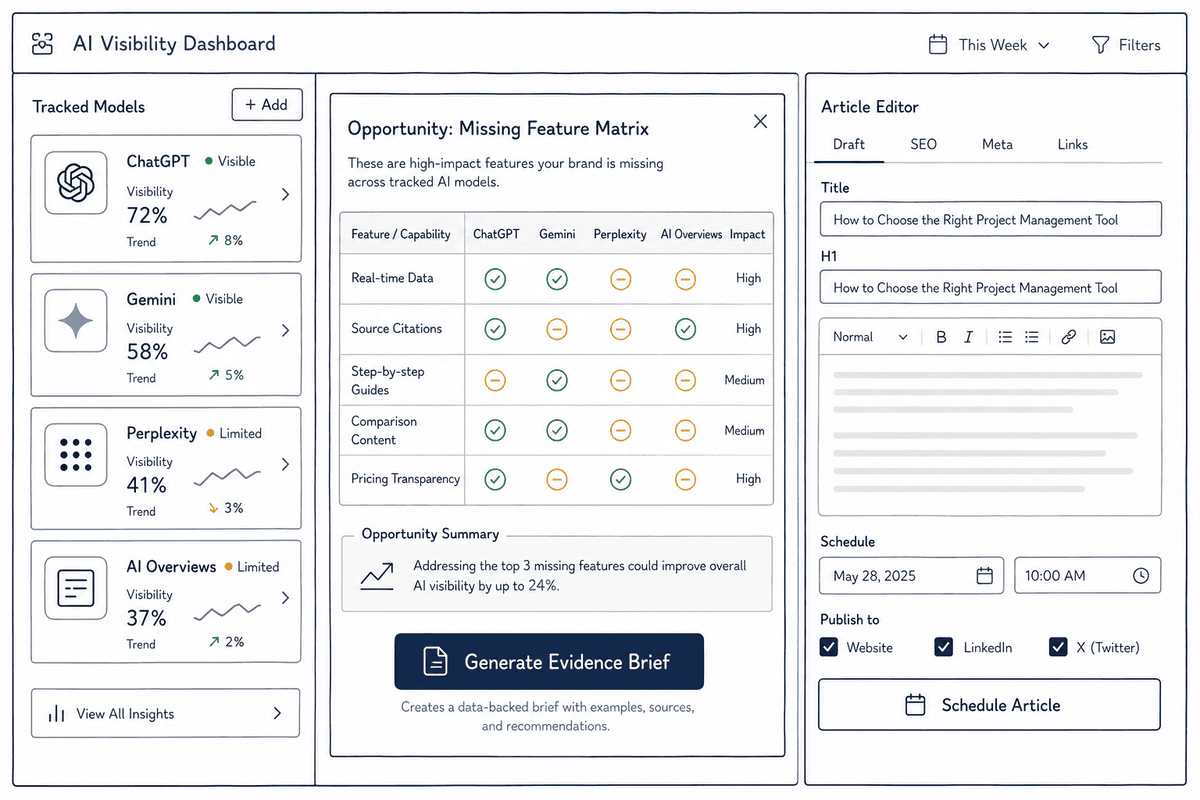
When BeVisible detects that your brand is omitted from a crucial buyer prompt, it doesn't just flag it red. It creates an actionable opportunity.
The platform analyzes the sources the LLMs did cite and identifies the information gap. It then generates an evidence-backed framework for a new article or a revision to an existing page. This ensures that when you execute, you aren't guessing what the AI wants—you are directly providing the missing facts, statistics, or entity relationships the model's retrieval system is actively seeking.
End-to-End Content Execution
With the opportunity defined, BeVisible moves your team into execution mode. The platform facilitates the drafting of articles specifically structured for AI consumption. It manages the review process, handles scheduling, and coordinates publishing work.
Instead of jumping between a tracking tool, a keyword research tool, Google Docs, and a CMS, your team operates in a single, closed-loop environment. When you How to Build an SEO Landing Page (7-Step Guide) using BeVisible's insights, you build a page engineered to be cited by Perplexity and recommended by ChatGPT.
Scenario: Fixing a Missing Mention in Perplexity
To understand the difference between tracking and execution, consider this scenario.
Imagine you run a SaaS company that provides specialized accounting software for marketing agencies. You discover that when a user asks Perplexity, "What is the best accounting software for a 50-person marketing agency?", Perplexity recommends three competitors. It cites various blog posts and software review sites.
The Tracking-Only Approach: A tool like Peec AI alerts you to this missing mention. You download the report. You send it to your marketing manager. The marketing manager looks at your website and realizes you don't have a specific page dedicated to 50-person agencies. They add "Write an article about 50-person agencies" to a Trello board. Three weeks later, a freelance writer delivers a generic 800-word post. It gets published. Perplexity never picks it up because it lacks the specific feature comparisons and pricing data the RAG system prefers.
The BeVisible Execution Approach: BeVisible alerts you to the missing mention. Within the same alert, it highlights why the competitors were cited: Perplexity pulled data from an article that specifically compared agency pricing models and included a feature matrix for multi-currency billing.
BeVisible immediately spins up a content opportunity: "Create an authoritative guide on accounting software for mid-sized agencies, focusing on multi-currency billing." The platform generates a brief outlining the exact headers and facts required. Your team uses the built-in execution tools to draft an in-depth, evidence-backed article. You review and schedule it directly through the platform. Because the content is explicitly engineered to fill the data gap Perplexity had, the next time the LLM indexes your site, it retrieves your new page and begins citing your brand.
The Economics of AI Content Execution
The shift toward AI search has dramatically altered marketing budgets. In the past, companies either hired expensive traditional SEO agencies or tried to automate technical fixes.
When it comes to AI optimization, the skills required are still highly specialized. Most traditional SEO agencies are struggling to pivot, often charging premium retainers while still relying on outdated keyword stuffing tactics that LLMs ignore. If you are comparing SEO Charges UK: Agency Rates vs Automation (2026), you will quickly find that paying an agency purely for "AI tracking reports" is a poor return on investment.
A platform with built-in content execution reduces the reliance on external agencies to interpret AI data. By providing clear, actionable content briefs directly tied to visibility gaps, internal marketing teams—or even solo founders—can execute highly sophisticated AI optimization campaigns without paying exorbitant agency retainers. You aren't just paying for data; you are paying for publishing velocity.
Common Mistakes When Optimizing for LLMs
Even with the best execution platform, teams can stumble if they apply traditional SEO mindsets to generative AI engines. Here are the most common failure modes to avoid when executing your content strategy.
1. Trying to "Hack" the AI
LLMs are not easily tricked by keyword density or hidden text. They evaluate the semantic relevance and factual density of a document. If your execution strategy involves stuffing prompts in invisible text on your homepage, you will fail. BeVisible focuses on evidence-backed opportunities because facts, unique data points, and clear definitions are what AI systems retrieve.
2. Ignoring Single-Page Application (SPA) Rendering Issues
Many modern SaaS websites are built as Single Page Applications using React, Vue, or Angular. While Googlebot has gotten better at rendering JavaScript, AI crawlers (like OpenAI's OAI-SearchBot) can struggle significantly with client-side rendering.
You can use BeVisible to execute the perfect article, but if the AI bot sees a blank page because your JavaScript didn't execute in time, you won't get cited. You must ensure you are Implementing SEO in Single Page Applications (3 Ways) correctly—whether through Server-Side Rendering (SSR), Static Site Generation (SSG), or dynamic rendering—before you expect to win AI visibility.
3. Writing Fluff Instead of Information Density
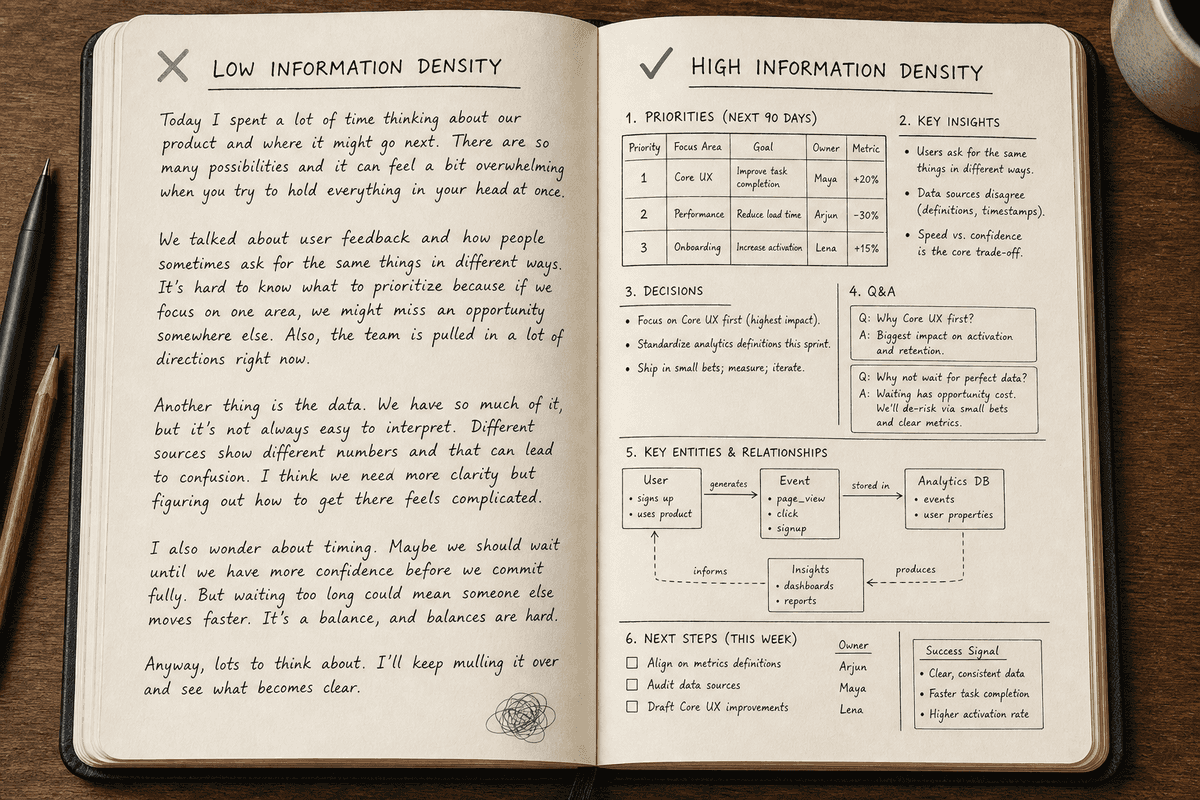
When an LLM summarizes a topic, it looks for high information density. It prefers clear tables, bulleted lists, direct answers, and strong entity relationships. If your content execution results in long, rambling paragraphs that bury the answer beneath 500 words of introductory fluff, the RAG system will pass over it in favor of a competitor's concise FAQ section.
This is why staying educated on modern search mechanics is crucial. Keeping up with the 11 Best SEO Blogs Every SaaS Founder Needs (2026) can help your team understand the nuances between writing for humans, writing for Google, and writing for an LLM retrieval system.
Structuring Content for AI Ingestion
When using BeVisible's execution tools, formatting is just as important as the words you choose. To maximize your chances of being cited as a source by Perplexity or AI Overviews, structure your published work systematically:
Executing on these specific structural requirements is incredibly difficult if your team is just looking at a tracking dashboard. An execution platform builds these constraints into the workflow, ensuring the output is optimized for machine reading.
FAQs About AI Visibility Platforms
What is an AI visibility platform? An AI visibility platform is a software tool that tracks how often and in what context a brand, product, or individual is mentioned by large language models and AI search engines like ChatGPT, Gemini, and Perplexity. Advanced platforms combine this tracking with content execution tools to help brands improve their presence.
Does Peec AI have content execution features? Peec AI is primarily a monitoring and tracking platform. While it provides deep, model-specific breakdowns and sentiment analysis that are excellent for enterprise brand defense, it requires teams to build their own external workflows to actually draft, schedule, and publish the content needed to fill visibility gaps.
How do you track Gemini and ChatGPT mentions effectively? Tracking these platforms requires automated prompt testing. You cannot manually type questions into ChatGPT all day. Tools like BeVisible automate the process of running hundreds of buyer-intent prompts through multiple LLM APIs, analyzing the responses, and alerting you when your brand is omitted or poorly represented.
Why is my content not being cited by Perplexity? Perplexity relies on a Retrieval-Augmented Generation (RAG) system. If you aren't being cited, it is usually because your content is either inaccessible to their crawler (often due to complex JavaScript or SPA rendering issues), lacks sufficient information density, or does not directly answer the semantic intent of the user's prompt as well as a competing source.
Moving from Observation to Action
The era of simply monitoring your search presence is over. Identifying that you have lost share of voice to a competitor in an AI overview is only valuable if you have the operational capacity to do something about it.
While legacy tracking tools will give you the bad news, a true AI visibility platform with content execution tools provides the solution. By integrating monitoring, gap analysis, content drafting, scheduling, and publishing into a single workflow, BeVisible ensures that your team isn't just watching the AI revolution happen—you are actively shaping what it says about your brand.