
When a prospect asks ChatGPT, Perplexity, or Google AI Overviews to recommend software in your niche, your brand is either named in that first paragraph or left out entirely. In 2026, over 40% of B2B buyers start their software evaluations inside AI chat interfaces rather than traditional search result pages.
For small marketing teams operating with 1 to 5 people, keeping track of how generative AI engines perceive, describe, and cite your brand has become just as urgent as tracking keyword rankings.
Otterly.ai gained early traction as an accessible entry point for monitoring ChatGPT prompts. It automated the tedious manual task of typing brand queries into ChatGPT to see if your software appeared in the response. However, small marketing teams scaling their Generative Engine Optimization (GEO) efforts quickly run into a fundamental bottleneck with simple prompt checkers.
Knowing that an AI model omitted your software is only 10% of the battle. The real challenge for a lean team is understanding why the AI chose your competitor, identifying which specific sources the AI cited, and executing evidence-backed content to claim that visibility before your quarterly target slips away.
This guide evaluates the top AI visibility software for small marketing teams in 2026, comparing Otterly.ai against comprehensive platforms built to turn AI visibility gaps into published, indexable work.
Why Otterly.ai Falls Short for Small Marketing Teams
Otterly.ai established itself by offering a straightforward value proposition: automated prompt testing inside ChatGPT. For an founder or solo marketer dipping their toes into AI monitoring, it provides a clean baseline.
Yet as small marketing teams mature their AI visibility strategy, four structural limitations make point-solution trackers insufficient:
- Single-Engine Blind Spots: Buyer research is fragmented. While ChatGPT remains popular, decision-makers heavily utilize Perplexity for deep web research, Google Gemini for workspace integration, and Google AI Overviews or AI Mode directly on search engine results pages. A tool limited primarily to basic ChatGPT prompts misses over half of actual buyer queries.
- Missing Source Citation Lineage: Generative AI models do not generate brand recommendations out of thin air. They pull from web crawlers, real-time search API indexes, vector databases, and third-party review sites. Simple prompt checkers tell you whether your brand name appears, but fail to map the underlying web sources, domain authorities, or listicles that influenced the AI model's answer.
- The Point-Solution Execution Gap: Knowing you are missing from a prompt answer creates an inbox alert, but does not solve the problem. Lean marketing teams do not have the bandwidth to spend hours manually researching competitor sources, drafting long-form content briefs, writing articles, and managing publishing pipelines for every missed prompt.
- Lack of Sentiment and Contextual Tracking: An AI model mentioning your brand is not an automatic victory. If an AI engine includes your product but labels it "expensive," "lacking integrations," or "outdated," your team needs context-aware tracking to spot negative sentiment before it degrades conversion rates.
 To move beyond reactive alert monitoring, small marketing teams require software that unifies multi-engine tracking, citation research, and automated content execution.
The 5-Point Evaluation Framework for Lean Teams
Small marketing teams cannot afford complex $20,000-per-year enterprise software suites that require weeks of implementation, nor can they rely on manual browser extensions.
When evaluating AI visibility software beyond Otterly.ai, assess platforms against five core criteria:
 Using these operational parameters, let's examine the leading AI visibility platforms available to small marketing teams today.
Top AI Visibility Software Options Beyond Otterly.ai
1. BeVisible
Best Overall for AI Visibility Monitoring and Content Execution
BeVisible is designed specifically for SaaS founders, growth teams, and B2B marketing groups that need to move directly from detection to resolution.
Rather than stopping at basic prompt tracking, BeVisible bridges the gap between tracking AI engine outputs and publishing the exact content needed to win recommendations.
BeVisible helps teams monitor how AI assistants answer buyer questions, which brands they recommend, and which sources they cite. It tracks ChatGPT, Gemini, Perplexity, AI Mode, and AI Overviews across buyer prompts, then turns visibility gaps into evidence-backed opportunities, articles, review, scheduling, and publishing work.
Key Features for Small Teams:
- Multi-Engine Tracking: Comprehensive monitoring across ChatGPT, Perplexity, Gemini, Google AI Overviews, and AI Mode.
- Citation Lineage Mapping: Instantly reveals which third-party domains, blogs, and documentation pages AI models rely on when forming answers to specific buyer prompts.
- Automated Gap-to-Publish Workflow: Directly converts identified visibility gaps and missing brand citations into structured, publishable articles and content updates engineered for AI retrieval.
- Competitor Share-of-Voice Dashboards: Tracks competitor positioning across high-intent buyer prompts to highlight exactly where rival products are winning recommendations.
Advantages:
- Combines AI search monitoring with direct publishing execution, saving small teams dozens of hours per week.
- Eliminates guesswork by highlighting the exact sources and citations influencing AI recommendations.
- Monitors the complete modern search landscape, including Google AI Mode and AI Overviews.
Considerations:
- Built specifically for teams ready to actively produce and publish content to fix visibility gaps, rather than passive observers who only want basic reporting graphs.
2. Profound
Best for Enterprise Brand Sentiment & Scale
Profound has positioned itself as an enterprise-grade AI brand monitoring platform. It offers deep analytics into how large brands are portrayed across major LLM architectures. In industry analysis comparing enterprise monitoring suites, such as discussions surrounding Ahrefs vs Profound, Profound stands out for its deep sentiment tracking capabilities.
Key Features:
- Deep prompt variance analysis across large enterprise query sets.
- Detailed sentiment dashboards highlighting negative, neutral, and positive brand associations.
- Enterprise team permissions and multi-brand portfolio monitoring.
Advantages:
- Highly detailed reporting metrics suitable for executive reporting.
- Extensive historical trend tracking across major AI models.
Considerations:
- High subscription costs can put it out of reach for bootstrapped or small marketing teams.
- Focuses on analytics and reporting rather than offering built-in content generation and publishing execution pipelines.
3. Am I On AI / Omnia
Best Entry-Level Aggregator for Basic Audits
For teams seeking a quick snapshot across public AI models, platforms highlighted in roundup guides like Omnia’s AI visibility comparison offer straightforward diagnostic checking. Tools like Am I On AI allow marketers to run spot audits to see if a domain appears in common LLM training sets or search outputs.
Key Features:
- Simple domain search interface for quick brand lookups.
- Multi-model query testing for high-level brand visibility scorecards.
- Basic comparative metrics against named domain competitors.
Advantages:
- Quick setup with zero learning curve for non-technical users.
- Useful for initial audits during product launches or brand renames.
Considerations:
- Lacks continuous tracking and automated alert systems across evolving prompt sets.
- Does not map deep source citations or assist in closing identified content gaps.
4. Ahrefs Brand & AI Mention Tracking
Best for Traditional SEO Teams Adding AI Layers
Ahrefs continues to expand its core organic search tools to monitor AI mentions and search engine features alongside standard keyword tracking. For teams that heavily rely on traditional rank tracking and backlink databases, leveraging traditional SEO suites with AI features provides familiar workflows.
Key Features:
- Integration of AI Overviews monitoring alongside traditional SERP tracking.
- Comprehensive backlink and domain rating analysis to evaluate source site power.
- Historical organic traffic and keyword performance metrics.
Advantages:
- Single subscription covers traditional SEO, backlink analysis, and emerging AI search features.
- Industry-standard web index database for verifying source domain authority.
Considerations:
- AI features are layered on top of a classic keyword-first architecture rather than built from the ground up for Generative Engine Optimization (GEO).
- Prompt variance tracking across conversational tools like ChatGPT or Perplexity is less central than standard search queries.
5. Frase.io AI Visibility & Content Suite
Best for Content Brief Optimization
Frase.io has long served content marketers focused on SERP research and topic modeling. As highlighted in their breakdown of the best AI visibility tools, Frase helps writers extract entity relationships and competitor headings to optimize web content for both human readers and search algorithms.
Key Features:
- SERP entity extraction and heading structure recommendations.
- Content brief generation based on top-ranking search pages.
- Direct text editor with real-time topic optimization scores.
Advantages:
- Excellent for drafting articles optimized around clear topical clusters.
- Streamlines topic research for content writers.
Considerations:
- Primarily focused on traditional search engine optimization and text scoring rather than automated multi-LLM prompt tracking across ChatGPT, Gemini, and Perplexity.
- Does not monitor ongoing conversational brand recommendations across AI assistants.
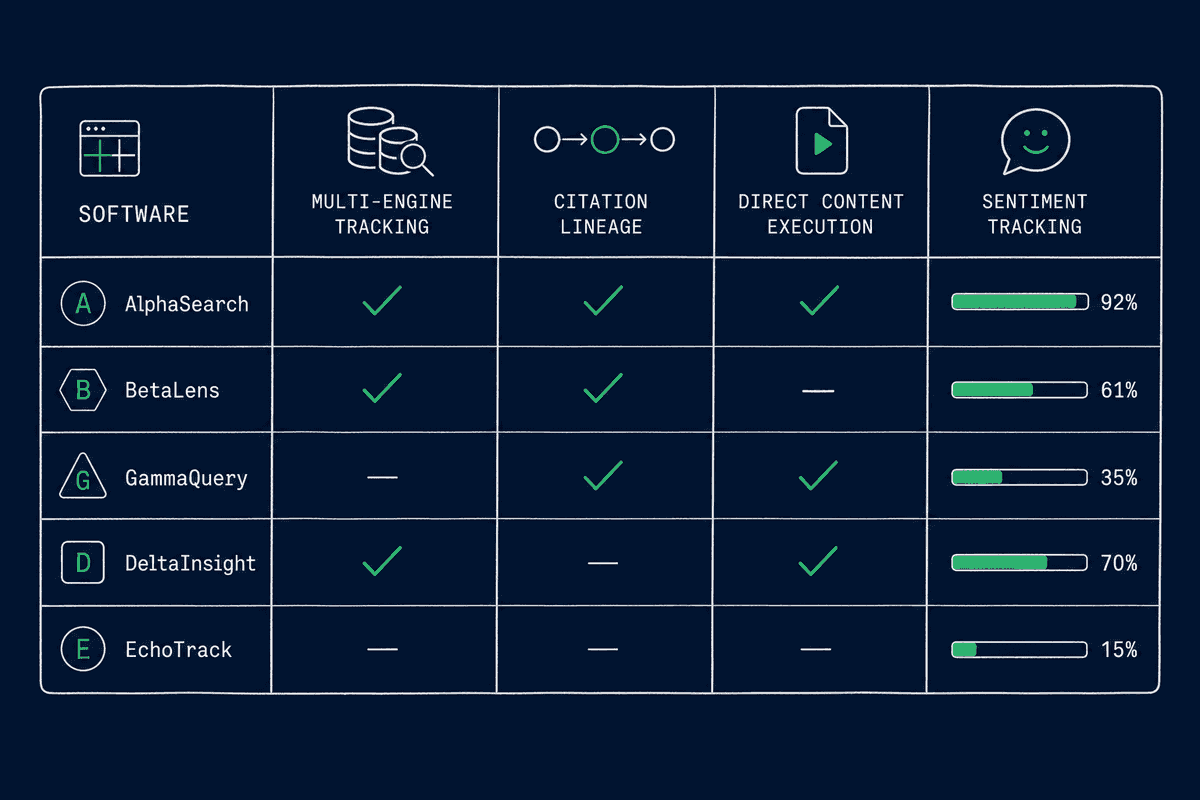
Tool Comparison Matrix
To help your team choose the right platform, here is how the top tools compare across core features, primary focus, and suitability for small marketing teams:
How AI Engines Decide Which Brands to Recommend
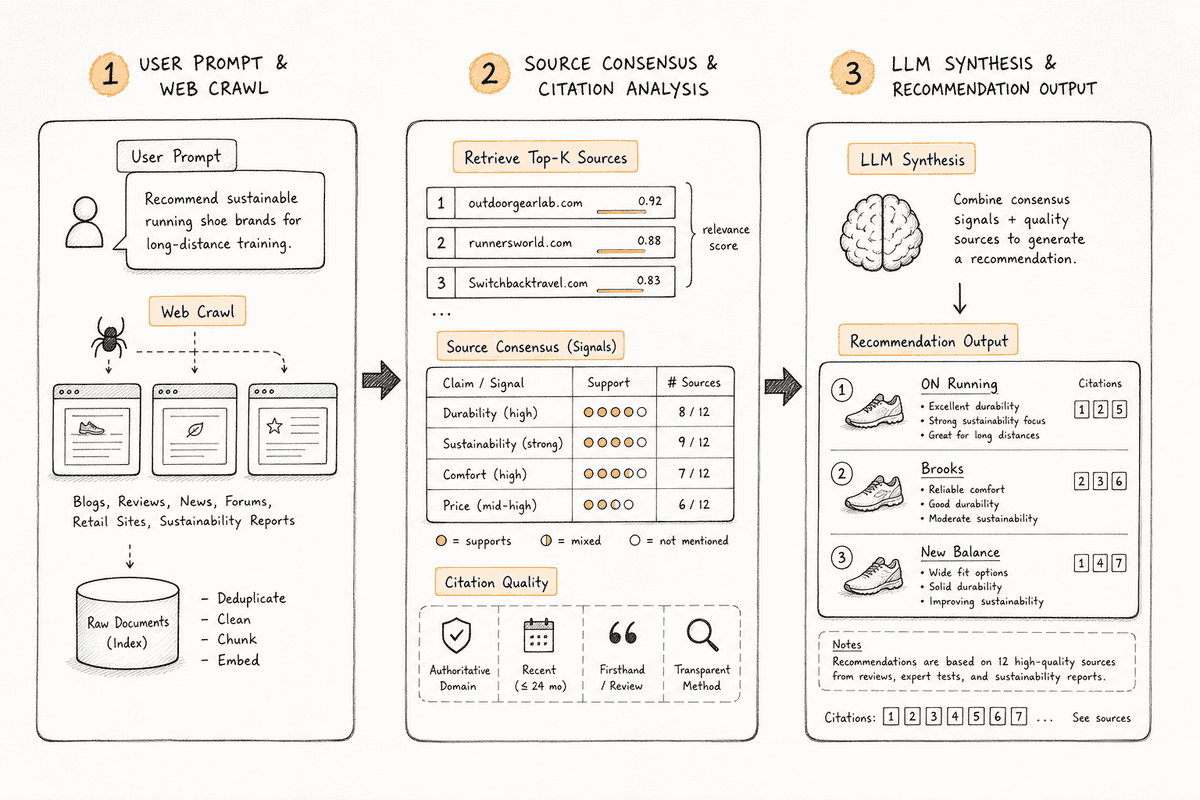
To select the right software, marketing teams must understand how generative engines process and recommend brands. Generative Engine Optimization (GEO) operates on fundamentally different mechanics than traditional keyword-density SEO.
When a user prompts an AI assistant with a commercial intent question—such as "What is the best AI visibility software for small marketing teams?"—the AI engine follows a three-stage retrieval and synthesis pipeline:
[ User Buyer Prompt ]
         │
         ▼
[ Stage 1: Retrieval & Web Search ] ──► Real-time search indexes & cached vector stores
         │
         ▼
[ Stage 2: Source Consensus Analysis ] ──► Extract entities from high-trust blogs, review sites, & docs
         │
         ▼
[ Stage 3: LLM Synthesis & Citation ] ──► Generate ranked recommendation answer + source citations
1. Retrieval-Augmented Generation (RAG) and Search Indexing
AI models rarely rely solely on frozen static training weights for commercial recommendations. Tools like Perplexity, Gemini, and ChatGPT search the web in real time using retrieval models. They scan live search results, retrieve text snippets, and pass those snippets into the prompt context window. As noted in research on research workflows with tools like Perplexity for consulting and deep queries, AI assistants function primarily as real-time research aggregators.
2. Entity Co-Occurrence and Citation Authority
The model evaluates how frequently your brand name co-occurs with relevant category keywords across authoritative third-party sources. If top-ranking comparative articles, industry roundups, and documentation pages repeatedly group your brand alongside key software categories, the AI model assigns a high confidence score to your brand entity.
3. Structural Clarity and Direct Answer Eligibility
Generative models favor web pages that supply direct, clear, and structured answers. If your website buries key value propositions, pricing parameters, use cases, and feature lists behind dense marketing jargon or un-indexable scripts, LLM web scrapers fail to extract clear facts. Providing clear comparison tables, explicit feature breakdowns, and structured schema significantly improves your brand's chances of being cited accurately.
Practical Workflow: Turning AI Visibility Gaps into Published Work
Monitoring missing brand mentions is useless if those insights stay trapped in a spreadsheet. Here is a battle-tested 5-step framework small marketing teams use to turn AI visibility gaps into high-ranking content.
Step 1: Map Your Core Buyer Prompts
Identify 15 to 30 high-intent prompts that your ideal customer profile (ICP) asks during software evaluations. Avoid generic one-word keywords. Focus on decision-stage prompts:
- "Best CRM software for 5-person agency team"
- "Alternative to [Competitor] with better integration features"
- "Top AI visibility platforms that integrate with publishing workflows"
Step 2: Audit Citation Sources Across All Major AI Engines
Run those prompts across ChatGPT, Perplexity, Gemini, and Google AI Overviews using your monitoring platform. Identify:
- Which competing brands are systematically recommended.
- Which third-party domain URLs are repeatedly cited as supporting sources.
- Which specific features or attributes the AI highlights for winning brands.
Step 3: Identify Content Missing from Your Domain
Compare the AI’s cited sources against your existing site structure. If AI models cite three industry roundup articles and two dedicated comparison landing pages, check whether your site offers structured equivalent content. For detailed guidelines on creating high-converting, indexable landing pages, review our practical guide on How to Build an SEO Landing Page (7-Step Guide).
Step 4: Publish Target Content Engineered for AI Extraction
Draft comprehensive articles and landing pages designed to fulfill the missing information gaps identified during your audit:
- Use clear H2 and H3 subheadings that mirror natural prompt questions.
- Place bulleted summary tables near the top of pages for easy RAG extraction.
- Include explicit entity definitions, straightforward feature lists, and transparent pricing structures.
- Avoid fluff, ambiguous buzzwords, or ungrounded claims that retrieval bots ignore.
Step 5: Track Indexing, Retrieval, and Recommendation Shifts
Once published, track the target prompt cluster within BeVisible. Monitor how fast search crawlers index your new content, whether AI models begin picking up your URLs in source citations, and how your brand recommendation score changes across ChatGPT, Perplexity, and Gemini over a 30-to-60-day window.
Scenario: How a 4-Person Growth Team Reclaimed 35% Share-of-Voice
To understand how this operates in practice, consider the scenario of a mid-stage B2B SaaS startup operating with a four-person growth team.
The Problem
The team realized that while they ranked on page one of Google for three primary target keywords, their direct competitor was capturing over 70% of recommendations inside ChatGPT and Perplexity for buyer prompts like "Best automated reporting tools for boutique agencies."
The team was using a basic prompt checker similar to Otterly.ai. It alerted them weekly that they were missing from ChatGPT responses, but gave zero insights into why or where the AI pulled its answers.
The Strategy
The growth team implemented a full-stack AI visibility and execution workflow:
- Citation Audit: They ran their top 20 agency prompts through a multi-engine audit platform. The audit revealed that Perplexity and ChatGPT were pulling citations from four specific review roundups and two detailed comparison articles that the team had never updated.
- Execution: Instead of spending two weeks writing custom content briefs from scratch, they used automated visibility gap workflows to generate structured comparison articles and update their landing page architecture.
- Distribution & Indexing: They updated their existing documentation, published two dedicated comparison pages, and secured updated listings on the cited third-party review boards.
The Results
Within 45 days of publishing:
- Their brand recommendation score across target Perplexity prompts increased from 0% to 65%.
- ChatGPT began citing their new landing pages directly in source footers for 12 out of 20 core buyer prompts.
- Inbound demo requests originating from conversational search queries increased by 35% quarter-over-quarter.
Common Myths About AI Visibility & GEO
As AI search evolves, several misconceptions prevent small marketing teams from building effective strategies.
Myth 1: "AI Visibility Tracker Data Is Identical to Keyword Rank Tracking"
Reality: Traditional search engines output deterministic, ranked lists of blue links based on query match algorithms. LLMs construct dynamic, probabilistic answers synthesized from multiple retrieval sources. A single prompt variation can yield different phrasings. AI visibility software must track prompt clusters across multiple iterations to establish true recommendation confidence scores.
Myth 2: "You Have to Pay AI Companies to Get Mentioned in ChatGPT or Perplexity"
Reality: While ad models are emerging, organic AI recommendations are grounded in Retrieval-Augmented Generation (RAG). AI assistants pull from high-authority, crawlable web content, structured data, and authoritative mentions across the web. Earning mentions is a function of information clarity, authority, and content accessibility—not paid sponsorship.
Myth 3: "A Prompt Tracking Tool Alone Will Fix Your AI Search Strategy"
Reality: Dashboards do not produce content. Receiving a weekly alert that your brand is invisible on ChatGPT does not move the needle unless your team actively creates, updates, and publishes the information AI engines are looking for. Tracking software must connect directly to execution workflows to deliver measurable growth.
Frequently Asked Questions
How does Generative Engine Optimization (GEO) differ from traditional SEO?
Traditional SEO focuses on optimizing web pages to rank for static search queries on search engine results pages (SERPs). GEO focuses on optimizing your brand’s overall web presence so that generative AI models (like ChatGPT, Gemini, and Perplexity) extract, synthesize, and recommend your software when answering complex buyer prompts. GEO emphasizes source citation authority, entity clarity, and multi-site consensus over keyword density.
How often do AI assistants update their source citations?
Citations in tools that rely on real-time search APIs (such as Perplexity, Google AI Overviews, and ChatGPT with Web Search) can update continuously as new web content is crawled and indexed. Pages that offer clear answers and earn strong backlink signals can begin appearing in AI citations within days to weeks of indexing.
Can a small marketing team handle GEO without hiring an expensive agency?
Yes. With the right software stack, a small team of 1 to 5 marketers can handle AI visibility in-house. By utilizing tools that combine multi-engine tracking with automated content execution, lean teams can monitor prompts, identify citation gaps, and produce high-impact articles without relying on external agency retainers. For teams building their in-house knowledge, reviewing our curated list of the 11 Best SEO Blogs Every SaaS Founder Needs (2026) offers additional frameworks for staying ahead of algorithm changes.
Which AI search engines should B2B software teams focus on first?
Focus on the platforms where high-intent buyers perform active research:
- Perplexity: Highly favored by technical buyers, research analysts, and B2B decision-makers for deep query synthesis.
- ChatGPT: The largest consumer and professional user base for broad discovery prompts.
- Google AI Overviews & AI Mode: Directly impacts top-of-funnel organic search traffic within Google's core ecosystem.
Actionable Checklist: Selecting Your AI Visibility Stack
When selecting the ideal AI visibility software for your team beyond Otterly.ai, check off these essential evaluation steps:
- Multi-Engine Audit Capability: Does the tool monitor ChatGPT, Gemini, Perplexity, AI Mode, and Google AI Overviews from a single dashboard?
- Citation Lineage Tracking: Can the platform extract the exact source URLs driving AI model recommendations?
- Execution Bridge: Does the tool help convert missing prompt citations into structured briefs, landing pages, or publishable articles?
- Sentiment Monitoring: Can you track how AI engines describe your product attributes, pricing, and competitive positioning?
- Resource Efficiency: Does the platform streamline manual research labor so your existing team can manage AI visibility without expanding headcount?
Monitoring your brand's presence across generative AI engines is no longer optional for growing software companies. While entry-level tools like Otterly.ai offer a basic starting point, small marketing teams that adopt full-stack visibility and execution software like BeVisible can systematically turn AI visibility gaps into consistent brand recommendations and pipeline growth.