
B2B software buyers no longer start their software evaluation journeys exclusively in standard Google search boxes. When a VP of Engineering wants to replace an observability stack, or a Head of Sales looks for automated pipeline scoring, they turn directly to AI assistants. They ask Perplexity for a curated comparison of mid-market solutions, prompt ChatGPT to analyze contract structures between competing vendors, and consult Gemini or Google AI Overviews to check technical integration capabilities.
If your product does not appear in those generative answers, your brand does not make the shortlist.
This shift has created a brand-new software category: Generative Engine Optimization (GEO) and Answer Engine Optimization (AEO) platforms. Profound helped put enterprise AI visibility tracking on the map by showing how brands are mentioned inside large language models. However, enterprise SaaS teams quickly realized that passive monitoring alone does not fix pipeline deficits. Tracking that your competitor is winning 70% of Perplexity prompts does nothing unless your content and growth teams can diagnose why the model selected them and immediately deploy content to reverse the gap.
Whether you need deeper prompt intelligence, automated content workflows, multi-engine tracking across ChatGPT, Gemini, Perplexity, and AI Overviews, or an end-to-end execution loop, this guide breaks down the best AI visibility tools available for SaaS marketing teams today.
What Is an AI Visibility Tool?
An AI visibility tool is a specialized intelligence platform that monitors, measures, and reverse-engineers how generative AI engines answer buyer questions.
Unlike traditional rank trackers that query static search engine result page (SERP) positions for single keywords, AI visibility platforms evaluate non-deterministic responses across models such as OpenAI ChatGPT, Google Gemini, Anthropic Claude, Perplexity, and Google AI Overviews.
 These platforms analyze four core dimensions of generative discovery:
- Brand Share of Voice (SoV): How frequently your brand is named when prospective buyers ask commercial and comparative questions in your niche.
- Sentiment and Positioning: Whether the AI engine presents your platform as an enterprise standard, a budget alternative, a legacy system, or an innovative challenger.
- Citation Intelligence: The exact web pages, review platforms, community threads, documentation sites, and PR mentions the AI engine retrieves and synthesizes to construct its answer.
- Competitor Displacement: Which competing platforms are consistently recommended alongside or instead of your solution across specific buyer personas.
For SaaS growth teams, these metrics provide the evidentiary foundation needed to guide editorial calendars, technical documentation, digital PR campaigns, and digital footprint management.
Why Look Beyond Profound for SaaS AI Visibility?
Profound built an early enterprise footprint by offering deep telemetry into how LLMs reference brands. For Fortune 500 conglomerates that require high-level governance reporting across hundreds of product lines, Profound provides robust tracking capabilities.
However, high-velocity SaaS marketing teams frequently encounter structural friction with enterprise-only legacy setups:
- High Cost and Long Contract Cycles: Enterprise tracking suites often demand annual commitments that price out early-stage, mid-market, and lean venture-backed SaaS marketing teams.
- The "Monitoring-Only" Bottleneck: Knowing your visibility score dropped by 12% in ChatGPT over thirty days provides zero tactical value if the software cannot pinpoint the missing citations or translate those gaps into publishable content assets.
- Lack of Direct Publishing and Content Workflows: Pure analytics tools force marketing teams to export CSVs, manually analyze citation domains, write briefs in separate document editors, and hand off drafts to content managers. This disjointed loop introduces weeks of latency while competitors continue capturing generative answers.
- Limited Engine Parity: Some platforms lean heavily on one or two LLM APIs while neglecting real-time web-browsing modes, such as Google AI Mode, Perplexity Pro, and ChatGPT SearchGPT integrations.
SaaS marketers need actionable platforms that combine visibility measurement with rapid execution.
The Best AI Visibility Tools for SaaS Marketing Teams
The following platforms represent the leading AI search monitoring and execution tools available today, evaluated by data reliability, engine coverage, citation tracking depth, and execution workflows.
+------------------------------------------------------------------------------------------------------------------------------------------------+
| Tool                 | Primary Engine Coverage                   | Core Strength                                      | Best For               |
+------------------------------------------------------------------------------------------------------------------------------------------------+
| BeVisible            | ChatGPT, Gemini, Perplexity, AI Overviews | End-to-end visibility tracking to published content| High-growth B2B SaaS   |
| Profound             | ChatGPT, Claude, Perplexity, Copilot      | Enterprise prompt governance & broad analytics     | Fortune 500 & Ent. PR  |
| AirOps               | ChatGPT, Perplexity, Search APIs          | Content production workflows & AI orchestration    | Content-heavy SaaS     |
| OtterlyAI            | ChatGPT, Gemini, Perplexity               | Lightweight monitoring & automated audits          | SMB & Mid-Market SaaS  |
| Peec AI              | ChatGPT, Perplexity, Claude, Local Engines| Multi-language & global search monitoring          | International SaaS     |

+------------------------------------------------------------------------------------------------------------------------------------------------+
1. BeVisible
Best for: SaaS marketing teams that want to monitor AI engine answers and automatically turn visibility gaps into published, high-ranking content.
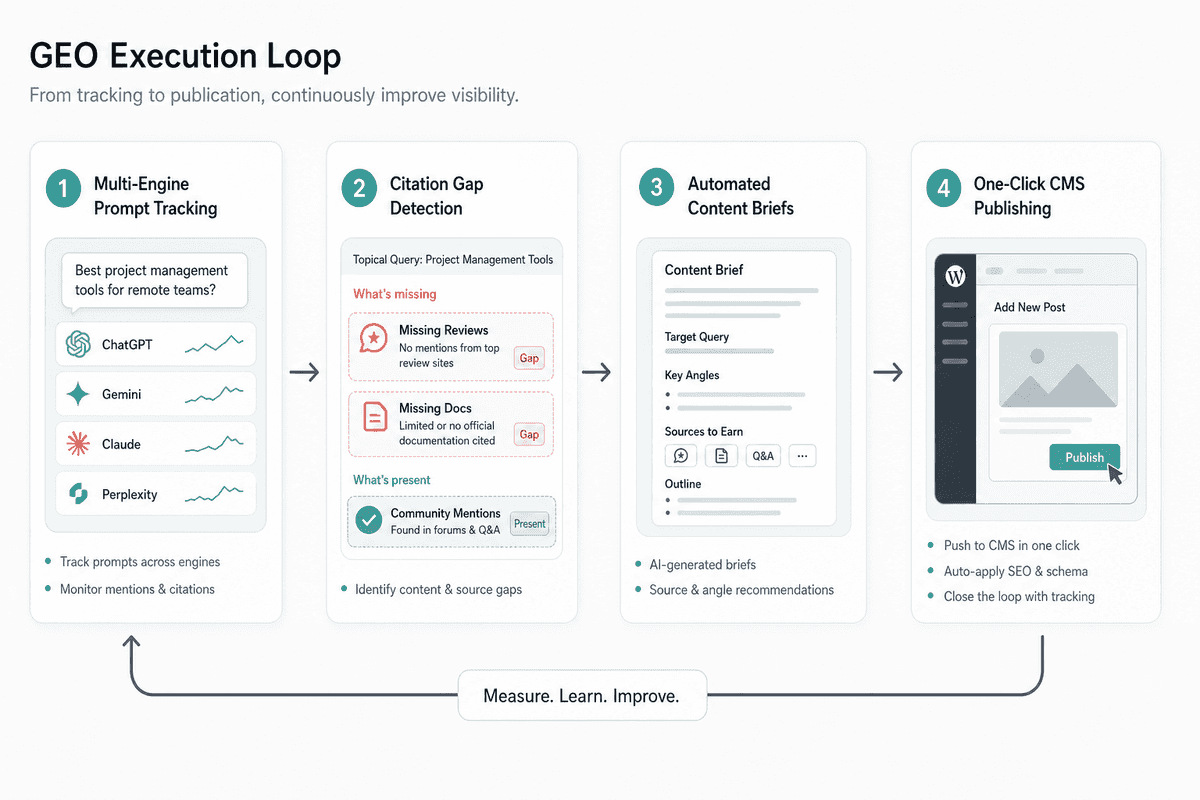
BeVisible approaches generative visibility as an integrated loop: monitoring, gap analysis, and content execution. Rather than treating AI visibility as a disconnected dashboard metric, BeVisible helps growth teams track how AI assistants answer buyer questions, which brands they recommend, and which sources they cite across ChatGPT, Gemini, Perplexity, AI Mode, and Google AI Overviews.
Key Capabilities
- Multi-Engine Buyer Prompt Tracking: Evaluates real-time generative responses across ChatGPT, Gemini, Perplexity, and Google AI Overviews to determine whether your SaaS platform is recommended for high-intent buyer queries.
- Deep Citation and Source Mapping: Identifies the exact third-party blogs, review networks, documentation pages, and community sites engines use as reference material.
- Opportunity Generation: Automatically detects specific prompt losses (e.g., when a competitor is recommended over your software for a key use case) and translates them into evidence-backed content briefs.
- Integrated Review, Scheduling, and Publishing: Bridges the gap between analytics and editorial execution by structuring briefs, facilitating team review, and scheduling content directly to your content management system.
Why SaaS Teams Choose BeVisible
Most analytics dashboards leave marketers stuck in analysis paralysis. BeVisible is designed specifically for teams that must defend their pipeline by turning missing mentions, weak citations, and competitor wins into published, citation-worthy work. By uniting measurement with editorial workflows, it eliminates the lag between discovering an AI visibility deficit and deploying the content required to capture the citation.
2. Profound
Best for: Enterprise corporations requiring high-level LLM governance, brand safety tracking, and large-scale prompt sampling across extensive brand portfolios.
Profound is widely recognized as an enterprise pioneer in LLM brand tracking. According to analysis on MarqOps, the platform focuses heavily on enterprise-scale prompt monitoring, tracking brand share across major frontier models, and evaluating how sentiment changes across massive prompt datasets.
Key Capabilities
- Prompt Volume Sampling: Runs thousands of automated prompt variations across ChatGPT, Claude, Perplexity, and Microsoft Copilot.
- Sentiment and Brand Sentiment Scoring: Categorizes engine answers by sentiment polarity, tracking whether generative outputs present the brand favorably.
- Competitor Share of Voice: Visualizes how often direct rivals appear across broad category prompts.
Trade-offs for SaaS Marketers
While Profound provides extensive historical tracking, it operates primarily as an observational platform. For SaaS teams that require rapid content turnaround, the lack of native content generation and publishing workflows means teams must manually interpret reports and run content production in third-party tooling.
3. AirOps
Best for: Content operations teams looking to build custom AI workflows and scale programmatically generated content grounded in AI search insights.
AirOps has evolved from a prompt orchestration tool into a flexible engine for content operations and AI visibility measurement. As detailed by AirOps, their toolset connects visibility data directly into grid-based workflows, allowing marketing teams to programmatically generate, test, and refresh content based on live search engine queries.
Key Capabilities
- Workflow Orchestration: Connects LLM prompts, live search results, and scraping APIs into automated multi-step data pipelines.
- Programmatic Content Updating: Identifies pages that have lost visibility and refreshes them using structured data inputs and brand guidelines.
- Bulk AI Evaluation: Allows teams to test how different prompts return brand recommendations at scale.
Trade-offs for SaaS Marketers
AirOps is highly flexible, but that flexibility requires significant operational setup. Marketing teams looking for a turnkey, out-of-the-box visibility monitoring dashboard often face a steep learning curve when configuring custom data grids and orchestrations.
4. OtterlyAI
Best for: Early-stage and mid-market SaaS companies seeking an intuitive, straightforward monitoring tool to track brand mentions across AI search engines.
OtterlyAI provides focused monitoring for brands that want to observe their AI visibility without the overhead of enterprise setups. Practitioners cited by Thomas Peham highlight OtterlyAI for its clean interface and automated generative audits that track presence across ChatGPT, Gemini, and Perplexity.
Key Capabilities
- Automated GEO Audits: Runs scheduled scans across critical commercial queries to check if your product is included in top-level lists.
- Citation Discovery: Reports which domains are cited when your brand or competitors are mentioned.
- Automated Alerts: Sends notifications when brand sentiment changes or when a competitor displaces your platform in standard prompts.
Trade-offs for SaaS Marketers
OtterlyAI focuses squarely on reporting. While it excels at delivering clean snapshots of brand positioning, it does not include execution infrastructure to help teams research, draft, or publish the content needed to reclaim lost ground.
5. Peec AI
Best for: International SaaS companies that sell across multiple languages, regions, and localized search engines.
Peec AI has carved out a niche by addressing global and multi-language Generative Engine Optimization. When an enterprise software company needs to evaluate how ChatGPT and Perplexity answer prompts in German, Japanese, Spanish, and English simultaneously, Peec AI provides localized prompt tracking.
Key Capabilities
- Multi-Language Prompt Monitoring: Tracks generative responses across different geographical locations and localized language models.
- Daily Visibility Updates: Provides high-frequency tracking of brand displacement across localized competitor landscapes.
- Regional Citation Mapping: Highlights which local directories, regional media publications, and localized review sites feed regional LLM answers.
Trade-offs for SaaS Marketers
If your SaaS product operates exclusively in single-market English-speaking regions, the multi-language focus may offer more complexity than your team needs for daily content operations.
6. Additional Niche Options: Vismore and Deployhyre
For marketing teams exploring specialized tool stacks, several newer platforms cater to targeted use cases:
- Vismore: Focuses on no-nonsense comparative analytics and framework-driven monitoring for growth marketers, as outlined in their AI visibility comparison guides.
- Deployhyre Toolset: Offers specialized monitoring utilities tailored for technical founders and developer tooling brands that need to evaluate technical documentation authority across LLM retrieval layers, reviewed across AI search visibility lists.
How AI Engines Decide Which SaaS Products to Recommend
To select the right tool, you must understand how generative engines determine which SaaS brands to surface.
Large language models do not simply read meta titles or rank keywords based on backlink volume. In systems like Perplexity, ChatGPT Search, and Google AI Overviews, the engine executes a multi-phase Retrieval-Augmented Generation (RAG) process.
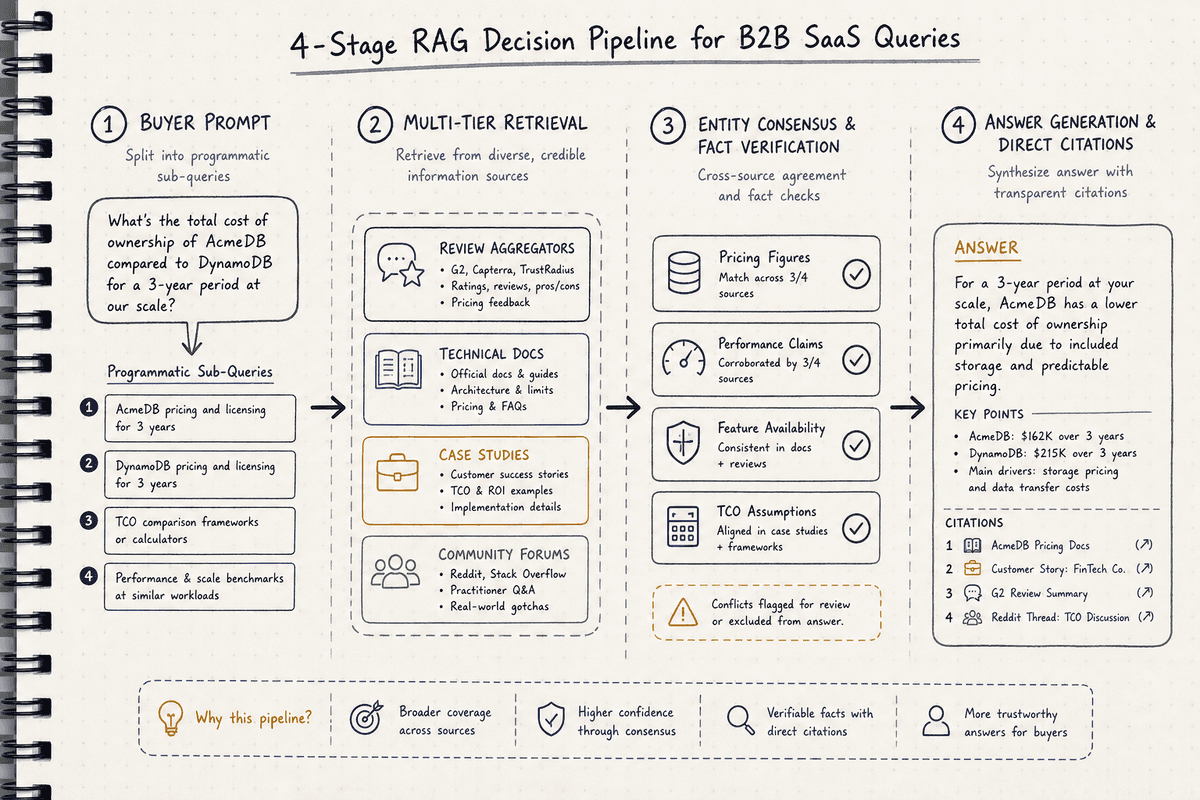
1. Intent Extraction and Sub-Query Generation
When a user asks: "What is the best SOC2 compliance automation tool for a 50-person engineering team?", the engine breaks the query down into several programmatic sub-queries:
- "SOC2 compliance automation platforms mid-market"
- "Top SOC2 tools pricing and engineering integrations"
- "Vanta vs Drata vs Secureframe feature comparison"
2. Retrieval Across Information Clusters
The engine queries live indexes and curated corpora, pulling information from four distinct citation tiers:
- Tier 1: High-Authority Review and Aggregator Platforms (G2, Capterra, Gartner Peer Insights).
- Tier 2: Technical Product Documentation and Public Repositories (API docs, integration guides, changelogs).
- Tier 3: Independent Editorial Comparisons and Case Studies (In-depth teardowns from industry practitioners).
- Tier 4: Community Discussions (Reddit, Hacker News, specialized Slack/Discord community summaries).
3. Synthesis, Verification, and Entity Consensus
The model evaluates consensus across the retrieved documents. If three independent, highly authoritative sources state that "Platform A requires 3 weeks to deploy and integrates natively with AWS," while Platform A's own website makes an unsubstantiated marketing claim, the engine favors the independent consensus.
4. Generation and Citation Placement
The engine produces its structured answer, explicitly linking to the sources that provided the verified facts.
If your AI visibility tool only tracks whether you appeared in the final text without revealing which retrieval tiers failed, your marketing team cannot diagnose why your competitors won the recommendation.
The "Monitoring vs. Execution" Trap: A SaaS Scenario
Consider a scenario from the B2B SaaS ecosystem that illustrates why passive tracking falls short.
A Series B developer-tools SaaS company noticed its incoming demo requests from organic search were dropping 20% quarter-over-quarter. When the growth marketing lead checked Perplexity and ChatGPT for queries like "best automated database migration tools for PostgreSQL," their primary competitor was recommended in 9 out of 10 prompts.
Using a legacy monitoring dashboard, they verified what they already feared: their brand visibility score was a meager 15%, while their competitor held an 85% share of voice.
The dashboard displayed a red downward trend line, but offered no actionable next steps.
When they analyzed the citation graph behind those prompts, the underlying issue became clear:
- Perplexity was repeatedly citing a 2-year-old comparative teardown published on an engineering blog that reviewed legacy versions of both tools.
- ChatGPT Search was pulling technical specifications from a competitor's public documentation page detailing schema migration performance benchmarks.
- The SaaS company had never published a dedicated comparison or performance benchmark addressing those specific PostgreSQL technical requirements.
Armed with these insights, the team took immediate action:
- They published a comprehensive technical benchmark page comparing schema migration speeds across modern databases.
- They updated their integration guides to include clear, machine-readable structured data and schema markup.
- They engaged with the original engineering publication to provide updated platform specifications.
Within six weeks, as AI search crawlers re-indexed the fresh documentation and benchmarks, the platform's citation frequency jumped to 65% across PostgreSQL migration prompts.
Knowing you have a visibility problem is trivial; having the systematic workflow to reverse-engineer citations and publish authoritative answers is what actually drives pipeline. If you are refining your overall content strategy to support these initiatives, reviewing how top teams structure their publications on our list of the 11 Best SEO Blogs Every SaaS Founder Needs can provide valuable editorial inspiration.
4-Step Evaluation Framework: Choosing the Right Tool
When selecting an AI visibility and optimization platform for your marketing team, use this four-step evaluation matrix.
+------------------------------------------------------------------------------------------------------------------------------------------------+
| Evaluation Pillar        | Critical Questions to Ask                                            | What to Avoid                                |
+------------------------------------------------------------------------------------------------------------------------------------------------+
| 1. Engine Parity         | Does it track ChatGPT (browsing), Perplexity Pro, Gemini, and AIO?   | Tools tracking only raw LLM APIs without web.|
| 2. Citation Intelligence | Does it pinpoint the exact URLs, reviews, and docs cited in answers? | Vague "visibility scores" with no citations. |
| 3. Execution Pipeline    | Can your team turn prompt gaps directly into briefs and content?     | Pure analytics tools requiring manual CSVs.  |
| 4. Prompt Customization  | Can you track complex, multi-turn B2B buyer journeys?                | Rigid tools that only accept short keywords. |

+------------------------------------------------------------------------------------------------------------------------------------------------+
1. Verify True Multi-Engine Parity
Large language models behave very differently depending on whether they run with or without web access. A tool that queries the static OpenAI GPT-4o API will produce completely different recommendations than a user asking ChatGPT Search or Perplexity Pro in a live browser. Ensure your chosen platform queries real-time, search-enabled engine configurations.
2. Require Granular Citation Graphing
Never settle for a single composite "Brand Health Score." Demand transparency into the exact source URLs, root domains, and third-party directories the engine parsed to create its summary. If a platform cannot show you the citation sources, you cannot build a strategy to win those citations back.
3. Prioritize Integrated Content Workflows
Evaluate how many clicks and tool transitions it takes to move from identifying a prompt gap to publishing a live piece of content. If your team has to export data, write briefs manually, copy paste into Google Docs, and coordinate separately in your CMS, your turnaround time will be too slow for fast-evolving search models. When creating new assets to capture these citations, structuring them properly with high-converting layouts is essential—for tactical structure, see our guide on How to Build an SEO Landing Page.
4. Insist on Complex B2B Prompt Clustering
B2B software buyers do not search in two-word fragments. They input nuanced requirements: "Compare Cloudflare Workers vs AWS Lambda for a multi-tenant SaaS application handling 50k requests per second." Ensure your platform allows you to monitor long-tail, multi-parameter prompt clusters that reflect genuine enterprise procurement questions.
Frequently Asked Questions (FAQ)
How do AI visibility tools handle non-deterministic answers?
Generative AI models are inherently non-deterministic, meaning they can deliver slightly different wording each time a prompt is submitted. High-grade AI visibility tools handle this by running automated prompt sampling at regular intervals across diverse simulated user contexts. Instead of relying on a single query snapshot, they calculate aggregate probabilities, citation consistency, and sustained brand sentiment over time.
What is the difference between traditional SEO and Generative Engine Optimization (GEO)?
Traditional SEO focuses on optimizing web pages to rank in static 10-blue-link search engine result pages based on keyword density, backlinks, and on-page technical factors. Generative Engine Optimization (GEO) focuses on establishing entity authority, data consensus, and citation trust so that AI synthesis engines select your platform as a recommended solution when answering complex, conversational buyer queries.
Can AI visibility tools guarantee that ChatGPT or Perplexity will recommend my brand?
No platform can ethically guarantee deterministic placement inside an LLM's generated response, as AI models constantly retrain weights and re-evaluate retrieved web context. However, AI visibility platforms provide the precise intelligence needed to win citations: identifying which sources the AI trusts, highlighting factual gaps in your current documentation, and enabling you to publish the authoritative content required to earn engine recommendations.
How quickly do changes to our content impact AI engine recommendations?
For engines with real-time web retrieval (such as Perplexity and ChatGPT Search), updates to high-authority pages, clear technical documentation, and authoritative comparison guides can influence generated answers within days of re-indexing. For core base-model weights that do not rely on live retrieval, changes take effect during subsequent model fine-tuning and retrieval-corpus refreshes.
The Verdict: Upgrading Your AI Discovery Stack
Relying on traditional rank trackers to safeguard your SaaS inbound pipeline leaves your marketing team blind to the channels where modern software decisions are actually made.
While enterprise tools like Profound introduced executive-level visibility monitoring, modern SaaS marketing teams require platforms that close the gap between data collection and content execution. Platforms that simply present red downward charts without execution tools create operational drag.
Winning in generative search requires an active loop:
- Monitor buyer prompts across ChatGPT, Gemini, Perplexity, and AI Overviews.
- Reverse-engineer the citations and consensus documents informing the engine's answers.
- Publish clear, authoritative, highly structured content to resolve visibility gaps.
- Track recommendation gains and defend your market position.
By equipping your growth and content teams with an AI visibility platform that integrates monitoring with rapid publishing, you ensure your software remains visible, cited, and recommended whenever prospective buyers ask for the best solution in your category.