
A B2B buyer is currently typing a prompt into ChatGPT, Gemini, or Perplexity. They are asking for a tool that does exactly what your SaaS product does. Within seconds, the AI assistant outputs a detailed, confident response recommending three vendors.
If your brand is not in that output, you did not just lose a click. You lost the entire evaluation cycle.
In 2026, the buyer journey rarely begins with scrolling past ten blue links on a traditional search engine results page. Instead, buyers rely on AI assistants to synthesize complex software categories, weigh pros and cons, and generate immediate shortlists. This shift to Answer Engine Optimization (AEO) and Generative Engine Optimization (GEO) has created a massive blind spot for SaaS growth teams. Traditional SEO tools measure rankings, search volume, and backlinks. They do not tell you how an LLM perceives your brand, how often you are cited in AI summaries, or whether an AI assistant is actively steering buyers toward your competitor.
To monitor and influence this new ecosystem, SaaS teams need specialized AI visibility tools. While enterprise platforms like Profound have established early dominance in tracking these metrics, relying solely on reporting dashboards is no longer enough. The real challenge isn't just knowing you are missing from ChatGPT's answers—it is knowing exactly what to publish, review, or fix to earn that recommendation next time.
This guide breaks down the mechanics of AI visibility tracking, examines why legacy tools fall short, and reviews the best AI visibility platforms for SaaS beyond the standard enterprise defaults.
Why Traditional SEO Platforms Fail at AI Visibility
If you are a SaaS founder or marketing director, you likely have a robust traditional SEO stack. You track keyword positions, monitor backlink velocity, and audit technical site health. However, these metrics have little correlation with how Large Language Models (LLMs) construct answers.
Understanding the gap between legacy SEO software and AI visibility tools requires looking at how AI assistants process information.
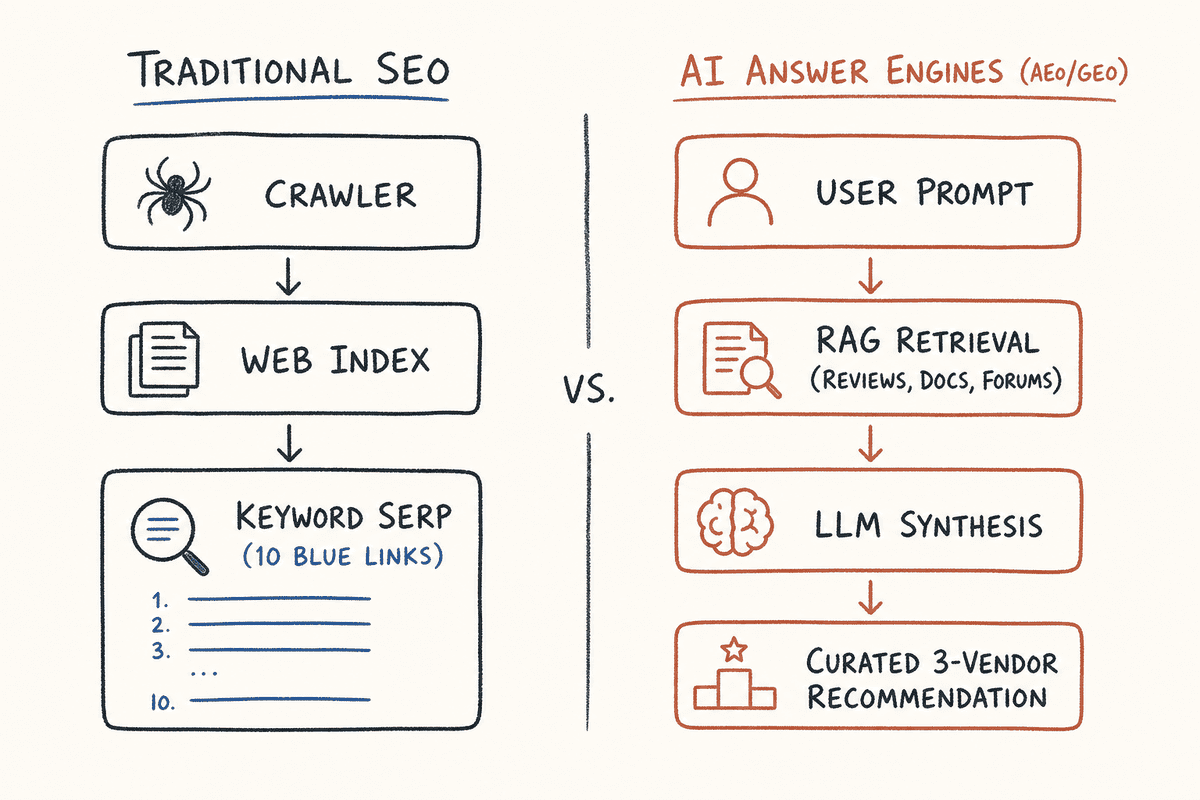
Search Engine Indexing vs. Retrieval-Augmented Generation (RAG)
Traditional search engines use crawlers to index pages, categorizing them based on technical structure, keyword relevance, and link equity. If you want to rank for "best payroll software," you build a comprehensive page, acquire authoritative backlinks, and ensure your site architecture is pristine. (This technical foundation remains important; just as traditional crawlers previously struggled with dynamic content before modern solutions emerged in single-page application SEO, AI crawlers also require accessible text to digest your core offering).
AI assistants operate differently. When a buyer asks Perplexity or Google's AI Overviews for a software recommendation, the system typically uses Retrieval-Augmented Generation (RAG). It performs a semantic search across its indexed data (or the live web) to pull contextually relevant snippets, then feeds those snippets into an LLM to generate a conversational answer.
Traditional SEO tools track whether your page ranks in the traditional index. AI visibility tools track whether your brand makes it through the RAG synthesis and into the final, generated output.
Summarization vs. Listicles
Traditional SEO tools optimize for listicles and individual page rankings. AI visibility tools measure summarized content. An LLM might pull information about your SaaS from a Reddit thread, a G2 review, a competitor's comparison page, and your own documentation, synthesizing it all into a single paragraph.
Legacy tools cannot parse this synthesis. They cannot tell you if the AI mentioned your brand positively, negatively, or as a mere footnote. According to testing methodologies across the industry, tracking these nuances requires platforms explicitly built to simulate user prompts and analyze the generated text [].
The Execution Gap
Perhaps the most significant failure of traditional tools in this context is the lack of specific actionability. If a legacy tool tells you that you dropped from position 3 to position 5 for a keyword, the playbook is standard: update the content, build a few links, check your Core Web Vitals.
If you discover you are completely omitted from ChatGPT's answer for "top inventory management software," the traditional SEO playbook is useless. You need a tool that can diagnose why the AI ignored you—perhaps it relies heavily on TrustRadius reviews you lack, or perhaps your competitor's PR mentions are dominating the AI's training data—and give you a concrete execution plan to fix it.
The Profound Baseline: Strengths and Limitations
When discussing AI visibility for SaaS, it is impossible to ignore Profound. It has rapidly become the default enterprise-grade solution for holistic AI search visibility and answer engine optimization [].
Profound is exceptionally powerful at what it does. It provides massive, sweeping datasets showing how a brand performs across various LLMs. It benchmarks competitive visibility and offers granular data on Answer Engine citations. For Fortune 500 companies with dedicated data science teams and massive marketing budgets, Profound serves as an incredible reporting engine.
However, for B2B SaaS growth teams, mid-market companies, and agile agencies, Profound often introduces a specific set of challenges:
- Dashboard Fatigue: Profound delivers a tremendous amount of data. For a lean growth team, logging into a platform to see thousands of data points regarding AI sentiment and share of voice can be overwhelming. Knowing you have a 12% visibility score in Gemini is interesting, but it does not tell you what your content team should do on Monday morning.
- Lack of Integrated Execution: Profound is a monitoring tool, not an execution tool. It highlights the gaps but leaves the remediation entirely up to you.
- Enterprise Pricing: The cost of enterprise-grade tracking platforms can be prohibitive for early-to-mid-stage SaaS companies that need to allocate budget not just to monitoring, but to actual content creation and technical fixes.
This creates a clear demand for alternatives. SaaS teams need tools that go beyond enterprise reporting. They need platforms that bridge the gap between "here is where you are missing" and "here is the exact published work required to fix it."
The 5 Best AI Visibility Tools for SaaS in 2026
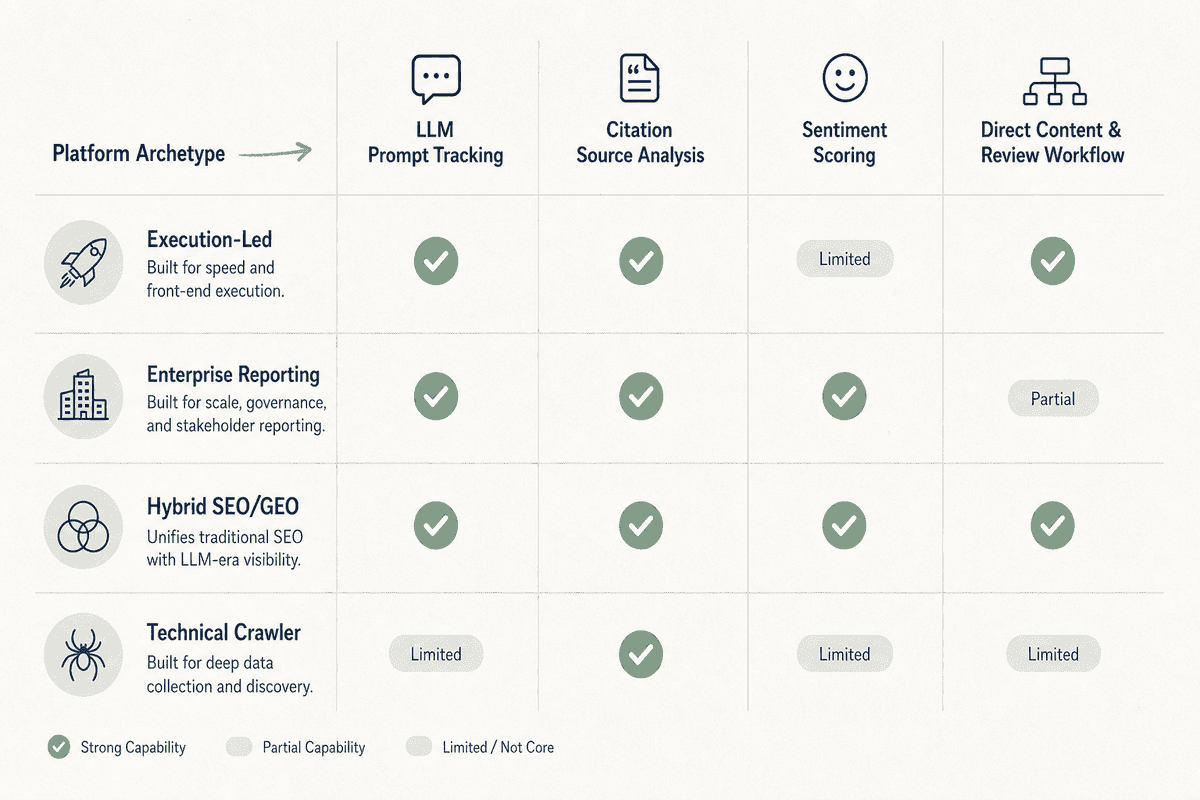
The landscape of AI visibility software has fragmented into distinct categories, ranging from execution-focused workflows to niche citation analyzers. Selecting the right platform depends heavily on your team size, workflow, and specific geographic or linguistic needs [].
Here is a detailed breakdown of the strongest AI visibility tools for SaaS teams moving beyond standard enterprise reporting.
1. BeVisible (Best for Monitoring to Execution)
BeVisible was built specifically to solve the execution gap inherent in first-generation AI tracking tools. Instead of merely providing a dashboard of visibility scores, BeVisible operates as a continuous loop of monitoring, diagnosing, and actionable output.
How it works: BeVisible tracks how top AI assistants—including ChatGPT, Gemini, Perplexity, AI Mode, and Google AI Overviews—answer high-intent buyer questions. You input the core prompts your buyers use (e.g., "What is the best alternative to Salesforce for remote sales teams?").
The platform continuously queries these prompts across multiple LLMs, tracking:
- Which brands are recommended in the answers.
- The exact sources the AI cites to justify those recommendations.
- The sentiment and context of your brand's mentions compared to competitors.
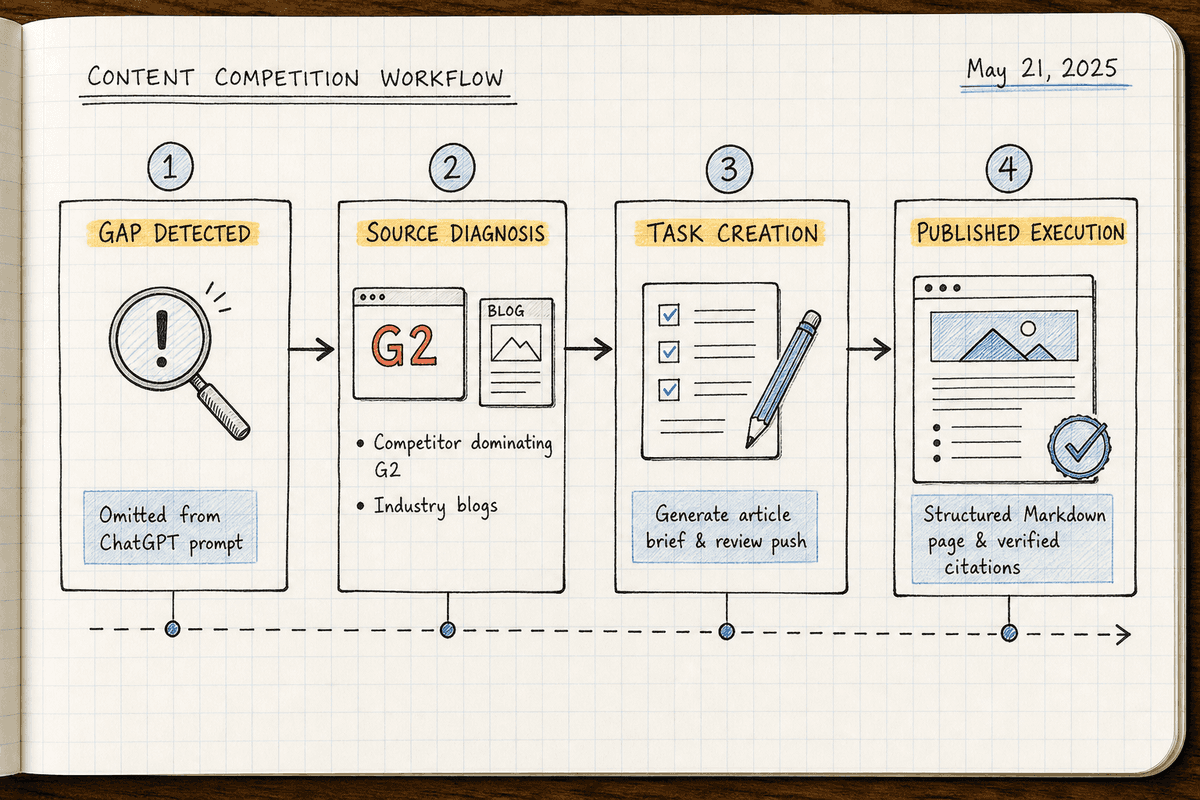
The Execution Workflow: Where BeVisible separates itself is in its output. When the platform detects a visibility gap—for example, Perplexity recommending your competitor because they are frequently cited in recent independent blog posts—BeVisible turns that gap into evidence-backed opportunities.
It generates specific tasks for your growth team:
- Article Opportunities: Identifying exactly what topics your content team needs to publish to provide the raw material the LLM is looking for.
- Review Work: Highlighting which third-party review platforms are feeding the AI's answers, allowing your customer success team to run targeted review campaigns.
- Publishing and Scheduling: Turning these insights into structured, assignable work rather than just a static PDF report.
For SaaS founders and B2B marketing teams that need to turn missing mentions and weak citations directly into published work, BeVisible acts as both the radar and the playbook.
2. Semrush (Best for Hybrid SEO and GEO Teams)
Semrush is a household name in traditional SEO, but their aggressive pivot into Generative Engine Optimization makes them a top choice for teams that want to manage traditional search and AI visibility under one roof.
How it works: Semrush leverages its massive existing infrastructure of backlink data, keyword volume, and site auditing, overlaying AI tracking capabilities. It helps teams monitor how their traditional SEO efforts are translating into AI Overview placements.
Strengths for SaaS:
- Unified Workflows: If your agency or in-house team is already deeply entrenched in Semrush for keyword tracking, keeping AI visibility in the same ecosystem reduces tool sprawl.
- Citation Authority Analysis: Because Semrush has the best backlink database of the tools listed here, they are exceptionally good at showing you the domain authority of the sources that AI assistants are citing. If ChatGPT cites a specific industry blog, Semrush immediately tells you how hard it will be to get a link or mention on that blog.
Tradeoffs: Semrush is still primarily anchored in traditional search engine metrics. Their AI tracking is excellent for Google's AI Overviews, but can sometimes lag behind dedicated, standalone platforms when mapping the deep conversational nuances of ChatGPT or Claude.
3. Peec AI (Best for Citation Analysis and Multi-Language LLMs)
Peec AI has carved out a strong reputation for mid-sized teams that need granular tracking of citations across a wide variety of LLMs. In comprehensive feature matrix comparisons, Peec AI consistently stands out for its specific focus on European multi-language environments and deep citation parsing [].
How it works: Peec AI focuses heavily on the sources feeding the RAG systems. It reverse-engineers the answers provided by LLMs to show you exactly which URLs provided the context. Furthermore, it tracks brand sentiment across these multiple engines.
Strengths for SaaS:
- Multilingual Capabilities: If your SaaS operates globally and you need to know how the French version of ChatGPT perceives your software versus the German version of Gemini, Peec AI is exceptionally capable.
- Sentiment Tracking: It doesn't just track mentions; it analyzes the adjectives and context surrounding your brand to ensure the AI isn't recommending you with heavy caveats.
Tradeoffs: Peec AI is highly analytical. It provides a phenomenal breakdown of what is happening [], but like Profound, requires your team to build the operational workflow to respond to the data.
4. Writesonic GEO (Best for Content Marketing Teams)
Writesonic originally made its mark as an AI content generation tool. With Writesonic GEO, they have created a platform that blends AI-friendly content optimization with direct visibility tracking.
How it works: This tool is built for the writer. It analyzes the current outputs of top LLMs for your target prompts and then acts as an active assistant in the content creation process. It scores your drafts based on how likely they are to be retrieved and cited by an AI assistant.
Strengths for SaaS:
- Direct Optimization: It takes the guesswork out of formatting content for AI ingestion. It will suggest structural changes, entity inclusions, and semantic phrasing that LLMs prefer.
- Speed to Market: If your content team needs a tool that actively helps them write better GEO-optimized content rather than just reporting on past performance, this is a strong contender.
Tradeoffs: It leans heavily into content creation rather than holistic brand visibility. If your visibility problem stems from a lack of third-party reviews, PR mentions, or competitor domination on external forums, optimizing your own blog posts through Writesonic won't solve the underlying issue.
5. Botify (Best for Large-Scale SaaS Technical Analytics)
Botify is traditionally an enterprise technical SEO platform, but its evolution into tracking AI crawler analytics makes it vital for massive SaaS websites—think platforms with tens of thousands of programmatic pages, user-generated content, or massive knowledge bases.
How it works: Botify monitors log files to track exactly how, when, and where AI bots (like OpenAI's crawlers, Googlebot-Extended, and Perplexity's bots) are hitting your site.
Strengths for SaaS:
- Crawl Budget Management: If you run a massive SaaS directory, knowing that OpenAI is actually crawling your pages is the first step to visibility. Botify provides undeniable proof of AI ingestion.
- Technical Remediation: It identifies technical roadblocks—like JavaScript rendering issues or poorly structured schema—that prevent AI from understanding your content.
Tradeoffs: Botify does not track the output of the LLM. It tells you that ChatGPT read your page, but it doesn't tell you if ChatGPT actually recommended your product to a user. It is a prerequisite tool for technical health, but not a complete visibility suite.
Core Metrics: What SaaS Teams Must Measure in AI Search
If you are transitioning your team from traditional SEO reporting to AI visibility tracking, you need a new vocabulary. The metrics that matter have fundamentally changed. When evaluating any of the tools above, ensure they can accurately track and report on these three core KPIs.
1. Share of Model (SoM) / Share of Voice
In traditional SEO, Share of Voice was often calculated by multiplying ranking position by estimated search volume. In the AI era, Share of Model measures the frequency with which your brand is mentioned across a set of diverse, relevant prompts within a specific LLM.
If a buyer asks ChatGPT 10 different variations of "how to automate B2B invoicing," and your SaaS is recommended in 4 of those answers, your Share of Model for that prompt cluster is 40%. Tracking this across different LLMs (e.g., you might have 40% in ChatGPT but 0% in Perplexity) is the baseline for any visibility campaign.
2. Recommendation Rate and Sentiment
Visibility is not always positive. An AI assistant might mention your brand as a cautionary tale, or highlight a specific negative feature based on an outdated Reddit thread.
- Mention: The AI stated your brand name.
- Citation: The AI linked to your website or a third-party source about you.
- Recommendation: The AI explicitly offered your software as a viable solution to the user's query.
Your AI visibility tool must differentiate between these states. A high mention rate with a low recommendation rate indicates a sentiment problem in the training data or RAG retrieval sources.
3. Citation Source Authority
When an AI recommends your competitor, where did it get the information? This is the most actionable metric a tool can provide.
LLMs do not invent recommendations in a vacuum; they pull from trusted digital sources. If Perplexity constantly cites a specific G2 comparison grid, a detailed review on a niche industry blog, and a specific YouTube video transcript when recommending your competitor, those are your target properties. You need to know the authority and origin of every citation to build your counter-strategy.
The Execution Playbook: Turning AI Gaps into Published Work
Monitoring AI visibility is only the diagnosis. The cure requires a fundamentally different approach to content creation and digital PR. When a tool like BeVisible alerts you to a visibility gap, here is the playbook for turning that data into revenue-driving execution.
Step 1: Diagnose the "Why" Behind the Omission
When your SaaS is missing from an AI answer, it is usually due to one of three reasons:
- The Information Void: The AI simply doesn't have enough clear, authoritative information about your specific features to confidently recommend you.
- The Competitor Echo Chamber: Your competitors have aggressively saturated third-party sites, review platforms, and forums with their messaging, drowning out your brand in the RAG retrieval process.
- The Format Failure: You have the right information on your site, but it is buried in un-crawlable PDFs, complex JavaScript without server-side rendering, or unstructured marketing fluff that an LLM cannot easily parse.
Step 2: Build AI-Optimized Landing Pages
If the issue is an information void or a format failure, you need to create destination assets that feed the LLM exactly what it wants: structured, objective, and dense information.
LLMs favor high information density. They want features, pricing, integrations, and limitations laid out clearly. When building an SEO landing page designed for AI visibility, abandon the vague marketing copy.
Best Practices for AI-Targeted Pages:
- Use Markdown-style structures: Clear H2s, H3s, bullet points, and standard HTML tables.
- Include distinct entities: Don't just say "integrates with CRM." Say "two-way native integration with Salesforce CRM, HubSpot, and Pipedrive." LLMs map relationships between specific entities.
- Answer the exact prompts: If the AI is failing to answer "What are the limitations of [Your Brand]?", write a section on your site detailing exactly who your software is not for. LLMs value objective transparency and will frequently cite brands that honestly state their ideal customer profile.
Step 3: Influence the Third-Party Citations
If the AI is retrieving its answers from third-party sites (which is incredibly common for Perplexity and Google AI Overviews), optimizing your own site isn't enough. You have to optimize the echo chamber.
Look at the citation data provided by your AI visibility tool.
- Are they pulling from Reddit? Your developer relations or community management team needs a strategy for authentic participation in those subreddits.
- Are they citing Capterra or G2? You need a targeted campaign to generate fresh, detailed reviews that mention the specific keywords and features the AI is looking for.
- Are they citing a specific industry blog's "Top 10" list? You need your PR or outreach team to contact that publication and negotiate inclusion.
This is where the concept of execution truly matters. Finding the gap requires the software; fixing the gap requires coordinated, cross-departmental marketing work.
Building an AI Visibility Tech Stack on a Budget
A common misconception among SaaS founders is that entering the AI visibility game requires a massive enterprise software budget. While tools like Profound command enterprise pricing for sweeping holistic data, agile teams can build highly effective execution stacks for a fraction of the cost.
The Lean AEO Stack
You do not need to track every conceivable prompt across every language model on day one. Start lean.
- The Core Tracker (e.g., BeVisible): Invest in a tool that focuses on high-intent buyer prompts and directly outputs actionable tasks. This replaces the need for a bloated reporting dashboard and directly feeds your content calendar.
- Your Existing SEO Platform: Continue using tools like Ahrefs or Semrush for technical site health and traditional backlink monitoring. Ensure your foundational SEO is flawless so AI crawlers don't hit technical roadblocks.
- A Workflow Management System: Whether it's Jira, Asana, or Linear, integrate your visibility tool's output directly into your existing sprint planning.
Automation vs. Agency Execution
As you scale your AI visibility efforts, you will face a familiar choice: handle the execution in-house using automated tools, or hire an agency to manage the digital PR and content creation.
The dynamics of this choice are shifting. Just as we have seen in debates over standard SEO charges in the UK and elsewhere regarding agency rates versus automation, AI visibility demands a hybrid approach. Automated tools are essential for monitoring the volatile, constantly shifting outputs of LLMs. No human team can manually query ChatGPT 50 times a day to track sentiment shifts.
However, the execution—writing the authoritative content, negotiating the third-party mentions, and managing the review campaigns—still requires skilled human practitioners. The most cost-effective approach for SaaS teams in 2026 is to use a tool like BeVisible to automate the diagnosis and generate the exact brief, then hand that highly specific brief to an in-house content marketer or a specialized agency to execute.
Overcoming Common AI Visibility Failure Modes
As SaaS teams rush to optimize for AI assistants, many fall into predictable traps. Avoid these common failure modes to ensure your visibility strategy generates actual pipeline, rather than just noise.
1. Hallucination Chasing
LLMs hallucinate. Occasionally, an AI assistant will output a wildly inaccurate answer, recommending a defunct competitor or inventing a feature your software doesn't have.
A major failure mode is treating every single prompt variation as a crisis. If you see a bizarre output, do not immediately upend your content strategy. Look for patterns. Is the AI consistently making the same error across multiple days and varying prompt temperatures? If yes, it is a data issue you must address. If it was a one-off hallucination, ignore it. Quality AI visibility tools track data longitudinally to filter out these anomalies.
2. The "Keyword Stuffing" Revival
Some marketers believe that simply repeating phrases like "Best AI tool" or "Highly recommended by experts" on their site will trick the LLM into recommending them. This does not work.
LLMs use semantic understanding, not crude keyword matching. They evaluate the depth, coherence, and contextual relevance of the information. Stuffing your pages with disjointed keywords will actually harm your visibility, as the LLM will struggle to parse the logical structure of your claims. Focus on entity relationships and clear, factual density.
3. Ignoring the "Real-Time" Component
Search engines update their indexes continuously. LLMs have training data cutoffs, but they augment this with real-time web search (RAG).
A common mistake is assuming that because an LLM's base training data is six months old, you cannot influence it today. Tools like Perplexity and Google's AI Overviews heavily bias recent, authoritative content retrieved during the live query. If you launch a major new feature, publishing a highly structured, technically sound press release and comprehensive documentation can influence AI answers within hours, not months.
FAQs About AI Visibility Tools for SaaS
What is the difference between Generative Engine Optimization (GEO) and Answer Engine Optimization (AEO)? While often used interchangeably, AEO typically refers to optimizing for direct-answer engines (like Perplexity or ChatGPT), focusing on being the recommended solution in a conversational output. GEO is a broader term that encompasses optimizing content so that generative AI models understand, retrieve, and synthesize it accurately, which includes Google's AI Overviews embedded in traditional search.
How long does it take to improve AI visibility after publishing new content? It depends on the engine. For real-time RAG systems like Perplexity or Google AI Overviews, a newly published, highly authoritative page can be cited within days or even hours if the engine decides to crawl it during a live user query. For core LLM recommendations that rely on base training data, it can take months for the model to be updated with new foundational knowledge.
Can I just use Google Search Console to track AI visibility? No. Google Search Console will show you impressions and clicks from Google Search, and it has slowly integrated some reporting for AI Overviews. However, it will not tell you if ChatGPT recommended you, how Gemini summarized your pricing page, or what third-party sources Perplexity is citing instead of your website. Comprehensive visibility requires third-party tracking tools.
Do AI visibility tools track private or logged-in user prompts? No. AI visibility tools simulate typical buyer prompts using their own infrastructure. They do not have access to the private chat histories of real users. They run controlled experiments (sending hundreds of targeted prompts through APIs or browser simulations) to establish a statistically significant baseline of how the AI typically responds to a specific query.
The Future of SaaS Pipeline
The transition from traditional search to AI-assisted discovery is no longer a future prediction; it is the current reality of B2B SaaS procurement. Buyers are bypassing marketing sites and going straight to the LLMs for unfiltered, synthesized recommendations.
While enterprise platforms have paved the way for massive data collection in this space, the next phase of AI visibility is entirely about execution. Identifying that you have a 0% Share of Model in ChatGPT is only useful if your tools tell you exactly what content to write and what citations to build to fix it. By moving beyond passive reporting and integrating tools that turn visibility gaps into published work, SaaS growth teams can ensure they remain exactly where they need to be: in the final, generated shortlist.