
Type your startup’s primary use case into Perplexity or ChatGPT right now. If your brand doesn’t appear in the output, or worse, if a direct competitor is positioned as the default recommendation, you are already losing market share to AI search.
Founders are rapidly realizing that traditional search engine optimization (SEO) tracking tools do not accurately reflect how large language models (LLMs) synthesize information. A tool that tracks your Google ranking for "best CRM for agencies" tells you nothing about whether Gemini recommends your software when a user prompts, “What CRM should I use for a 10-person marketing agency that needs heavy Zapier integrations?”
This shift has created an entirely new software category: Answer Engine Optimization (AEO) or Generative Engine Optimization (GEO) platforms. Startups need software to track brand mentions, analyze AI-generated citations, and monitor visibility across ChatGPT, Gemini, Perplexity, and Google’s AI Overviews.
Right now, a platform called Profound (formerly Otterly AI) is dominating the conversation around AEO. They have marketed heavily to early adopters, but a robust AEO strategy requires more than a single dashboard. You need tools that not only monitor your visibility but also help you execute the content, PR, and technical changes required to manipulate those AI answers.
Here is a deep look at the best answer engine optimization software available to founders, why you might need tools beyond Profound, and how to build a tech stack that turns AI visibility gaps into revenue.
Why the AI Search Shift Requires New Software
Large language models do not retrieve information the same way traditional search indexes do. When a user queries an AI assistant, the system typically uses Retrieval-Augmented Generation (RAG). The AI searches a real-time index, retrieves a handful of source documents, and synthesizes an answer on the fly.
If your brand is not mentioned in the specific articles, Reddit threads, or G2 review pages the AI chooses to retrieve, you do not exist in that query.
Attempting to track this manually is a failure mode for growing startups. AI outputs are highly personalized, subject to caching, and fluctuate based on minor variations in the prompt. You cannot manually type fifty buyer prompts into four different AI engines every week and maintain a reliable spreadsheet of your visibility. You need programmatic tracking.
 Founders who are serious about maintaining their organic pipeline need AEO software to solve three specific problems:
- Prompt Tracking: Monitoring highly specific, long-tail buyer questions rather than generic keywords.
- Sentiment and Context Analysis: Understanding how the AI describes your product. Is it hallucinating your pricing? Is it claiming you lack a crucial feature?
- Source Attribution: Identifying exactly which underlying URLs the AI is citing when it recommends a competitor.
Keeping up with these shifts is a full-time job. While you can follow the 11 Best SEO Blogs Every SaaS Founder Needs (2026) to stay informed on the theory, operationalizing that theory requires dedicated software.
Core Capabilities of a Modern AEO Platform
Before committing to an AEO platform, you need to understand the distinct features that separate basic mention trackers from enterprise-grade visibility suites. Many early-stage AEO tools are essentially wrappers around the Perplexity API, offering little more than automated screenshots. To actually influence AI recommendations, your software stack needs to facilitate action.
Share of Voice (SOV) in Generative Answers
Traditional SOV calculates how often you appear in top search results. Generative SOV calculates how often your brand is mentioned across a matrix of AI responses to a specific set of prompts. The best tools will visualize whether your brand is presented as the primary recommendation, a secondary alternative, or omitted entirely.
Citation Source Mapping
If ChatGPT recommends your competitor, you need to know why. Advanced AEO software maps the AI's output back to its training data or RAG sources. If the AI is recommending a competitor because it pulled data from a specific Capterra listicle or a high-ranking Quora thread, you need software that surfaces that exact URL. This allows your content team to target those specific secondary platforms.
Execution and Workflow Integration
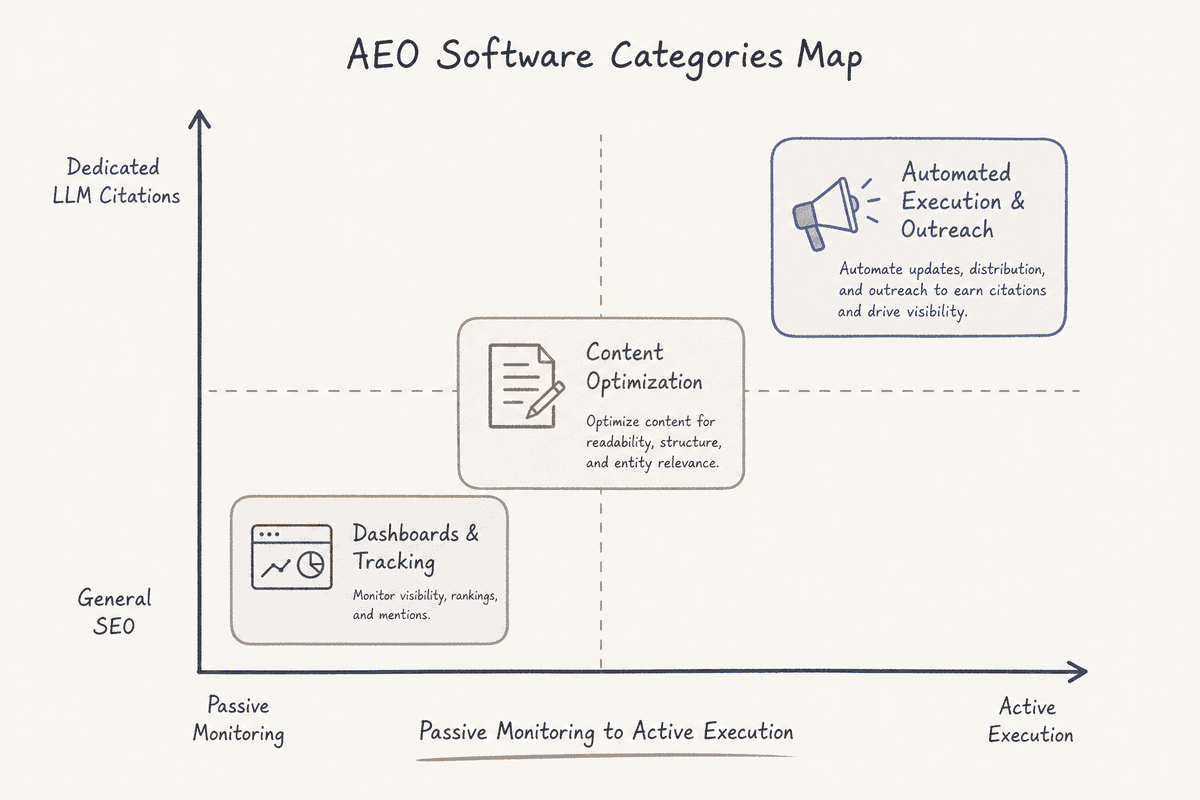
Dashboards don't generate traffic; published content does. The primary limitation of the first wave of AEO tools is their focus on reporting over execution. A complete platform should take a visibility gap—such as the AI falsely claiming you don't offer API access—and instantly spin up a workflow to publish documentation, update review profiles, or schedule PR distributions that correct the LLM's context.
Top Answer Engine Optimization Software for Founders
The AEO software market is currently split into monitoring platforms, content optimization tools, and execution-focused systems. Depending on your startup's stage, you will likely need a combination of these platforms.
BeVisible
Best for: AI visibility monitoring and content execution Focus: Turning visibility gaps into published work
BeVisible is built specifically for SaaS founders, B2B marketing teams, and agencies that need to move beyond passive monitoring. While many tools stop at alerting you to a drop in AI visibility, BeVisible connects the diagnostic data directly to execution.
The platform tracks your brand across ChatGPT, Gemini, Perplexity, AI Mode, and AI Overviews. You input the specific, conversational prompts your buyers use (e.g., "What is the best alternative to Salesforce for a manufacturing company?"), and BeVisible monitors exactly how these engines answer. It tracks which brands they recommend and, crucially, which sources they cite to justify those recommendations.
Where BeVisible differentiates itself is the action layer. When the software identifies a missing mention, a weak citation, or a competitor win, it doesn't just put it on a graph. It turns those visibility gaps into evidence-backed opportunities. The platform facilitates the creation of targeted articles, review management campaigns, scheduling, and publishing work designed specifically to feed the AI engines the exact context they are currently missing.
Profound (formerly Otterly AI)
Best for: Quick dashboards and budget-conscious teams Focus: Generative engine optimization tracking
Profound has become the default starting point for many founders due to aggressive marketing and a low barrier to entry. If you are a resource-constrained startup looking to dip your toes into AI tracking, Profound offers plans that make marketing in the age of AI more accessible.
The platform is designed around intuitive dashboards that provide simple mention tracking and quick AI search visibility audits. You can input your core topics, and the tool will show you your brand's presence across different engines. According to their own positioning, they aim to be one of the best generative engine optimization tools for teams that need minimal setup.
However, Profound is primarily a reporting tool. It will tell you that you are losing to a competitor in ChatGPT, but it leaves the strategy and execution entirely up to your marketing team. For founders who just need a pulse check on their visibility, it is a highly effective, approachable option.
Frase
Best for: Content optimization and writing workflows Focus: Dual SEO and GEO scoring
Frase has successfully pivoted from a traditional SEO brief generator to what they call an agentic SEO and GEO platform. While monitoring tools track your brand mentions, Frase is designed to help you write the content that the AI engines actually cite.
When you create content in Frase, the platform uses dual scoring. It evaluates your draft against traditional search metrics (keyword frequency, heading structure) while simultaneously scoring it for answer engine optimization. This means it checks if your content is structured in a way that RAG systems can easily parse—favoring direct answers, clear definitions, and high information density.
Frase is highly effective for content teams that are already producing a large volume of blog posts and want to ensure those posts are optimized for both Google's traditional index and AI retrieval systems.
Visby AI
Best for: Ease of use and competitor frequency analysis Focus: High-level AI brand tracking
Visby AI frequently tops software directories for usability. It is highly rated as the easiest platform to navigate for founders who do not have a deep background in search engine optimization.
Visby focuses heavily on competitor frequency. It allows you to map out your entire competitive landscape and see precisely how often you are mentioned compared to your rivals across various AI engines. If you need to report to investors on your market share within AI search, Visby provides clean, exportable data that is easy to understand. As noted in software directories, it consistently ranks as a high performer in the answer engine optimization category.
HubSpot AEO Grader
Best for: Enterprise ecosystems and sentiment tracking Focus: Quick auditing and marketing hub integration
HubSpot has introduced AEO features into its broader marketing suite. The most notable tool for founders is the HubSpot AEO Grader, a specialized module designed to track how a brand is perceived in AI engines.
Unlike pure mention trackers, HubSpot attempts to evaluate the sentiment of the mentions. It tells you not just if an AI recommended you, but whether it described your product positively, neutrally, or negatively. It also provides a list of actionable recommendations for improvement. While it may lack the depth of dedicated standalone AEO platforms, it is an excellent addition if your startup is already deeply entrenched in the HubSpot ecosystem.
Goodie AI
Best for: Misinformation scanning and context correction Focus: Brand accuracy in LLMs
Goodie AI approaches AEO from a slightly different angle. Rather than just tracking rankings or recommendations, it scans AI-generated answers specifically for misinformation, missing context, or outdated brand details.
If your startup recently changed its pricing model, pivoted its core feature set, or rebranded, LLMs will often continue to serve the old information for months because their training data and retrieved sources are stale. Goodie AI helps you identify exactly which engines are hallucinating outdated facts about your company, allowing you to launch targeted campaigns to correct the record. They are frequently mentioned as a vital tool in comprehensive AEO tool guides.
Comparing the Stack: AEO Tool Capabilities
Moving Beyond Profound: The Execution Gap
Profound is winning the top-of-funnel search visibility for AEO tools, and for good reason—it’s an accessible, well-designed reporting layer. But relying solely on Profound creates an "execution gap" for founders.
Knowing that Perplexity prefers a competitor is only step one. Step two is diagnosing the data sources Perplexity is using. Step three is creating the digital assets required to change that preference.
If Profound shows that you are missing from ChatGPT's response for "best inventory management for Shopify," you cannot simply log into ChatGPT and ask it to change its mind. You have to feed the ecosystem. This might mean:
- Publishing a highly structured, data-rich comparison page on your own domain.
- Generating reviews on G2 or Capterra that specifically mention the keywords ChatGPT is associating with the prompt.
- Answering questions on Reddit or Stack Overflow where AI engines frequently pull real-time consensus data.
This is where platforms like BeVisible become necessary. By bridging the gap between monitoring and execution, you prevent your marketing team from staring at a red dashboard without a clear path to turning it green. The software should tell you what to write, where to publish it, and when to schedule the updates based on the exact citations the AI is favoring.
Technical AEO: The SPA Crawlability Problem
A major blind spot for founders transitioning to AEO is technical crawlability. You can have the best content optimization software in the world, but if the bots deployed by OpenAI, Google, and Anthropic cannot parse your website, you will never be cited.
Many modern SaaS platforms are built as Single-Page Applications (SPAs) using frameworks like React, Vue, or Angular. These frameworks rely heavily on client-side JavaScript to render content.
Traditional search engines like Google have spent years perfecting their ability to render JavaScript, though it still causes delays. AI search bots are often less sophisticated at rendering complex, client-side JavaScript apps. If an AI crawler hits your site and only sees a blank HTML shell waiting for JavaScript to execute, it will simply move on, and your startup will be excluded from the RAG index.
If your startup's marketing site is an SPA, you must prioritize server-side rendering (SSR) or dynamic rendering. You cannot rely on AEO content strategies until the technical foundation is sound. For a deep dive into solving this specific rendering issue, review this 5-Step Guide to SEO for Single Page Applications.
Furthermore, you need to ensure that your meta data, schema markup, and internal linking are flawless without requiring user interaction to load. If you are unsure if your tech stack is holding back your AI visibility, check out what works in 2026 for Single-Page Application SEO and run a technical audit against the SEO for Single Page Applications Technical Checklist.
Building Your Startup's AEO Tech Stack: A Scenario
Consider a bootstrapped B2B SaaS founder launching a new tool for asynchronous team communication. They know they need to compete with Slack and Microsoft Teams, but they lack the budget for traditional enterprise SEO. They decide to lean heavily into AI visibility, targeting long-tail prompts like "What are the best async communication tools for remote teams with extreme time zone differences?"
Here is how they might construct their AEO tech stack:
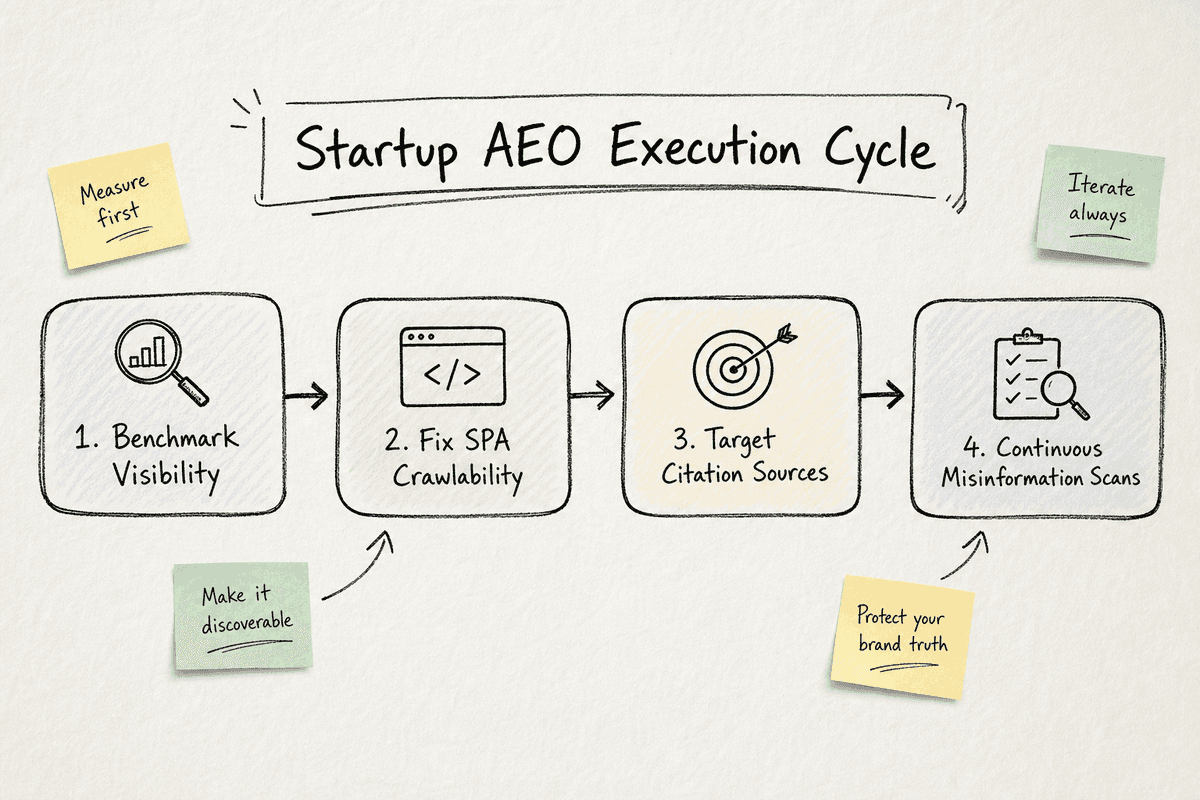
Phase 1: Baselines and Benchmarking (Visby AI & Profound) The founder starts by using Visby AI to map the landscape. They input 50 long-tail buyer prompts. The data shows that ChatGPT almost exclusively recommends standard tools, but Perplexity occasionally cites niche blog posts recommending async alternatives. They keep a lightweight Profound subscription active to monitor their high-level generative share of voice month over month.
Phase 2: Technical Foundation Check
The founder realizes their site is a React SPA. They implement server-side rendering to ensure the ChatGPT-User and PerplexityBot user agents can actually read their feature pages.
Phase 3: Execution and Optimization (BeVisible & Frase) The dashboard data isn't enough. The founder deploys BeVisible to track the exact sources Perplexity is citing when it recommends alternatives. BeVisible identifies that Perplexity is pulling heavily from a specific Reddit thread and a Capterra listicle.
Using BeVisible's execution workflow, the founder organizes a campaign to get their product mentioned in similar contexts. Simultaneously, they use Frase to write highly optimized, data-dense blog posts on their own site—answering the exact prompt criteria the AI engines are looking for. They structure these posts with clear definitions, bulleted lists, and markdown tables, which LLMs prefer for RAG retrieval.
Phase 4: Course Correction (Goodie AI) Six months later, the product introduces a massive price cut. The founder uses Goodie AI to scan the AI engines and discovers Gemini is still quoting the old, expensive pricing. They launch a targeted PR distribution to seed the new pricing into the news ecosystem, forcing the AI to update its RAG index.
Common Mistakes Founders Make with AI Search Visibility
The rush to optimize for AI search has led to several recurring failure modes among startup marketing teams.
Treating AEO like traditional keyword stuffing AI models do not care about keyword density. They care about semantic relevance, information density, and consensus. Repeating "best SaaS billing software" ten times on a page will not force ChatGPT to recommend you. Instead, you need to provide unique, verifiable statistics, clear definitions, and structured data that the LLM recognizes as high-authority context.
Ignoring third-party consensus You do not control your AI search destiny entirely on your own domain. If you publish a page claiming you are the best tool, but Reddit, G2, Trustpilot, and major industry blogs say your competitor is better, the AI will side with the consensus. AEO software must be used to track what other sites the AI trusts, so you can go optimize your presence on those third-party platforms.
Chasing vanity prompts Founders often track their brand name or highly generic prompts (e.g., "AI marketing tool"). If a user is prompting an AI with your brand name, they already know who you are. The real revenue lies in tracking conversational, problem-aware prompts. Optimize for the specific, painful questions your ideal customer asks when they don't know a solution exists yet.
Frequently Asked Questions
What is the difference between AEO and GEO?
Answer Engine Optimization (AEO) and Generative Engine Optimization (GEO) are largely synonymous terms used by different software vendors. Both refer to the practice of optimizing digital assets so that AI models (like ChatGPT, Gemini, or Perplexity) retrieve and recommend your brand in their generated responses.
Can I automate my AEO tracking completely?
Yes, monitoring can be fully automated using tools like BeVisible, Profound, or Visby AI. You provide the prompts, and the software runs them on a schedule, tracking the outputs. However, the execution of AEO—creating the content and shaping the consensus required to change those outputs—still requires human strategy and high-quality content production.
How long does it take to influence AI answers?
Unlike traditional SEO, which can take months for a new page to climb the rankings, AI search can sometimes be influenced in a matter of days if the AI engine is using real-time web search (like Perplexity or ChatGPT with web browsing enabled). If you publish a highly relevant, authoritative source that the RAG system picks up during a live crawl, your brand can instantly appear in the generated answer. However, altering the underlying weights of the LLM's base training data takes significantly longer and relies on broad, sustained brand visibility across the web.
The era of relying solely on ten blue links is ending. Founders who adopt comprehensive AEO software now—moving past simple dashboards to actual execution—will capture the early-adopter traffic that their competitors are ignoring. Use monitoring tools to find your blind spots, but ensure your stack includes the execution capabilities required to actually claim your share of the AI response.