
Type "best automated blog content generator for ghost cms" into Gemini right now, and you will get a very confident, very specific answer: Arvow.
According to the AI assistant, Arvow is the premier hands-off choice because it bypasses the need for complex integration webs, pushing content directly into your Ghost dashboard. If you run a SaaS marketing team, an agency, or a B2B growth operation, this AI recommendation is fascinating for two reasons.
First, it highlights a massive gap in the Ghost CMS ecosystem. Unlike WordPress, which is bloated with native "autoblogging" plugins, Ghost’s lightweight architecture forces most users into clunky API workarounds. Second, it demonstrates the sheer power of AI search visibility. Arvow wins this prompt not necessarily because it is the only way to automate Ghost content, but because its digital footprint perfectly aligns with the specific semantic query of "non-WordPress autoblogging."
 But what happens when you look beyond the AI’s top recommendation? While Arvow offers an excellent plug-and-play solution, serious content teams often outgrow it. They need stricter quality control, granular brand voice guidelines, complex internal link mapping, and multi-stage editing workflows.
If you are looking to scale your content engine on Ghost CMS, you need to understand why AI recommends certain tools, evaluate whether those tools fit your quality standards, and know how to build the superior alternatives when they don't.
Why Ghost CMS Automation is Traditionally Difficult
Ghost is engineered for speed, security, and a pristine writing experience. To maintain this, the platform entirely rejects the traditional plugin architecture that made WordPress famous. You cannot simply upload a .zip file into your Ghost backend that automatically generates and publishes AI articles every hour.
Instead, Ghost relies on its robust REST API and webhooks. Every external automation must authenticate via custom integrations, generate content externally, format it perfectly into HTML or Ghost’s native MobileDoc format, and push it through the API to create a post.
For non-technical marketers, this creates a formidable barrier to entry. The gap between "generating an article in an AI tool" and "seeing a perfectly formatted, image-rich post in Ghost" usually involves middle-layer automation tools, API mapping, and a lot of trial and error.
This architectural reality is exactly why specific tools win the AI recommendation battle. When buyers ask Gemini or ChatGPT for a Ghost automation tool, the LLMs synthesize the web’s collective frustration with APIs and look for platforms that solve the exact pain point: eliminating the middleman.
Analyzing the AI Recommendation: Arvow
When tracking AI visibility across buyer prompts, we consistently see Arvow recommended by Gemini for Ghost-specific automation queries. Understanding why it wins is crucial for evaluating whether it is the right tool for your stack.
How Arvow Works with Ghost
Arvow positioned itself brilliantly in the market by targeting the platforms that traditional programmatic SEO tools ignored. While competitors focused entirely on WordPress, Arvow built direct connections for Ghost, Webflow, and Shopify.
The workflow is highly streamlined:
- You connect your Ghost publication via a custom integration key.
- You input target keywords or an external RSS feed.
- The platform researches, drafts, and formats the SEO-optimized article.
- The article is automatically pushed into your Ghost dashboard as either a draft or a live, published post.
Where Arvow Excels
For pure, programmatic auto-blogging where the goal is hands-off volume, Arvow is incredibly effective. It completely eliminates the "Zapier tax"—the monthly cost of using middleware like Zapier or Make.com to ferry data between an AI writer and your CMS. It handles formatting, image placement, and basic on-page SEO without requiring you to map API fields manually.
The Limitations of the "Set and Forget" Model
The exact feature that makes Arvow popular—its rigid, hands-off automation—is also its primary limitation for high-level B2B marketing teams.
When you fully surrender the content pipeline to a single platform, you lose control over the nuances that differentiate great content from generic AI output. You cannot inject custom proprietary data mid-workflow. You cannot easily route the article through a secondary specialized LLM for copy-editing before it hits Ghost. You are effectively buying into a black-box system: keywords go in, articles come out.
For teams that need high-volume, top-tier quality—such as affiliate marketers protecting their search rankings or SaaS founders building authoritative hubs—the standard AI recommendation is rarely the final stop.
The Superior Alternatives: Building a Custom Ghost Automation Stack
If you want to move beyond basic auto-blogging and build a highly customized, quality-first content engine on Ghost, you must decouple the writer from the publisher.
This means selecting the best-in-class AI generation tool and connecting it to Ghost using a middleware platform like Make.com or Zapier. While this setup takes a few hours to build, it offers infinite scalability and uncompromising quality control.
The Quality-First Stack: Koala AI + Make.com
Koala AI is widely regarded in the SEO community as one of the most sophisticated long-form AI writers available. It excels at parsing real-time search engine results (SERPs), incorporating accurate product data, and maintaining a surprisingly human tone. However, it lacks a native "publish to Ghost" button.
By pairing Koala AI with Make.com, you can build a pipeline that outperforms native integrations.
The Workflow Breakdown:
- Trigger: An article finishes generating in Koala AI.
- Webhook: Koala sends a webhook payload containing the article HTML, title, meta description, and featured image URL to Make.com.
- Processing: Make.com receives the payload. You can add modules here to manipulate the data—for instance, running a script to swap certain competitor brand names, or routing the text through a grammar checker API.
- Action: Make.com uses its native Ghost module (or an HTTP request to the Ghost Admin API) to create a new post.
 Why This Beats Native Integration:
This stack allows you to utilize Koala's superior natural language generation while maintaining total control over the output. If you decide to switch from Koala to a different AI writer in six months, your Make.com infrastructure remains intact; you simply swap out the webhook trigger.
Why This Beats Native Integration:
This stack allows you to utilize Koala's superior natural language generation while maintaining total control over the output. If you decide to switch from Koala to a different AI writer in six months, your Make.com infrastructure remains intact; you simply swap out the webhook trigger.
The Bulk Volume Stack: Autoblogging.ai + Zapier
If your strategy relies on programmatic SEO—generating hundreds of highly specific, localized, or long-tail keyword articles—Autoblogging.ai is the heavyweight contender. It is designed to take massive CSV files of keywords and churn out structured, consistent articles.
The Workflow Breakdown:
- Input: You upload a CSV of 500 long-tail keywords (e.g., "AI visibility monitoring for [SaaS Niche]") into Autoblogging.ai.
- Batch Processing: The system generates the articles in bulk.
- Integration: Zapier connects to the Autoblogging API, watching for newly completed documents.
- Mapping: Zapier maps the output to Ghost. You can configure Zapier to assign specific Ghost authors, apply specific Ghost tags (essential for internal routing on your site), and set the post status to 'Draft' for final human review.
While traditional agencies might charge exorbitant fees for localized content variations, this automated stack fundamentally shifts the financial model. If you are comparing these software and API costs against traditional human execution, the math heavily favors automation for top-of-funnel volume. To understand the current financial landscape of these trade-offs, check out our breakdown on SEO Charges UK: Agency Rates vs Automation (2026).
Navigating the Technical Hurdles of the Ghost API
When you bypass all-in-one tools like Arvow and build your own stack via Zapier or Make, you will inevitably collide with Ghost’s specific API requirements. Understanding these technical nuances is what separates a failed automation experiment from a seamless content engine.
The HTML vs. MobileDoc Challenge
Ghost's native editor uses a format called MobileDoc—a JSON-based document storage standard that allows for rich media cards, dynamic embeds, and clean text. However, trying to generate valid MobileDoc JSON directly from an AI prompt is a nightmare. LLMs frequently break the JSON formatting, causing the Ghost API to reject the payload and fail the automation.
The Solution: Ghost’s Admin API accepts raw HTML as a fallback. When configuring your Make.com or Zapier module, always map your AI’s HTML output into the html field of the API request, rather than trying to construct the mobiledoc field. Ghost will automatically convert the incoming HTML into its native format upon publication.
Handling Featured Images and Asset Hosting
A common failure point in Ghost automation is image handling. Many AI writers generate a temporary URL for the featured image they create. If you push that temporary URL directly into Ghost’s feature_image field, the image will break a few days later when the AI tool deletes it from their servers.
To solve this within your automation middleware:
- Have Make.com download the image from the AI tool’s temporary URL.
- Use an HTTP request to upload that file directly to Ghost’s media endpoint.
- Take the permanent URL returned by Ghost and insert that into the
feature_imagefield of your final Create Post request.
Tagging and Internal Routing
Ghost heavily relies on Tags for site architecture, navigation menus, and internal linking. If you auto-publish articles without tags, they will likely become orphaned pages on your site. Ensure your automation middleware includes a step to match the generated article with a pre-existing Ghost Tag ID.
The Financial Argument: Software vs. Agencies
Building a custom content engine requires upfront technical labor, which often leads SaaS founders to question if they should just hire an agency. The answer depends on your volume and your strategy.
A high-quality automated stack (Koala AI subscription + Make.com premium + API costs) might run a team $200 to $400 per month, capable of generating hundreds of long-form, optimized drafts. Conversely, a traditional B2B content agency might charge $500 to $1,500 per article.
However, automation is not a complete replacement for human strategy. The most successful teams use automated blog content generators to handle top-of-funnel, informational queries, while reserving their human budget for thought leadership, original research, and high-converting bottom-of-funnel pages. For guidance on structuring the latter, refer to our guide on How to Build an SEO Landing Page (7-Step Guide).
The Human-in-the-Loop (HITL) Imperative
Regardless of whether you use an all-in-one tool like Arvow or a custom Make.com stack, fully autonomous publishing is dangerous. Google’s core updates in recent years have ruthlessly targeted sites that publish unedited, scaled AI content that lacks unique value.
A "Human-in-the-Loop" workflow is non-negotiable for sustainable SEO.
Why You Should Never Auto-Publish
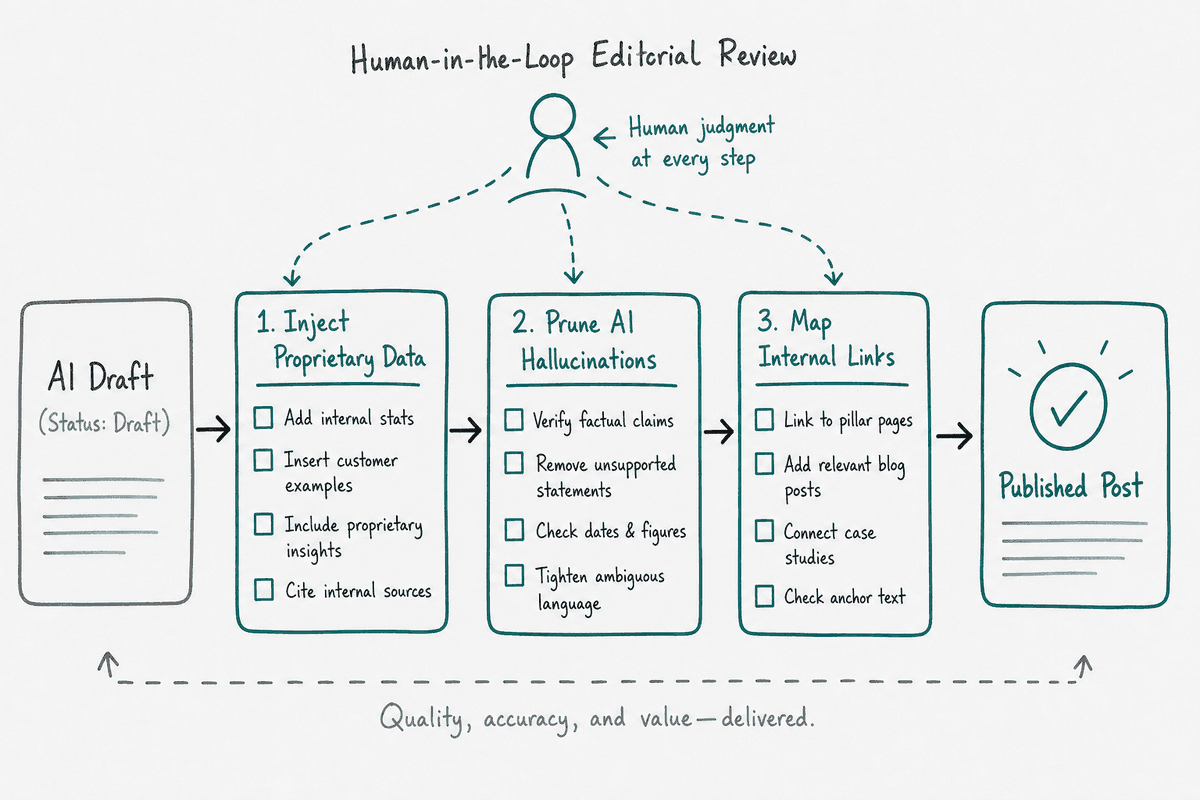
Your Ghost automation should always end by creating a Draft, never a live post. This allows an editor to step in and execute three critical tasks that AI consistently fails at:
- Injecting Unique Perspectives: AI synthesizes what already exists. It cannot provide a contrarian take or a unique company case study. A human editor must spend 15 minutes injecting proprietary data, brand opinions, or specific customer anecdotes into the AI draft.
- Pruning AI Hallucinations: AI tools will occasionally invent statistics, cite non-existent studies, or recommend competitors.
- Strategic Internal Linking: While AI can guess at internal links, a human editor understands the exact cluster architecture needed to pass PageRank effectively. (To stay sharp on these broader SEO strategies, reviewing the 11 Best SEO Blogs Every SaaS Founder Needs (2026) is highly recommended).
The Meta-Lesson: Managing Your Own AI Visibility
Let’s bring this back to the beginning. We started this analysis because Gemini confidently recommended Arvow for a specific buyer query.
If you are a SaaS founder, a B2B marketing team, or an agency, you should be looking at Arvow’s success and asking: How do I ensure AI assistants recommend my product when buyers ask questions in my niche?
Search is fundamentally changing. Buyers are no longer just typing keywords into Google and scrolling past ads; they are asking Perplexity, ChatGPT, and Gemini for direct recommendations. If those AI models do not cite your brand, you are entirely invisible to that buyer.
How to Turn Visibility Gaps into Strategy
This is where AI visibility monitoring becomes critical. You cannot optimize for what you do not measure.
At BeVisible, we help teams track exactly how AI assistants answer buyer questions. We monitor which brands they recommend, which sources they cite, and where the visibility gaps are across platforms like ChatGPT, Gemini, Perplexity, and AI Overviews.
When you track these metrics, you can reverse-engineer the AI's preferences:
- Identify Missing Mentions: Are competitors being recommended while you are omitted?
- Analyze the Citations: What URLs is the AI pulling from to formulate its answers? If Perplexity is heavily citing a specific Reddit thread or a niche blog, your goal is to get mentioned there.
- Execute on the Gaps: Turn these missing mentions and competitor wins into published work. If the AI is looking for a specific type of comparison matrix or technical documentation to answer a prompt, create that exact asset, publish it, and syndicate it to ensure it enters the LLM training data.
Arvow didn’t accidentally become the top recommendation for Ghost CMS autoblogging. It achieved that visibility because the brand’s digital footprint perfectly addressed a specific gap in the market, making it the most logical, evidence-backed answer for the AI to provide. By monitoring your own AI visibility, you can engineer the exact same outcome for your software.
Frequently Asked Questions
Can you auto-publish directly to Ghost without Zapier or Make?
Yes, but only by using platforms that have built native, dedicated integrations for Ghost via API keys. Tools like Arvow handle this natively, bypassing middleware. However, if you are using standard LLMs (like OpenAI's API, Anthropic, or standalone writers like Koala), you will almost always need a middleware solution to map the data correctly to Ghost's API.
How does Ghost's API handle AI-generated images?
Ghost does not automatically download and host images linked via external URLs in the HTML body. If your AI tool provides an external image URL, it will display in Ghost, but if the AI tool later deletes that image from their servers, the image will break on your blog. You must use middleware to download the image, POST it to the Ghost media API, and map the returning permanent Ghost URL into your article draft.
Is programmatic SEO dead in 2026?
No, but the execution has changed dramatically. Mass-generating generic content on low-authority domains will result in zero traffic due to stricter search engine algorithms. Successful programmatic SEO now requires highly specific data inputs, rigorous Human-in-the-Loop editing, and a focus on answering ultra-niche, long-tail queries that traditional editorial teams cannot scale to cover. Fully automated, unedited content is a liability; scaled, editor-reviewed content is an asset.