
When a growth lead opens ChatGPT, Gemini, or Perplexity to test high-intent buyer prompts, the primary concern is not where a website sits on page one of Google. The question is whether the AI assistant explicitly recommends the brand, cites its primary resources, or directs potential buyers straight to a competitor.
This shift has created a distinct category of software: Generative Engine Optimization (GEO) platforms. While early market entrant Evertune established itself as a tool for tracking AI share-of-voice at the executive level, content practitioners quickly ran into a wall. Knowing that your brand is invisible across 60% of commercial AI prompts does not tell your editorial team what to write, which primary sources to target, or how to turn visibility gaps into published, indexable work.
Content teams require software that bridges the gap between AI visibility analytics and actual content production. Measurement alone does not change how large language models (LLMs) synthesize answers. Real visibility gains happen when editorial teams uncover missing citations, identify winning sources, produce targeted content, and track real-time changes in AI response patterns.
Here is an analysis of the top GEO platforms for content teams in 2026, evaluating tools beyond Evertune based on their workflow integration, citation intelligence, and practical publishing capabilities.
What Content Teams Actually Need from a GEO Platform
Most generative engine optimization tools were built for brand managers and market researchers. They excel at producing high-level charts showing share of model voice across LLMs. However, content strategists and writers need an operational engine rather than a passive dashboard.
       ┌─────────────────────────────────────────────────────────┐
       │             THE AI VISIBILITY WORKFLOW GAP              │
       └─────────────────────────────────────────────────────────┘

  TRADITIONAL GEO TOOLING (e.g., Evertune)
  ┌───────────────────────┐      ┌───────────────────────┐
  │ Track AI Brand        │ ───► │ Executive Scorecards  │ ───► [ Stagnation ]
  │ Share-of-Voice        │      │ & Sentiment Charts    │      (No action path)
  └───────────────────────┘      └───────────────────────┘

  PRACTITIONER-FIRST GEO PLATFORM (e.g., BeVisible)
  ┌───────────────────────┐      ┌───────────────────────┐      ┌───────────────────────┐
  │ Monitor Buyer Prompts │ ───► │ Identify Citation     │ ───► │ Generate & Publish    │
  │ Across AI Assistants  │      │ Sources & Competitors │      │ Targeted Content      │
  └───────────────────────┘      └───────────────────────┘      └───────────────────────┘
                                                                            │
                                 ┌───────────────────────┐                  │
                                 │ Re-Evaluate AI Model  │ ◄────────────────┘
                                 │ Response Changes      │
                                 └───────────────────────┘
 When evaluating tools for editorial and growth execution, four core capabilities determine whether a platform will drive organic AI recommendations or become unused software:
- Prompt-Level Granularity: The platform must track realistic buyer prompts rather than isolated keywords. Buyers do not ask AI search tools for "B2B accounting software." They ask: "What are the best accounting platforms for mid-market SaaS companies integrating with Stripe, and how do their pricing tiers compare?"
- Citation Source Extraction: The tool should identify the exact web pages, review aggregators, Reddit threads, and technical blogs that AI engines cite when forming their answers.
- Execution Workflow: Finding a gap is only half the battle. The platform must help teams convert visibility gaps into structured article briefs, clear content outlines, and review workflows.
- Closed-Loop Verification: After new content is published or updated, the platform must re-query ChatGPT, Gemini, Perplexity, AI Mode, and Google AI Overviews to verify whether the brand has been integrated into synthesized answers.
Understanding these operational criteria helps clarify where each major GEO tool fits in a modern tech stack.
Top 5 GEO Platforms for Content Teams (2026 Rankings)
1. BeVisible
Best for: End-to-end AI visibility tracking, citation discovery, and automated content execution.
BeVisible is built specifically for growth and content teams that need to turn missing AI recommendations into published content. Rather than stopping at visibility tracking, BeVisible closes the loop between analytics and editorial execution.
┌─────────────────────────────────────────────────────────────────────────┐
│                      BEVISIBLE EXECUTION FLOW                           │
│                                                                         │
│  [Prompt Monitor] ──► [Citation Gap Detected] ──► [Evidence Brief]      │
│                                                          │              │
│  [Live Recommendation] ◄── [Automated Publishing] ◄── [Content Engine]  │
└─────────────────────────────────────────────────────────────────────────┘
The platform continuously monitors how major AI assistants—including ChatGPT, Gemini, Perplexity, AI Mode, and AI Overviews—answer target buyer prompts. When BeVisible flags a prompt where your brand is unmentioned or where a competitor dominates the citations, it analyzes the underlying sources the AI model relied upon.
From there, BeVisible translates visibility gaps into actionable content opportunities. It equips writers with evidence-backed outlines designed to satisfy LLM extraction criteria, handles scheduling and publishing, and continuously monitors when the AI assistant updates its citations to include your brand.
- Key Strengths: Combines prompt tracking with direct content creation and publishing workflows; monitors all major LLM search interfaces; provides exact citation mapping.
- Best Suited For: SaaS teams, B2B growth marketers, and agencies that require an active content engine alongside AI tracking.
2. Evertune.ai
Best for: Enterprise brand monitoring and executive sentiment reporting.
Evertune is a pioneer in the AI visibility space, widely recognized for establishing baseline metrics around generative engine optimization. Its platform offers high-level visibility scoring, sentiment analysis, and comparative share-of-voice tracking across major large language models.
┌─────────────────────────────────────────────────────────────────────────┐
│                       EVERTUNE DASHBOARD LAYOUT                         │
│                                                                         │
│  ┌───────────────────────┐  ┌───────────────────────┐  ┌─────────────┐  │
│  │ Brand Share of Voice   │  │ Sentiment Analysis    │  │ LLM Coverage│  │
│  │ 42% (+3% MoM)          │  │ 88% Positive          │  │ 4/5 Engines │  │
│  └───────────────────────┘  └───────────────────────┘  └─────────────┘  │
└─────────────────────────────────────────────────────────────────────────┘
According to Evertune's analysis on choosing GEO platforms, measuring generative engine optimization requires tracking how models perceive brand authority over time. Evertune excels at providing high-level reporting for Chief Marketing Officers and VP-level stakeholders who need macro-level data on how AI systems portray their enterprise.
However, Evertune is less focused on direct content execution. It tells content managers that a gap exists, but leaves the manual labor of researching source citations, drafting structured articles, and managing publishing workflows entirely to external tools.
- Key Strengths: Enterprise-grade dashboards; robust historical share-of-voice reporting; clear brand sentiment metrics.
- Limitations: Lacks native editorial production tools, article generation, or workflow engines to act directly on tracked gaps.
3. Scrunch
Best for: SEO teams transitioning into GEO with a focus on technical content auditability.
Scrunch bridges traditional search engine optimization and generative search analytics. As discussed in industry discussions regarding AI visibility platforms, Scrunch appeals to organic search leads who want to evaluate whether their existing website content is "AI-ready."
┌─────────────────────────────────────────────────────────────────────────┐
│                        SCRUNCH AUDIT MATRIX                             │
│                                                                         │
│  Page URL              │ Schema Validity │ Fact Density │ AI Readiness  │
│  ──────────────────────┼─────────────────┼──────────────┼────────────── │
│  /blog/pricing-guide   │ 100%            │ High         │ Ready         │
│  /features/analytics   │ 40%             │ Low          │ Needs Update  │
└─────────────────────────────────────────────────────────────────────────┘
The platform audits existing content assets for technical attributes that influence LLM ingestion, such as schema markup accuracy, semantic clarity, and factual density. Scrunch flags potential AI hallucinations regarding your brand and assesses whether your domain’s structure allows AI crawlers to efficiently parse key business details.
- Key Strengths: Strong technical audit features for existing web assets; bridges traditional rank tracking with LLM indexing; identifies brand hallucinations.
- Limitations: Requires manual editorial effort to create new assets; less focus on automated publishing or continuous prompt execution workflows.
4. Peec
Best for: Agencies and small marketing teams needing quick, cost-effective visibility benchmarks.
Peec is a lightweight AI monitoring platform tailored for lean teams and boutique digital agencies. Rather than offering deep enterprise feature sets or automated editorial execution, Peec provides clean, low-overhead snapshots of how specific brands appear across conversational search tools.
┌─────────────────────────────────────────────────────────────────────────┐
│                        PEEC SNAPSHOT REPORT                             │
│                                                                         │
│  Target Prompt: "Best CRM for real estate agents"                       │
│  Status: Brand Mentioned (Rank #2 in Perplexity, Absent in ChatGPT)     │
└─────────────────────────────────────────────────────────────────────────┘
For teams that want simple brand monitoring without committing to complex software, Peec offers an accessible starting point. It enables marketers to run manual or scheduled spot-checks across prompt lists and generate simple client-ready exports.
- Key Strengths: Simple interface; rapid setup; accessible pricing for early-stage teams and smaller agencies.
- Limitations: Limited citation depth; no native content drafting, scheduling, or publishing capabilities.
5. SixthShop
Best for: E-commerce content teams optimizing product catalogs for AI recommendations.
SixthShop focuses specifically on e-commerce generative engine optimization. AI search tools are increasingly used as shopping assistants, answering queries like: "Where can I buy sustainable running shoes under $150 with a wide toe box?"
┌─────────────────────────────────────────────────────────────────────────┐
│                     SIXTHSHOP CATALOG SYNC                              │
│                                                                         │
│  E-Commerce Feed ──► [Structured JSON-LD Engine] ──► LLM Shopping Discovery│
└─────────────────────────────────────────────────────────────────────────┘
SixthShop works by structuring product feeds, technical specifications, customer reviews, and merchant data into formats that LLM web crawlers and shopping graphs easily consume. It gives retail content teams visibility into which product lines AI models recommend for specific long-tail buyer scenarios.
- Key Strengths: Purpose-built for structured e-commerce product data; monitors AI shopping recommendations; tracks product attribute matching.
- Limitations: Not suitable for B2B SaaS, long-form editorial strategy, or lead-generation content models.
Direct Comparison: Evaluating GEO Platforms by Content Capability
To help team leads choose the right software, the table below breaks down each platform across essential functional areas.
Why Evertune Falls Short for Hands-On Editorial Teams
Evertune succeeded in establishing AI share-of-voice as an important marketing metric. However, growth leads and content directors frequently run into operational bottlenecks when using brand-level tracking tools as their primary GEO engine.
┌─────────────────────────────────────────────────────────────────────────┐
│                    THE GEO PLATFORM MISMATCH                            │
│                                                                         │
│  EXECUTIVE MONITORING TOOL (Evertune)                                   │
│  "Your brand authority score in ChatGPT fell 8% this month."             │
│  └──► Problem: No tactical guidance on what content to build next.      │
│                                                                         │
│  ACTIONABLE CONTENT ENGINE (BeVisible)                                  │
│  "Perplexity cites 3 review blogs for 'best billing engine'. Write an   │
│   article addressing these 4 comparison metrics to earn citations."     │
│  └──► Outcome: Clear editorial path directly tied to AI visibility.     │
└─────────────────────────────────────────────────────────────────────────┘
The Reporting vs. Execution Divide
Knowing that your share-of-voice on ChatGPT dropped by 12% over the last quarter provides an accurate diagnostic, but it offers no clear solution. Traditional SEO teams experienced a similar challenge a decade ago when rank-tracking tools simply alerted them to ranking drops without indicating which content adjustments were necessary.
Content teams do not just need alerts; they need actionable work orders. When an AI platform flags an unmentioned brand query, the immediate operational questions are:
- What exact sources is the LLM relying on to construct its answer?
- Is the AI citing primary technical documentation, third-party comparison sites, or long-form blog posts?
- How can we structure an updated page or new article to match the information structure the LLM is selecting?
Without native workflow features that translate data into editorial briefs, teams waste hours manually cross-referencing prompts in ChatGPT and Perplexity.
The Problem of Static Scorecards
Enterprise reporting software often treats GEO as a static monthly metric. In reality, AI search citations are dynamic. LLM crawlers refresh web data frequently, shifting recommendations based on newly indexed web pages, clear factual formatting, and direct answers to complex questions.
A content team relying on monthly static scorecards remains behind the curve. By the time an executive dashboard highlights a lost AI recommendation, competitors may have held that recommendation slot for weeks. Winning AI recommendations requires agile monitoring and immediate content deployment.
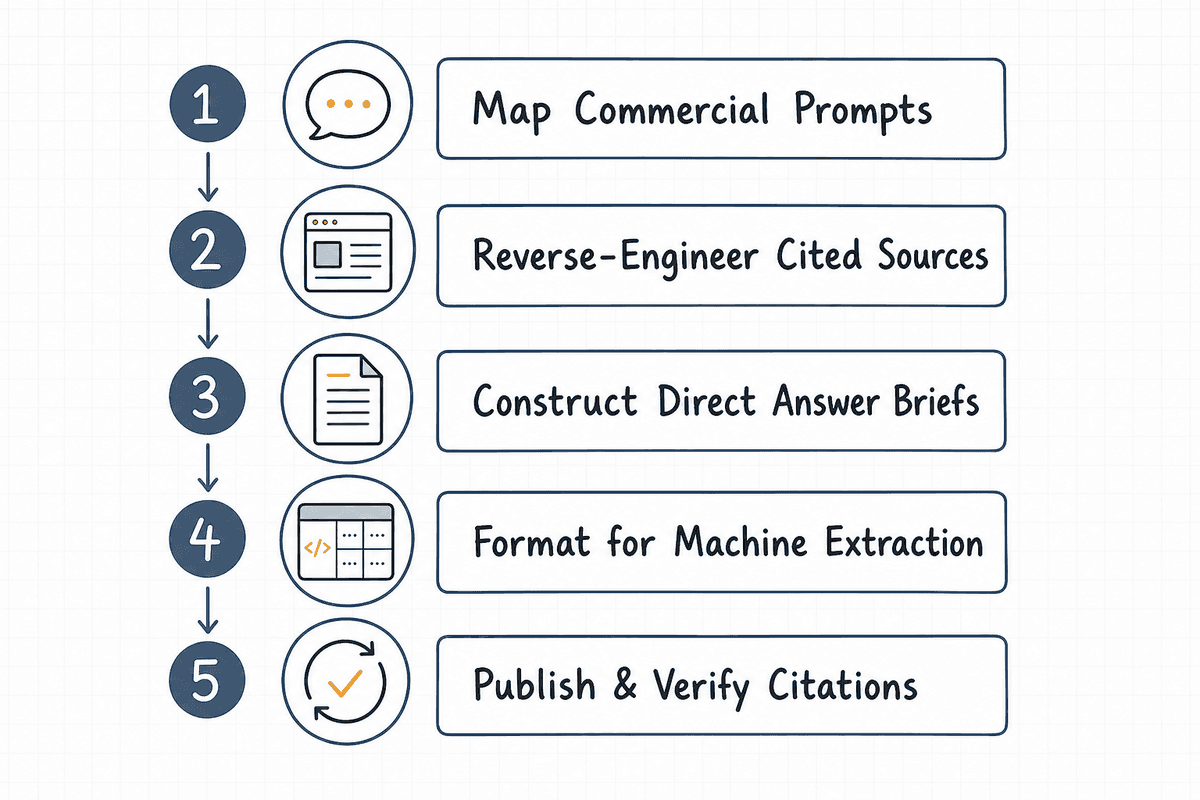
The 5-Step GEO Execution Blueprint for Content Teams
To systematically secure recommendations in conversational search engines, content teams should follow a repeatable execution framework. Generative engine optimization is an operational process that combines monitoring with tactical publishing.
┌─────────────────────────────────────────────────────────────────────────┐
│                   5-STEP GEO EXECUTION BLUEPRINT                        │
│                                                                         │
│  [Step 1] Map Commercial Prompts                                         │
│     │                                                                   │
│  [Step 2] Reverse-Engineer Cited Sources                                │
│     │                                                                   │
│  [Step 3] Construct High-Density Direct Answer Briefs                   │
│     │                                                                   │
│  [Step 4] Format for Machine Extraction (Schema, Tables, Headers)       │
│     │                                                                   │
│  [Step 5] Publish & Verify Model Response Adjustments                   │
└─────────────────────────────────────────────────────────────────────────┘
Step 1: Map Commercial Prompts Across Target AI Models
Start by assembling a prompt matrix that reflects how real buyers investigate your category. Avoid basic keyword lists and focus on natural language, comparison queries, and specific deployment conditions.
For example, a team selling developer security tools should track prompts such as:
- "What are the top static analysis security tools for enterprise Python codebases?"
- "Compare Tool A vs Tool B for SOC2 compliance tracking in AWS environments."
- "Which code scanner has the lowest false-positive rate for mid-sized engineering teams?"
Input these prompts across ChatGPT, Gemini, Perplexity, and Google AI Overviews to establish a clear baseline of which brands appear in the initial response.
Step 2: Reverse-Engineer Cited Sources and Citation Nodes
When an AI assistant recommends a product or answers a complex prompt, it relies on information retrieved from specific web pages or internal training vectors.
Analyze the footnoted sources across the generated answer. Identify patterns in the citation graph:
- Are the AI models drawing information primarily from technical documentation, customer reviews, niche agency blogs, or industry comparison guides?
- Are specific third-party domains cited repeatedly across multiple prompts?
- What specific data points (pricing tables, feature matrix lists, benchmark numbers) are being pulled into the summary?
Identifying these citation nodes highlights precisely where your team needs to publish fresh, indexable material. If your content team is evaluating external publishing partners or agency support during this phase, reviewing transparent cost structures—such as comparing agency rates against software automation in SEO Charges UK—helps clarify budget allocation between software and manual production.
Step 3: Construct High-Density Direct Answer Briefs
LLMs prioritize content that directly answers specific questions without unnecessary fluff. Traditional SEO articles often buried the core answer beneath introductory background context to lengthen the page. Generative engine optimization requires the exact opposite structure.
Place concise, factual answers immediately beneath explicit subheadings. Use structured data formats, clear bullet points, and authoritative statements that can be cleanly extracted by LLM parser routines.
Step 4: Format Content for LLM Web Extraction
To maximize the chances of being cited by search-enabled AI systems like Perplexity and Google AI Overviews, format your published content for easy machine parsing:
- Use Explicit H2 and H3 Headings: Phrase subheadings as clear questions or direct statements matching the prompt topic.
- Implement Markdown Tables: AI engines frequently extract tables directly when generating side-by-side product comparisons.
- Maintain High Factual Density: Avoid vague marketing statements. Use specific figures, clear deployment details, explicit integration boundaries, and defined pricing structures.
- Include Semantic Schema: Leverage JSON-LD structured data (
TechArticle,Product,FAQPage) to make page data easily readable for web crawlers.
Step 5: Publish, Schedule, and Verify Model Citations
Once the article or product resource is live, the GEO loop remains incomplete until you verify that AI search engines have updated their responses.
Use your GEO platform to re-query the target prompts over subsequent days and weeks. Track whether the model:
- Begins fetching and citing your newly published URL.
- Incorporates your brand name into synthesized lists.
- Positively shifts the context in which your product is recommended.
If the AI engine continues citing competitor sources after several weeks, refine the page's factual density, add missing comparison tables, or focus on acquiring secondary citations from the third-party platforms the model frequently references.
3 Misconceptions About Generative Engine Optimization
As marketing teams rush to adapt to AI search, several unproven assumptions have emerged. Disentangling fact from fiction prevents wasted editorial resources.
┌─────────────────────────────────────────────────────────────────────────┐
│                    GEO MYTHS VS. REALITY MATRIX                         │
│                                                                         │
│  MYTH 1: "GEO replaces traditional SEO completely."                     │
│  REALITY: AI search models rely on traditional search indexes for discovery.│
│                                                                         │
│  MYTH 2: "Longer content guarantees better AI citations."              │
│  REALITY: LLMs prefer clear, structured, high-density factual answers.  │
│                                                                         │
│  MYTH 3: "Monthly tracking is sufficient for AI search."                │
│  REALITY: LLM citations shift continuously as web crawlers update.      │
└─────────────────────────────────────────────────────────────────────────┘
Myth 1: GEO Replaces Traditional SEO Completely
A common mistake is assuming that generative engine optimization operates independently of search engine optimization. In reality, AI search engines like Perplexity, Google AI Overviews, and Bing Copilot rely heavily on traditional web search indexes to discover content.
If a page lacks basic technical SEO best practices, structured HTML, and clean indexing pathways, an AI crawler will rarely find or index it. For teams managing non-standard architecture, technical foundations remain non-negotiable. For instance, single-page web applications must handle client-side rendering properly so that search engines and AI bots can parse text efficiently. Detailed technical frameworks like SEO for Single Page Applications and Implementing SEO in Single Page Applications show how foundational indexing issues directly impact discovery.
Generative engine optimization builds on top of a solid technical foundation. It expands SEO by focusing on structured information architecture, answer clarity, and authority distribution across the web.
Myth 2: Massive Content Volume Guarantees AI Recommendations
Publishing generic 10,000-word guides full of intro sections does not guarantee visibility in conversational AI tools. Large language models are designed to compress and summarize information, meaning they actively filter out fluff.
An AI engine searching for "best enterprise log management software" bypasses long introductory paragraphs about why log management matters. It skips straight to content blocks containing direct comparisons, technical parameters, pricing details, and integration requirements. Content teams win AI recommendations through structured factual density, not inflated word counts.
Myth 3: AI Citation Monitoring Only Needs to Happen Monthly
Some growth marketers assume that AI training models update so slowly that quarterly or monthly monitoring is sufficient. While foundational model pre-training takes time, modern AI assistants rely on real-time web retrieval (RAG - Retrieval-Augmented Generation).
Tools like Perplexity, ChatGPT with Web Browsing, and Google AI Overviews fetch live web pages continuously. A competitor publishing a clearly structured comparison piece today can begin appearing in AI citations within days. Real-time prompt monitoring is necessary to protect established category positioning.
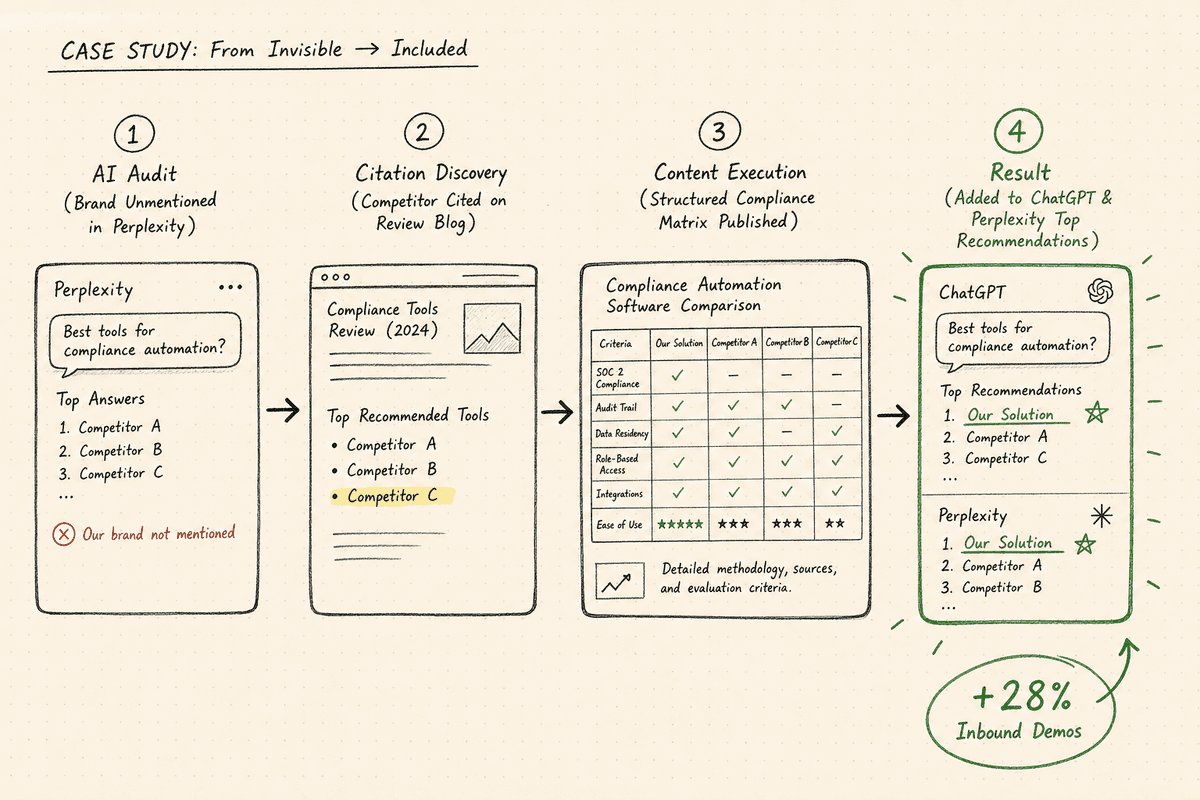
Practical Scenario: Turning an AI Citation Gap into a Winning Recommendation
To see how an operational GEO workflow functions in practice, consider this real-world scenario involving a mid-market SaaS business.
┌─────────────────────────────────────────────────────────────────────────┐
│                     SCENARIO: CLOSING THE CITATION GAP                  │
│                                                                         │
│  1. AUDIT PHASES                                                        │
│     Target Prompt: "Best customer onboarding software for B2B SaaS"     │
│     Initial State: Competitor A and Competitor B recommended.           │
│     Missing Brand: User onboarding platform "FlowOnboard".              │
│                                                                         │
│  2. CITATION ANALYSIS                                                   │
│     AI Source Identified: Perplexity citing a comparison table on       │
│     a third-party software review blog.                                 │
│                                                                         │
│  3. EXECUTION ACTION                                                    │
│     FlowOnboard publishes a high-density, matrix-backed guide           │
│     addressing technical integration, SLA metrics, and pricing.       │
│                                                                         │
│  4. RESULT                                                              │
│     Within 14 days, AI Overviews and Perplexity cite FlowOnboard's      │
│     resource, adding them to top recommendations.                       │
└─────────────────────────────────────────────────────────────────────────┘
The Challenge
"FlowOnboard," a mid-market SaaS platform offering user onboarding software, noticed a steady drop in qualified inbound leads coming through organic discovery. When the growth team audited commercial buyer prompts in ChatGPT and Perplexity, they found a clear gap:
Prompt: "What are the best customer onboarding software platforms for B2B SaaS companies with complex enterprise compliance needs?"
AI Assistant Response: Recommended Competitor A and Competitor B, citing three specific sources: a industry blog post, a review site summary table, and a vendor comparison article. FlowOnboard was unmentioned.
The Strategy
Rather than simply logging the lost share-of-voice metric on an executive dashboard, the content team used an execution-focused GEO platform to reverse-engineer the result:
- Source Discovery: The platform extracted the three primary URLs cited by Perplexity and Google AI Overviews.
- Gap Analysis: The AI models favored these three sources because each contained detailed markdown tables comparing SOC2 compliance, SSO capabilities, and API integration speeds. FlowOnboard’s existing website lacked a clean comparison resource containing these exact parameters.
- Content Production: Using the visibility platform's structured recommendations, the team built a detailed, fact-dense guide titled "Enterprise Onboarding Software Compliance & Integration Matrix."
- Formatting for Extraction: The article placed technical specifications, security certifications, and pricing structures directly into clean HTML tables and FAQ schemas near the top of the page.
The Outcome
Within 14 days of publishing and indexing the new guide:
- Perplexity updated its citation references for enterprise onboarding prompts, adding FlowOnboard's new guide as a footnoted primary source.
- ChatGPT's web retrieval mode began including FlowOnboard as a top-three recommended vendor for enterprise compliance queries.
- FlowOnboard tracked a 28% increase in high-intent demo requests coming from buyers who cited AI assistants during discovery.
This operational sequence illustrates why content teams need tools that link prompt monitoring directly to editorial production.
Frequently Asked Questions
What is the main difference between an SEO platform and a GEO platform?
An SEO platform monitors search engine result pages (SERPs), tracking keyword rankings, organic traffic, backlink profiles, and technical site health on engines like Google and Bing.
A GEO platform monitors conversational AI assistants like ChatGPT, Gemini, Perplexity, AI Mode, and Google AI Overviews. It tracks how often your brand is recommended in synthesized answers, identifies which web sources the AI models cite, and helps teams structure content specifically for large language model extraction.
Can a team use traditional SEO tools alongside a dedicated GEO platform?
Yes. Traditional SEO tools and dedicated GEO platforms serve complementary functions. Traditional SEO platforms ensure your site is properly crawled, indexed, and ranked in search engine databases. GEO platforms sit on top of that foundation, analyzing how conversational search interfaces process, summarize, and cite your published content when answering complex user prompts.
How fast do AI assistants like ChatGPT and Perplexity update their citations?
For AI assistants using real-time web retrieval (Retrieval-Augmented Generation), citations can update within days or weeks of a new web page being crawled and indexed. However, for core model outputs that rely on static pre-training datasets without live web access, updates occur only when the foundational model is retrained or fine-tuned. Modern commercial queries overwhelmingly rely on live web retrieval, making rapid content execution effective.
Choosing the Right GEO Stack for Your Team
Selecting the right generative engine optimization platform comes down to team role and operational goals.
If your primary responsibility is executive reporting, brand reputation management, and presenting high-level sentiment metrics to board members, an analytics-focused tool like Evertune.ai provides clean macro-level dashboards.
If your primary responsibility is driving growth, producing content, and ensuring your product is recommended when potential buyers ask AI assistants for solutions, you need an execution platform. BeVisible provides end-to-end prompt monitoring, citation source extraction, and direct publishing workflows designed to turn visibility gaps into published, indexable assets.
To explore how your brand currently appears across conversational search engines, begin by running an audit of your top ten commercial buyer prompts across ChatGPT, Perplexity, and Gemini. Identify where your brand is missing, isolate the sources being cited, and equip your editorial team to claim those citations.