
You check your traditional rank tracker, and your core commercial pages are sitting comfortably on page one of Google. Traffic is steady. Yet, inbound demo requests from high-value accounts have started to plateau.
The disconnect stems from a quiet shift in buyer behavior. When a B2B founder or marketing director wants a new software tool, they are no longer sifting through ten blue links. They are opening Perplexity, prompting ChatGPT, or asking Google Gemini to build them a shortlist of the best platforms for their specific use case. If your brand is not recommended by these AI assistants—and if your content is not cited in their generated responses—you are entirely invisible to a growing segment of your total addressable market.
Traditional SEO tools cannot measure this. A keyword rank tracker does not understand the nuanced, conversational pathways a large language model (LLM) takes to synthesize an answer. To monitor and influence how AI models perceive your brand, you need Generative Engine Optimization (GEO) tooling.
While Otterly.ai has gained early traction as a budget-friendly baseline for startups, the GEO ecosystem is expanding rapidly. Teams that want to go beyond passive tracking and turn visibility gaps into published work need to look at the broader landscape.
This guide breaks down the best GEO tools for B2B startups, how to evaluate them, and how to build an AI visibility pipeline that actually drives pipeline revenue.
Why Generative Engine Optimization is the New B2B Baseline
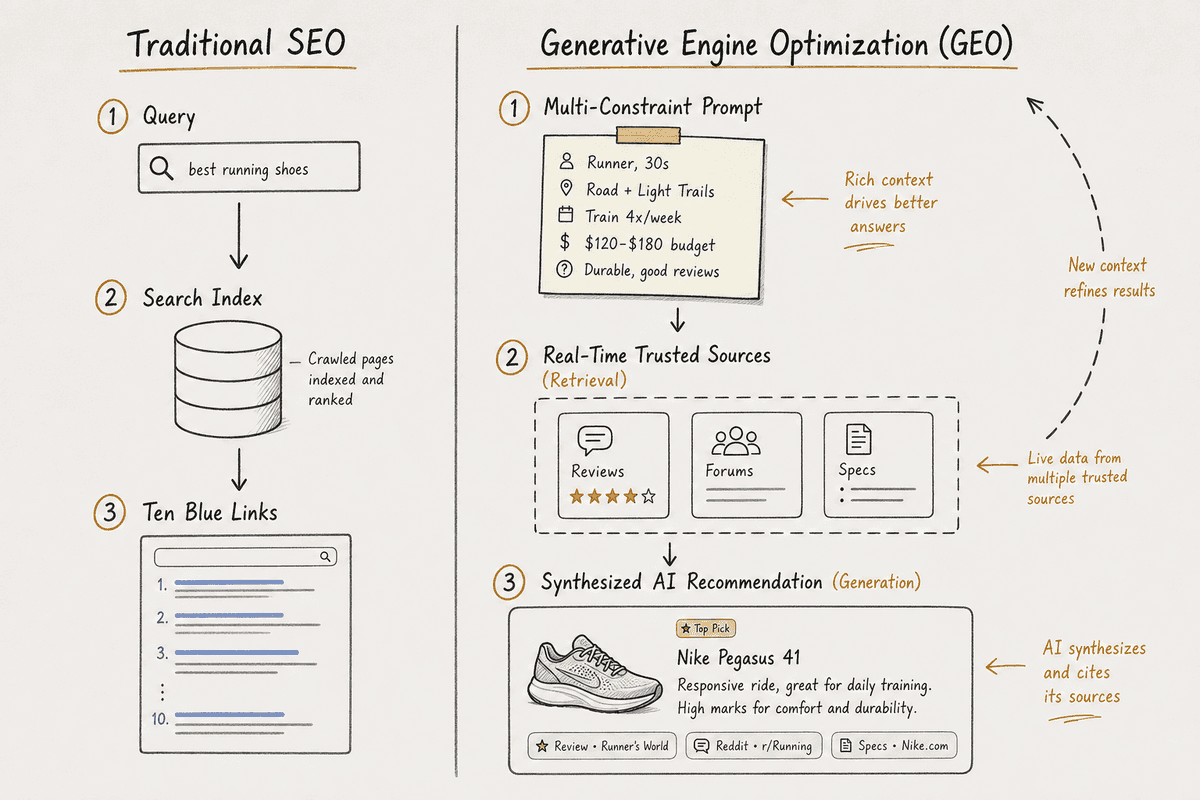
The premise of GEO is straightforward, even if the execution is complex. As Semrush recently summarized the industry shift: SEO helps you rank, but GEO helps you get cited by AI.
Large language models do not retrieve links; they retrieve information. When an AI assistant receives a prompt like "Compare the best expense management platforms for mid-sized SaaS companies," it uses Retrieval-Augmented Generation (RAG) to scan its training data and real-time search indexes. It looks for consensus among authoritative sources, extracts the most relevant features, compares pricing, and formulates a definitive answer.
The scale of this shift is difficult to ignore. Recent data highlights that 72% of users are already engaging with AI Overviews and similar generative interfaces. For a B2B startup, this means your buyers are using AI to bypass traditional vendor research entirely.
If your competitors are explicitly mentioned in these AI-generated responses while your brand is omitted, you are losing market share at the very bottom of the funnel. You are missing out on active buyers who have high intent but rely on Claude, Gemini, or Perplexity to filter their options.
What Makes a Good GEO Tool for a B2B Startup?
Generative Engine Optimization is still an emerging discipline. The market is currently flooded with legacy SEO platforms attempting to staple AI-tracking features onto their existing dashboards. For a B2B startup looking to gain a competitive edge, you need tools built specifically for the nuances of LLM behavior.
When evaluating a GEO platform, look for these core capabilities:
- Multi-Engine Tracking: It is not enough to track just Google's AI Overviews. B2B buyers heavily index on Perplexity for research and ChatGPT for analysis. A viable tool must monitor visibility across multiple engines.
- Citation Source Analysis: Knowing that an AI recommended your competitor is only half the battle. You need to know why. The tool must reveal which third-party articles, review sites, or Reddit threads the AI cited to form that recommendation.
- Prompt-Based Monitoring: Buyers do not use one-to-two word keywords in AI chat interfaces. They write detailed, conversational prompts. Your tool must allow you to track long-tail, highly specific buyer scenarios.
- Actionable Workflows: Data without execution is just overhead. The best platforms help you turn a missing mention into a clear task—whether that means updating a feature page, pursuing a specific third-party review, or drafting a new comparison article.
If you are currently evaluating your marketing stack and deciding whether to handle this in-house or hire outside help, the economics of GEO tools are highly favorable compared to traditional retainers. For context on broader marketing costs, you can review our breakdown of SEO Charges UK: Agency Rates vs Automation (2026) to see how automated tracking often outperforms manual agency reporting.
The Best GEO Tools for B2B Startups in 2026
The following tools represent the strongest options for B2B teams looking to secure their position in AI-generated search results.
1. BeVisible (Best for AI Visibility Monitoring & Execution)
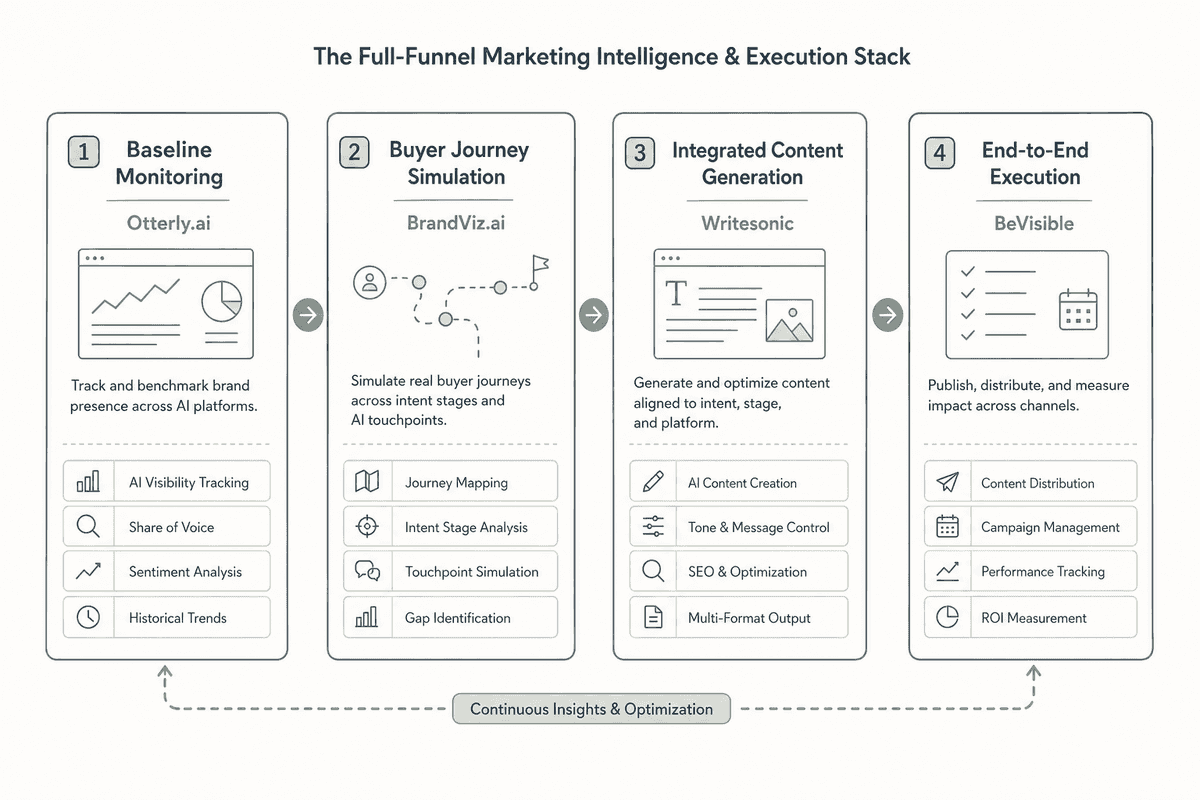
Understanding where you are missing from AI recommendations is useless unless you have a systematic way to fix it. BeVisible is built specifically for growth teams, SaaS founders, and B2B marketers who want to close the loop between data and execution.
BeVisible monitors how AI assistants answer specific buyer questions. It tracks ChatGPT, Gemini, Perplexity, AI Mode, and Google's AI Overviews across the exact conversational prompts your buyers use.
Instead of just presenting a dashboard of visibility metrics, BeVisible identifies which brands the AI recommends and, critically, which sources the AI cites to validate those recommendations. When BeVisible detects a visibility gap—perhaps ChatGPT is consistently citing a competitor's blog post or a specific G2 review page you are absent from—it turns that data into evidence-backed opportunities.
The platform then helps teams turn these competitor wins into scheduled publishing work, targeted review generation, or new article creation. If you need to build out new assets to capture AI attention, understanding How to Build an SEO Landing Page (7-Step Guide) remains a highly relevant skill, as AI models heavily cite well-structured, authoritative landing pages.
2. BrandViz.ai (Best for Buyer Intent Simulation)
For teams that want to visualize the exact paths buyers take through AI interfaces, BrandViz.ai offers a compelling feature set. Rather than just tracking static positions, the platform specializes in simulating complex buyer journeys.
BrandViz.ai runs automated, multi-step conversations with various LLMs to see how your brand perception changes as a user asks follow-up questions. For example, a user might start with "best project management software," follow up with "which of these integrates best with Jira," and conclude with "compare the pricing of the top two." BrandViz tracks if and when your brand drops out of the conversation.
This simulated journey approach provides excellent qualitative data for product marketing teams who need to understand how their positioning holds up under AI scrutiny.
3. Otterly.ai (Best Budget Baseline for Early-Stage)
Otterly.ai has positioned itself as the accessible entry point into the GEO market. With pricing starting at roughly $29 per month, it is highly attractive for early-stage startups that need basic brand visibility tracking without a heavy enterprise contract.
Otterly allows users to input their brand name, core competitors, and primary topics. It then scans various AI outputs to generate a baseline visibility score. While it may lack the deep workflow integration of BeVisible or the conversational journey simulation of BrandViz, it provides a reliable, low-cost health check.
For founders who are just beginning to explore AI search, Otterly serves as a strong "check engine" light. Once the tool reveals that your brand is entirely absent from Perplexity's recommendations, you can upgrade your tooling or processes to actually solve the problem.
4. Writesonic (Best for Combined Content Generation and GEO)
Historically known as an AI writing assistant, Writesonic has pivoted heavily into the GEO space, building an integrated suite for teams that want to research and create content in one place.
As noted in recent industry breakdowns of AI tools for Generative Engine Optimization, Writesonic allows marketers to identify which sources are currently mentioning competitors and then immediately spin up AI-optimized content designed to target those exact citation gaps.
This all-in-one approach is highly efficient for lean content teams. You can analyze an AI Overview, spot a missing angle, and use Writesonic's LLM capabilities to draft a highly structured, entity-rich article tailored to fill that gap.
5. Profound (Best for Deep Enterprise Analytics)
On the opposite end of the spectrum from Otterly is Profound. Built for enterprise-grade analytics, Profound ingests massive amounts of AI output data to provide granular visibility metrics across thousands of permutations.
While typically priced out of the range of a seed-stage B2B startup, growth-stage companies with large product catalogs or extensive programmatic SEO strategies often require this level of data ingestion. Profound is particularly strong at identifying macro-trends in how LLMs update their knowledge bases over time, allowing enterprise teams to forecast where AI sentiment is shifting in their industry.
Feature Comparison Matrix
To clarify how these platforms stack up against the specific needs of a B2B startup, consider the following breakdown of their core competencies.
The Mechanics of AI Citations: How LLMs Choose Winners
To fully leverage any of these tools, you need a foundational understanding of how AI models select the brands they recommend. B2B founders often assume that ranking highly on Google automatically guarantees placement in ChatGPT. This is a dangerous misconception.
Traditional search engines use complex algorithms based on backlinks, page speed, and keyword density to rank web pages. Large language models operate differently. They use vector embeddings to understand the semantic relationship between concepts.
When a B2B buyer asks Perplexity, "What is the most secure cloud storage for European healthcare startups?" the LLM does not look for a page with those exact keywords. Instead, it looks for consensus across its trusted data sources regarding security, European compliance (GDPR), healthcare use cases, and cloud storage providers.
To win these citations, your marketing strategy must satisfy four distinct pillars of AI visibility.
1. The Entity Consensus
LLMs treat your brand as an entity. If you claim to be a "healthcare CRM," but third-party review sites list you as a "general sales tool," and forums describe you as "email marketing software," the AI detects conflicting information.
AI models prioritize certainty. When faced with conflicting entity definitions, the model will simply omit your brand and recommend a competitor whose identity is universally agreed upon across the web. GEO tools help you identify these discrepancies by showing you exactly how AI is currently summarizing your brand.
2. High-Density Fact Patterns
AI assistants thrive on structured data. They prefer content that is definitive, statistical, and clearly formatted. If your competitor's website states, "Our software integrates with Salesforce, HubSpot, and Jira," while your website vaguely promises, "We connect with all your favorite tools," the AI will cite the competitor.
The competitor provided extractable facts. You provided marketing copy.
When auditing your visibility gaps, pay attention to the sources the AI is citing. You will almost always find that the winning sources use specific numbers, clear feature lists, and unambiguous technical claims.
3. Third-Party Validation (The RAG Trust Factor)
Models like Perplexity and Google's AI Overviews rely heavily on Retrieval-Augmented Generation (RAG). Before generating an answer, they run a rapid background search to pull in real-time information from trusted domains.
In the B2B space, these trusted domains are rarely vendor websites. They are review platforms (G2, Capterra), authority publications, industry forums (Reddit, HackerNews), and established blogs. If you want a deep dive into the types of publications that hold weight in B2B tech, reviewing the 11 Best SEO Blogs Every SaaS Founder Needs (2026) can provide context on what authoritative industry content looks like.
If your GEO tool reveals that an AI is heavily citing a specific Reddit thread or a niche industry blog for a core buyer prompt, your next action is not to update your own website. Your action is to figure out how to get mentioned on that specific trusted domain.
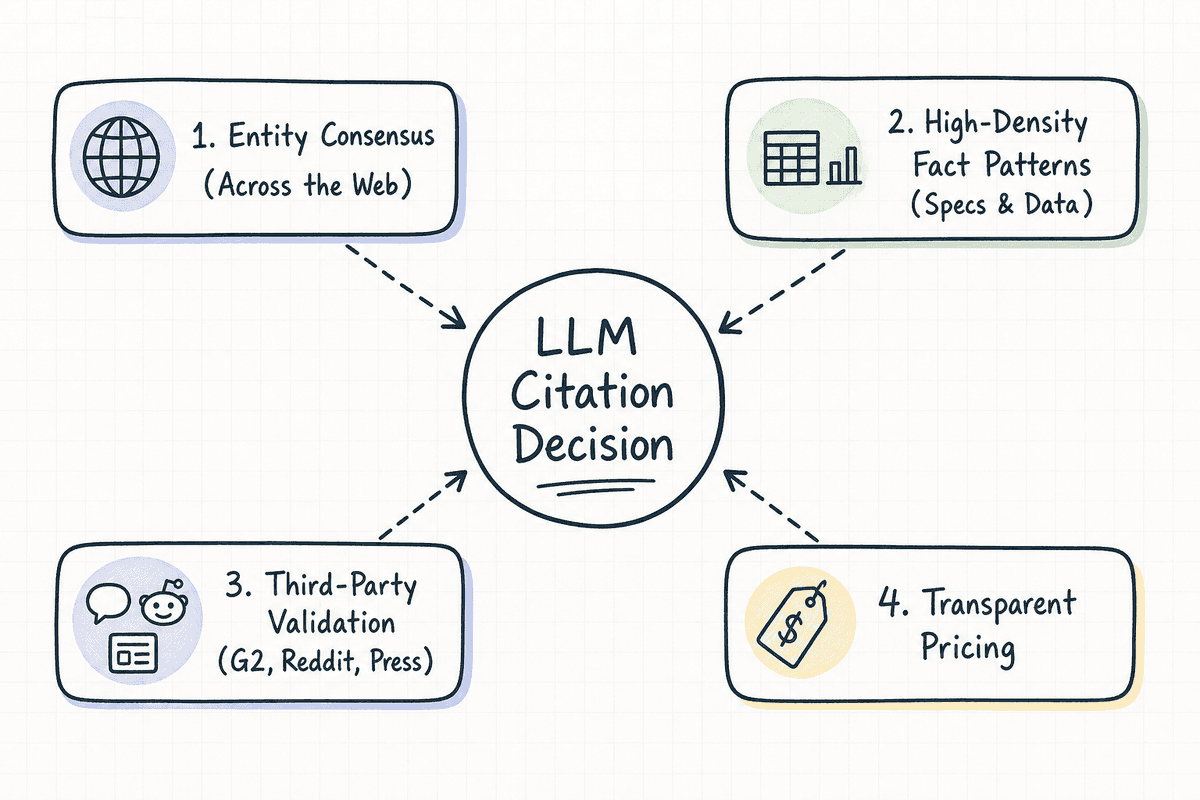
4. Pricing Transparency
One of the most frequent friction points in B2B AI search is pricing. Buyers routinely prompt AI with questions like, "Which is cheaper for a team of 50: Competitor A or Competitor B?"
If your pricing is hidden behind a "Book a Demo" wall, the AI cannot answer the prompt accurately regarding your brand. It will either state that your pricing is unknown—which introduces friction—or it will completely exclude you from the comparison in favor of a vendor with transparent tiers.
A B2B Visibility Scenario: Putting GEO to Work
Understanding the theory is helpful, but seeing a GEO workflow in practice clarifies why these tools are necessary. Let us look at a realistic scenario for a mid-market SaaS company.
The Situation: A B2B startup providing compliance software for fintech companies notices a drop in high-intent demo requests. They are still ranking well on traditional search for terms like "fintech compliance software," but pipeline velocity has slowed.
The Discovery: The marketing director uses BeVisible to run a series of prompt tests based on their ideal customer profile. They input prompts like:
- "What are the best compliance tools for a Series A fintech startup?"
- "Compare [Brand] vs [Competitor] for SOC2 compliance."
The Gap: The data returns a stark reality. Across ChatGPT and Perplexity, the startup is rarely recommended in the top three. Worse, when asked directly to compare the startup against its main competitor, the AI confidently states that the competitor is better suited for Series A companies due to faster implementation times.
The Source Analysis: The team digs into the citations provided by the GEO tool. They discover that the AI's claim about "faster implementation" is sourced directly from a highly-ranked comparison article on a third-party affiliate site, and corroborated by three recent reviews on G2.
The Execution: Armed with this data, the startup does not waste time guessing. They execute a targeted response:
- Content Creation: They publish a detailed, factual breakdown of their implementation timeline, specifically structured with bullet points and clear timelines to feed the LLM extractable data.
- Review Campaign: They reach out to three recent successful Series A clients and incentivize them to leave reviews specifically mentioning their fast, 14-day implementation process.
- Digital PR: They pitch a data-backed guest post to an industry blog about "Why Fintech Implementation Shouldn't Take 6 Months," ensuring their brand entity is associated with speed in a trusted third-party ecosystem.
Within six weeks, the GEO tracking tool shows a shift. Because the underlying data ecosystem has changed, the LLMs update their generated responses. The startup regains its position in the AI-generated shortlist.
This level of precision is impossible if you are only tracking traditional keyword ranks.
3 Generative Engine Optimization Mistakes B2B Founders Make
As startups rush to optimize for AI, they frequently fall into predictable traps. Avoid these three common failure modes when rolling out your GEO strategy.
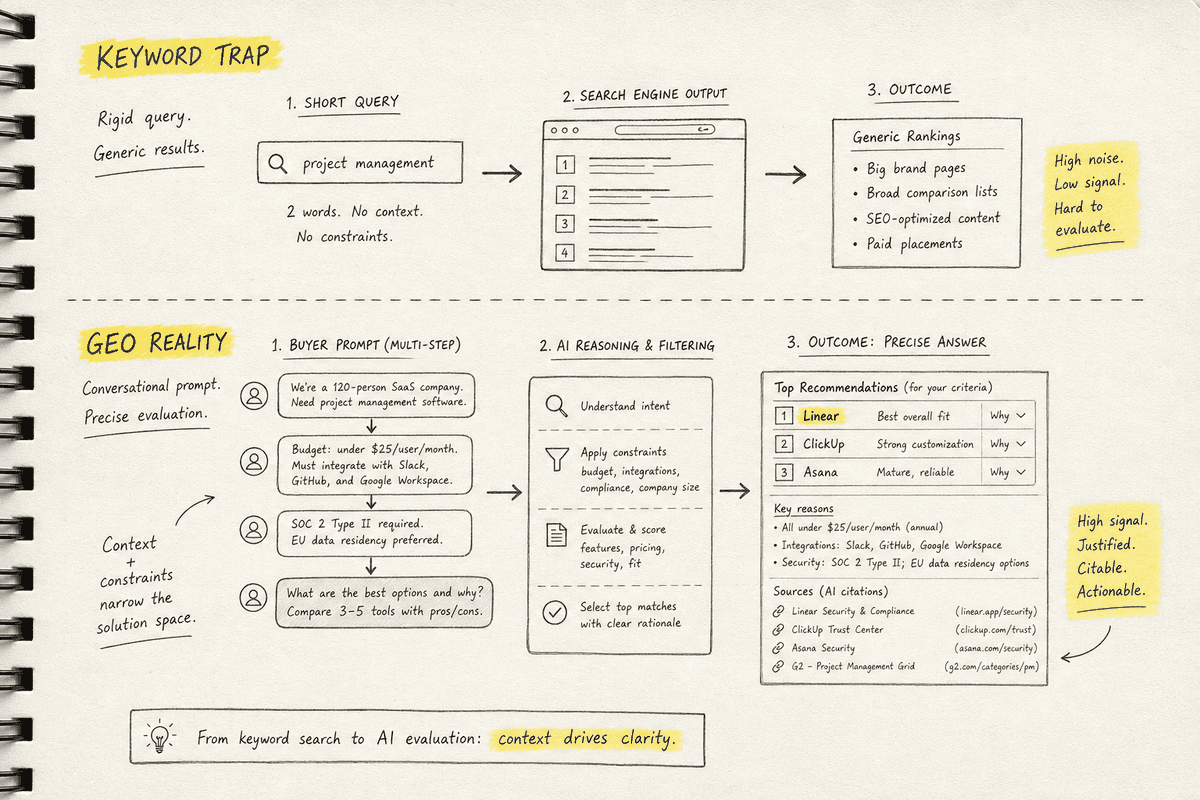
Mistake 1: Treating Prompts Like Keywords
Traditional SEO trained marketers to strip away context. You targeted "B2B CRM" instead of "What is the best CRM for a B2B sales team of five people working remotely?"
AI models are designed for the latter. If you only track short-tail keywords in your GEO tool, you are measuring the wrong behavior. B2B buyers use AI to handle complex constraints. You must track long, highly specific prompts that reflect your buyer's actual pain points, constraints, and integration requirements.
Mistake 2: Relying Solely on "AI-Generated" Content to Win AI Citations
There is a flawed logic that suggests the best way to appease an AI is to feed it AI-generated content. While LLMs are excellent for outlining and restructuring data, publishing generic, synthesized content on your blog will not help you win citations.
AI models are looking for information gain—new facts, unique data points, proprietary research, and strong opinions that are not already present in their training data. If you publish content that merely summarizes what the AI already knows, it has no reason to cite you as a source. Focus on publishing primary research, clear technical documentation, and rigid feature specifications.
Mistake 3: Hiring Agencies Without AI Tooling Capabilities
Many traditional SEO agencies are currently rebranding their services as "AI Optimization" without fundamentally changing their workflows or toolsets. If you are outsourcing this work, you must interrogate their methodology.
If an agency is still delivering static keyword ranking reports and cannot show you how your brand appears in conversational prompts across multiple LLMs, they are not executing GEO. Be cautious of vendors attempting to charge premium retainers for outdated practices. (For more on evaluating agency red flags in the context of modern search, reviewing guides like Hiring SEO Services in Phoenix? 5 Red Flags (2026) provides a solid framework for vetting technical marketing partners).
Integrating GEO With Your Existing SEO Strategy
Generative Engine Optimization does not replace traditional Search Engine Optimization; it builds upon it.
The architectural foundation required for traditional search—clean site structure, fast load times, logical internal linking, and accessible content—is the same foundation that allows AI crawlers to efficiently parse your data. If your website is technically broken, an LLM will struggle to extract your feature sets just as much as Googlebot does.
This is particularly true for complex web architectures. If you operate a modern web application, ensuring your technical foundation is sound is non-negotiable. For example, if you rely heavily on JavaScript frameworks, you must ensure your setup is readable by automated bots. Reviewing resources like SEO for Single Page Applications: A 5-Step Guide (2026) and the broader Implementing SEO in Single Page Applications (3 Ways) will ensure your site architecture is not quietly sabotaging your AI visibility.
Furthermore, optimizing for traditional search engine features can directly influence AI outcomes. Google's AI Overviews are heavily biased toward domains that already hold high topical authority and traditional ranking power. You cannot abandon traditional link building and technical SEO and expect to win in AI search. The two disciplines must operate in tandem.
Frequently Asked Questions About GEO Tools
As this category of software matures, B2B teams consistently ask similar questions regarding implementation, expectations, and mechanics.
How long does it take to see results in AI search visibility?
Unlike traditional SEO, which can take months for a new page to climb the ranks, AI visibility can shift rapidly. Search-grounded models like Perplexity and AI Overviews pull data in real-time. If you successfully get a high-authority publication to update an article with your brand information, an LLM might begin citing that new information within hours or days of the page being crawled. However, changing the overarching consensus of an LLM's base training data requires consistent effort over months.
Does GEO completely replace traditional keyword research?
No. Traditional keyword research helps you understand the overarching topics and search volumes in your industry. GEO prompt research helps you understand the conversational constraints buyers apply to those topics. Use traditional tools to find the territory, and use GEO tools to map the specific conversational paths buyers take through it.
Why does ChatGPT recommend my competitor, but Perplexity recommends my brand?
Different AI assistants use different architectures and trust metrics. ChatGPT (especially when not using its search function) relies heavily on its static training data, which historically favors brands with massive legacy footprints across the open web. Perplexity is heavily optimized for real-time RAG, meaning it prioritizes recent, highly structured articles, news, and technical documentation. Your GEO strategy must account for these distinct model personalities.
Do I need a technical background to use a GEO platform?
The best modern platforms are designed for marketing and growth teams. While understanding concepts like RAG and vector embeddings helps you strategize better, tools like BeVisible, Otterly, and Writesonic abstract the technical complexity away. They present the data in clear interfaces—showing you the prompt, the AI's answer, the cited sources, and the necessary action items.
Final Thoughts on Building Your Visibility Stack
The era of ten blue links being the sole driver of B2B software discovery is over. AI search optimization is now a mandatory competency for B2B SaaS.
Your buyers are actively asking AI assistants to solve their problems, evaluate their options, and build their shortlists. If you do not have the tooling in place to monitor those conversations, you are flying blind in the most critical phase of the modern buyer journey.
Whether you choose a budget-friendly starting point like Otterly.ai, a deep analytical engine like Profound, or an end-to-end execution platform like BeVisible, the most important step is simply starting. Map your core buyer prompts, run the analysis, find the missing citations, and get to work closing the gaps. The startups that master this workflow today will be the default recommendations of tomorrow's AI assistants.