
If you lead a B2B marketing team or a SaaS growth function in 2026, you already know the sinking feeling of typing your highest-converting category keyword into ChatGPT, Gemini, or Perplexity, only to see your top competitor recommended as the "industry standard."
Worse, you might see an AI hallucinate a feature you don't even have, or cite a three-year-old Reddit thread complaining about a bug you fixed in 2023.
Traditional SEO rank tracking platforms are completely blind to this. Ahrefs and Semrush can tell you where your URL ranks on a traditional Google SERP, but they cannot tell you how often Claude recommends your software when a buyer asks, "What is the best alternative to [Competitor]?"
To solve this, the market has exploded with AI brand visibility tracking tools—often referred to as GEO (Generative Engine Optimization) monitors or AI search monitors. Profound emerged early as a heavyweight in this space, heavily focused on understanding AI citations and large-scale enterprise representation. But for many fast-moving growth teams, agencies, and SaaS founders, a massive data dashboard isn't enough. They need platforms that don't just measure the gap, but actually help close it.
Let's look at the best platforms for tracking brand visibility in AI answers today, moving beyond Profound to explore tools built for execution, sentiment analysis, and multi-model monitoring.
The Paradigm Shift: Why Traditional Rank Tracking Fails in an AI World
Before we compare the tools, we have to understand why legacy SEO software cannot track AI visibility.
Search engines retrieve documents. Answer engines synthesize information.
When a user searches Google, the engine ranks a list of URLs based on links, content relevance, and user experience. When a user prompts an AI assistant, the underlying Large Language Model (LLM) uses a process called Retrieval-Augmented Generation (RAG). It queries a search index, pulls snippets from multiple sources, processes them through its neural network, and generates a conversational response.
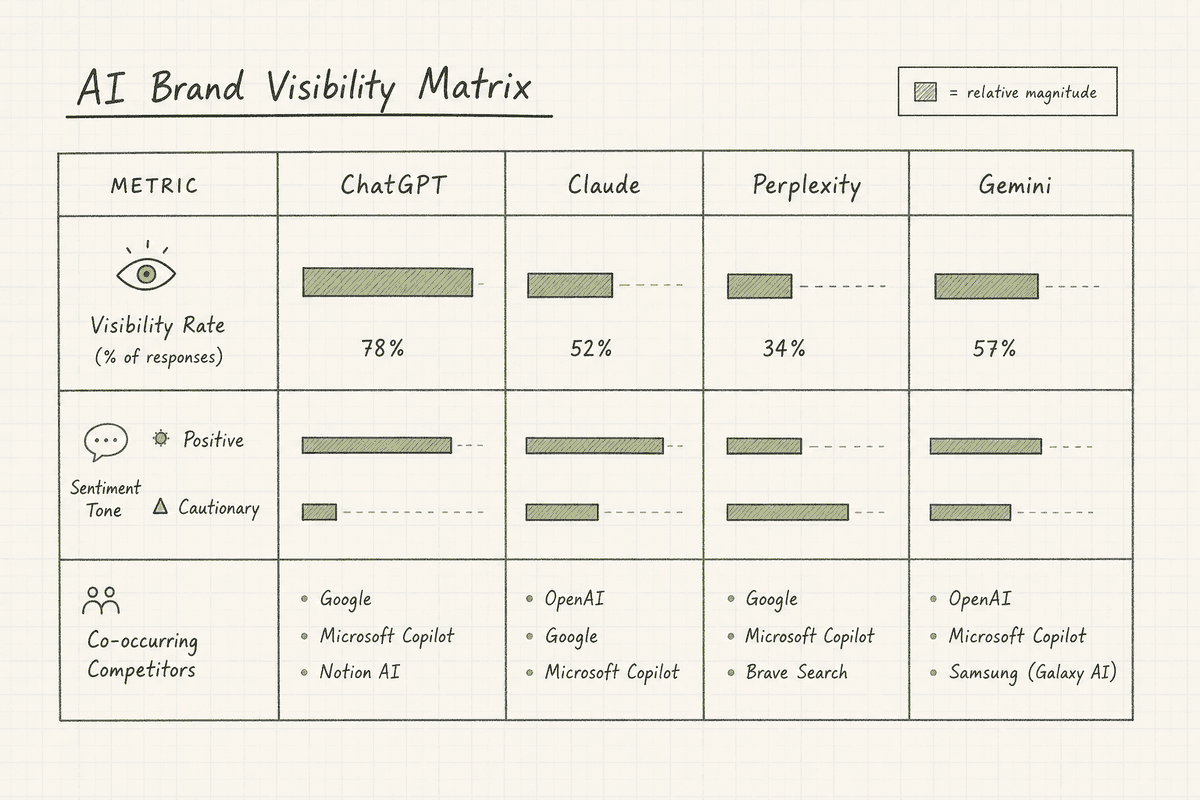
 Because of this architectural difference, tracking AI visibility requires an entirely different set of metrics:
- Share of Voice (SoV) within Answers: You aren't ranking "Position 1." You are either mentioned, recommended, cited as a source, or entirely omitted from the synthesized paragraph.
- Sentiment and Context: Being mentioned isn't always good. If Perplexity lists you under "Alternatives to consider with caution due to pricing," your visibility is high, but your conversion potential is zero.
- Competitor Co-occurrence: How often is your brand mentioned in the exact same AI response as your primary rival?
- Model Variance: ChatGPT (OpenAI), Gemini (Google), and Claude (Anthropic) all weigh training data and real-time retrieval differently. You might dominate Gemini but be invisible to ChatGPT.
The "Manual Tracking" Myth
The most common mistake marketing teams make is assigning a junior marketer to manually test prompts in ChatGPT once a month.
This approach is fundamentally flawed. AI assistants use conversational memory, session state, and personalization. If your marketer has been talking to ChatGPT about your company for weeks, the AI will heavily bias its answers to include your brand, creating a false positive. Furthermore, LLMs operate with a "temperature" setting that introduces randomness; an answer generated on Tuesday might look very different on Thursday, even with the exact same prompt.
Professional tracking platforms use clean, isolated API calls to simulate un-biased buyer queries at scale, giving you a mathematically sound baseline of your true visibility.
Evaluating the Top AI Visibility Tracking Platforms
While Profound is a powerful platform for citation mapping, the ecosystem has matured to offer specialized tools tailored to different workflows. Whether you need SKU-level tracking for an e-commerce catalog, sentiment analysis across obscure LLMs, or a direct pipeline from tracking to content execution, there is a specialized tool available.
1. BeVisible (Best for Execution-Led Growth Teams)
We built BeVisible because we realized that knowing you are losing to a competitor in ChatGPT is only half the battle. Data without a deployment strategy is just expensive anxiety.
BeVisible helps teams monitor how AI assistants answer buyer questions, which brands they recommend, and which sources they cite. It tracks ChatGPT, Gemini, Perplexity, AI Mode, and AI Overviews across buyer prompts, then turns visibility gaps into evidence-backed opportunities, articles, review, scheduling, and publishing work.
Where it excels: Instead of just giving you a dashboard of declining visibility scores, BeVisible focuses on the feedback loop. If Perplexity drops your brand from a "best tools for..." prompt, BeVisible identifies why (e.g., a competitor recently published an integration guide that the AI's RAG system prefers). It then automatically generates the strategic brief and scheduling workflow for your content team to publish the necessary assets to win that citation back.
It is designed specifically for SaaS founders, B2B marketing teams, agencies, and content teams who want to measure AI-search visibility and immediately turn missing mentions, weak citations, and competitor wins into published work.
2. PromptTrack (Best for Pure Share of Voice and GEO Monitoring)
If your primary goal is to establish a rigorous, mathematical baseline for your brand's presence across different prompts, PromptTrack is a strong contender.
It focuses on tracking how often your brand appears in LLM answers (ChatGPT, Gemini, Perplexity, etc.) and measuring "share of voice" across specific, categorized prompts. Built specifically for GEO and AI SEO monitoring, it shows exactly how you rank in AI responses across the queries you care about most.
Where it excels: PromptTrack is highly effective for teams transitioning from traditional SEO to GEO. The interface feels familiar to SEO professionals, translating complex AI outputs into trackable Share of Voice metrics. You can read more about their approach to [PromptTrack][https://promptrack.cloud/?utm_source=chatgpt.com].
3. Orbilo (Best for Multi-Model Sentiment Analysis)
Not all buyers use ChatGPT. Developers often prefer Claude. Tech enthusiasts might test Grok. Researchers lean heavily on Perplexity. If your audience is fragmented across the AI ecosystem, you need a multi-model approach.
Orbilo is a multi-model AI brand monitoring platform that tracks mentions across ChatGPT, Claude, Perplexity, Grok, Gemini, and DeepSeek. It provides highly detailed dashboards for visibility score, sentiment, competitor tracking, and prompt-based analysis.
Where it excels: Orbilo shines in its sentiment analysis engine. It doesn't just register a brand mention; it contextualizes it. If a new competitor enters the market and LLMs start comparing you unfavorably on price, Orbilo's sentiment tracking will catch the shift before it hits your bottom line. You can explore their multi-model capabilities at [Orbilo][https://orbilo.co/?utm_source=chatgpt.com].
4. Siftly (Best for Ongoing Benchmarking and Co-Occurrence)
In traditional SEO, you monitor your position relative to the domains above and below you. In AI visibility, you monitor who the AI lumps you together with.
Siftly tracks brand visibility across AI engines and reports mentions, ranking position, sentiment, and competitor co-occurrence. It’s designed heavily for marketing teams who want ongoing visibility benchmarking across multiple AI platforms.
Where it excels: Siftly's co-occurrence tracking is its standout feature. If you are a premium, enterprise-grade software, you want AI to mention you alongside Salesforce and Oracle. If the AI is consistently grouping you with cheap, entry-level freemium tools, you have a brand positioning problem at the LLM level. Siftly highlights exactly who you are sharing the AI's "brain space" with. Check out their benchmarking tools at [Siftly][https://www.siftly.ai/features/ai-brand-monitoring?utm_source=chatgpt.com].
5. Are We On AI (Best for Lightweight Trend Tracking)
Not every company needs an enterprise-grade execution platform or complex sentiment matrices. Some founders just want a reliable, simple answer to a simple question: "Are we showing up?"
Are We On AI is a simpler AI visibility tracker that monitors how often your brand appears across LLMs and produces a visibility score, competitor gap analysis, and trend tracking.
Where it excels: It is incredibly easy to set up. You don't need a certified GEO specialist to interpret the dashboard. It serves as a fantastic early-warning system for startups who want to ensure their PR efforts and digital footprint are actually penetrating the training data and retrieval systems of major AI platforms. Learn more about their lightweight approach at [Are We On AI][https://areweonai.com/?utm_source=chatgpt.com].
6. Alhena (Best for eCommerce and SKU-Level Tracking)
If you sell software or services, brand and category tracking is usually enough. But if you manage a catalog of 5,000 physical products, knowing that your brand is mentioned doesn't help you sell a specific pair of running shoes.
Alhena stands apart because it tracks at the SKU level. It monitors whether AI engines recommend specific product models, configurations, or inventory items when users ask for highly specific buying advice (e.g., "What are the best noise-canceling headphones under $200 for small ears?").
Where it excels: Alhena is the definitive choice for large retail, manufacturing, and eCommerce brands that need granular, product-specific AI visibility data. You can see how they approach SKU-level AI tracking at [Alhena][https://alhena.ai/blog/ai-brand-visibility-tracking-tools/?utm_source=chatgpt.com].
Feature Comparison: Choosing the Right Platform
To help clarify the landscape, here is how these platforms align based on their core focus and ideal user base.
Structuring Your AI Prompt Strategy
Buying a tool is useless if you are tracking the wrong inputs. In traditional SEO, you track keywords. In GEO, you track prompts.
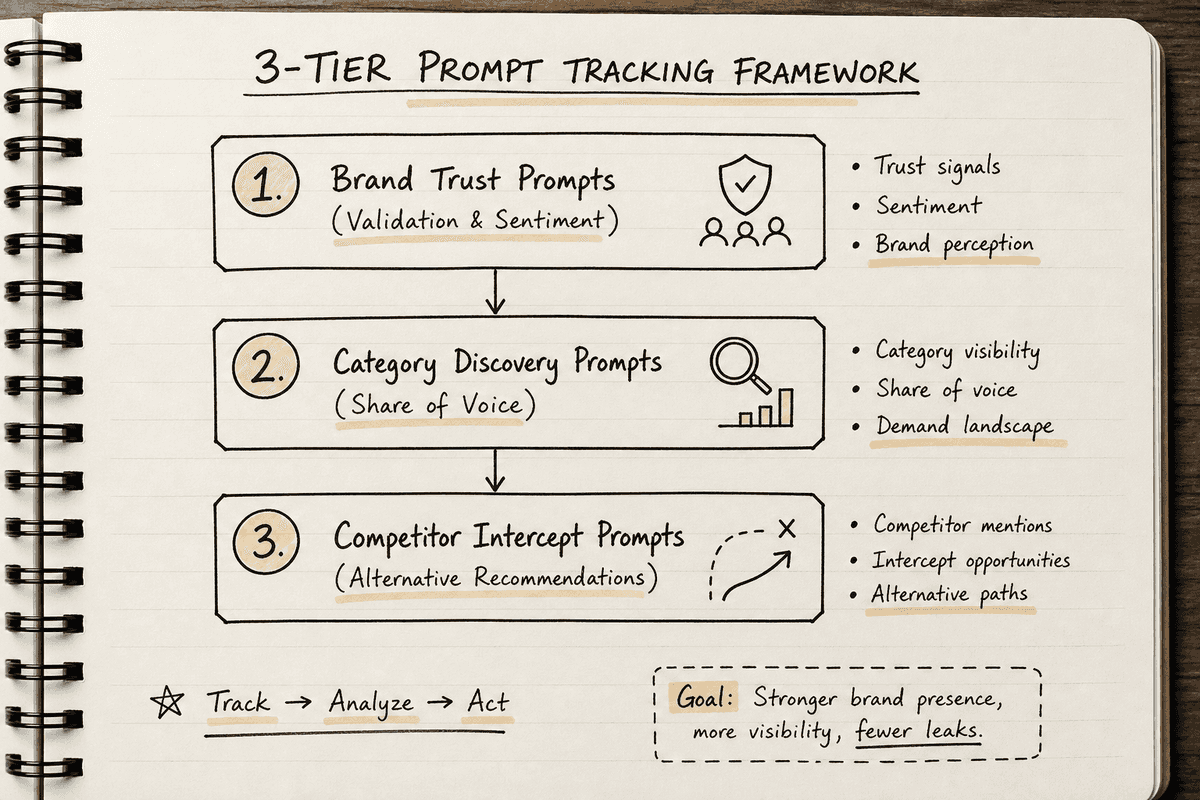
A mature AI visibility tracking strategy segments prompts into three distinct buckets. If you aren't tracking all three, you are leaving massive blind spots in your marketing data.
1. Brand Trust Prompts
These are prompts where the user already knows who you are, but they are asking the AI to validate their decision.
- "What are the main downsides of using [Your Brand]?"
- "Is [Your Brand] secure enough for healthcare data?"
- "How does [Your Brand]'s pricing compare to its value?"
If you have weak visibility or negative sentiment here, you will suffer from a high drop-off rate in the middle of your sales funnel. Buyers will express interest, consult Perplexity, and quietly ghost your sales team.
2. Category Discovery Prompts
These are the equivalent of high-volume, non-branded search terms. The buyer knows their problem but doesn't know the vendors.
- "What are the best platforms for tracking brand visibility in AI answers?"
- "Recommend a lightweight CRM for a remote real estate agency."
- "Which email marketing tools actually have good deliverability in 2026?"
Winning these prompts is the holy grail of generative engine optimization. It requires a sustained, authoritative digital footprint that forces the AI's RAG systems to retrieve your brand as the canonical answer.
3. Competitor Intercept Prompts
This is where AI can become a vicious competitive battleground. Users are asking about your competitor, and you want the AI to suggest you instead.
- "What is the best alternative to [Competitor] for small businesses?"
- "Why do people migrate away from [Competitor]?"
- "Tools similar to [Competitor] but with better reporting."
If your competitor has properly optimized their AI visibility, they will defend these prompts. If they haven't, these queries represent your fastest path to stealing market share.
A Real-World Scenario: The Cost of Flying Blind
Consider a mid-market B2B SaaS company operating in the supply chain logistics space. Let's call them FreightFlow.
For years, FreightFlow dominated traditional search for terms like "route optimization software." They had an incredible SEO moat. But in early 2026, their demo requests inexplicably dropped by 20%. Their traditional rank trackers showed them holding Position 1 on Google. Traffic to the blog was steady.
What they couldn't see was that a massive segment of their buyers had shifted to using Perplexity Pro for vendor research.
When a buyer asked Perplexity, "What is the best route optimization software that integrates with SAP?", Perplexity was retrieving an outdated, three-year-old forum post claiming FreightFlow's SAP integration was buggy and unreliable. Perplexity synthesized this into a confident, bulleted answer: "FreightFlow is a popular option, however, users frequently report critical failures with their SAP integration. A more stable alternative is [Competitor]."
FreightFlow was bleeding pipeline, and their SEO tools were telling them everything was fine.
Once they implemented an AI visibility tracking platform, they caught the negative sentiment instantly. More importantly, they executed a fix. Using an execution-focused tool, they identified the specific information gap the AI was suffering from. Their content team published a highly technical, updated engineering blog post detailing their brand-new, certified SAP integration. They created a dedicated landing page for the feature—following principles similar to those in How to Build an SEO Landing Page (7-Step Guide)—and syndicated it through authoritative industry PR channels.
Within ten days, Perplexity's RAG system ingested the new, highly authoritative signals. The AI's answer shifted from a warning into a glowing recommendation. Demo requests recovered.
This is the difference between traditional SEO and AI visibility execution.
How to Actually Influence AI Visibility (Execution Matters)
Tracking the data is only the diagnostic phase. Once you know where you are missing, how do you actually change the mind of a Large Language Model?
You cannot buy ads inside a ChatGPT response (yet). You cannot stuff keywords into a metadata tag and expect Claude to care. Influencing AI requires feeding the beast what it actually wants: dense, authoritative, un-gated, highly structured information.
1. Own Your Unstructured Data
LLMs struggle with nuance. If your website relies on vague, clever marketing copy ("We unleash your team's potential synergy"), the AI has no idea what you actually do. You need to provide stark, structured facts. Ensure your site has clear, descriptive text detailing your features, pricing, target audience, and limitations.
2. Blanket the RAG Retrieval Zones
When an AI assistant searches the live web to formulate an answer, it favors highly authoritative, frequently updated domains. It looks at Reddit, Quora, G2, Trustpilot, Capterra, and top-tier industry blogs. If your brand is only mentioned on your own domain, the AI won't trust you. You must execute a digital PR strategy that places mentions of your brand on the exact sites the AI crawls for context. If you are targeting regional queries, look at local ecosystem guides, much like how finding the Top 7 Agencies for SEO in Durham (Ranked 2026) requires a specific local footprint.
3. Build Feature-Specific Citation Assets
If you are missing from a prompt like "AI tracking tools with sentiment analysis," you need to publish a definitive asset about sentiment analysis. The AI needs a URL it can confidently cite as the source of truth. This is where BeVisible's workflow thrives—taking the missing prompt, generating the brief, and pushing it to your content pipeline. Staying updated on these execution strategies is vital; following the right industry thinkers, as detailed in the 11 Best SEO Blogs Every SaaS Founder Needs (2026), can keep your team ahead of the curve.
Frequently Asked Questions
How often do AI answers change?
Because models like ChatGPT (with Search) and Perplexity rely on real-time web retrieval (RAG), their answers can theoretically change daily based on new information published to the web. However, core model updates (changing from GPT-4o to GPT-5, for example) cause massive, systemic shifts in visibility that require immediate auditing. Tracking platforms usually monitor daily or weekly to catch both RAG fluctuations and model updates.
Does tracking AI visibility help with traditional SEO?
Yes, but indirectly. The strategies required to optimize for AI—publishing dense, authoritative, well-structured content and building mentions on high-trust third-party platforms—are incredibly beneficial for traditional Google search rankings. Google's own AI Overviews blur the line between traditional search and AI synthesis, making a dual strategy essential.
Which LLMs are most important to track?
It depends entirely on your audience. For general consumers and broad B2B, ChatGPT and Google Gemini dominate market share. For technical audiences and developers, Claude is heavily utilized. For deep research and B2B vendor selection, Perplexity is rapidly becoming the industry standard. A strong tracking strategy monitors at least three of the major models to identify discrepancies in how your brand is perceived across the ecosystem.
The Future Belongs to Those Who Execute
The days of flying blind in the AI era are over. We now have the technology to see exactly what the world's most powerful answer engines are saying about our brands.
Whether you choose PromptTrack for deep share-of-voice metrics, Orbilo for multi-model sentiment, Siftly for benchmarking, or BeVisible to tie all that data directly into a rigorous content execution pipeline, the most important step is simply to start.
The companies that treat AI visibility as a measurable, actionable marketing channel today will be the default recommendations of tomorrow. The companies that ignore it will eventually find themselves omitted from the conversation entirely.