
When prospective buyers ask ChatGPT, Perplexity, or Google AI Overviews to recommend software in your niche, your product either appears in the answer or gets left out entirely. For large enterprises with custom marketing operations, platforms like Profound provide expansive intelligence across generative search engines. However, for lean marketing teams, bootstrapped SaaS founders, and growth agencies, high-end enterprise platforms often introduce high annual price commitments, bloated feature sets, and a fundamental execution problem: they tell you where you are missing, but leave you to figure out how to bridge the gap manually.
Smaller teams do not have the luxury of spending hours staring at complex analytics dashboards without a direct path to publishing content. Every hour spent analyzing data needs to translate directly into content that captures citations and secures brand recommendations across major AI assistants.
This guide reviews the best Profound alternatives for smaller teams, examining how each tool handles tracking across major engines, source citation mapping, cost efficiency, and the critical leap from visibility insights to published work.
Why Smaller Teams Struggle With Enterprise GEO Platforms
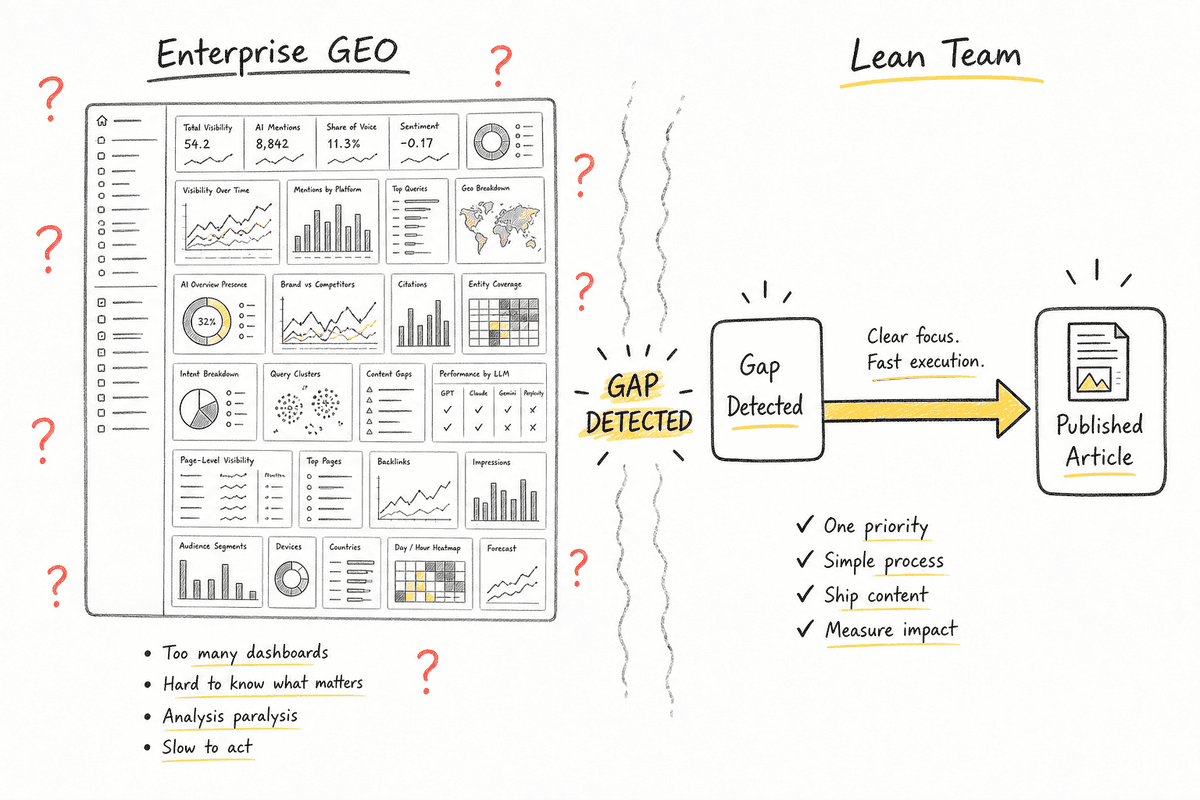
Generative Engine Optimization (GEO) has rapidly shifted from an experimental discipline into a core growth metric. Enterprise monitoring platforms were built primarily for corporate brand managers who need enterprise governance, deep historical trend analysis, and custom executive reporting. While valuable for multinational corporations, that architecture creates specific friction points for smaller teams.
1. High Financial Commitments and Opaque Contracts
Enterprise platforms like Profound frequently require custom enterprise agreements, annual lock-ins, and tiered seat pricing that can swallow a significant portion of a small team's software budget. For a team of two marketers or a founder handling growth, paying thousands of dollars per month just to observe baseline data is difficult to justify. Smaller organizations require transparent, self-serve monthly plans that scale as prompt tracking needs expand.
2. The Analytics-to-Execution Gap
The primary point of failure for lean teams using enterprise GEO tools is dashboard paralysis. Enterprise platforms generate massive volumes of metric charts showing where competitor brands are cited across hundreds of prompt variations. However, knowing that a competitor is cited in 42% of Perplexity prompts for "best CRM for real estate" does not fix your absence. Lean teams lack dedicated writers and SEO researchers to manually reverse-engineer those citations, write counter-content, and optimize it for AI retrieval models.
3. Resource Overhead and Seat Management
Enterprise tools often require dedicated training and multi-step onboarding processes. Roles are divided between analysts who digest data and execution teams who implement changes. In a smaller team, the person analyzing AI assistant recommendations is often the same person writing the content, managing the website, and running distribution. Software built for this reality prioritizes speed, clarity, and automated execution over complex administrative settings.
What to Look for in a Lean AI Visibility Tool
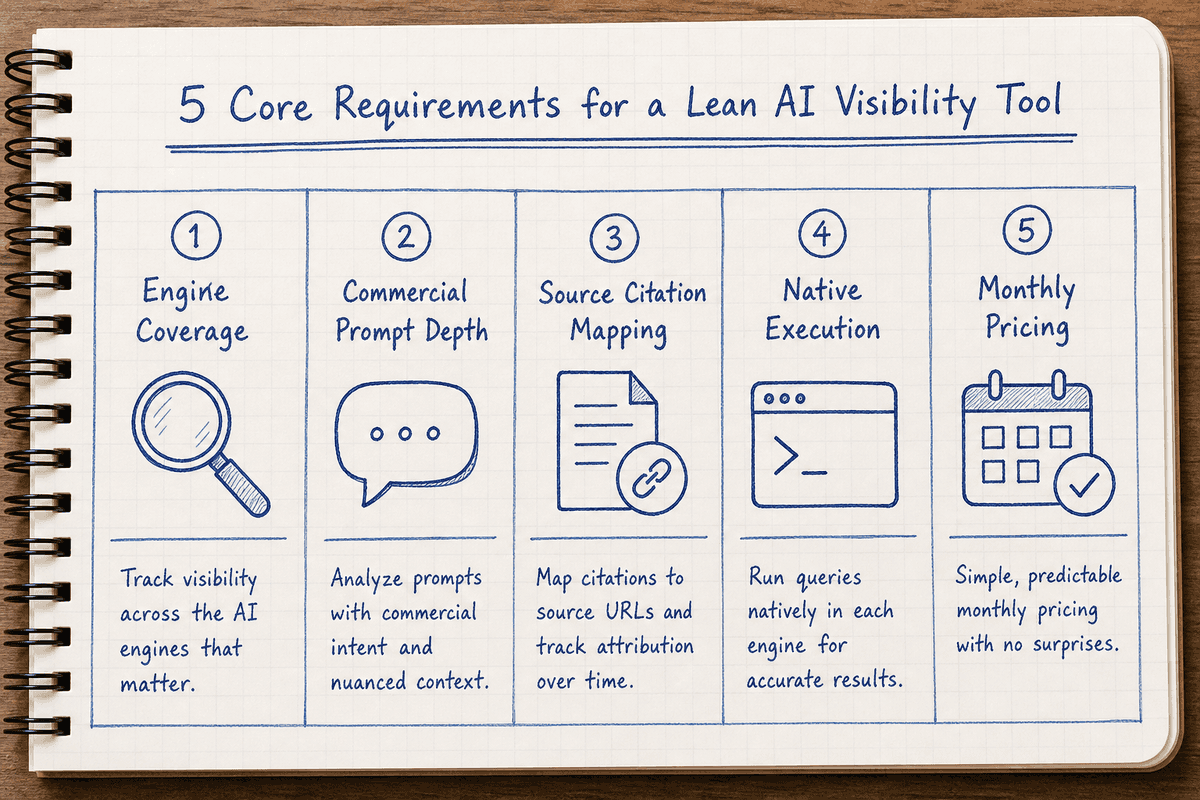
Before selecting an alternative, it helps to understand the core infrastructure required to track and improve your brand's presence inside AI search engines. Evaluating tools against five core capabilities ensures you do not trade enterprise bloat for an underpowered tool.
Engine Breadth Across Buyer Touchpoints
Buyers do not rely on a single AI assistant. A prospect might research high-level software categories on ChatGPT, ask Perplexity for technical feature comparisons, and rely on Google AI Overviews or AI Mode during live web searches. A reliable alternative must track prompt responses across all primary conversational engines rather than specializing in just one.
Citation and Entity Mapping
AI models rely on Retrieval-Augmented Generation (RAG) and index lookups to ground their answers in live web citations. A strong monitoring tool must break down why an engine recommended a rival brand. Did the model pull from a third-party review site, an industry blog post, an official documentation page, or an aggregator list? Identifying the underlying citation source allows you to target your outreach and content production accurately.
Automated Execution Workflows
Tracking missing brand recommendations is only half the battle. The true differentiator for lean teams is how quickly insights turn into action. The ideal platform automatically converts detected visibility gaps into structured content briefs, draft articles, and ready-to-publish updates that align with what AI retrieval systems are actively searching for.
The Top Profound Alternatives for Smaller Teams
Here is an analysis of the leading alternatives to Profound tailored for smaller teams, comparing their feature sets, ideal use cases, and key trade-offs.
1. BeVisible
Best for: End-to-end AI visibility tracking combined with automated content execution.
BeVisible was engineered specifically to solve the analytics-to-execution gap that slows down smaller marketing teams. Rather than serving as a passive monitoring dashboard, BeVisible functions as an active optimization platform that connects tracking data directly with content production and publishing.
+-----------------------------------------------------------------------+
|                         BEVISIBLE WORKFLOW                            |
+-----------------------------------------------------------------------+
|  1. MONITOR           2. AUDIT            3. GENERATE    4. PUBLISH   |
|  Track prompts across  Identify missing   Produce        Review and   |
|  ChatGPT, Perplexity,  mentions & source  evidence-based publish to   |
|  Gemini & Google AI   gaps                articles       CMS          |

+-----------------------------------------------------------------------+
Key Capabilities
- Multi-Engine Prompt Tracking: Monitors how ChatGPT, Gemini, Perplexity, AI Mode, and Google AI Overviews answer target buyer questions, tracking which brands are recommended and which sources are cited.
- Evidence-Backed Opportunity Detection: Identifies exact prompts where competitors appear but your brand is missing, isolating the missing citations and context required to rank.
- Integrated Content Execution: Turns visibility gaps into fully structured, research-backed articles designed to win citations from the specific engines where you are underperforming.
- Streamlined Review & Publishing: Includes integrated review cycles, scheduling, and direct publishing hooks to keep lean teams moving from gap detection to published live assets without tool-switching.
Pros
- Eliminates the need for separate tracking tools and content generation stacks.
- Focuses on actionable buyer-intent prompts rather than vanity tracking.
- Designed specifically for lean growth teams, agencies, and SaaS founders who need immediate output.
- Provides clear visibility into source domain citations across conversational search platforms.
Cons
- Built explicitly for teams that want to produce content and win citations; less suited for corporate teams that only want executive reporting dashboards without execution features.
2. Otterly.ai
Best for: Quick brand mention audits and light, low-touch LLM monitoring.
Otterly.ai provides a simplified entry point into AI brand monitoring. It focuses on tracking brand mentions across major conversational interfaces without requiring complex configuration.
Key Capabilities
- Prompt Auditing: Runs periodic checks across popular buyer queries to verify whether your brand appears in assistant outputs.
- Simple Dashboarding: Displays clear, high-level summaries of brand presence over time.
- Competitor Mention Tracking: Tracks basic presence comparison between your brand and immediate competitors.
Pros
- Low learning curve with minimal setup required.
- Affordable price point suitable for early-stage startups and small budgets.
- Clean visual dashboards for fast reporting.
Cons
- Limited depth regarding root-cause citation analysis.
- No built-in content generation or workflow engine to address identified missing mentions.
- Infrequent prompt refresh rates on standard tiers.
3. Rankscale
Best for: Traditional SEO teams transitioning into AI search rank tracking.
Rankscale approaches AI search monitoring through the lens of traditional rank tracking. It models LLM response tracking similarly to how classic rank trackers monitor Google SERP positions.
Key Capabilities
- Positional Tracking: Assigns numerical visibility ranks based on where your brand appears inside generated response lists.
- Engine Disaggregation: Separates performance metrics between different model releases and search integrations.
- Keyword Volatility Alerts: Sends notifications when AI engine outputs shift significantly for tracked phrases.
Pros
- Familiar interface for SEO professionals accustomed to traditional rank-tracking dashboards.
- Detailed historical trend charts for long-term monitoring.
- Good granular data on response ordering.
Cons
- Treats conversational responses like static SERP lists, which does not always reflect how AI models synthesize answer recommendations.
- Lacks native execution tools, requiring teams to manually transfer data to external content management systems.
4. Peec AI
Best for: Snapshot share-of-voice reporting and quick competitive checks.
Peec AI offers lightweight AI share-of-voice analytics designed to help teams quickly assess how prominently their brand features in generative engine outputs compared to rivals.
Key Capabilities
- Share-of-Voice Scoring: Calculates aggregate percentage visibility metrics across prompt groups.
- Sentiment Overview: Categorizes assistant responses as positive, neutral, or negative toward your brand.
- Competitor Benchmarking: Compares side-by-side snapshot recommendations from target prompts.
Pros
- Simple share-of-voice metric that is easy to explain to non-technical stakeholders.
- Fast account setup and clean tracking interface.
- Helps teams rapidly spot major brand perception issues in assistant responses.
Cons
- Lacks deep source-attribution breakdowns showing which web URLs drove the response.
- Does not offer automated content creation, scheduling, or direct publishing workflows.
5. Brand24 (with AI Search Add-ons)
Best for: Combined social media listening, PR tracking, and broad brand mention monitoring.
Brand24 is primarily a social listening and web monitoring platform that has expanded its coverage to track brand mentions within generative search environments alongside traditional channels.
Key Capabilities
- Multi-Channel Brand Tracking: Monitors social media, news outlets, forums, blogs, and AI responses in a single feed.
- Sentiment Analysis: Analyzes brand mention sentiment across broad digital platforms.
- Reach and Volume Metrics: Estimates audience reach and conversation volume around specific brand names.
Pros
- Comprehensive platform for teams that want social listening and media monitoring combined with basic AI tracking.
- Excellent contextual awareness of traditional PR discussions and online news mentions.
- Robust notification and reporting system.
Cons
- Generative search monitoring is an add-on feature rather than the core architecture of the platform.
- Does not track complex, multi-turn B2B buying prompts effectively.
- No workflow tools for optimizing web content to capture search engine RAG citations.
6. Custom API Scripting (OpenAI/Perplexity APIs + Google Sheets)
Best for: Technical teams with dedicated engineering resources wanting maximum custom control.
Some technical teams build custom monitoring solutions using the direct APIs of OpenAI, Anthropic, and Perplexity, outputting data to Google Sheets or custom internal dashboards.
Key Capabilities
- Custom Prompt Logic: Allows complete control over system prompts, temperature settings, and query frequency.
- Direct Data Ownership: Stores raw JSON outputs directly in private databases or cloud storage.
- Tailored Scripting: Custom scripts can test edge-case parameters and specific localized prompts.
# Conceptual Python snippet for basic prompt sampling
import openai

def check_ai_recommendation(prompt_text):
    client = openai.OpenAI()
    response = client.chat.completions.create(
        model="gpt-4o",
        messages=[{"role": "user", "content": prompt_text}],
        temperature=0.2
    )
    answer = response.choices[0].message.content
    return answer
Pros
- Extremely low raw operational cost (pay only for direct API token usage).
- Complete flexibility over query structures and prompt variables.
- No dependency on third-party SaaS platform roadmaps.
Cons
- Requires continuous maintenance as API endpoints, models, and retrieval search setups change.
- High engineering overhead to build custom parsing, web interface tracking, and citation extraction.
- Zero built-in marketing execution features or content production workflows.
Detailed Tool Comparison Matrix
To help evaluate which platform aligns with your team's budget and operational requirements, the table below provides a breakdown of capabilities, execution features, and ideal team profiles.
The Strategic Gap: Why Tracking Is Not Enough for Smaller Teams
Selecting a tool requires understanding how search discovery has evolved. For over two decades, search engine optimization was straightforward: perform keyword research, optimize page elements, build backlinks, and monitor rankings on a SERP tracking tool.
AI assistants handle queries differently. When a user asks an AI assistant for a software recommendation, the system executes a multi-step process.
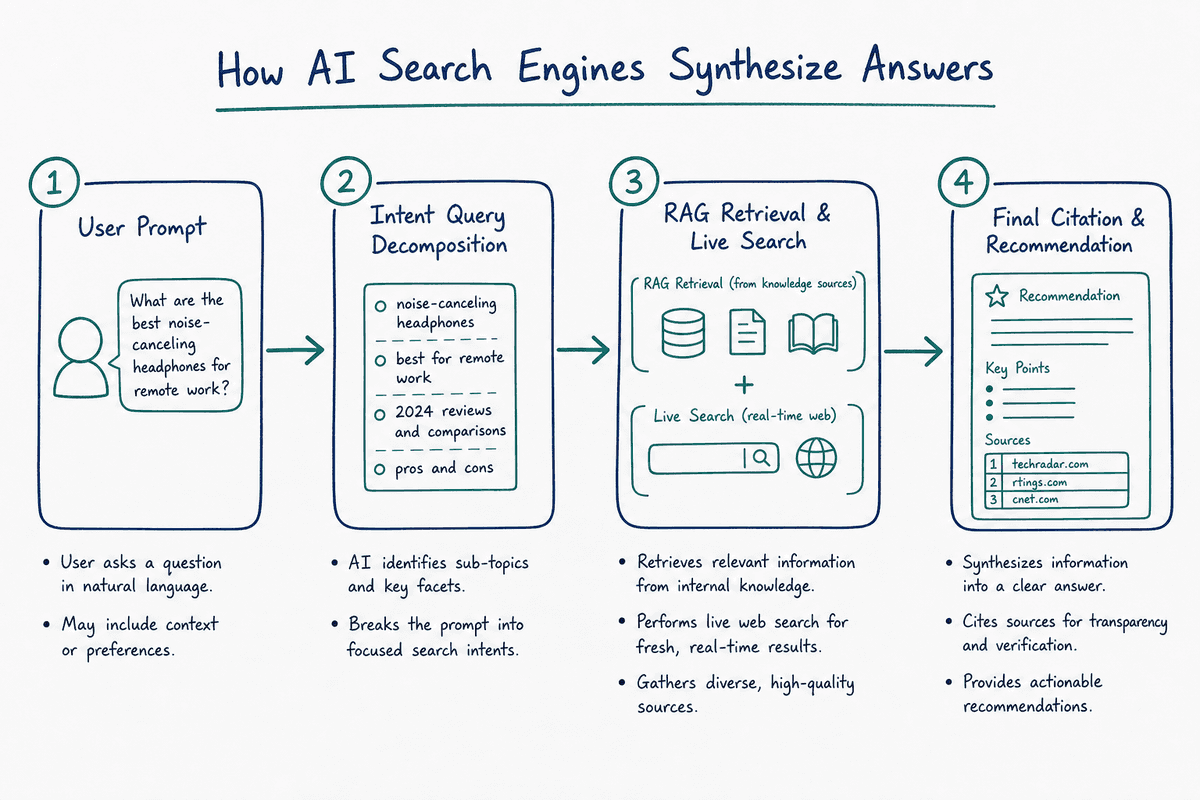
+--------------------------------------------------------------------------+
|                      HOW AI ASSISTANTS GENERATE ANSWERS                   |
+--------------------------------------------------------------------------+
|  [User Prompt]                                                           |
|       │                                                                  |
|       ▼                                                                  |
|  [Intent Query Decomposition] ──► Breaks prompt into technical concepts   |
|       │                                                                  |
|       ▼                                                                  |
|  [RAG Retrieval & Live Search] ──► Queries web index for trusted sources  |
|       │                                                                  |
|       ▼                                                                  |
|  [Synthesis & Attribution]    ──► Generates answer & embeds citations    |
|       │                                                                  |
|       ▼                                                                  |
|  [Final Recommended Output]   ──► Displays brands with hyperlinked sources|

+--------------------------------------------------------------------------+
- Query Decomposition: The assistant breaks the user's prompt into sub-queries, identifying explicit constraints (e.g., "for small teams," "under $100/mo," "with CRM integration").
- Retrieval-Augmented Generation (RAG): The system searches its underlying index or queries live search APIs (like Bing or Google) to collect high-authority context documents.
- Entity Extraction & Synthesis: The language model reads the retrieved documents, identifies recurring brand entities, checks review sentiment, and synthesizes a direct response.
- Citation Embedding: The model embeds direct source links to validate its recommendations to the user.
If your software tool only tracks steps 3 and 4, you are operating on lagging indicators. Seeing that your competitor is recommended while you are missing gives you information, but it does not tell your team how to become part of the RAG retrieval set during step 2.
Breaking the "Dashboard Paralysis" Loop
Smaller teams often fall into a predictable trap when adopting enterprise monitoring software:
- Week 1: Set up tracking for 50 commercial buyer prompts.
- Week 2: Discover your brand is absent in 65% of ChatGPT and Perplexity responses.
- Week 3: Export CSV spreadsheets of missing mentions and present them in a marketing catch-up meeting.
- Week 4: Realize no new content has been created to fix the issue because the team is overwhelmed by daily operations.
To overcome this bottleneck, smaller teams must adopt software that automates the bridge between insight and published assets. When a visibility gap is identified, the system should immediately help construct the content required to capture that specific citation opportunity.
For founders navigating resource decisions around growth, evaluating how automation reduces manual overhead is essential. Comparing tool investments against team capacity—much like comparing agency retainers versus automated solutions—helps clarify how to scale operations efficiently without bloating overhead.
Case Scenario: How a Lean SaaS Team Won AI Search Recommendations
To understand how turning visibility insights into published content works in practice, consider the strategy used by a B2B SaaS startup in the scheduling automation space.
The Problem
The startup had an established product with strong customer retention, but was completely absent from AI assistant answers. When potential buyers asked Perplexity or ChatGPT, "What are the best scheduling tools for small agencies with client portals?", the assistants consistently recommended two enterprise incumbents.
+-----------------------------------------------------------------------+
|                       INITIAL AI VISIBILITY STATUS                     |
+-----------------------------------------------------------------------+
|  Tracked Query: "Best scheduling tools for small agencies"            |
|  - ChatGPT Recommendation: Incumbent A, Incumbent B (Brand Missing)   |
|  - Perplexity Recommendation: Incumbent A, Incumbent C (Brand Missing)|
|  - Primary Cited Sources: 3 third-party lists, 2 technical reviews     |

+-----------------------------------------------------------------------+
The Analysis
Using targeted citation tracking, the team discovered why the AI models were omitting their software:
- The AI engines relied heavily on comparison content that detailed explicit feature matrices for "agency client portals."
- The startup's existing landing pages used vague marketing language rather than clear structured data detailing their integration capabilities.
- Third-party review lists cited by Perplexity had not updated their comparative roundups in over eight months.
The Execution Workflow
Instead of spending weeks analyzing spreadsheets, the team implemented a four-step execution strategy:
+-----------------------------------------------------------------------+
|                         EXECUTION TIMELINE                            |
+-----------------------------------------------------------------------+
|  Day 1: Identify source URL gaps & missing entity attributes         |
|  Day 3: Publish structured, evidence-backed comparison articles       |
|  Day 7: Implement clear schema & explicit technical tables            |
|  Day 14: Re-evaluate assistant outputs & verify brand insertion        |

+-----------------------------------------------------------------------+
- Structured Content Creation: They created an in-depth comparison guide structured specifically for RAG parsing. They added clear HTML comparison tables, feature checklists, and explicit headings matching real buyer prompts.
- Landing Page Optimization: They restructured their main solution page to clearly answer technical questions about permissions, portal settings, and onboarding workflows. For advice on building pages structured for high search clarity, see our guide on how to build an SEO landing page.
- Index Refresh Triggering: They published the new content and ensured prompt re-indexing by pinging search engines and submitting updated XML sitemaps.
The Outcome
Within 18 days of publishing the updated content, Perplexity refreshed its citation index. The next time the prompt was tested, the assistant included the startup in its top three recommended solutions, specifically citing the newly published comparison page as its supporting evidence source.
Step-by-Step Guide: Setting Up a Lean AI Visibility Process in 14 Days
If you are transitioning away from enterprise platforms like Profound or starting fresh with a lean alternative, here is a practical 14-day blueprint to establish an efficient AI monitoring and execution workflow.
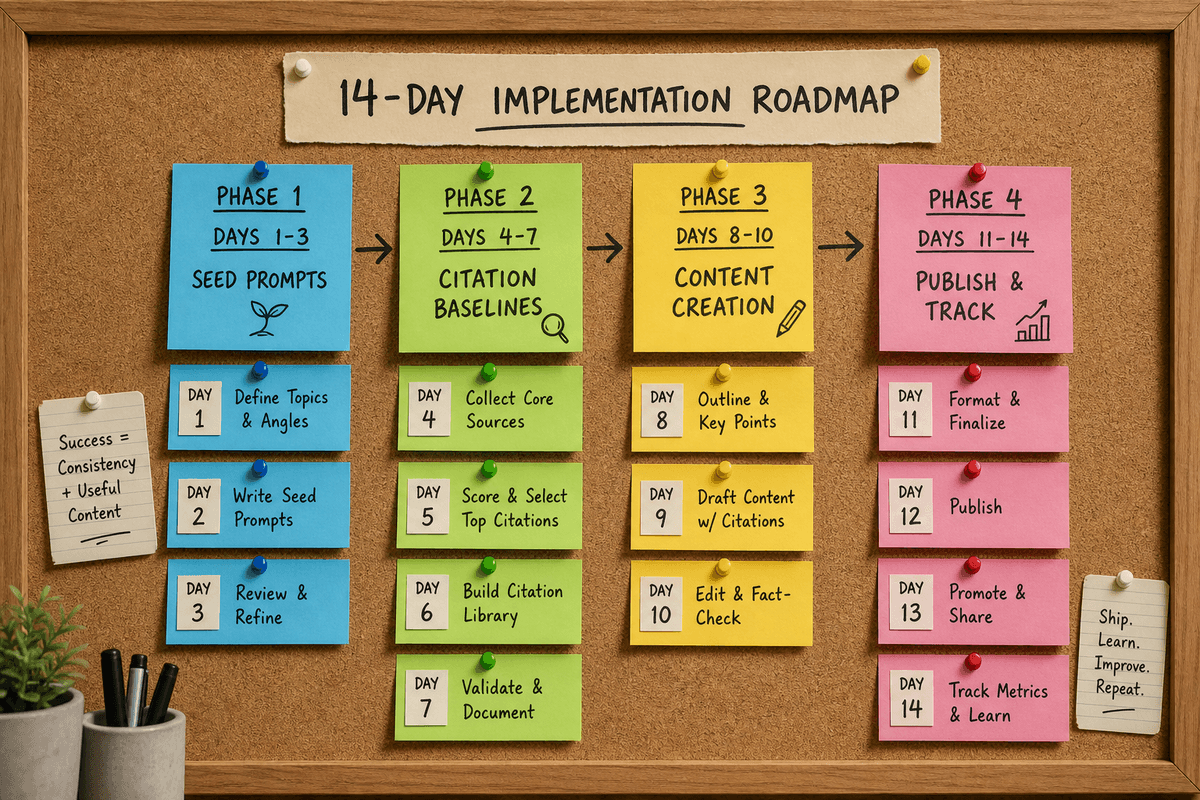
+-----------------------------------------------------------------------+
|                 14-DAY LEAN AI VISIBILITY BLUEPRINT                   |
+-----------------------------------------------------------------------+
|  DAYS 1-3  │ Define Core Prompt Matrix (Commercial vs Discovery)      |
|  DAYS 4-7  │ Establish Baselines & Map Citation Sources             |
|  DAYS 8-10 │ Generate & Audit Content to Fill Identified Gaps         |
|  DAYS 11-14│ Publish Assets & Monitor AI Engine Index Refreshes      |

+-----------------------------------------------------------------------+
Phase 1: Build Your Seed Prompt Matrix (Days 1–3)
Do not track thousands of generic keywords. Start with 20 to 50 high-intent prompts that directly mirror how prospective customers evaluate software in your category. Divide your prompts into three core buckets:
Category 1: Direct Software Recommendations
- "What are the top AI visibility tools for lean marketing teams?"
- "Best alternatives to enterprise GEO software for startups."
Category 2: Feature & Use-Case Specific Queries
- "Which software lets me track ChatGPT and Perplexity citations automatically?"
- "How to track brand recommendations in Google AI Overviews on a budget."
Category 3: Head-to-Head Comparisons
- "Tool A vs Tool B for small team SEO monitoring."
- "Is Enterprise Platform X worth it for a team of 3 marketers?"
Phase 2: Establish Baselines and Citation Audit (Days 4–7)
Run your prompt matrix through your monitoring tool to set baseline benchmarks:
- Calculate Brand Presence Rate: Determine the percentage of target prompts where your brand appears in the main answer text.
- Catalog Primary Citations: Map the top 10 external domains that AI search engines cite most frequently when answering queries in your niche.
- Identify Competitor Share: Note which competitors dominate answers and analyze how the models describe their key value propositions.
Phase 3: Content Generation and Optimization (Days 8–10)
Identify the top 5 prompts where your brand is missing but should logically be recommended. Use your execution tool to draft content specifically designed to answer those questions.
When generating content to capture AI search citations, structure the material using these clear formatting patterns:
- Use Explicit Definition Headers: State exactly what your product does using clear subject-verb-object structures (e.g., "BeVisible is an AI visibility tracking platform that...").
- Include Detailed Feature Tables: AI models extract tabular data efficiently during RAG retrieval passes.
- Provide Verifiable Claims: Back up feature capabilities with explicit examples rather than broad marketing claims.
+-----------------------------------------------------------------------+
|                  RAG-FRIENDLY CONTENT STRUCTURE                       |
+-----------------------------------------------------------------------+
|  [H2: Clear Feature Definition Header]                                |
|  │                                                                    |
|  ├── [Direct Answer Paragraph] (2-3 concise sentences)                 |
|  │                                                                    |
|  ├── [Structured Comparison Table] (Features / Specs / Use Cases)     |
|  │                                                                    |
|  └── [Bullet List of Verifiable System Attributes]                   |

+-----------------------------------------------------------------------+
Phase 4: Publish, Index, and Measure (Days 11–14)
Publish your new assets directly to your website or blog. Ensure search engines can crawl the pages instantly:
- Submit the new URLs directly in Google Search Console and Bing Webmaster Tools.
- Internal link to the new pages from high-authority sections of your website.
- Re-test your core prompt matrix in your monitoring tool after 7 to 10 days to track citation updates and mention inclusion.
To stay up to date on evolving search formats and growth strategies, review our curated list of the best SEO blogs for founders.
Four Common Myths About AI Search Visibility
As smaller teams adapt to AI-driven search, several misconceptions can lead to misallocated time and resources.
Myth 1: Traditional SEO Rank Tracking Is Sufficient for AI Search
The Reality: Traditional rank trackers monitor static SERP link positions. AI search engines synthesize answers dynamically using RAG, personalized context, and multi-source aggregation. A page ranking #3 on Google web search might be omitted entirely from a ChatGPT or Perplexity answer if its text lacks structured entity answers. Tracking conversational visibility requires direct prompt testing across LLMs.
Myth 2: You Need Thousands of Tracked Prompts to Gain Value
The Reality: Enterprise teams often track thousands of low-intent keywords to build massive reporting dashboards. For smaller teams, tracking 30 to 50 focused, commercial-intent buyer prompts provides clear, actionable intelligence without overwhelming the team with data noise.
Myth 3: AI Assistants Refresh Their Knowledge Instantly
The Reality: While tools like Perplexity and Google AI Overviews query live web search indices continuously, foundational models like base ChatGPT operate on periodic web crawling cycles and index refreshes. Winning a recommendation takes time. Expect a lag of 7 to 21 days between publishing new content and seeing shifts across live RAG-assisted search engines.
Myth 4: Simply Adding Brand Mentions to Content Will Fix Absence
The Reality: AI engines evaluate context, source authority, and technical accuracy. Merely repeating your brand name across low-quality blog posts will not influence answer engines. Content must directly satisfy the query parameters, provide clear technical attributes, and be hosted on authoritative, indexable web pages.
Frequently Asked Questions
What is the main difference between enterprise tools like Profound and lean alternatives?
Enterprise tools prioritize broad corporate intelligence, deep historical reporting, and multi-seat governance for large organizations. Lean alternatives focus on transparent pricing, fast setup, buyer-intent tracking, and direct workflows that bridge the gap between analytics data and content production.
How often should a small team check AI visibility metrics?
Tracking weekly or bi-weekly is ideal for most smaller teams. Daily tracking often creates unnecessary noise because AI search indices require time to process new content updates and web crawls.
Can a lean team outrank an enterprise competitor inside ChatGPT or Perplexity?
Yes. AI search engines choose sources based on relevance, clear structured text, and direct query alignment rather than domain authority alone. A smaller company with focused, authoritative content that answers buyer prompts directly can secure citations over a large competitor relying on vague marketing copy.
How do search engines like Google AI Overviews use content differently than ChatGPT?
Google AI Overviews relies heavily on Google's main web crawler and index, summarizing real-time web results directly above search listings. ChatGPT combines baseline LLM knowledge training with web retrieval through Bing. Optimizing content for clear structural readability, tables, and explicit headers improves visibility across both systems.
Making the Right Choice for Your Team
Enterprise visibility platforms serve a purpose for large corporations with specialized analytics teams. However, if you run a growth team, agency, or lean SaaS company, software that only offers complex reporting dashboards without execution tools will quickly create operational backlogs.
When evaluating Profound alternatives, look beyond high-level dashboard charts. Choose a solution that fits your operational rhythm, provides clear domain citation tracking, and provides a direct path from identifying visibility gaps to publishing high-impact content.
By focusing on commercial buyer prompts, understanding how AI engines pull source information, and using software designed for active execution, smaller teams can compete effectively and secure recommendations across conversational search platforms.