
If you search for "SEO London" right now, you will notice an immediate quirk in the search results. The top spots are heavily dominated by the Sponsors for Educational Opportunity (SEO London), an excellent charity that places underrepresented students into top-tier corporate careers. They have held that authoritative brand footprint since 2000.
But if you are a SaaS founder, indie hacker, or startup operator hunting for search engine optimization expertise in the UK capital, finding the right partner requires digging past the non-profit dominance to evaluate a highly saturated, often overpriced agency market.
London is home to thousands of digital marketing firms, ranging from boutique Shoreditch strategy houses to massive global networks holding courts in the City. Yet, for high-growth software companies, the traditional London agency model is frequently misaligned with the velocity, technical infrastructure, and unit economics required to scale organic MRR in 2026.
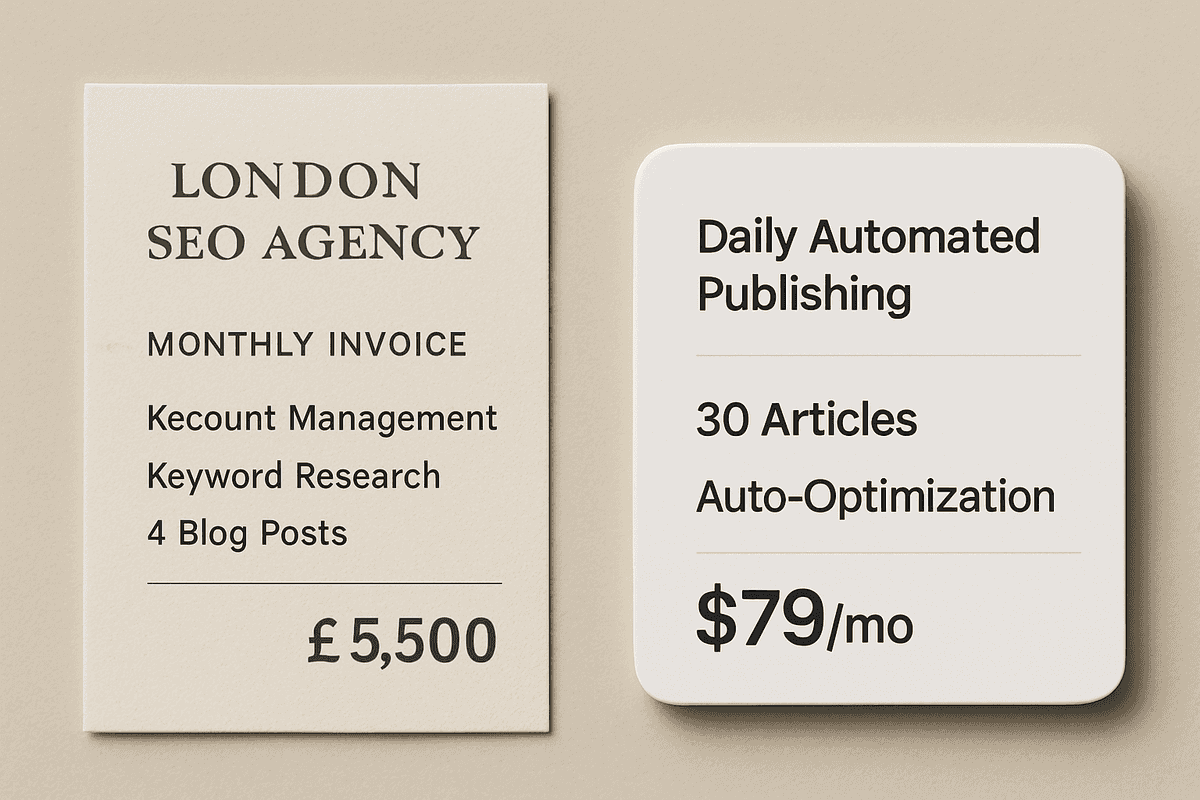
Instead of signing a £5,000-per-month retainer with a generalist firm, SaaS startups need to rethink how search works in an era of AI summaries, single-page applications, and automated daily publishing. Here is how to evaluate the London SEO landscape, the common failure modes of hiring local agencies, and why full-pipeline automation is quietly replacing the traditional retainer.
The SaaS Unit Economics Problem in Traditional Agencies
The fundamental disconnect between London SEO agencies and SaaS startups comes down to Customer Acquisition Cost (CAC) payback periods and content velocity.
A typical mid-tier London agency charges between £3,000 and £8,000 per month. For that retainer, a standard deliverable includes a monthly strategy call, keyword rank tracking, and perhaps four to six 1,000-word blog posts written by a generalized copywriter.
For a brick-and-mortar business or an enterprise B2B service firm closing six-figure deals, that velocity and cost might make sense. For a product-led SaaS company charging $49/month, the math fails completely.
If you are paying £5,000 monthly for six articles, you are investing roughly £833 per asset. Even if those articles eventually rank and bring in 100 trials a month converting at 5%, your CAC from organic alone remains dangerously high during the initial 6-12 month ramp-up period. You are paying agency overhead—account managers, fancy office leases, and client-wining budgets—rather than investing directly in organic output.
The Velocity Bottleneck
SaaS SEO requires rapid experimentation. You need to blanket top-of-funnel queries, comparison pages, and technical documentation. Publishing four times a month means you are adding 48 indexed URLs a year. Competitors leveraging automated daily publishing are adding 365 indexed, highly targeted answers in the same timeframe.
You can review a deeper breakdown of these cost structures in our guide to SEO Charges UK: Agency Rates vs Automation (2026).
4 SEO Engagement Models for London Startups
When evaluating how to handle your search presence in the UK, founders generally choose between four primary models. Understanding the tradeoffs of each is critical before handing over access to your CMS.
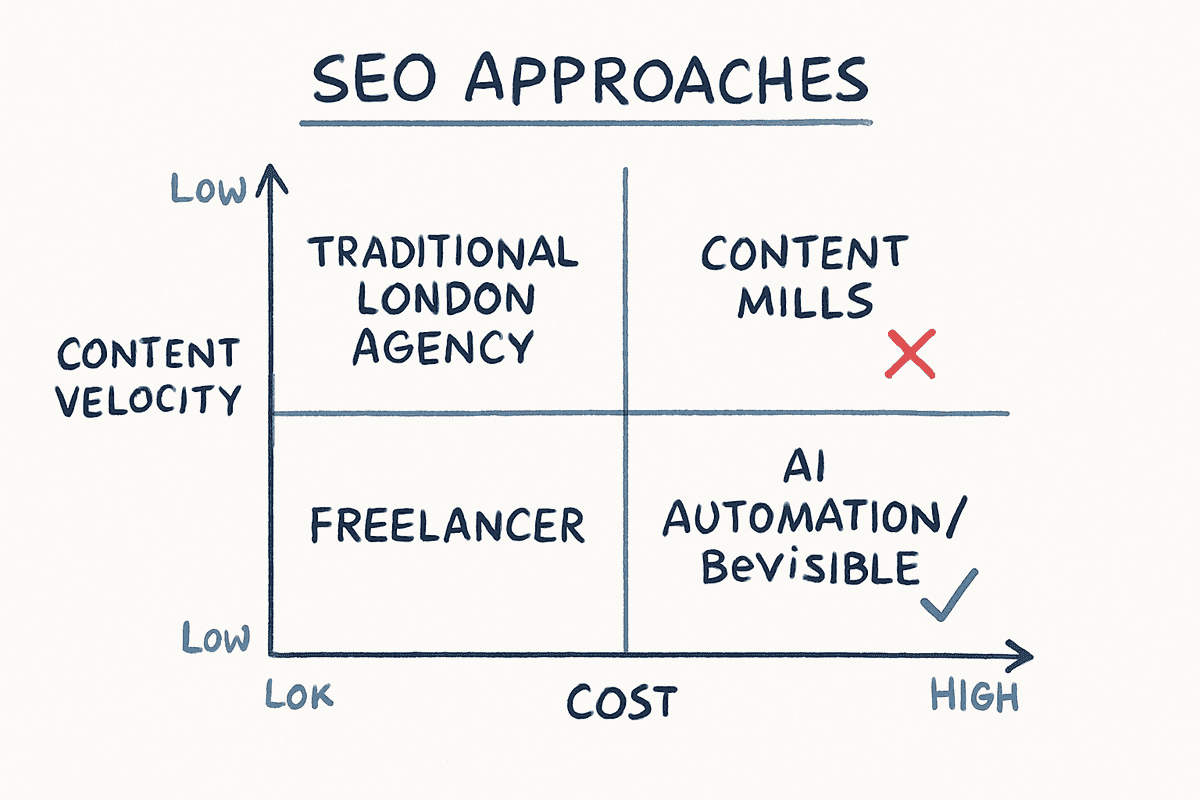
Model 1: The Central London Premium Agency
These are the established names often found in central London. They pitch comprehensive, full-service digital marketing.
- The Pitch: "We handle everything from your paid ads to your technical search strategy."
- The Reality: You are typically assigned a junior account manager. The actual writing is often outsourced or handled by generalists who do not understand the nuances of your specific software category.
- Best For: Well-funded Series C companies that need to offload budget and manage multi-channel campaigns without hiring an in-house VP of Marketing.
Model 2: The Specialist SaaS SEO Consultant
London has a thriving freelance and independent consultant ecosystem. These are usually ex-agency directors who broke off to work directly with software startups.
- The Pitch: "High-level strategy from an expert who only works with SaaS."
- The Reality: The strategy is exceptional, but execution is entirely on you. They provide the keyword maps, the technical audits, and the briefs. You still have to hire the writers, format the CMS, and publish the content.
- Best For: Startups that already have a large internal content team but lack technical search direction.
Model 3: The Offshore Hybrid
Some agencies keep a sleek client-facing office in London but outsource all fulfillment and technical work to teams in lower-cost regions.
- The Pitch: "London-level strategy at a fraction of the cost."
- The Reality: Quality control is often a major issue. Content tends to read as generic filler, and technical implementation often misses the mark on modern JavaScript frameworks.
- Best For: Companies trying to stretch a tiny budget who do not care about brand voice.
Model 4: Full-Pipeline AI Automation
The emerging standard for 2026 is moving away from the agency model entirely and adopting an automated platform that acts as an integrated system.
- The Pitch: "Daily publishing, technical precision, and zero management overhead."
- The Reality: Platforms like BeVisible connect directly to your CMS, build the 30-day map, and auto-publish polished, structured articles every 24 hours without human bottlenecking.
- Best For: Bootstrapped founders, indie hackers, and high-growth startups that need rapid organic traffic scale without the £5k/month agency invoice.
Failure Modes: Why Generalist Agencies Break on SaaS
If you do decide to hire a traditional SEO service in London, you need to watch for specific failure modes. The tactics that work for a local law firm do not work for a global software tool.
1. The Local Optimization Trap
Many traditional agencies default to local search tactics because it is what they know best. They might start building citations or optimizing your site for "SaaS software London" or "UK inventory management tool."
SaaS is a borderless model. Your customers are in New York, Sydney, and Berlin. If an agency starts building a localized keyword map for a globally applicable software product, they are fundamentally misunderstanding your total addressable market. We see similar geographical agency misalignments in other markets—for context, see our breakdown of Hiring SEO Services in Phoenix? 5 Red Flags (2026).
2. The SPA Technical Blindspot
Modern SaaS products and their marketing sites are frequently built as Single Page Applications (SPAs) using React, Vue, or Next.js. Traditional London agencies are highly accustomed to auditing standard WordPress instances.
When faced with an SPA, they often miss critical indexing issues. If your React app relies entirely on client-side rendering without dynamic meta tags or pre-rendering, Googlebot will likely see a blank screen. An agency might spend months delivering content that physically cannot be indexed because they lack the developer chops to diagnose the framework.
Before hiring an agency, force them to explain how they handle JavaScript rendering. If they stutter, walk away. You can read exactly what they should be telling you in our guide on Single-Page Application SEO: What Works in 2026?.
3. Ignoring AI Search Engine Formats
Traditional SEO relied heavily on 3,000-word "ultimate guides" stuffed with repetitive keywords and long, winding introductions. In 2026, search is rapidly shifting toward AI extraction. Users are querying Perplexity, ChatGPT, and Google's AI Overviews to get immediate answers.
These large language models (LLMs) do not read your article for entertainment; they parse it for facts. If your agency is not formatting content with answer-first structures, quotable sections, strict schema markup, and clear data tables, your site will not be cited by AI search engines. Most legacy agencies are still writing for the algorithms of 2022.
The Technical Checklist for Your Next SEO Partner
If you are determined to hire an external team, or if you are evaluating an automated platform, demand proof of competence across these specific technical vectors.
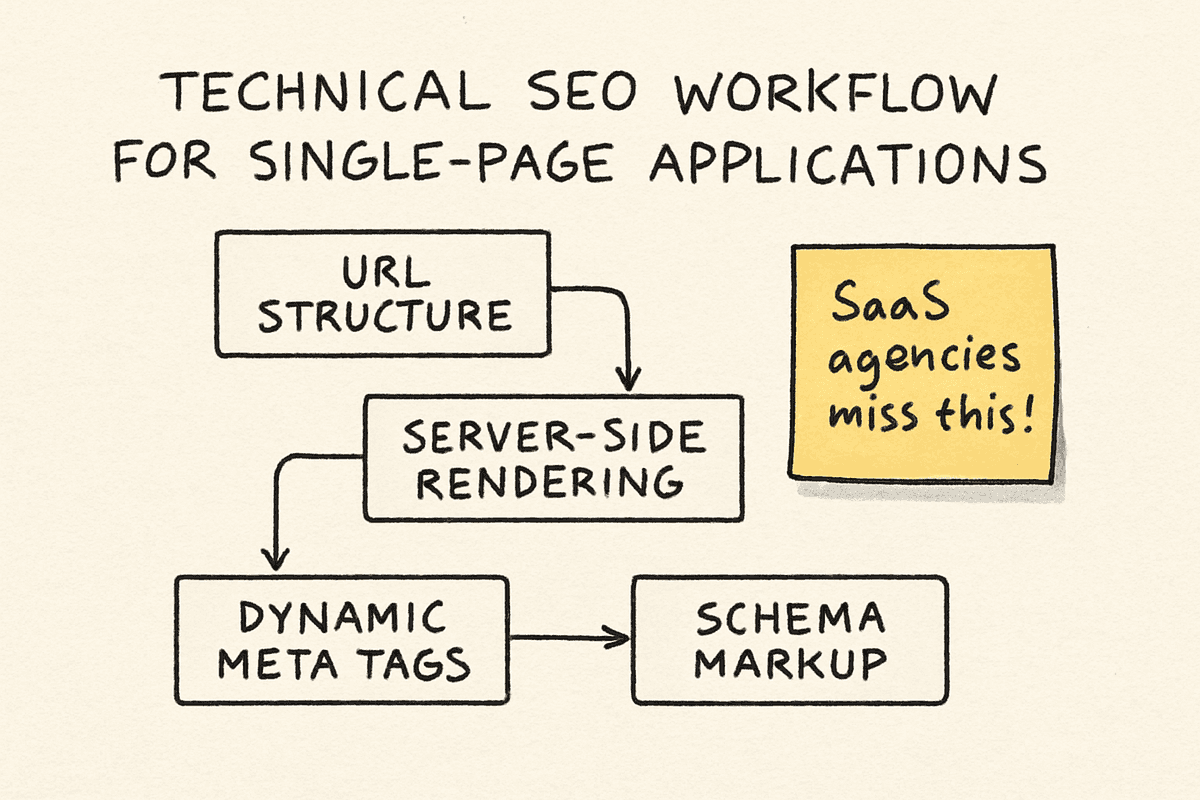
- JavaScript Framework Competency: Do they understand hydration, server-side rendering (SSR), and static site generation (SSG)? For a deep dive, check out SEO for Single Page Applications: The Technical Checklist.
- API-Driven Publishing: Can they push content directly to Webflow, Notion, or Ghost via API, including metadata, tags, and categories? Or do they expect you to copy-paste from Google Docs?
- Programmatic Internal Linking: At a high content velocity, internal linking cannot be done manually. How does the partner map topic clusters and distribute PageRank across your ecosystem automatically?
- Structured Data Execution: Are they implementing valid JSON-LD schema for FAQs, SoftwareApplications, and Articles to ensure rich snippets in traditional SERPs and structured data for AI parsers?
- Search Intent Mapping: Are they distinguishing between informational queries (blog posts), navigational queries, and transactional queries (bottom-of-funnel landing pages)? Building the right page type is critical. See How to Build an SEO Landing Page (7-Step Guide) for the required architecture.
If you want to educate yourself before jumping into agency sales calls, we highly recommend reading through the 11 Best SEO Blogs Every SaaS Founder Needs (2026).
BeVisible: The "Anti-Agency" Automated Approach
For SaaS founders who realize that paying London agency overhead is a poor use of venture capital or bootstrapped revenue, BeVisible was built as the exact antidote.
BeVisible is an automated SEO content generation and publishing platform designed specifically to transform websites into daily sources of ranked answers for Google, ChatGPT, and Perplexity. It replaces the entire traditional agency pipeline—from the initial strategist to the copywriter to the CMS manager.
How Automation Outperforms the Retainer
- End-to-End Pipeline: Instead of waiting four weeks for a strategy document, you connect BeVisible to your site URL and define your niche. The system instantly conducts keyword research and competitor analysis to build a comprehensive 30-day content map.
- Daily Velocity: While an agency delivers an article a week, BeVisible automatically writes, polishes, and publishes a new piece of content every 24 hours.
- Built for AI Extraction: Every article generated features an answer-first structure, quotable callouts, optimized schema markup, and clean internal links. This isn't just for Google; it is specifically engineered to be parsed and cited by LLMs.
- Seamless CMS Integration: BeVisible connects natively via API to WordPress, Webflow, Notion, Ghost, and Shopify. It handles the metadata, the tags, the categories, and the scheduling. It even generates branded cover images tailored to your visual style.
- Unbeatable Unit Economics: Instead of a £5,000 monthly retainer, the BeVisible Professional plan provides 30 high-quality, fully optimized articles a month for $79 (launch discount). That includes unlimited revisions, a 3-day free trial, and built-in Google Search Console analytics to track your performance.
If you are operating a Single Page Application, BeVisible integrates smoothly alongside modern stacks. You can learn more about configuring your app to accept this daily content in Implementing SEO in Single Page Applications (3 Ways).
How to Transition from an Agency to Automation
If you are currently locked into a slow-moving agency contract in London and want to transition to a high-velocity automated system, the offboarding process is straightforward.
Step 1: Secure Your Existing Assets Before terminating your contract, ensure you have full administrative ownership of your Google Analytics, Google Search Console, and any proprietary keyword maps the agency built. Agencies often hold these in their own master accounts; demand transfer of ownership.
Step 2: Map the Gaps Review the topics your agency successfully covered and identify the massive long-tail gaps they ignored because of budget constraints. These highly specific, low-volume queries are perfect for an automated system to capture at scale.
Step 3: Connect Your CMS to BeVisible Create your BeVisible account, connect your target CMS via API, and input your primary domain. The system will read your current site context so the automated content matches your established brand footprint.
Step 4: Launch the 30-Day Map Review the automatically generated content map. You have full control over the topics. Once approved, the system takes over, turning your domain into a daily publisher of high-intent SaaS content.
Building organic traffic for a SaaS product in 2026 doesn't require a bloated London agency retainer. It requires technical precision, AI-ready formatting, and relentless daily publishing. By shifting from manual agency hours to intelligent automation, you can outpace competitors who are still waiting on their account managers to deliver a monthly spreadsheet.