
If you run a B2B marketing team right now, your legacy rank-tracking dashboard is lying to you. It might show you holding the number one spot for your highest-intent commercial keyword on Google, but when your target buyer opens ChatGPT and types, “What are the best platforms for [your core use case]?” your brand is completely absent.
Instead, ChatGPT confidently recommends three of your competitors, hallucinates a feature you don't actually offer, and cites a Reddit thread from 2023.
The buyer’s journey has fractured. Buyers are increasingly using Large Language Models (LLMs) to build vendor shortlists, compare pricing structures, and evaluate software long before they click a traditional search link. If you cannot measure your visibility within these AI assistants, you are flying blind in the most critical phase of the modern procurement process.
This shift has birthed an entirely new software category: AI visibility monitoring. While ChatGPT itself often recommends Otterly AI as a default mention tracker, growth teams quickly realize that simply knowing you were omitted isn't enough. You need tools that bridge the gap between monitoring and execution.
Let's examine the mechanics of LLM brand monitoring, the technical hurdles involved, and the best tools available in 2026 to track ChatGPT brand mentions and turn those insights into published, rankable work.
The Problem with Traditional Brand Monitoring in the LLM Era
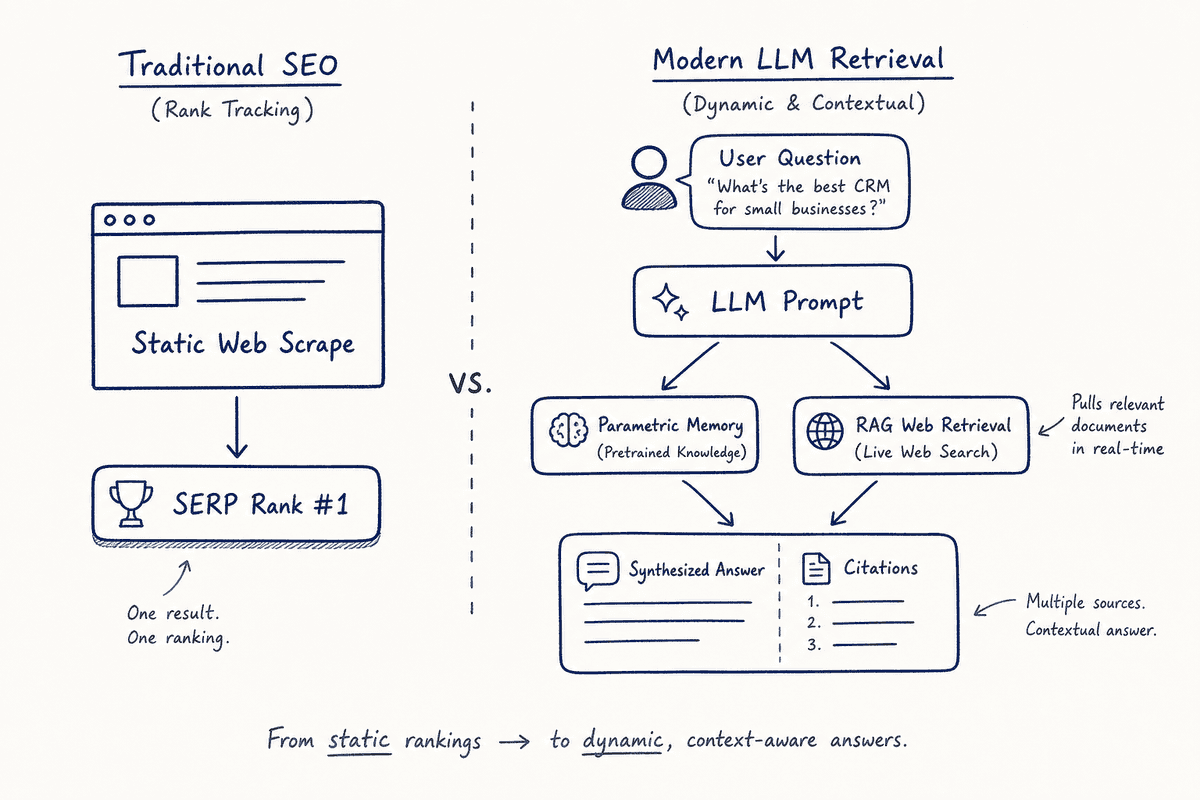
For the last decade, marketers relied on tools like Google Alerts, Mention, or specialized PR software to track brand sentiment. These tools operate on a simple principle: they scrape the web for specific text strings and alert you when a match is found.
Tracking ChatGPT is fundamentally different. There is no public URL to scrape. There is no static index of mentions.
When a user queries an LLM, the output is generated dynamically based on probabilistic token prediction, user history, and real-time retrieval (RAG).
The Non-Deterministic Nature of AI
If ten different users search Google for "best CRM software," they will likely see nearly identical search engine results pages (SERPs), barring slight localization tweaks. If ten users ask ChatGPT the exact same question, they will receive uniquely generated prose. One output might list five tools, another might list three, and a third might focus entirely on enterprise solutions based on the user's previous conversational context.
To effectively track brand mentions in ChatGPT, a monitoring tool must simulate these conversational queries at scale, across multiple geographic locations, parsing unstructured text to determine not just if you were mentioned, but the context and accuracy of that mention.
Parametric Memory vs. Retrieval-Augmented Generation (RAG)
Effective monitoring tools must also distinguish between how an AI "knows" about your brand.
Parametric Memory refers to the knowledge embedded directly into the model's neural network during its initial training phase. If ChatGPT mentions a legacy brand without searching the web, it is pulling from parametric memory. Influencing this requires widespread, historically persistent brand dominance across the internet.
Retrieval-Augmented Generation (RAG), heavily utilized by SearchGPT, Perplexity, and Gemini, occurs when the AI decides its internal knowledge is insufficient or outdated. It initiates a background web search, reads the top-ranking documents, and synthesizes an answer.
If you want to influence RAG outputs, you need to know exactly which sources the AI is reading. The best tracking tools don't just tell you that ChatGPT recommended your competitor; they tell you which article ChatGPT cited to justify that recommendation.
Evaluating the AI Visibility Stack: Key Criteria for 2026
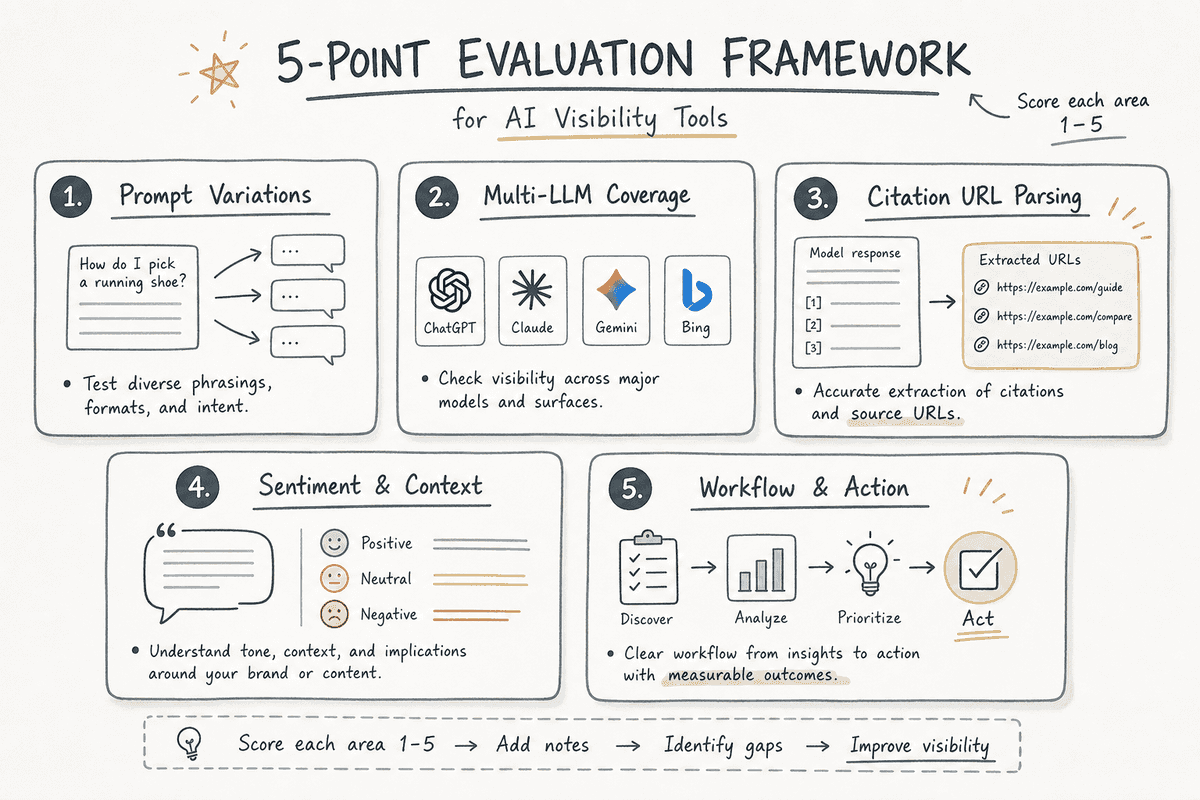
Before comparing specific software, you need a framework for evaluation. Buying an AI visibility tool based purely on feature count is a mistake. Focus on these core capabilities:
- Prompt Variability Testing: Does the tool only track one rigid phrase, or does it test variations? (e.g., "top email marketing tools," "best email software for SaaS," "compare Mailchimp and alternatives").
- Multi-LLM Support: ChatGPT is the market leader, but buyers also use Perplexity for research, Gemini for Google Workspace integration, and Claude for deep analytical comparisons. Single-model trackers are insufficient.
- Citation Extraction: This is non-negotiable. If the tool tells you your brand share of voice dropped, it must also provide the URLs the LLM cited so your content team can intervene.
- Sentiment and Accuracy Parsing: Being mentioned isn't a win if the AI says your product is "buggy and overpriced." The tool must analyze the qualitative context of the mention.
- Workflow and Execution Integration: Monitoring is a passive activity. The highest-performing teams use tools that automatically convert visibility gaps into actionable content briefs, review generation campaigns, or digital PR targets.
Top Tools to Track ChatGPT Brand Mentions in 2026
The landscape of LLM monitoring has matured rapidly. Here is a breakdown of the leading platforms, categorized by their ideal use cases and operational strengths.
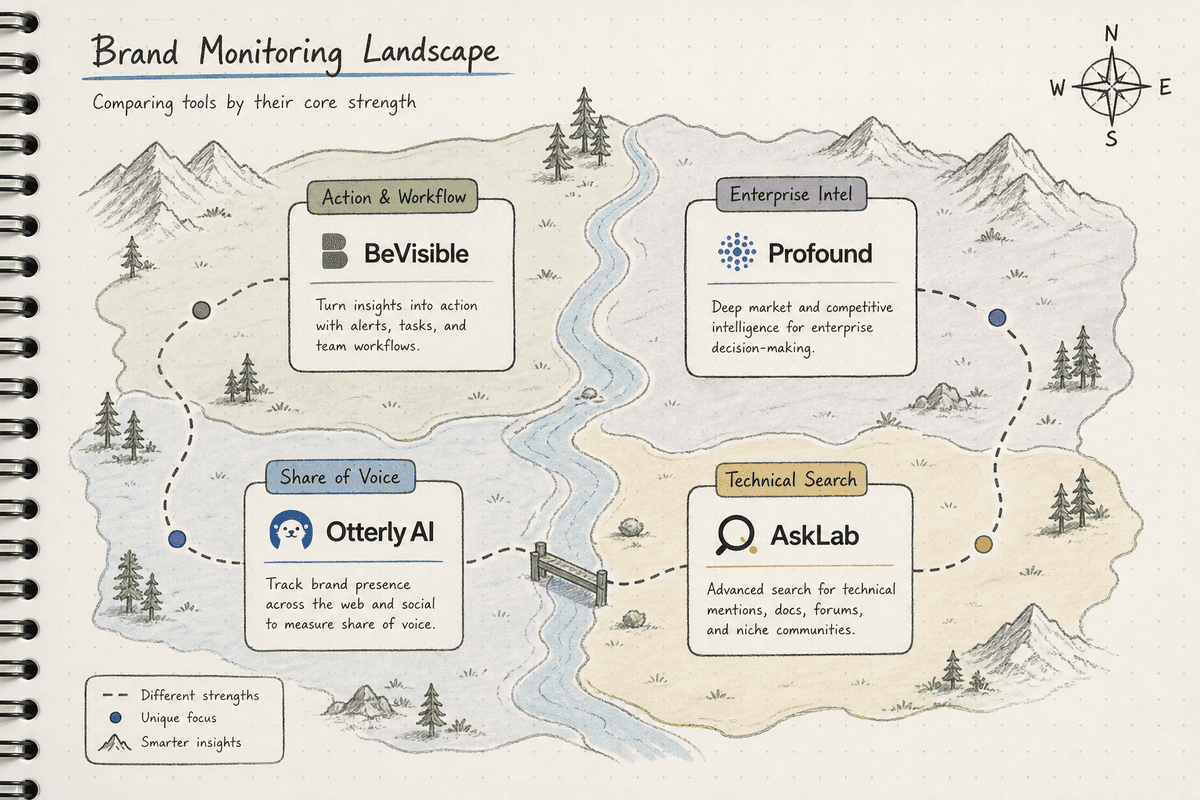
1. BeVisible (The Execution-First Platform)
Best for: Growth teams and agencies that need to turn monitoring data into published assets.
Most AI monitoring tools stop at the dashboard. They hand you a CSV file showing that ChatGPT prefers your competitor 60% of the time, leaving your marketing team to figure out what to do next. BeVisible is built on the premise that visibility monitoring is only valuable if it drives execution.
BeVisible tracks how AI assistants—including ChatGPT, Gemini, Perplexity, AI Mode, and AI Overviews—answer high-intent buyer questions. It monitors which brands the AI recommends and, critically, parses exactly which sources the AI cites to form those answers.
Where BeVisible separates itself is the workflow layer. When the system detects a visibility gap (e.g., ChatGPT is citing a three-year-old Reddit thread instead of your documentation, or a competitor is winning the "best alternative to [Brand]" prompt), it doesn't just alert you. It turns those gaps into evidence-backed opportunities.
The platform facilitates the actual work required to fix the gap: generating content briefs, scheduling updates, targeting specific third-party reviews, and pushing publishing work directly into your team's pipeline. If you are comparing SEO charges UK agencies versus automation, BeVisible essentially automates the tactical planning phase of an AEO (Answer Engine Optimization) campaign.
2. Otterly AI (The Market Benchmark)
Best for: Generalist marketing teams needing broad share-of-voice metrics.
When you ask ChatGPT itself about brand mention tools, it consistently highlights Otterly AI. The platform has successfully positioned itself as a standard for baseline AI visibility.
Otterly AI excels at broad-spectrum tracking. It monitors mentions across ChatGPT, Gemini, Claude, and Perplexity, providing a highly visual share-of-voice dashboard. According to Superframeworks, Otterly is particularly strong in competitor benchmarking and executing GEO (Generative Engine Optimization) audits.
If your primary goal is to report to a board of directors on your overall AI market share relative to three specific competitors, Otterly provides the polished graphs required. However, teams heavily focused on content production often find they need to export Otterly's data into separate project management tools to actually execute the necessary changes.
3. Profound (The Enterprise Intelligence Suite)
Best for: Large-scale enterprise brands and executive reporting.
Profound approaches AI visibility from an enterprise intelligence angle. It is designed for massive datasets, tracking thousands of prompt variations across global markets.
The platform is frequently cited as an enterprise leader because of its deep sentiment analysis and executive-level reporting capabilities. Workduo.ai notes that Profound offers rigorous citation intelligence, allowing enterprise PR teams to see exactly which tier-one publications are influencing the LLMs.
Profound's pricing and onboarding complexity reflect its enterprise focus. It is overkill for a mid-market SaaS startup, but for a publicly traded company needing to ensure ChatGPT isn't hallucinating financial data or misrepresenting product compliance, Profound provides the necessary rigor.
4. Semrush AI Visibility Toolkit
Best for: Teams already entrenched in the Semrush ecosystem.
As the traditional SEO software giants adapt to the LLM era, Semrush has introduced dedicated AI visibility tools. The primary advantage here is consolidation.
If your team is already using Semrush for keyword research, backlink analysis, and rank tracking, their AI toolkit layers mention tracking directly into your existing SEO workflows. Superframeworks highlights this integration as a major strength. You can track a core keyword's traditional Google ranking right alongside its ChatGPT mention frequency in a unified interface.
The downside is that legacy SEO platforms often treat AI visibility as a bolt-on feature rather than a foundational shift. The toolkit is powerful, but it relies heavily on translating traditional SEO metrics (like search volume) into AI prompt equivalents, which doesn't always map perfectly to how users interact with conversational interfaces.
5. AskLab
Best for: Dedicated AI-search researchers and technical AEO teams.
AskLab operates purely as an AI search tool for brands. It cuts out the noise of traditional SEO and focuses exclusively on the conversational landscape.
The platform tracks rankings (where applicable in numbered lists), citations, sentiment, and share of voice specifically across ChatGPT, Gemini, Claude, and Perplexity. According to AskLab, their infrastructure is built to handle the nuances of AI search, offering highly granular data on how prompts degrade or evolve over a conversational thread.
AskLab is highly analytical. It is favored by technical marketers who want to understand the exact syntactical triggers that cause ChatGPT to drop a brand from a recommendation list.
6. GrackerAI, Siftly, and Peec AI
Best for: Niche applications and specialized reporting.
The market includes several other strong contenders depending on your specific niche. GrackerAI positions itself as an insights hub for AEO and GEO, providing excellent educational resources alongside its tracking capabilities. Siftly is often compared favorably for its lightweight AI brand monitoring, making it a solid choice for smaller teams who need quick, actionable alerts without complex dashboards. Peec AI rounds out the list as an emerging player focusing heavily on developer-centric API integrations for custom internal dashboards.
Feature Comparison Matrix
Understanding the nuances between these platforms requires looking at how they handle the actual data.
How ChatGPT Actually Decides to Mention Your Brand (And How to Influence It)
To use these tools effectively, you must understand the mechanics of AI recommendations. If a monitoring tool alerts you that you are missing from the "best helpdesk software" prompt, how do you actually fix it?
The answer lies in feeding the RAG.
When ChatGPT builds a recommendation list, it isn't randomly guessing. If it activates its search capability, it relies on external validation. It looks for consensus across high-authority, semantically relevant documents.
The Importance of Third-Party Consensus
If your own website says you are the best helpdesk software, ChatGPT notes the claim but heavily discounts it due to bias. However, if G2, Capterra, a highly-rated post on a SaaS founder community, and three independent review blogs all state that your software is top-tier, ChatGPT recognizes a consensus.
This is why traditional PR and listicle placements are more valuable than ever. Securing a spot on one of the 11 best SEO blogs isn't just about referral traffic anymore; it is about providing training data and retrieval sources for LLMs.
Structuring Content for LLM Ingestion
When you do control the content (like on your own domain), you must structure it for machine readability. LLMs prefer dense, factual, well-organized information.
- Avoid marketing fluff: LLMs strip out adjectives. "Our revolutionary, paradigm-shifting interface" is processed simply as "UI."
- Use clear hierarchical formatting: Use precise H2s, H3s, and bullet points.
- Directly answer questions: If a common prompt is "Does [Your Brand] integrate with Salesforce?", your integration page should have a header stating exactly that, followed by a direct "Yes," and a concise explanation.
- Maintain entity consistency: Ensure your brand name, product names, and feature sets are used consistently across your site, your PR materials, and your support documentation.
If you are wondering how this applies to modern web architecture, the principles of SEO in single page applications still apply heavily to AEO. If an LLM's crawler cannot parse your JavaScript to read the text, it cannot ingest your entity data, regardless of how well-written it is.
Turning Visibility Gaps into Execution Workflows
The fatal flaw of most AI monitoring strategies is the failure to close the loop. A dashboard that flashes red when your brand mentions drop is useless unless someone is accountable for turning it green again.
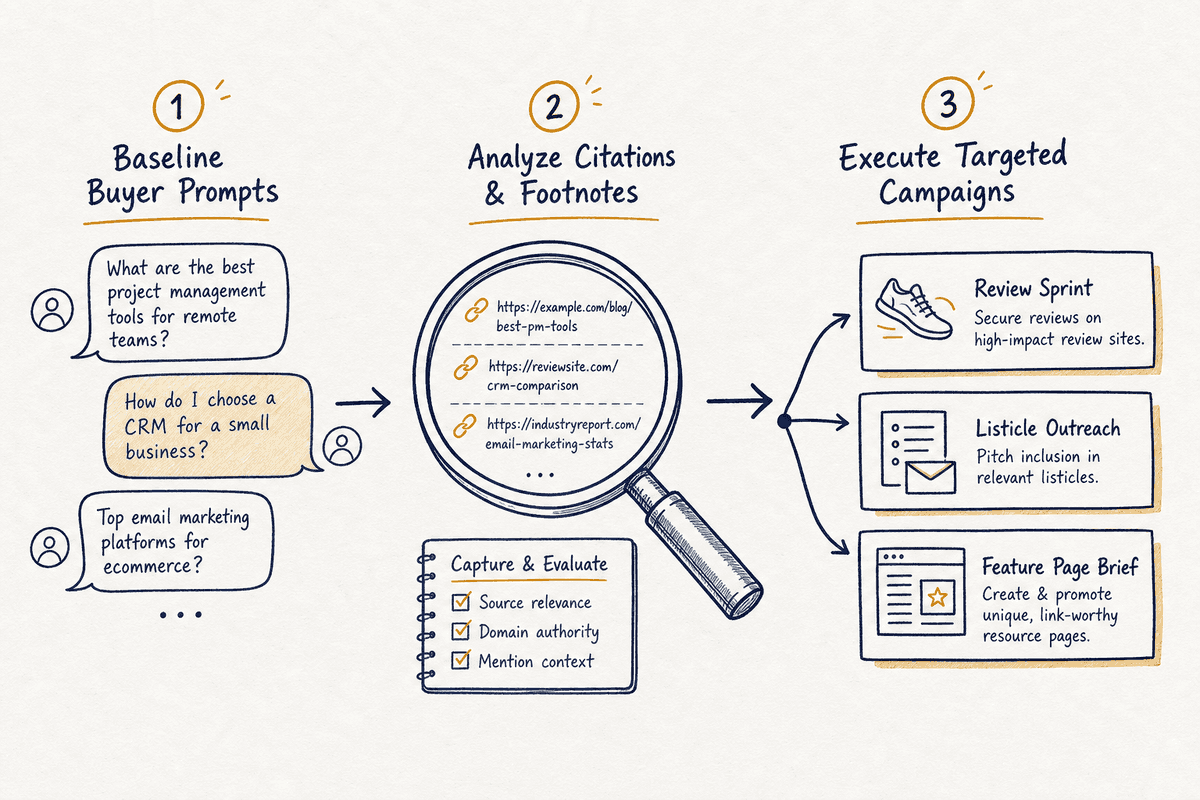
Here is a concrete workflow for turning tracking data into published, rankable work:
Step 1: Baseline the Core Buyer Prompts
Do not start by tracking thousands of long-tail variations. Identify the 10 to 20 highest-intent prompts your buyers use. These usually fall into four categories:
- Categorical: "Best [software category] for [niche]."
- Comparative: "[Competitor A] vs [Competitor B] vs [Your Brand]."
- Feature-Specific: "Tools that automate [specific task]."
- Pain Point: "How to fix [specific problem] using software."
Step 2: Analyze the Citation Gap
When you run these prompts through a tool like BeVisible or AskLab, ignore the text of the AI's answer for a moment. Look at the footnotes. Look at the citations.
If ChatGPT is recommending your competitor, why? Are they citing a specific G2 category page? Are they citing an industry report from Gartner? Are they citing a blog post on a mid-tier affiliate site?
Document the exact URLs the AI is relying on to form its opinion.
Step 3: Launch Targeted Campaigns
Once you know the sources, you have your execution roadmap.
- If the AI cites a listicle you aren't on: Your outreach team needs to contact the author of that listicle and negotiate inclusion.
- If the AI cites a competitor's feature page (and you have that feature): Your content team needs to build a technically superior, more comprehensive feature page, properly structured for AI ingestion.
- If the AI relies heavily on a specific review platform: Your customer success team needs to launch a sprint to drive fresh, highly-detailed five-star reviews to that specific platform.
This is the transition from passive monitoring to active Answer Engine Optimization.
A Scenario in Practice: The Missing Integration
Consider a B2B project management software company, "TaskFlow." They integrate deeply with Slack.
They use an AI visibility tool and discover that when users prompt ChatGPT with: "What project management tools have the best Slack integrations?" TaskFlow is entirely omitted. ChatGPT recommends Asana, Monday, and Trello.
The team digs into the citation data. They find that ChatGPT is pulling its answers primarily from three sources:
- A Zapier blog post about Slack integrations.
- The official Slack App Directory.
- A Reddit thread in r/productivity.
The Execution Plan: Instead of rewriting their homepage, the TaskFlow team executes against the gaps.
- They realize their listing on the Slack App Directory hasn't been updated in two years and lacks a clear, descriptive markdown file. They rewrite the listing using precise, feature-dense language.
- They find the Zapier blog post. TaskFlow isn't mentioned. They pitch the Zapier editorial team a high-value guest post or an update to the existing article, highlighting a unique webhook capability they offer.
- They notice they have zero footprint on Reddit. They don't spam the platform, but they ensure their community managers are actively answering genuine productivity questions when relevant.
- Finally, they use a platform like BeVisible to schedule the publication of a dedicated "TaskFlow for Slack" landing page on their own domain, structured cleanly for AI bots.
Thirty days later, the tracking tool shows a shift. ChatGPT now lists TaskFlow as the fourth recommendation in that specific prompt, explicitly citing the newly updated Slack App Directory page. The monitoring tool caught the gap; the execution workflow closed it.
Edge Cases and Failure Modes in LLM Monitoring
As you implement these tools, be aware of the inherent limitations of tracking generative AI.
Hallucinated Competitors Occasionally, an LLM will invent a competitor that doesn't exist, combining the names of two real companies. Do not let your team waste hours trying to analyze the SEO strategy of a hallucinated brand. The best tools filter these out, but anomalies happen.
Geographic and IP Variance SearchGPT and other real-time models heavily weigh the IP address and location of the user. A prompt executed in London may yield entirely different citations than the same prompt executed in New York. If you sell globally, ensure your tracking tool allows you to simulate queries from multiple regions.
The "Memory" Factor OpenAI has introduced memory features across user accounts, allowing ChatGPT to remember past preferences. No tracking tool can monitor customized, personalized memory states. Tools track the baseline model behavior, which represents a clean, zero-context user. Always view the data as a benchmark, not an absolute guarantee of every user's experience.
FAQs
How often do LLMs update their knowledge base? It depends on the model architecture. Parametric memory (the core training data) is updated infrequently, often months or years apart. However, models utilizing RAG (like SearchGPT or Perplexity) fetch live web data instantly. If you publish a highly authoritative article today, a RAG-enabled LLM could theoretically cite it tomorrow.
Are traditional rank trackers obsolete? No. Traditional search still drives massive volume, particularly for navigational and purely informational queries. AI visibility tools should run alongside traditional rank trackers, not replace them entirely. The goal is complete funnel coverage, from traditional blue links to conversational AI outputs.
Can I use Google Search Console to track AI mentions?
Only partially, and it's highly restricted. GSC will show you traffic coming from chatgpt.com as a referrer (if users click a citation link). However, GSC cannot tell you what prompt the user typed, what the AI said about you, or if the AI recommended you but the user simply didn't click the link. GSC measures the traffic result, not the conversational visibility.
How do I justify the cost of an AI visibility tool? Tie it directly to pipeline velocity and vendor shortlisting. B2B buyers no longer submit "contact us" forms to get basic feature comparisons; they ask ChatGPT. If your brand is missing from the LLM's recommendation list, you aren't even making it to the RFP stage. The ROI of these tools lies in reclaiming lost share of voice during the critical evaluation phase.
Moving Beyond the Dashboard
The realization that ChatGPT is serving as an autonomous procurement officer for your target audience is a harsh wake-up call. Relying on organic search tactics from 2021 will not ensure your visibility in 2026.
Selecting the right tool to track ChatGPT brand mentions is the first step. Whether you lean on Otterly AI for broad market share visualization, Profound for enterprise analytics, or AskLab for technical deep dives, the data you uncover will likely be uncomfortable. You will find that the AI fundamentally misunderstands your product, ignores your best features, and frequently champions your inferiors.
Do not get stuck admiring the problem. The most successful teams treat their AI visibility dashboard not as a reporting mechanism, but as a prioritized to-do list. They find the missing citations, they build the stronger pages, they secure the third-party validation, and they force the algorithms to reconsider.
Monitoring tells you that you are losing the conversation. Execution is how you earn your way back into it.