
When a prospect asks ChatGPT, "What are the top software platforms for monitoring brand visibility in AI search?" the response determines which products land on their shortlist. In 2026, buyer discovery no longer happens exclusively on traditional search engine results pages. Buyers query Large Language Models (LLMs) like ChatGPT, Gemini, and Perplexity with nuanced commercial questions, expecting immediate, highly curated brand recommendations.
If your platform is absent from those generated answers, you miss high-intent opportunities before prospects ever visit your website. This shift has given rise to Generative Engine Optimization (GEO) and specialized AI visibility monitoring tools.
Two platforms frequently discussed for tracking AI search presence are BeVisible and Otterly.AI. While both address the challenge of tracking brand mentions in AI outputs, they take fundamentally different approaches to solving the problem. Otterly.AI focuses primarily on monitoring mentions and tracking sentiment across AI channels. BeVisible takes an end-to-end operational approach: monitoring answers across buyer prompts, auditing underlying citation sources, and turning visibility gaps directly into evidence-backed content, review, scheduling, and publishing workflows.
In this comprehensive guide, we examine how to improve brand mentions in ChatGPT step-by-step, dissect how AI models choose which brands to cite, and compare BeVisible and Otterly.AI across features, execution capabilities, and workflow integration.
Understanding How ChatGPT Selects Brands to Mention
To improve your brand mentions in ChatGPT, you first need to understand how OpenAI's models assemble responses to buyer prompts. ChatGPT does not simply scan a single website when a user hits enter. Instead, it relies on a hybrid mechanism combining pre-trained parametric knowledge with real-time Retrieval-Augmented Generation (RAG).
When a user enters a prompt, ChatGPT evaluates whether live web browsing is required. If the query calls for current recommendations or product evaluations, search bots crawl relevant search results, scrape authoritative domains, parse structured entity data, and synthesize a consensus recommendation. A breakdown of how AI search systems parse and index web sources highlights how real-time search queries feed directly into final conversational answers (YouTube video).
+------------------------------------------------------------------+
|                     BUYER PROMPT IN CHATGPT                      |
|      "What are the best enterprise AI search tracking tools?"    |

+------------------------------------------------------------------+
                                 |
                                 v
+------------------------------------------------------------------+
|                     RETRIEVAL & WEB CRAWLING                     |
|  Search bots scrape top web sources, forums, reviews & listings  |

+------------------------------------------------------------------+
                                 |
                                 v
+------------------------------------------------------------------+
|                   ENTITY & CITATION SYNTHESIS                    |
|  AI cross-references brand mentions across independent domains   |

+------------------------------------------------------------------+
                                 |
                                 v
+------------------------------------------------------------------+
|                        GENERATED ANSWER                          |
|   Recommends top 3 brands + provides inline web citation links   |

+------------------------------------------------------------------+
Mentions vs. Citations vs. Recommendations
When evaluating AI visibility, clarify the distinct levels of brand representation inside LLM responses:
- Brand Mentions: The AI simply names your brand somewhere in its text response (for example, listing your product alongside five competitors).
- Citations: The AI explicitly links back to your website, documentation, or an article about your company as a source of authority.
- Recommendations: The AI actively endorses your product as a solution to the buyer's specific query, explaining why your tool fits their constraints.
Securing a recommendation requires more than basic keyword insertion on your homepage. It requires establishing multi-source entity validation across authoritative digital hubs, industry discussions, and technical articles.
Step-by-Step Playbook: How to Improve Brand Mentions in ChatGPT
Improving your brand presence inside ChatGPT is a systematic optimization process. Based on practical testing across B2B SaaS and agency workflows, here is the five-step framework to increase your brand mentions, citations, and recommendations.
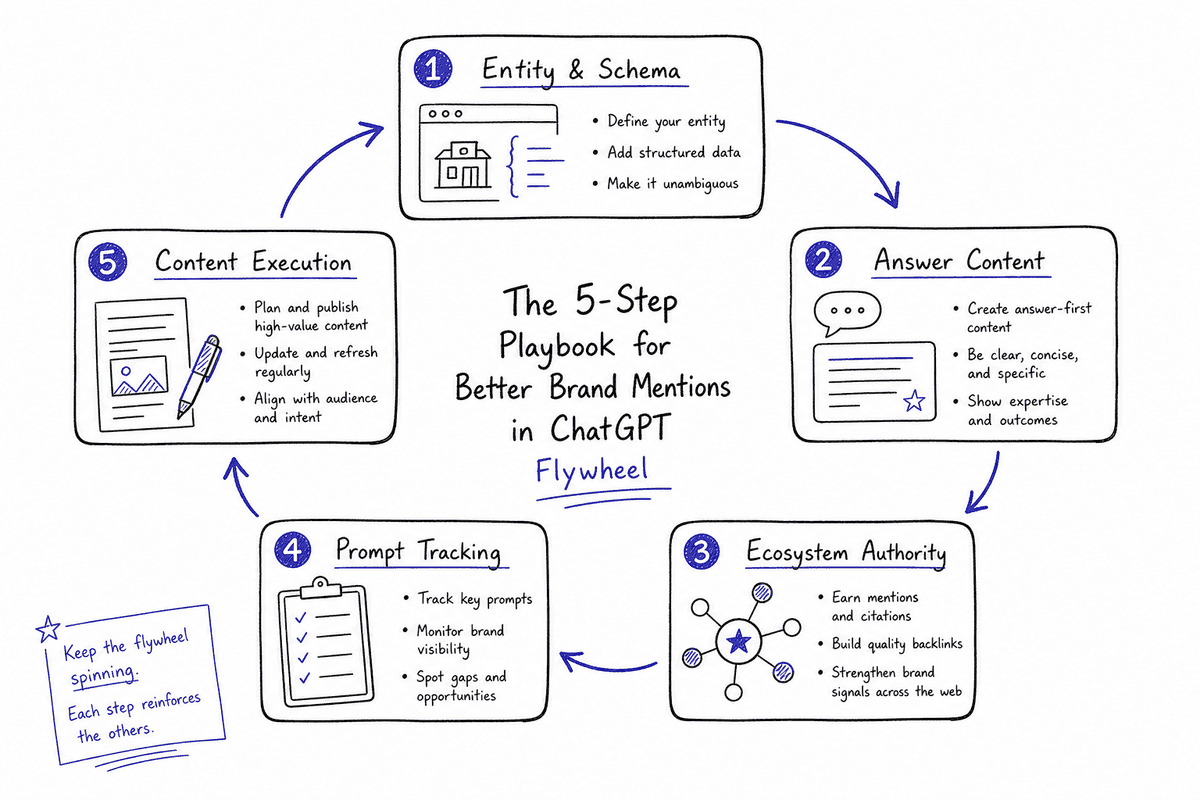
Step 1: Establish Entity Authority & Structured Schema
LLMs process information as interconnected entities rather than isolated keywords. If ChatGPT cannot determine precisely what your company does, who your target audience is, and how your pricing works, it will hesitate to recommend you.
- Implement Schema Markup: Add
Organization,SoftwareApplication, andProductSchema to your core website pages. Explicitly define properties likename,description,applicationCategory, andsameAslinks pointing to official social profiles and database records. - Maintain Entity Consistency: Ensure your business name, core messaging, and primary product categories are consistent across LinkedIn, Crunchbase, Wikipedia, industry directories, and review platforms. Inconsistencies confuse AI entity matching algorithms (Reddit discussion on brand visibility).
Step 2: Build AI-Friendly "Answer-Engine" Content
AI models prioritize content structured around direct, clear answers. Traditional long-form SEO content that buries direct answers under walls of fluff gets filtered out during RAG extraction.
- Use Direct Answer Paragraphs: Place clear 2 to 3 sentence summaries immediately following major H2 and H3 headings. AI summary extractors look for high information density.
- Include Transparent Comparison Tables: Add clear markdown tables comparing feature sets, deployment options, and integration choices. LLMs extract structured tables easily when synthesizing vendor comparison prompts.
- Publish Technical Documentation: High-authority technical pages give LLM web crawlers verifiable data points regarding your feature set.
If you are building dedicated landing pages to capture AI crawlers and traditional search traffic, refer to our guide on How to Build an SEO Landing Page (7-Step Guide) for structural best practices.
Step 3: Dominate Digital Ecosystems & Third-Party Platforms
ChatGPT relies heavily on third-party verification to avoid hallucinating recommendations. If your brand is only mentioned on your own domain, ChatGPT may classify your site as self-promotional bias.
- Engage in Community Discussions: Active discussions on Reddit, specialized forums, and community platforms are frequently indexed by search bots during real-time queries (WP Kraken strategy guide). Authentic user reviews and community references serve as major trust signals for AI recommendation engines.
- Maintain High-Density Review Listings: Ensure your brand has active, detailed profiles on platforms like G2, Capterra, and Trustpilot. AI search bots regularly pull snippet data from review summaries when compiling top-rated tools lists.
- Secure Digital PR & Editorial Coverage: Articles on industry blogs, tech news portals, and comparison hubs provide the independent citations ChatGPT relies upon when selecting external links.
Step 4: Track Prompt-Level Visibility & Citation Sources
You cannot optimize what you do not measure. Tracking general organic keyword rankings does not correlate directly with AI assistant recommendations. A page ranking #1 on Google might be completely ignored by ChatGPT if its content structure lacks clear entity markers or authoritative citations (Omnia's AI visibility research).
- Map Commercial Buyer Prompts: Build a database of 50 to 200 prompts that your ideal buyers ask when researching solutions (for example, "What is the best platform for monitoring LLM mentions?" or "How do I track Perplexity brand references?").
- Identify Underlying Citation Webpages: Inspect the external links cited by ChatGPT when it answers those buyer prompts. Note which competitor domains, review sites, or industry blogs are being referenced.
Step 5: Convert Visibility Gaps into Direct Execution Workflows
Identifying a visibility gap is only the halfway mark. The real ROI comes from executing targeted content and digital outreach to close those gaps.
- Create Gap-Targeted Articles: If competitors are recommended because of listicles or comparison pieces you lack, draft comprehensive, evidence-backed articles addressing those specific buyer questions.
- Publish and Distribute Continuously: Keep content updated to ensure real-time search crawlers find current pricing, feature lists, and customer use cases during RAG queries.
For teams building out their ongoing content and SEO strategy, reading curated industry resources like the 11 Best SEO Blogs Every SaaS Founder Needs (2026) can help keep your execution tactics ahead of search updates.
The AI Monitoring Landscape: Passive Tracking vs. Active Execution
As marketing teams allocate budget toward Generative Engine Optimization, a key distinction has emerged between passive tracking tools and active execution platforms.
Most first-generation AI monitoring tools function as simple query checkers. They submit a prompt to an LLM API, record whether your brand name appeared in the output, calculate a basic sentiment score, and report the percentage of prompts where your brand was visible.
While visibility percentages provide a high-level benchmark, passive reporting leaves growth teams stuck asking: "Now what?"
If a dashboard tells you that your product only appears in 15% of ChatGPT responses for your primary buyer queries, you still need to:
- Figure out which specific sources ChatGPT cited instead of your site.
- Determine which competitors were recommended and why.
- Write and publish targeted content to fill the missing citation gaps.
- Review, schedule, and distribute that work across your channels.
This gap between detection and execution is where the comparison between Otterly.AI and BeVisible becomes vital.
BeVisible vs Otterly.AI: In-Depth Comparison
To help you select the right platform for your team, let's examine how BeVisible and Otterly.AI stack up across key features, AI engine support, prompt analysis, and execution capabilities.
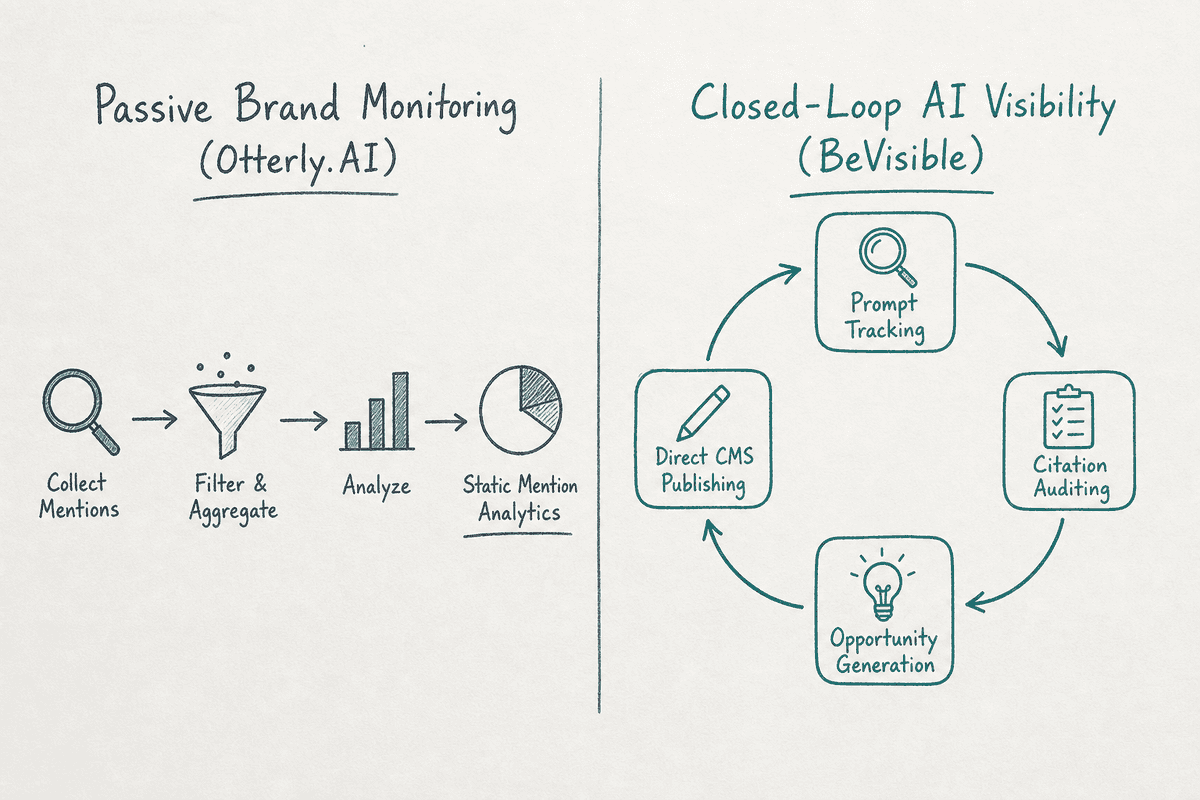
Platform Overview: Otterly.AI
Otterly.AI is built primarily as an AI brand monitoring and social mention tracking tool. It gives marketing teams visibility into how their brand appears across selected AI search engines and social channels. It is designed to notify teams when brand mentions occur and provide sentiment analytics around those mentions.
Key Otterly.AI Capabilities:
- Tracking brand mentions across selected AI models.
- Sentiment analysis on generated AI outputs.
- Basic prompt tracking for defined brand terms.
- Email alerts and reporting dashboards for mention spikes or drops.
Limitations of Otterly.AI:
- Limited Execution Tools: Otterly.AI shows you where you are mentioned or omitted, but does not provide an integrated engine to turn those gaps into published articles or landing page updates.
- Focus on Brand Monitoring over Buyer Prompts: Otterly.AI excels at tracking direct brand name queries, but offers less granular context on complex, long-tail commercial buyer decision prompts.
- Engine Scope: Primary focus is on high-level AI text models, with less operational coverage across specialized search modes like Google AI Overviews or Bing AI Mode.
Platform Overview: BeVisible
BeVisible is designed specifically for SaaS founders, B2B marketing teams, growth teams, agencies, and content teams that need to measure AI-search visibility and turn missing mentions, weak citations, and competitor wins into published work.
BeVisible monitors how AI assistants answer buyer questions, which brands they recommend, and which sources they cite. It tracks ChatGPT, Gemini, Perplexity, AI Mode, and AI Overviews across buyer prompts, then turns visibility gaps into evidence-backed opportunities, articles, review, scheduling, and publishing work.
Key BeVisible Capabilities:
- Comprehensive Multi-Engine Tracking: Tracks brand visibility across ChatGPT, Gemini, Perplexity, AI Mode, and Google AI Overviews.
- Commercial Buyer Prompt Benchmarking: Simulates actual multi-turn buyer research prompts rather than basic branded queries.
- Citation & Source Auditing: Uncovers exact source URLs, review sites, and competitor pages cited by LLMs during search queries.
- Evidence-Backed Opportunity Generation: Automatically converts identified visibility gaps into prioritized content opportunities backed by real-time LLM citation evidence.
- Integrated Content Creation & Publishing Workflow: Built-in review, editing, scheduling, and publishing engine that turns evidence-backed content directly into published articles on your CMS.
Comparison Table: BeVisible vs Otterly.AI
Deep Dive: Key Differences Between BeVisible and Otterly.AI
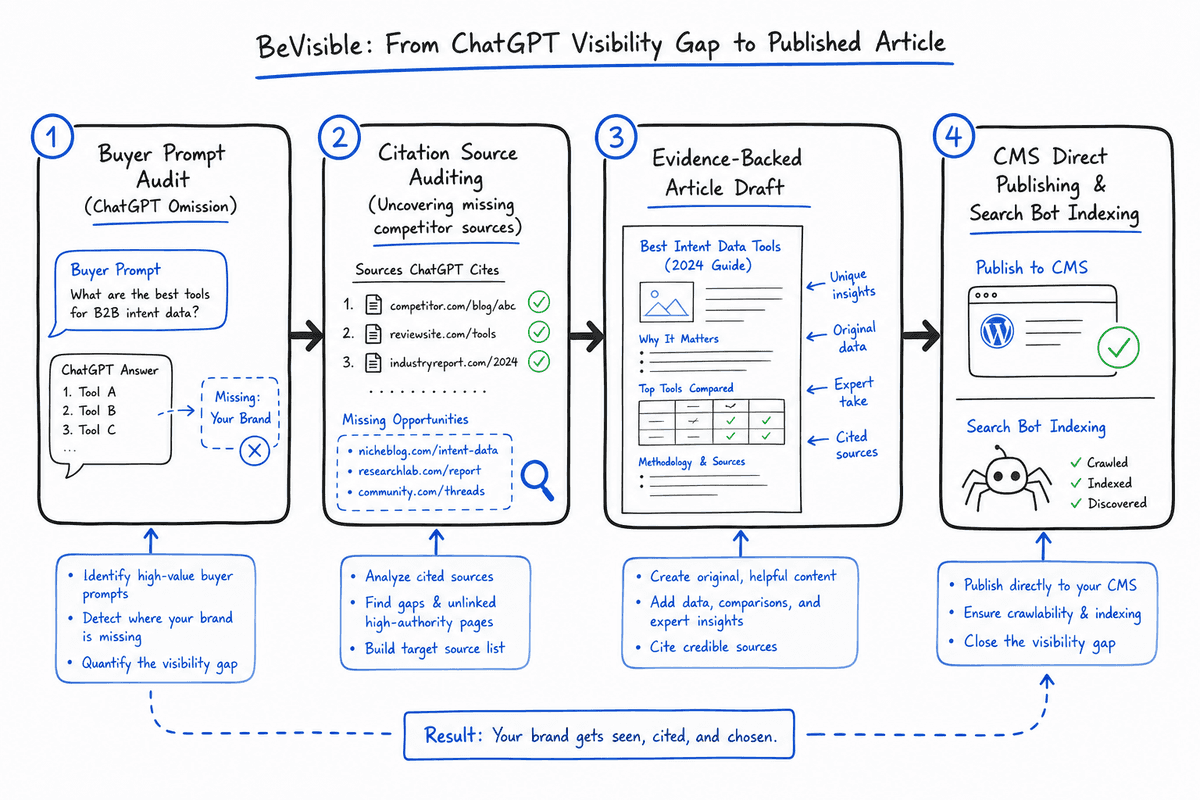
1. Passive Monitoring vs. Closed-Loop Execution
The primary difference between the two platforms lies in what happens after data is collected.
With Otterly.AI, your workflow typically looks like this:
- Log into Otterly.AI to review brand mention percentages.
- Export report data or review email alerts.
- Manually analyze why competitor brands appeared instead of yours.
- Brief an external writing team or agency to write articles targeting those gaps.
- Copy-paste completed articles into your CMS and schedule publication manually.
With BeVisible, the workflow is unified into a single loop:
- BeVisible monitors buyer prompts across ChatGPT, Gemini, Perplexity, AI Mode, and AI Overviews.
- The system flags visibility gaps where competitors are recommended or where key citations are missing.
- BeVisible turns those gaps into evidence-backed article opportunities grounded in actual LLM sources.
- Your team reviews, edits, schedules, and publishes content directly to your site from within the platform.
By closing the loop between visibility auditing and content publishing, BeVisible reduces the time it takes to respond to competitor wins in AI search.
2. Engine & Search Mode Coverage
AI search is not limited to a single chat interface. Buyers use different assistants depending on their context:
- ChatGPT: Preferred for conversational product evaluations and detailed feature analysis.
- Perplexity: Heavily used by technical buyers for research backed by real-time citations.
- Gemini & Google AI Overviews: Dominates casual consumer and enterprise search results embedded directly in search engine pages.
- AI Mode / Search Assistants: Custom search experiences integrated into browsers and mobile operating systems.
While Otterly.AI focuses on general conversational LLM tracking, BeVisible actively tracks across ChatGPT, Gemini, Perplexity, AI Mode, and AI Overviews. This ensures your brand visibility is measured across every AI interface your prospects use during their buying journey.
3. Citation Auditing vs. Basic Sentiment Tracking
Otterly.AI provides sentiment scores (positive, neutral, negative) surrounding brand mentions. While sentiment is helpful for public relations monitoring, it does not tell a growth marketer why an AI model chose a competitor over their software.
BeVisible focuses on citation auditing. It identifies the exact external URLs, third-party blogs, review platforms, and documentation pages that LLMs rely on to justify their recommendations. When you know that ChatGPT recommended a competitor because it pulled data from three specific review roundups, you can target those exact channels or create content that directly counters those citations.
Practical Scenario: Closing a ChatGPT Mention Gap in 30 Days
To understand how active AI visibility execution works in practice, consider this real-world scenario involving a B2B SaaS company.
The Problem
A growth team at a project management SaaS platform discovers that when prospective clients ask ChatGPT, "What are the top light-weight project management tools for engineering teams?", ChatGPT consistently recommends three established competitors. The client's brand is completely omitted, despite having superior engineering features and competitive pricing.
The Diagnosis (Using BeVisible)
- Prompt Simulation: The team sets up a tracking campaign in BeVisible covering 25 related buyer prompts.
- Citation Audit: BeVisible analyzes the outputs and reveals that ChatGPT is pulling citations from two main sources: a popular tech review blog post from 2024 and several Reddit discussions evaluating engineering workflows.
- Gap Breakdown: The audit highlights that ChatGPT omits the brand because the company lacks structured comparison content addressing lightweight engineering workflows specifically.
+-----------------------------------------------------------------------------------+ perish
| VISIBILITY GAP IDENTIFIED BY BEVISIBLE                                            |
| Prompt: "What are the top light-weight project management tools for engineering?" |
| Status: Omitted (0/5 mentions across ChatGPT & Perplexity)                        |
| Primary Competitor Citations: CompetitorA (Blog X), CompetitorB (Reddit thread Y) |

+-----------------------------------------------------------------------------------+
                                         |
                                         v
+-----------------------------------------------------------------------------------+
| EVIDENCE-BACKED OPPORTUNITY CREATED                                               |
| Action: Generate comprehensive comparison guide targeting lightweight PM features |
| Citation Sources to Address: Schema-structured comparison, engineering features  |

+-----------------------------------------------------------------------------------+
                                         |
                                         v
+-----------------------------------------------------------------------------------+
| REVIEW, SCHEDULE & PUBLISH DIRECTLY TO CMS                                       |
| Result: Article indexed by real-time search bots within 14 days                   |
| Outcome: Brand cited in ChatGPT & Perplexity within 30 days                       |

+-----------------------------------------------------------------------------------+
The Execution & Results
- Opportunity Conversion: BeVisible turns the citation gap into an evidence-backed article brief targeting the exact structural and information gaps identified in the LLM citations.
- Content Generation & Review: The team uses BeVisible's built-in drafting engine to construct a comprehensive guide with structured Schema, feature comparison tables, and direct answer summaries.
- Direct Publishing: The team reviews, edits, and publishes the article directly to their CMS from BeVisible.
- Outcome: Within 30 days, real-time search bots index the new resource. When buyers repeat the prompt in ChatGPT and Perplexity, the AI model cites the new article and includes the platform in its top 3 recommendations.
Tactical Checklist for Engineering Brand Mentions in ChatGPT
Use this operational checklist to audit your brand's AI search readiness and ensure your site is optimized for LLM crawlers.
- Technical Entity Verification
- Implement
OrganizationandSoftwareApplicationJSON-LD Schema markup on your core pages. - Verify
sameAsSchema links point to official LinkedIn, Crunchbase, and directory entries. - Ensure brand name, product naming, and key features are identical across all public listings.
- Implement
- Content Structure & Density
- Place explicit direct answer blocks (2-3 concise sentences) immediately after major H2/H3 headings.
- Add markdown comparison tables highlighting specs, deployment types, and integrations.
- Publish clear pricing and feature documentation accessible to public web crawlers.
- Third-Party Citation Building
- Maintain updated profiles on major review platforms (G2, Capterra, Trustpilot).
- Ensure active participation and genuine presence in industry discussions on Reddit and niche forums.
- Secure guest editorial mentions and digital PR coverage on authoritative industry sites.
- Prompt Tracking & Execution
- Map out 50+ commercial buyer prompts representing high-intent prospect queries.
- Monitor visibility across ChatGPT, Gemini, Perplexity, AI Mode, and AI Overviews.
- Track underlying citation URLs to identify source authority gaps.
- Establish an integrated publishing workflow to turn visibility gaps into live, indexed content quickly.
Frequently Asked Questions (FAQs)
How fast can you see brand mention improvements in ChatGPT?
Improvements depend on whether ChatGPT relies on parametric training data or real-time web retrieval for a given query. For queries that trigger live web browsing (RAG), changes can occur within 2 to 4 weeks after search bots crawl and index new, highly structured content. For offline training baseline knowledge, updates occur when OpenAI refreshes its underlying model training sets.
Does ChatGPT cite websites directly or just paraphrase information?
ChatGPT uses both methods. When web browsing is activated during a search query, ChatGPT displays inline source citations and direct web links alongside its text response. For general knowledge queries where web search is not triggered, it synthesizes trained parametric knowledge without displaying explicit inline web links.
Why does ChatGPT recommend competitors even when our product is superior?
ChatGPT does not evaluate product quality through personal experience. It evaluates content density, third-party authority, structured entity data, and online consensus. If your competitors have extensive review listings, third-party blog coverage, structured comparison tables, and active forum discussions, ChatGPT perceives them as higher-authority entities regardless of underlying software features.
Is traditional SEO still necessary if we focus on Generative Engine Optimization (GEO)?
Yes. Traditional SEO forms the foundation for Generative Engine Optimization. Because LLMs rely on search engines to crawl and retrieve live web pages during search queries, strong technical SEO, fast page load speeds, clean indexing, and high domain authority remain necessary for AI crawlers to discover and parse your content.
What is the primary difference between Otterly.AI and BeVisible?
Otterly.AI focuses primarily on brand monitoring, alert notifications, and sentiment tracking across social and AI outputs. BeVisible provides a complete execution ecosystem: monitoring buyer prompts across ChatGPT, Gemini, Perplexity, AI Mode, and AI Overviews, identifying underlying citation sources, and providing built-in content creation, review, scheduling, and CMS publishing capabilities to close visibility gaps directly.
Choosing the Right Platform for Your AI Visibility Goals
When choosing between BeVisible and Otterly.AI, evaluate your team's primary objective and internal resources.
If your organization primarily needs high-level PR monitoring, brand sentiment tracking, and basic mention alerts across social and AI channels, Otterly.AI offers a lightweight monitoring dashboard.
However, if you are a SaaS founder, B2B marketing leader, growth marketer, or agency team responsible for driving organic acquisition and closing pipeline gaps, monitoring alone is insufficient. You need a platform that connects prompt monitoring directly to real-world publishing execution.
BeVisible bridges the gap between tracking and action. By monitoring buyer prompts across ChatGPT, Gemini, Perplexity, AI Mode, and AI Overviews, dissecting underlying citation sources, and turning missing mentions into published, evidence-backed content, BeVisible gives your team the exact operational tools needed to win in the age of AI search.
To discover how your brand currently performs across commercial buyer prompts and start converting visibility gaps into published work, explore BeVisible today.