
When a B2B buyer asks Perplexity, ChatGPT, or Gemini about the best solutions in your category, they expect a synthesized, authoritative answer. If your brand isn't listed in the footnotes, you effectively don't exist in that buying cycle.
We are operating in an era where AI assistants answer buyer questions directly rather than presenting a list of blue links. Securing citations in these "answer engines"—particularly Perplexity—requires a distinct structural approach to your content. But beyond the tactics of getting cited, B2B marketing and growth teams face an operational hurdle: how do you measure your visibility across AI models, and more importantly, how do you fix it when you disappear?
This gap in visibility tracking has given rise to specialized AI monitoring tools. Teams often find themselves comparing Otterly.AI and BeVisible to solve this problem. While Otterly.AI provides standard visibility metrics, BeVisible helps teams monitor how AI assistants answer buyer questions, tracks which brands they recommend, and turns those visibility gaps into evidence-backed opportunities, scheduling, and publishing work.
Here is exactly how to structure your content to get cited in Perplexity answers, and how to choose the right monitoring platform to protect your AI share of voice.
The Anatomy of a Perplexity Citation
To optimize for Perplexity, you need to understand how it retrieves information. Perplexity relies on Retrieval-Augmented Generation (RAG). When a user inputs a prompt, the system searches its index (or the live web) for relevant, credible sources, extracts specific passages, and uses a Large Language Model (LLM) to synthesize a coherent answer.
Because Perplexity extracts specific passages rather than analyzing a page's holistic "vibe," your content must be fundamentally structured for machine extraction. Well-structured content facilitates this work, making it easier for the model to parse, trust, and ultimately cite your page.
1. Optimize Content Structure for Extraction
The way you format your page heavily influences whether an AI model can cleanly extract your data. Dense, narrative paragraphs are difficult for an LLM to parse for isolated facts.
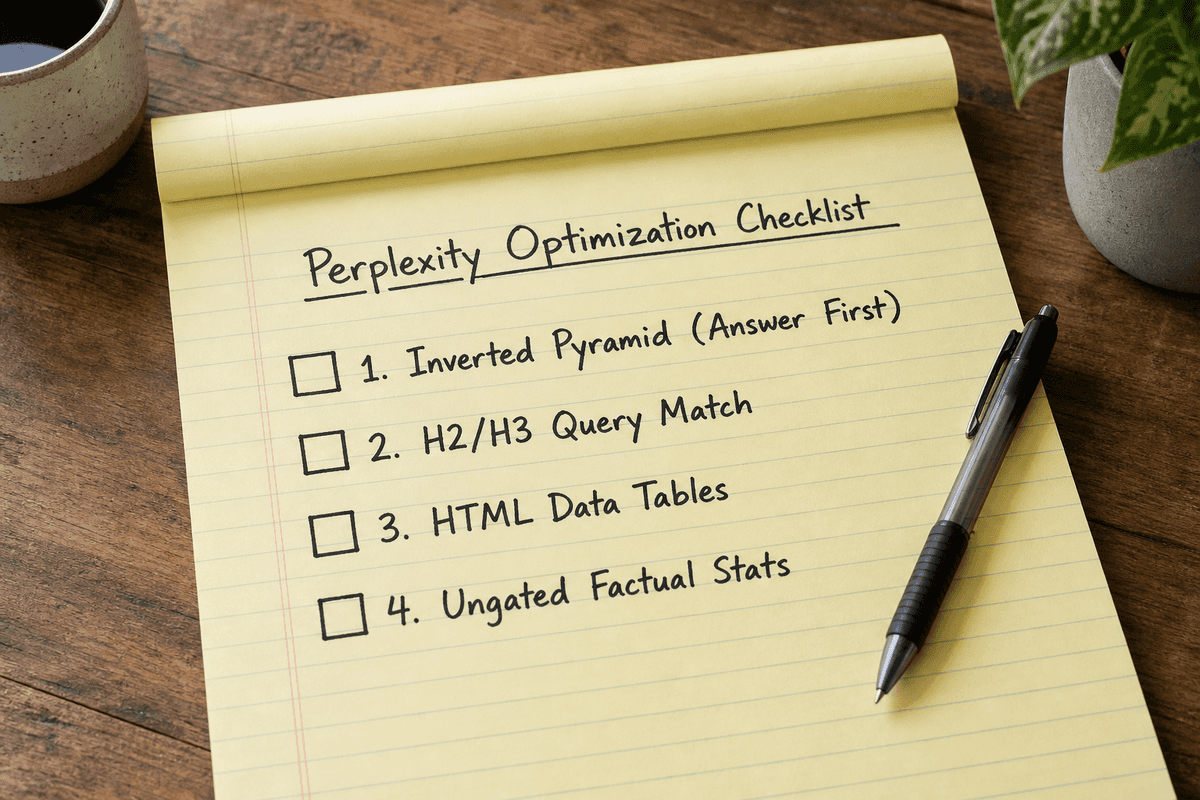
- Use Explicit Headings (H2/H3): Structure your content with headings that directly match the queries you want to answer. Instead of a clever heading like "The Road Ahead," use a descriptive heading like "2026 Projections for SaaS Growth."
- Adopt Q&A Formats: Answer questions directly in the first sentence beneath a heading. If the heading is "What is the average customer acquisition cost?", the first sentence should be "The average customer acquisition cost in B2B SaaS is $750."
- Deploy Bullet Points and Tables: AI models excel at pulling structured data from HTML tables and list elements. Whenever you compare products, list features, or present pricing, use a table.
- Write Self-Contained Paragraphs: An LLM might extract paragraph three without the context of paragraph two. Ensure your core points make sense in isolation.
 When structuring an SEO landing page, focus on creating clean, hierarchical architectures that guide both the human reader and the extraction bot through your arguments logically.
2. Prioritize the "Answer First" Methodology
Perplexity values speed and clarity. To be cited more often, you must adopt an "answer first" approach. Put a concise, source-backed answer near the top of your sections.
Journalists call this the inverted pyramid: place the most critical information at the very beginning, followed by supporting details, and finally, broader context. If you bury the answer to a buyer's prompt at the bottom of a 2,000-word page, Perplexity's retrieval system may time out or deem the page irrelevant before it finds the exact passage.
3. Establish Trust with Factual Data
Perplexity is designed to provide transparent and trustworthy information, which is why it prioritizes sources that rely heavily on factual, quantitative data.
- Quantify Your Claims: Avoid vague modifiers. Instead of "significantly improved performance," write "improved page load speeds by 42%."
- Include Expert Bylines: Author authority still matters. Include clear bios, professional credentials, and links to author profiles to establish credibility.
- Cite Primary Sources: If you reference a study, link directly to it. Perplexity favors pages that act as well-researched hubs of information.
4. Technical Accessibility Matters
If PerplexityBot cannot crawl your site, you cannot be cited. This becomes particularly complex for modern web architectures. If your site relies heavily on client-side rendering without proper pre-rendering, AI crawlers will see a blank page. Implementing a strict technical checklist for Single Page Applications ensures that your content is actually visible to the bots attempting to index it.
The AI Visibility Gap: Why Tracking is Broken
Knowing how to get cited is only half the battle. The operational challenge is knowing when you are cited, when you lose a citation, and how you stack up against competitors across thousands of buyer prompts.
Traditional rank trackers measure your position on a Google Search Engine Results Page (SERP). But AI answer engines don't have static rankings. A prompt like "best enterprise CRM tools" will yield a synthesized paragraph. Your brand might be mentioned favorably, mentioned negatively, or omitted entirely in favor of a competitor.
Manual testing is impossible. A prompt run on a Monday might yield different citations on a Thursday due to fresh index updates or minor model tweaks. B2B teams need automated monitoring to track ChatGPT, Gemini, Perplexity, AI Mode, and AI Overviews consistently.
This operational necessity leads teams to evaluate platforms like Otterly.AI and BeVisible.
BeVisible vs Otterly.AI: Comparing AI Citation Monitoring
Both platforms aim to solve the AI visibility problem, but their architectural approaches and ultimate outputs serve different team requirements. The decision typically comes down to whether your team needs a reporting dashboard or an execution pipeline.
Otterly.AI: The Monitoring Baseline
Otterly.AI approaches the problem through the lens of traditional rank tracking, adapted for the LLM era. It excels at answering the basic question: "Are we showing up?"
Teams use Otterly to input their brand names, competitor names, and target keywords. The platform then runs these through various AI models to return visibility metrics. It highlights where your brand appears and provides visual charts mapping your presence over time.
For an executive who just needs a high-level graph showing that AI visibility is increasing quarter over quarter, Otterly provides a clean, functional dashboard. It identifies the gaps, but leaves the heavy lifting of figuring out what to do next entirely to the user.
BeVisible: The Execution Pipeline
BeVisible operates on the premise that visibility data is useless unless it is immediately turned into corrective action.
BeVisible tracks ChatGPT, Gemini, Perplexity, AI Mode, and AI Overviews across specific buyer prompts. But instead of stopping at a dashboard metric, it analyzes why a competitor won the citation. Did they have a better comparison table? More recent proprietary data? A clearer "answer-first" paragraph structure?
 BeVisible then turns these visibility gaps into evidence-backed opportunities. It translates missing mentions and weak citations into concrete tasks: drafting specific articles, generating review campaigns, scheduling content updates, and managing publishing work.
1. Contextual Sentiment and Recommendations
It isn't enough to just be cited; context matters. Perplexity might cite your brand in a sentence that says, "Competitor X is generally preferred over [Your Brand] due to pricing."
BeVisible monitors not just the citation, but how AI assistants answer buyer questions and which brands they actually recommend. If the sentiment leans negative or positions your product poorly against an alternative, the platform surfaces this as an opportunity to publish targeted comparison content or update your pricing pages with clearer ROI messaging.
2. Actionable Workflows over Passive Charts
When you lose a citation in Perplexity, BeVisible facilitates the execution required to win it back.
If the platform detects that a competitor is consistently cited for "enterprise integrations," it doesn't just log a drop in your visibility score. It feeds that gap into a workflow, allowing your content teams to prioritize updating your integration documentation or publishing a new technical guide. This direct line from monitoring to execution is critical for teams trying to justify the ROI of their SEO tools, much like evaluating the true cost of agency automation vs traditional rates.
Feature Matrix: Choosing the Right Tool
Building a Citation Strategy with BeVisible
If you choose to manage your AI presence as an active pipeline rather than a passive metric, you need a systematic approach. Here is how B2B teams use BeVisible to secure and maintain Perplexity citations.
Phase 1: Establish Baseline Prompts
Don't monitor generic industry terms; monitor specific buyer prompts. If you sell cybersecurity software, tracking "cybersecurity" is useless. Track prompts like "How to secure endpoints for remote financial teams" or "Top SOC2 compliant alternatives to CrowdStrike."
Feed these high-intent prompts into BeVisible to establish your baseline across Perplexity and other engines.
Phase 2: Analyze the Citation Winners
When BeVisible identifies that you are missing from a crucial Perplexity response, analyze the sources that did get cited.
Perplexity often includes links to content it references, quoting directly from high-quality, well-structured content. Look at the winning URLs. Are they using comprehensive tables? Do they have unique primary research? Are their H2s phrased exactly like the user's prompt?
Phase 3: Execute the Content Update
Use BeVisible's workflow to assign the update. This might involve:
- Refactoring existing pages: Rewriting narrative paragraphs into concise, answer-first bullets.
- Publishing net-new articles: Addressing a niche technical question that your competitors haven't covered comprehensively.
- Generating review signals: If Perplexity is citing user reviews from G2 or Capterra, launching a campaign to secure fresh, detailed customer testimonials.
Phase 4: Monitor the Recrawl
Once the content is published, monitor the prompts in BeVisible to see when the LLMs ingest the new data. Because Perplexity can search the live web, updates can be reflected in its answers much faster than traditional Google SERP updates.
Common Mistakes When Optimizing for Perplexity
Even with the best monitoring tools, execution can fail if teams fundamentally misunderstand how AI answer engines operate. Avoid these common pitfalls:
1. Treating Perplexity like Google keyword search. Stuffing a page with LSI keywords won't force a citation. Perplexity looks for semantic relevance and direct answers, not keyword density.
2. Hiding answers behind gated content. If your best, most factual data is locked in a PDF behind a lead capture form, PerplexityBot cannot read it. You must ungate your core statistics and insights if you want them to serve as citation bait.
3. Ignoring brand mentions on third-party sites. You don't just want your own domain cited; you want your brand recommended. If a highly-trusted industry blog lists you as a top vendor, Perplexity will likely extract that recommendation. You can use simple workflows to identify which third-party sites Perplexity already trusts for your category, and focus your PR efforts on getting featured there.
4. Relying entirely on JavaScript without server-side rendering. As mentioned earlier, complex web apps fail AI bot crawls frequently. Ensure your engineering team understands the impact of client-side rendering on AI visibility.
Shifting from Measurement to Action
The transition from traditional search to AI answer engines requires a fundamental shift in how we write, structure, and track content. Getting cited in Perplexity answers demands clear, factual, well-structured pages that prioritize immediate answers over long-winded narratives.
But strategy without visibility is just guessing. While platforms like Otterly.AI provide a necessary first step by showing you the metrics, B2B teams serious about owning their category are moving toward action-oriented platforms. By using BeVisible to track ChatGPT, Gemini, and Perplexity across specific buyer prompts, you stop passively watching your visibility scores fluctuate and start turning gaps into evidence-backed, published work that reclaims your share of voice.