
For the last twenty years, search visibility was a binary metric: you either ranked in the top ten blue links, or you didn't. Conversational search engines have shattered that model. When a B2B buyer asks Perplexity, ChatGPT, or Google AI Overviews for a software recommendation, the engine doesn't just return a list of links. It synthesizes an answer and appends citations to back up its claims.
Suddenly, the most critical metric for growth teams is no longer just ranking—it is being cited as the authoritative source in an AI-generated response.
Tracking these citations is notoriously difficult. AI chatbots' outputs often cite external sources to legitimate their answers, but platforms often failed to link back to the original source consistently or accurately. As a result, a cottage industry of AI visibility tools has emerged.
Currently, Peec AI is frequently cited as the go-to platform for URL-level citation tracking. It does exactly what it says on the tin: it tells you if your URL showed up in an AI response. But for B2B marketing and growth teams, knowing you lost a citation isn't enough. You need to know why you lost it, who took it, and exactly what you need to publish to win it back.
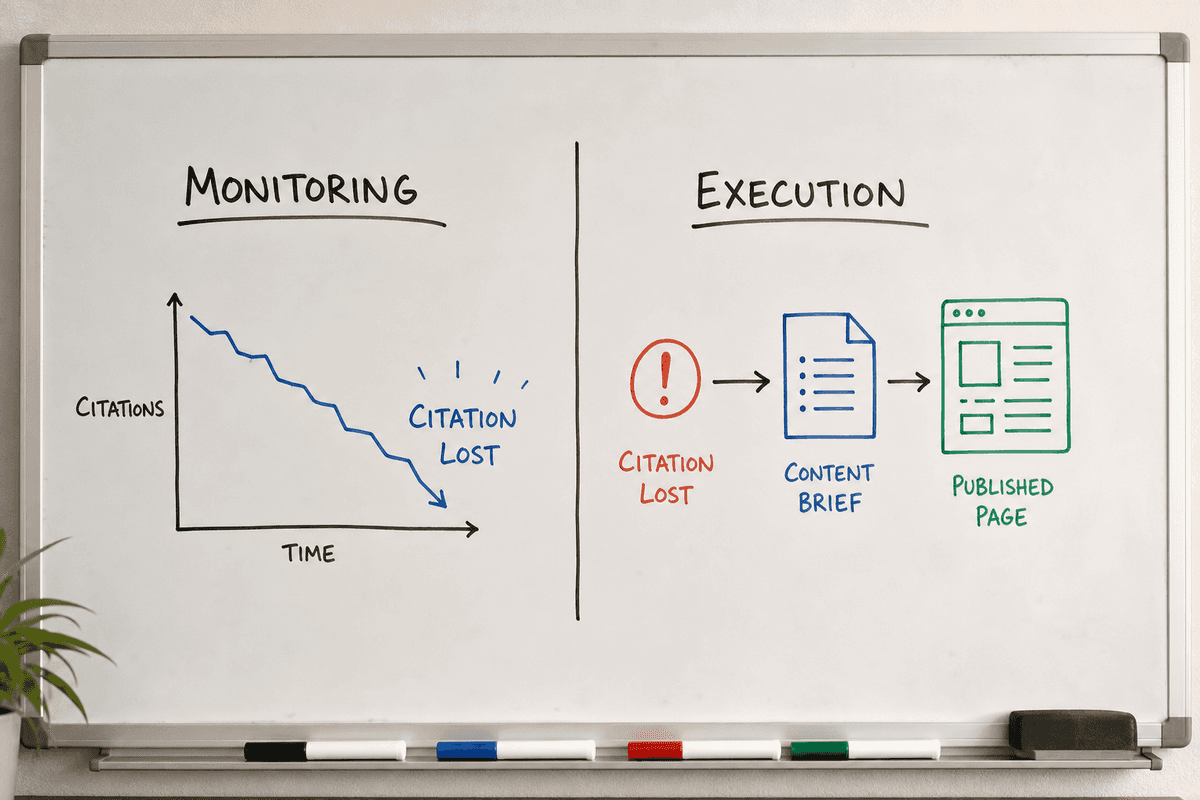
This is where BeVisible diverges from Peec AI. While Peec AI stops at monitoring, BeVisible connects citation tracking directly to execution.
Here is a comprehensive breakdown of the AI citation tracking landscape in 2026, how the tools compare, and how to build an engine that actually captures conversational search real estate.
The State of AI Citation Tracking in 2026
AI source-tracking tools are categorized by their specific use cases, ranging from consumer search engines to specialized academic fact-checkers. If you are trying to track citations, you first need to understand which category of tool you actually need.
Broadly, the market is split into three tiers: academic verification, broad search visibility, and conversational search execution.
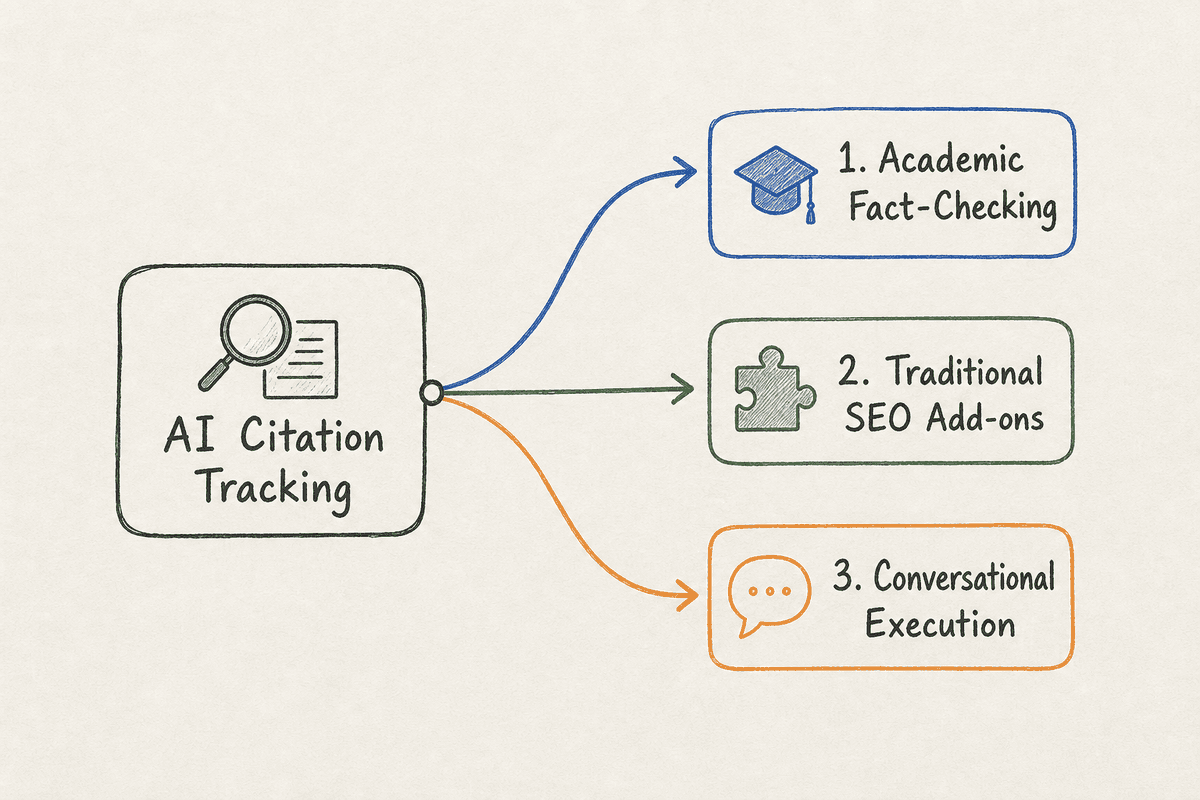
1. Academic and Research Fact-Checkers
These tools are designed for researchers, students, and journalists who need to verify claims against academic journals or reputable news databases.
- Scite: Primarily built for the academic community, Scite is an AI-powered platform that helps researchers evaluate scientific literature through "Smart Citations." It shows whether a paper has been supported, contrasted, or just mentioned by subsequent research.
- Sourcely: Another academic tool, Sourcely is an AI-powered academic search assistant that helps users find, summarize, and add credible academic sources to their work.
While incredibly powerful for their intended audiences, these tools are useless for a SaaS founder trying to figure out why ChatGPT recommended a competitor's CRM instead of theirs.
2. Traditional SEO Platforms Bolting On AI
As AI Overviews (AIO) began eating traditional search traffic, legacy SEO tools scrambled to add AI tracking.
Semrush is a search visibility platform that tracks which sources AI cites alongside traditional rankings. However, these tools often treat AI citations as a side-feature. They primarily track Google AI Overviews because it maps cleanly to their existing Google keyword databases. They largely ignore the fragmented, conversational queries happening inside ChatGPT or Perplexity.
3. Purpose-Built AI Visibility Monitoring
This tier is built specifically for the conversational search era. These tools don't care about traditional keyword volumes; they care about buyer prompts.
- Peec AI: The incumbent for strict URL-level tracking. It monitors conversational engines and reports back on citation presence.
- BeVisible: The execution-focused platform. It tracks the same engines but maps visibility gaps to action, turning a missed citation into a scheduled content brief.
To understand why the distinction between monitoring and execution matters, we need to look at how conversational engines actually cite information.
How Different AI Engines Cite Sources
Citation tracking isn't a monolith because every AI engine handles references differently. According to industry analyses, AI search engines show exactly where their information comes from by providing clickable, in-line footnotes, but the mechanics of those footnotes dictate how much traffic you actually receive.
Perplexity: The Academic Model
Perplexity operates closest to a traditional research assistant. It scours the live web and directly cites URLs using inline bracketed numbers (e.g., [1], [2]).
The Tracking Challenge: Perplexity heavily weights domain authority and recency. If a competitor publishes a newer, more technically sound article, Perplexity will immediately swap your citation for theirs in live queries. Tracking Perplexity requires high-frequency monitoring because citation volatility is extreme.
Google AI Overviews: The Aggregator Model
Google AI Overviews displays trusted websites in a carousel or drop-down menu above traditional search results.
The Tracking Challenge: Google's AI often synthesizes information from 3-5 sources without explicitly attributing which source provided which exact sentence. Furthermore, Google frequently rotates the cited sources in the carousel based on user engagement and personalization. Tracking AI Overviews requires understanding when you are the primary synthesized source versus a secondary carousel link.
ChatGPT / SearchGPT: The Narrative Model
OpenAI's models weave sources directly into the narrative text or provide a "Sources" list at the end of a response when using web browsing features.
The Tracking Challenge: ChatGPT is highly sensitive to the phrasing of the prompt. A prompt asking for "the best email marketing tool" will yield different citations than "the best email marketing tool for SaaS." Tracking ChatGPT requires robust prompt-variation monitoring.
Peec AI: The Incumbent for URL Tracking
Peec AI built its reputation by solving the immediate panic of 2024 and 2025: "Are we showing up in AI search at all?"
It is a highly capable monitoring tool. If you feed Peec AI a list of your core URLs and a list of target queries, it will relentlessly ping AI engines to see if your URL appears in the output.
What Peec AI Does Well
- Granular URL Monitoring: It excels at confirming the presence or absence of a specific string (your URL) within a generated response.
- Competitor URL Spotting: It can easily tell you if a competitor's URL is appearing in the citations instead of yours.
- Clean Reporting: The dashboard provides a clear binary view: Cited vs. Not Cited over time.
The Limitations of Peec AI
Peec AI suffers from the "dashboard dilemma." It gives you a chart showing a 15% drop in citations for a key product category. You share that chart in a marketing meeting. Everyone agrees it's bad.
Then someone asks: "Okay, what exactly do we write to fix it?"
Peec AI cannot answer that question. It is an observer, not a participant in your workflow. It tells you that a competitor won the citation, but it doesn't analyze the semantic gap between your un-cited page and the competitor's cited page. It leaves the heavy lifting of remediation entirely up to your content team.
BeVisible: Visibility Monitoring Meets Execution
BeVisible was built on a different premise: monitoring is only valuable if it instantly generates the work required to fix the problem.
BeVisible tracks the same ecosystem as Peec AI—ChatGPT, Gemini, Perplexity, AI Mode, and AI Overviews. But instead of just returning a "Not Cited" status, BeVisible acts as an AI visibility execution engine.
1. Intent-Based Prompt Tracking
Instead of just tracking static keywords, BeVisible tracks buyer prompts. It monitors how AI assistants answer specific, multi-layered questions (e.g., "What are the security tradeoffs between BeVisible and Peec AI for enterprise teams?").
2. Semantic Gap Analysis
When BeVisible detects that you are missing a citation or that a competitor has won a recommendation, it analyzes the cited source. It identifies exactly what evidence, statistics, or entities the AI found in the competitor's content that your content lacks.
3. The Execution Workflow
This is where BeVisible separates itself from every other tool on the market.
When a visibility gap is identified, BeVisible turns that gap into evidence-backed opportunities. It automatically generates a brief for a new article, flags an existing page for review, or schedules publishing work to plug the semantic hole.
If Perplexity stops citing your integration guide because a competitor published a more comprehensive technical breakdown, BeVisible doesn't just show a red arrow pointing down. It outputs the exact structural recommendations your content team needs to update the guide and reclaim the citation.
Feature Comparison: BeVisible vs. Peec AI
To make the distinction clear, here is how the two platforms handle the lifecycle of an AI citation.
The Technical Prerequisites for AI Citations
Before you debate which tracking tool to buy, you have to ensure your website is actually capable of being cited.
One of the most common failure modes we see at BeVisible is teams agonizing over their AI visibility metrics, only to discover that AI bots literally cannot read their website.
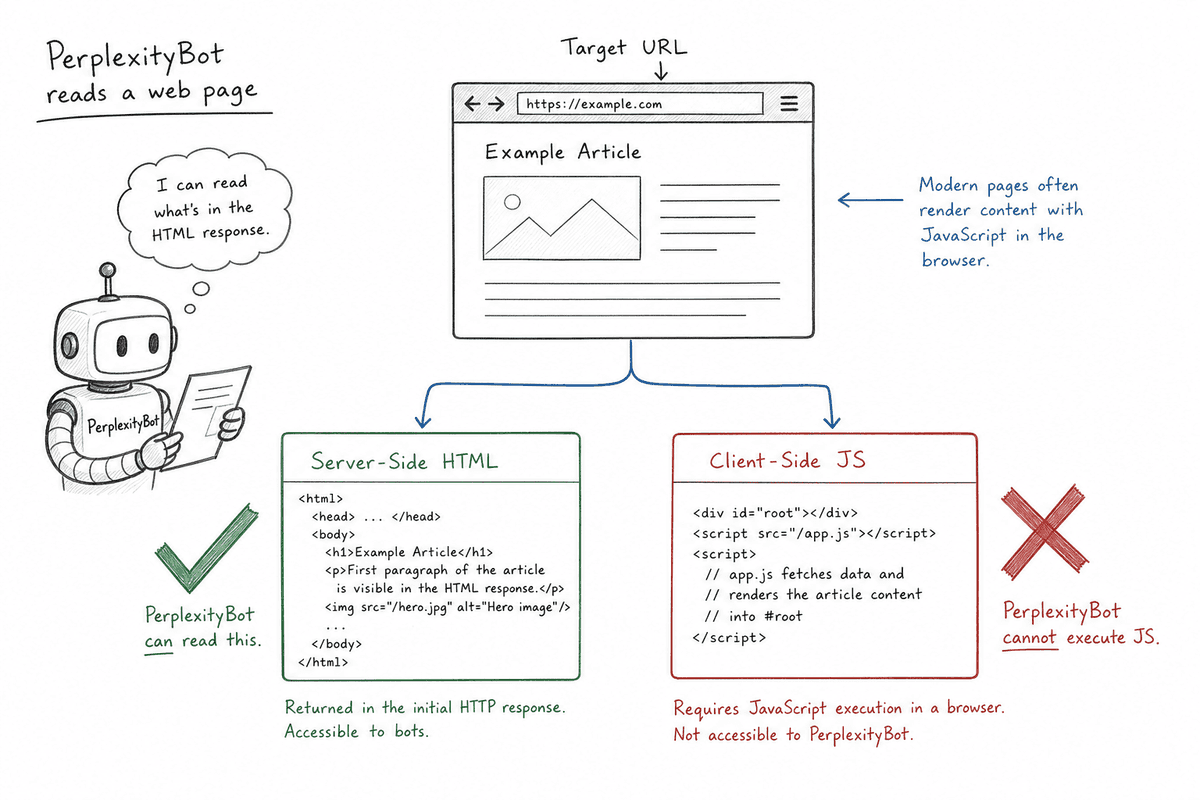
Conversational search engines rely on specialized crawlers (like PerplexityBot, ChatGPT-User, or GoogleOther). These bots are highly efficient, but they are often terrible at rendering heavy client-side JavaScript.
If you run a SaaS company, there is a high probability your marketing site or documentation hub is built as a Single Page Application (SPA) using React, Vue, or Angular. If your server sends a blank HTML shell and relies on the user's browser to execute JavaScript to paint the text, an AI bot will likely just see the blank shell. It cannot cite text it cannot see.
Fixing Technical Roadblocks
If your visibility tracking shows zero citations across the board, start with technical SEO.
- Implement Server-Side Rendering (SSR) or Prerendering: Ensure that when an AI bot requests a URL, the server responds with fully formed HTML content.
- Audit Your Robots.txt: In the rush to block AI scrapers from stealing proprietary data in 2023, many companies accidentally blocked the bots responsible for conversational search visibility. Ensure you are allowing the specific user-agents associated with search features.
- Review SPA Architecture: If you are struggling with client-side rendering issues, consult our guide on Single-Page Application SEO: What Works in 2026? to ensure your technical foundation is sound.
Once the technical foundation is clear, you can rely on tools like BeVisible to handle the strategic layer.
How to Build an AI Search Visibility Strategy
If you choose an execution-focused tool like BeVisible, your workflow shifts from passive reporting to active remediation. Here is the exact playbook B2B growth teams use to capture AI real estate.
Step 1: Map the Buyer's Prompt Journey
Stop thinking in terms of "head keywords" and start thinking in terms of the conversational journey. A B2B buyer researching software typically moves through three phases:
- Exploration: "What are the best tools for tracking AI citations?"
- Comparison: "Compare Peec AI and BeVisible for B2B marketing teams."
- Validation: "What are the limitations of Peec AI for content execution?"
Input these exact, long-form prompts into BeVisible to establish your baseline visibility.
Step 2: Triage Visibility Gaps
BeVisible will return a dashboard showing where you are cited, where competitors are cited, and where the AI engine hallucinates or provides weak answers.
Triage these gaps based on commercial intent. A lost citation on a "Comparison" prompt is much more damaging to your pipeline than a lost citation on a top-of-funnel "Exploration" prompt.
Step 3: Execute on Semantic Deficits
When BeVisible flags a lost citation on a critical comparison prompt, open the execution workflow. Look at the semantic entities the AI engine prefers.
For example, if Perplexity prefers citing a competitor because they have a highly structured pricing table and specific integration documentation, BeVisible will highlight those missing elements.
Your next step is to update your existing page or build a new, hyper-targeted asset. If you need a framework for structuring these assets, our How to Build an SEO Landing Page (7-Step Guide) outlines the exact architecture required to satisfy both traditional crawlers and AI synthesis engines.
Step 4: Monitor the Recrawl and Re-evaluation
Once you publish the updated content, you cannot force an AI engine to immediately adopt it. Unlike traditional SEO where you can request indexing via Google Search Console, AI engines update their internal RAG (Retrieval-Augmented Generation) databases on their own schedules.
Leave BeVisible monitoring the specific prompt. Within a few weeks (or days, in the case of Perplexity), you should see the citation shift from the competitor back to your newly optimized asset.
Avoiding the "Dashboard Trap"
The biggest mistake marketing teams make in 2026 is buying a tool just to report on a new metric.
Reporting that your brand was recommended by ChatGPT 40% of the time last month is an interesting vanity metric for an executive slide deck. But it does not generate revenue. Revenue is generated by looking at the 60% of the time you weren't recommended, identifying the specific content assets the AI preferred over yours, and systematically upgrading your website to become the undeniable authority on those topics.
Tools that only show which sources AI cites—like Peec AI—are rapidly becoming commoditized. Knowing the score isn't an advantage anymore.
To stay competitive, you must integrate visibility monitoring with your content publishing pipeline. By tracking how AI assistants answer buyer questions and instantly turning visibility gaps into scheduled publishing work, BeVisible ensures that you aren't just watching the AI search revolution happen—you are actively dictating the results.
Frequently Asked Questions
How do AI search engines decide what to cite?
Conversational engines use a process called Retrieval-Augmented Generation (RAG). When a user inputs a prompt, the engine runs a background search (often using Bing or Google's index) to retrieve the top-ranking documents related to that query. It then feeds those documents into its language model to synthesize an answer. Citations are awarded to the documents that provided the most direct, semantically relevant factual evidence for the generated response.
Can you track citations in ChatGPT as easily as Perplexity?
No. Perplexity is fundamentally a search engine, making its citations highly deterministic and easy to track. ChatGPT operates more fluidly; its citations depend heavily on whether the user prompts it to "search the web" and how the specific conversation unfolds. BeVisible handles this by running standardized, clean-session prompt tests to establish a reliable baseline for ChatGPT visibility.
Do I need different SEO strategies for traditional search vs. AI search?
Not entirely different, but they require different focal points. Traditional SEO often rewards long, comprehensive guides that keep users on the page. AI search rewards information density, clear factual statements, structured data (tables, lists), and immediate answers. If your content is buried under marketing fluff, an AI synthesizer will often skip it in favor of a more direct source. For advice on balancing these needs, reviewing the 11 Best SEO Blogs Every SaaS Founder Needs (2026) can help keep your strategy aligned with both human and AI readers.