
You type a high-intent commercial prompt into Perplexity, Gemini, or ChatGPT: “Top platforms for [your exact SaaS category] for mid-market teams.”
The AI generates a beautifully formatted list of recommendations, complete with bullet points, pros, cons, and citations. Your biggest competitor is ranked number one. Your second biggest competitor is number two. Your brand is completely omitted.
This is an AI visibility gap. In the era of Generative Engine Optimization (GEO), missing out on these citations means Large Language Models (LLMs) are actively routing buyers to your competitors because your digital footprint lacks the structure, context, or freshness they trust.
Two platforms have emerged to help marketing and growth teams tackle this problem: Profound and BeVisible.
While Profound has built a strong reputation for monitoring AI share of voice at an enterprise scale, tracking gaps is only half the battle. The real challenge is operational: how do you actually turn those missing mentions, weak citations, and competitor wins into published content that reclaims your visibility?
This guide breaks down the core differences between BeVisible and Profound, and walks you through the exact process of turning AI visibility gaps into a concrete content strategy.
What Exactly is an AI Visibility Gap?
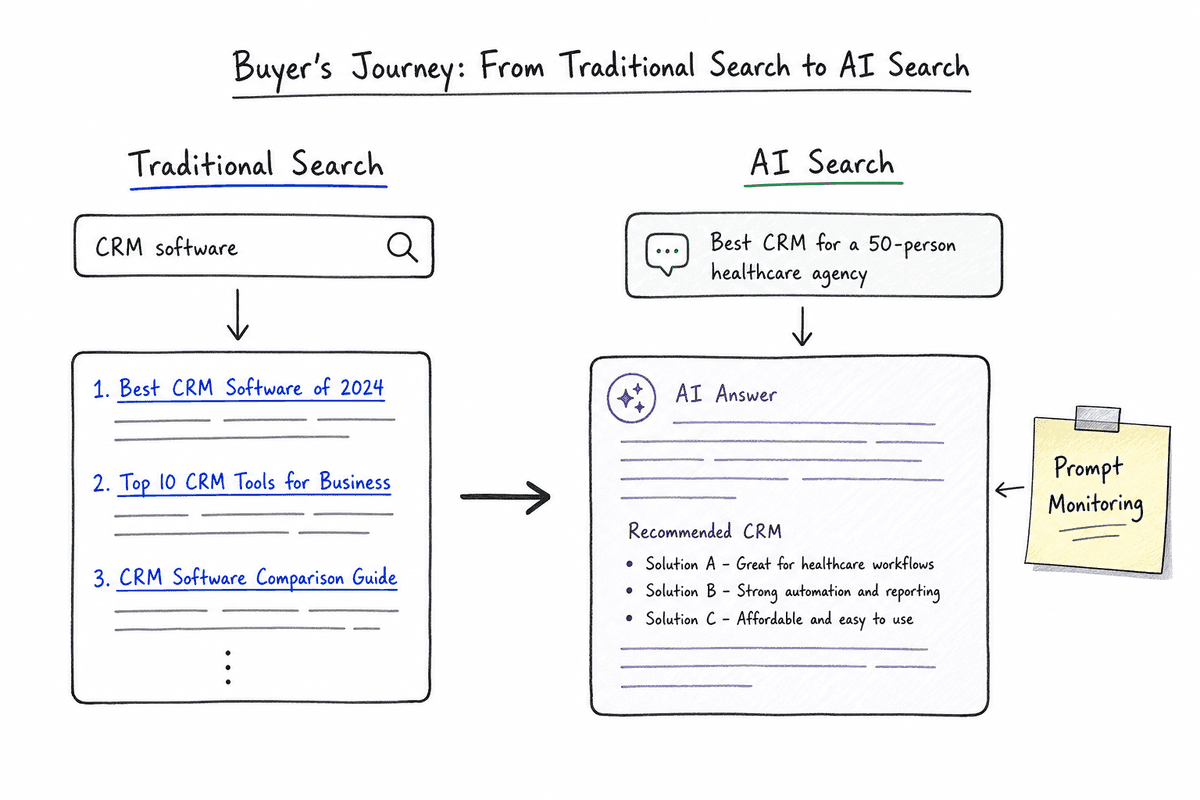
Before you can fix the problem, you have to understand how LLMs build their answers. Unlike traditional search engines that retrieve a list of ten blue links based on keyword matching, AI assistants use Retrieval-Augmented Generation (RAG). They synthesize an answer in real-time by pulling facts, relationships, and consensus from trusted sources across the web.
An AI visibility gap occurs when an LLM fails to recognize your brand as a relevant, authoritative entity for a specific buyer prompt.
These gaps usually stem from three core deficits:
- Contextual Deficits: The AI doesn't understand exactly who you serve or what your product does because your website lacks clear, definitive statements. As RAD Web Marketing notes, reviewing your site page by page to ensure services, products, and contact info are clearly listed is a fundamental first step to stopping AI tools from skipping your brand.
- Consensus Deficits: The AI can read your website, but it doesn't see anyone else on the internet agreeing with your claims. There are no third-party reviews, no Reddit discussions, and no authoritative mentions corroborating your position.
- Structural Deficits: The information exists on your site, but it is trapped in heavy client-side JavaScript, un-crawlable PDFs, or poorly formatted paragraphs that LLMs struggle to parse.
The Shift: From Keywords to Prompts
The traditional SEO playbook relies on keyword volume. If a keyword has 5,000 monthly searches, you build a landing page for it.
AI visibility requires a shift from keywords to buyer prompts.
Buyers are no longer searching for "CRM software." They are prompting AI with: "What is the best CRM software for a 50-person healthcare staffing agency that integrates with Outlook and has HIPAA compliance?"
Turning AI visibility gaps into content requires finding these specific, long-tail prompts where AI engines omit or misrepresent your brand, and then building tightly structured, authoritative assets to claim those spots.
BeVisible vs Profound: Core Philosophies Compared
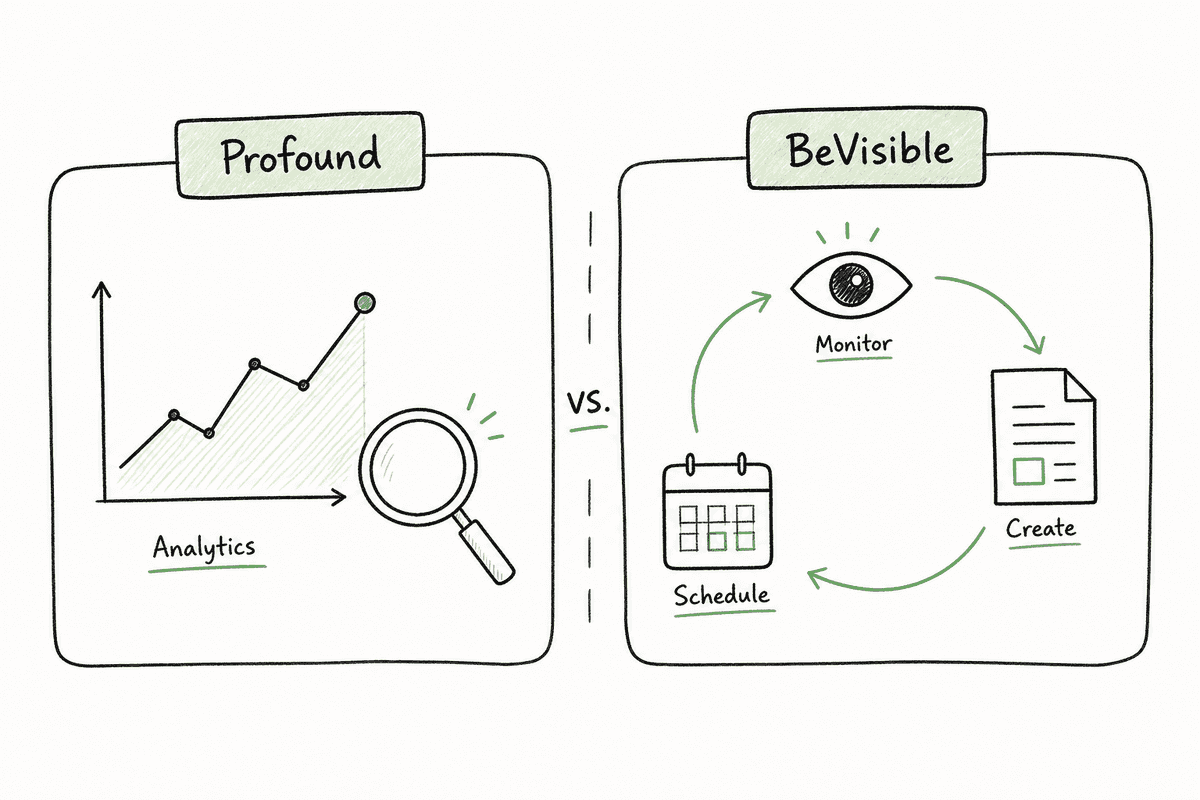
Both BeVisible and Profound exist to solve the AI visibility problem, but they approach it from fundamentally different angles.
Profound: The Analytics Dashboard
Profound operates primarily as an intelligence and analytics platform. It is designed to give you a macro-level view of your AI share of voice.
If you need to show the Chief Marketing Officer a quarterly chart comparing your brand's overall sentiment and citation frequency across ChatGPT and Gemini against five enterprise competitors, Profound excels. It acts as a radar system, alerting you to where you are visible and where you are not.
However, a radar system doesn't shoot down the incoming threat. Once Profound identifies a gap, the burden of execution—analyzing why the gap exists, briefing writers, creating content, scheduling publishing, and building external signals—falls entirely on your team's manual workflows.
BeVisible: The Execution Engine
BeVisible (https://bevisible.app) approaches the problem as a workflow and execution platform. It monitors ChatGPT, Gemini, Perplexity, AI Mode, and Google AI Overviews across buyer prompts, but it doesn't stop at reporting the gaps.
BeVisible is built for teams that need to do the work. It takes the data—how AI assistants answer buyer questions, which brands they recommend, and which sources they cite—and actively turns those visibility gaps into evidence-backed opportunities, articles, review generation workflows, scheduling, and publishing tasks.
Instead of just handing you a chart that says "You are missing from prompts about HIPAA compliant CRMs," BeVisible helps you structure the exact article, landing page, or review campaign needed to inject your brand into the LLM's context window.
Feature Breakdown
How to Turn AI Visibility Gaps into Content
Identifying a gap with a tool like BeVisible is step one. Step two is executing a content strategy that forces the LLMs to recognize your brand.
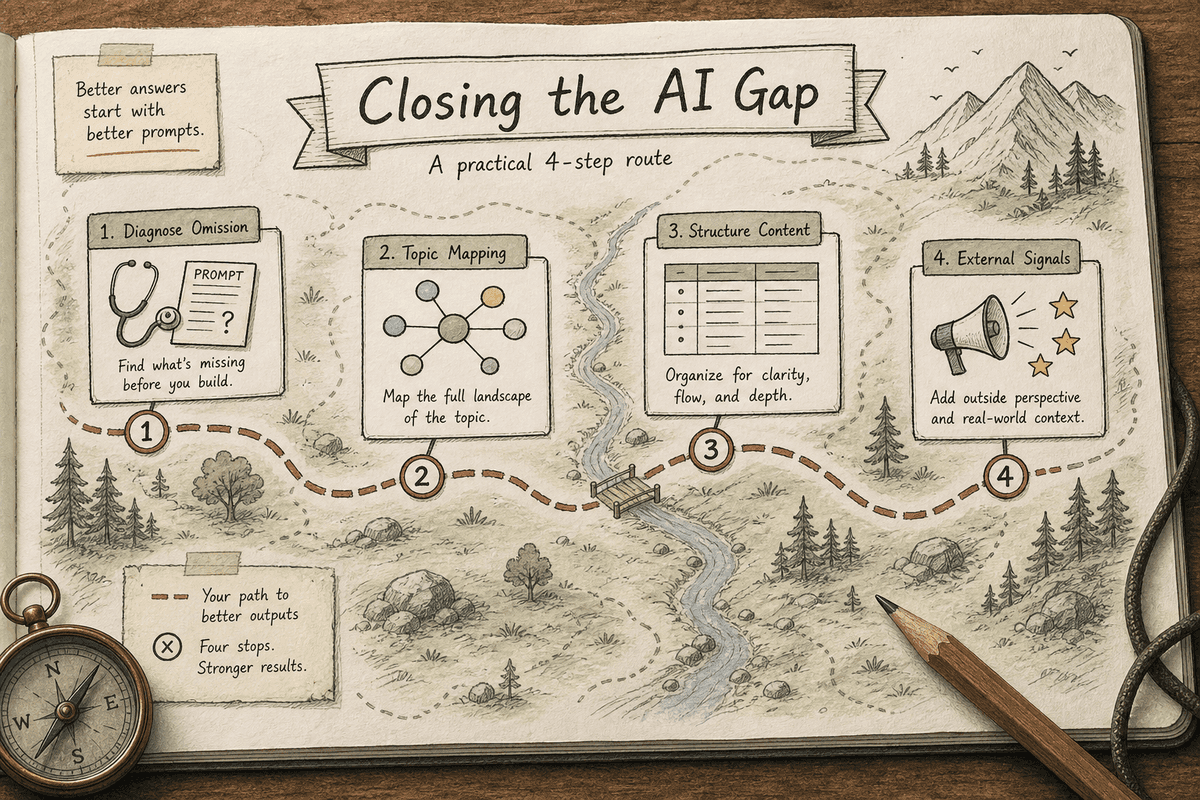
This is not about keyword stuffing; it's about providing the exact structure, data density, and external validation that AI models crave. Here is the framework for turning visibility gaps into published work.
1. Diagnose the Omission
Before creating content, you must identify why AI platforms are bypassing you.
When you track a commercial prompt and see your competitor cited instead of you, look at the footnote. Where did the AI get its information?
Often, LLMs pull answers from competitors because your current digital footprint lacks the structure or freshness they trust. As discussed in an interview with Louise Linehan on refreshing content, updating older, stale content with clear Q&A formats and explicit, direct answers is a primary method for improving generative engine optimization.
Ask yourself:
- Did the AI cite a competitor's blog post? (You need better owned content).
- Did the AI cite a G2 or Capterra listicle? (You need better third-party reviews).
- Did the AI cite a Reddit thread? (You need community presence).
2. Build a Comprehensive Topic Map
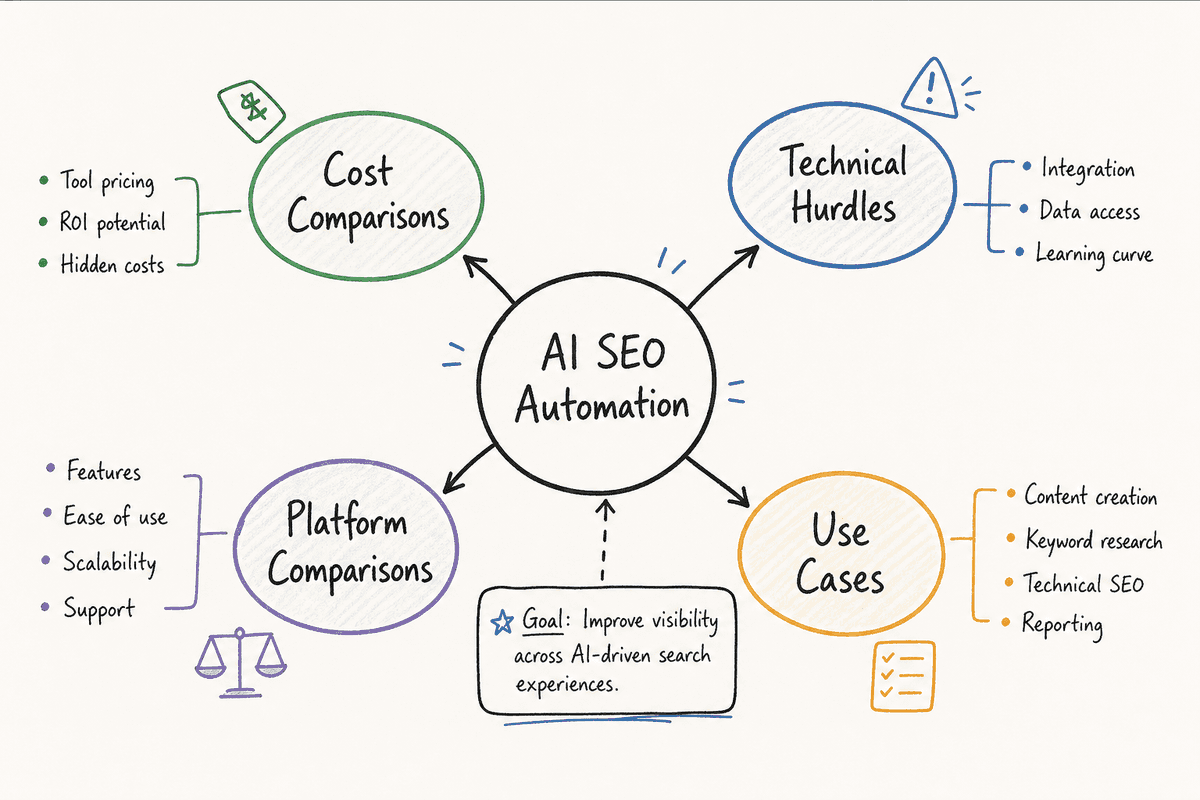
AI models rely on relationships between entities. If you want to rank for a specific use case, you cannot just write one shallow blog post. You need to map out the entire semantic neighborhood of that topic.
Search Engine Journal recommends creating a simple topic map: put your main topic in the center, then list the subtopics, adjacent questions, use cases, objections, and technical requirements around it.
For example, if your visibility gap is around "AI SEO automation," your topic map should include:
- Cost comparisons (e.g., how automation compares to agency rates, a concept explored in our guide on SEO Charges UK: Agency Rates vs Automation (2026)).
- Technical hurdles.
- Specific platform comparisons.
3. Structure Content for LLM Ingestion
When writing to close an AI visibility gap, structure is just as important as substance. LLMs favor content that is highly structured, easy to parse, and rich in factual data.
Use Direct Definitions: Do not bury the answer in the fourth paragraph. If the prompt is "What is the best SEO tool for Etsy?", your related page should explicitly state criteria early on, similar to how we structure our 7 Best Etsy SEO Tools to Boost Sales in 2026 guide.
Leverage Tables and Lists: AI assistants love parsing Markdown tables and unordered lists. If you are comparing features, use a table. If you are listing steps, use a numbered list. This structural clarity reduces the computational effort required for the LLM to extract the information, making it more likely to be cited.
Increase Data Density: Replace generic adjectives with specific data points.
- Weak: "Our platform is very fast."
- AI-Optimized: "Our platform processes 10,000 requests per second with a 12ms latency."
4. Create the Content Assets
Depending on the gap diagnosed in step one, you will need to deploy different types of content.
- The Definitive Guide: If the AI is pulling from fragmented, weak sources, build a massive, structured guide that serves as the ultimate authority on the topic. If you need a template, look at How to Build an SEO Landing Page (7-Step Guide).
- The Competitor Comparison: If the AI cites your competitor, create a brutally honest, feature-by-feature comparison page (like the one you are reading right now).
- The Technical Deep Dive: Sometimes gaps exist because the AI doesn't understand your technical methodology. Detailed checklists, like our SEO for Single Page Applications: The Technical Checklist, provide the deep semantic context LLMs need to view you as an authority.
5. Validate with External Signals
You can publish the best content in the world, but if the AI doesn't see anyone else talking about it, it may still hesitate to recommend you over a well-established competitor.
To truly close the visibility gap, you need external consensus.
Pierview’s guide on closing AI visibility gaps highlights the importance of pitching thought leadership pieces, securing guest posts, publishing whitepapers, and collaborating with recognized industry bodies to build mentions on trusted domains.
Additionally, reviews play a massive role. Discussions on Reddit regarding local SEO and AI emphasize that once SEO fundamentals are complete, focusing on the diversification of your reviews across different niche-relevant websites is critical for whole-AI visibility.
Diagnosing Technical Blockers to AI Visibility
Sometimes, the reason you have an AI visibility gap has nothing to do with your content strategy, and everything to do with your technical infrastructure.
If you use BeVisible and notice that AI platforms consistently omit your brand even though you have incredible content, your site might be technically unreadable to LLM crawlers.
The Single Page Application (SPA) Problem
Many modern B2B SaaS websites are built as Single Page Applications using frameworks like React, Vue, or Angular. While these provide a snappy user experience, they can be a nightmare for AI crawlers like ChatGPT-User or Googlebot.
If your content relies on client-side JavaScript to render, there is a high probability that the crawler sees a blank page. If the LLM can't read the page, it can't cite the page.
Fixing this requires server-side rendering (SSR) or dynamic rendering. For a deep dive into resolving this specific bottleneck, review Single-Page Application SEO: What Works in 2026? and our broader guide on Implementing SEO in Single Page Applications (3 Ways).
Even when the tech stack is sound, basic technical hygiene matters. Missing internal links, deeply nested pages, and slow load times will throttle the rate at which AI agents ingest your new content. Before you panic about a visibility gap, ensure your technical foundation is solid by following SEO for Single Page Applications: A 5-Step Guide (2026).
The Economics of Closing the Gap
Identifying and closing AI visibility gaps used to be a heavily manual, expensive process. You would have to hire an agency, wait weeks for a manual audit, and pay premium retainers to get a list of recommendations.
Unfortunately, many traditional agencies are still selling outdated keyword-tracking services disguised as "AI SEO." If you are evaluating outside help, it pays to know what to look for. Check out Hiring SEO Services in Phoenix? 5 Red Flags (2026) for insights into avoiding agencies that don't understand generative engine optimization. Even if you aren't in Phoenix, the principles of avoiding snake-oil SEO apply globally.
This is where tools like BeVisible change the economics. By automating the monitoring of AI assistants and directly translating those gaps into scheduled publishing work, growth teams can execute at a fraction of the cost of a traditional agency retainer.
(For more on navigating these costs, see our breakdown of Top 7 Agencies for SEO in Durham (Ranked 2026) to see how modern agencies are incorporating automation, and read the top industry voices in our 11 Best SEO Blogs Every SaaS Founder Needs (2026)).
FAQs About AI Search Visibility
How long does it take for ChatGPT or Perplexity to index new content designed to fill a gap? It varies wildly. Perplexity is designed for real-time retrieval and can index and cite a well-structured, highly authoritative news piece or blog post in a matter of hours. ChatGPT (depending on the model and whether it utilizes Bing search integration) might take days or weeks. The key is ensuring your new content is internally linked from high-authority pages on your site to speed up discovery.
Does traditional SEO still matter for AI visibility? Absolutely. LLMs trust authoritative sources. The traditional metrics of SEO—site speed, mobile usability, technical architecture, and high-quality backlinks—signal to the AI that your site is a trustworthy entity. You cannot hack AI visibility with a poor website.
Why is my brand mentioned positively in Gemini but omitted entirely in ChatGPT? Different LLMs use different training data cut-offs, different live-retrieval search engines (Google vs Bing), and different weighting algorithms for consensus. This is exactly why multi-engine monitoring platforms like BeVisible are necessary. You have to monitor the specific gaps per engine to tailor your execution strategy.
Taking Action on Your AI Visibility
If you want a static dashboard to present high-level share-of-voice metrics at a quarterly board meeting, Profound is an excellent, robust tool.
But if you are a SaaS founder, growth marketer, or content team that needs to actively fix the problem—if you want to monitor exactly how AI assistants answer your buyers' prompts, identify the citations you are losing, and seamlessly turn those visibility gaps into evidence-backed articles, landing pages, and publishing schedules—BeVisible is the platform built for execution.
Stop letting AI route your buyers to your competitors. Start tracking your prompt visibility, mapping your contextual gaps, and publishing the structured content that forces Large Language Models to recognize your brand as the definitive answer.