
Search has fundamentally shifted from returning a list of ten blue links to generating synthesized, conversational answers. When a potential buyer asks ChatGPT, Gemini, or Perplexity for the best software in your category, these AI models don't just generate text—they retrieve live data and cite specific sources. If your brand isn't among those citations, you are effectively invisible to a growing segment of buyers.
The challenge for growth teams is no longer just optimizing for keywords; it's optimizing for AI model retrieval. To do that, you need tools that show which sources AI cites for your target buyer prompts.
Historically, the market for citation tracking was dominated by academic platforms. If you search for tools to verify AI citations, you will often find lists of academic source generators designed for students and researchers. However, for B2B marketers, SaaS founders, and agencies, the requirement is entirely different. You don't need a tool to write a term paper—you need an enterprise platform to measure your brand's AI-search visibility, track competitor mentions, and turn missing citations into an actionable content pipeline.
In the commercial AI visibility space, two platforms frequently enter the conversation: Profound and BeVisible.
This guide breaks down the mechanics of AI citation tracking, compares BeVisible and Profound feature-by-feature, and explains how to transition your strategy from passive monitoring to active content execution.
The Two Types of AI Citation Tools
Before comparing specific enterprise platforms, it is crucial to separate the market into two distinct categories based on user intent: Academic Verification and Commercial Visibility.
1. Academic and Text Verification Tools
Often, when people ask for "tools that show which sources AI cites," they are approaching the problem from the perspective of a user trying to prevent AI hallucinations in academic or professional writing. Reddit discussions among PhD students frequently highlight the unreliability of native LLM citations for peer-reviewed literature.
To solve this, specific academic tools were built:
- Scite AI: A platform that helps researchers evaluate scientific literature through "Smart Citations," showing whether a paper was supported or contrasted by subsequent research.
- Sourcely: An AI tool that scans written paragraphs and cross-references them against credible academic databases to provide verifiable sources.
- Atlas Workspace: A platform often used for source-grounded research, which provides its own evaluations of AI reference tools.
These tools rely on closed databases of published research papers and journals. They verify past claims.
2. Commercial AI Visibility Tools
For marketing, growth, and SEO teams, the use case is inverted. You aren't trying to write a paper; you are trying to figure out why an AI assistant recommended your competitor instead of you.
You need to input a prompt like "What are the best CRM tools for healthcare?" and see exactly which websites ChatGPT, Perplexity, Gemini, and Google's AI Overviews cited to generate their answers.
This is where Profound and BeVisible operate. They monitor AI engines at scale, analyze the generated outputs, extract the domains cited, measure brand sentiment, and map the visibility gaps.
Core Comparison: BeVisible vs Profound
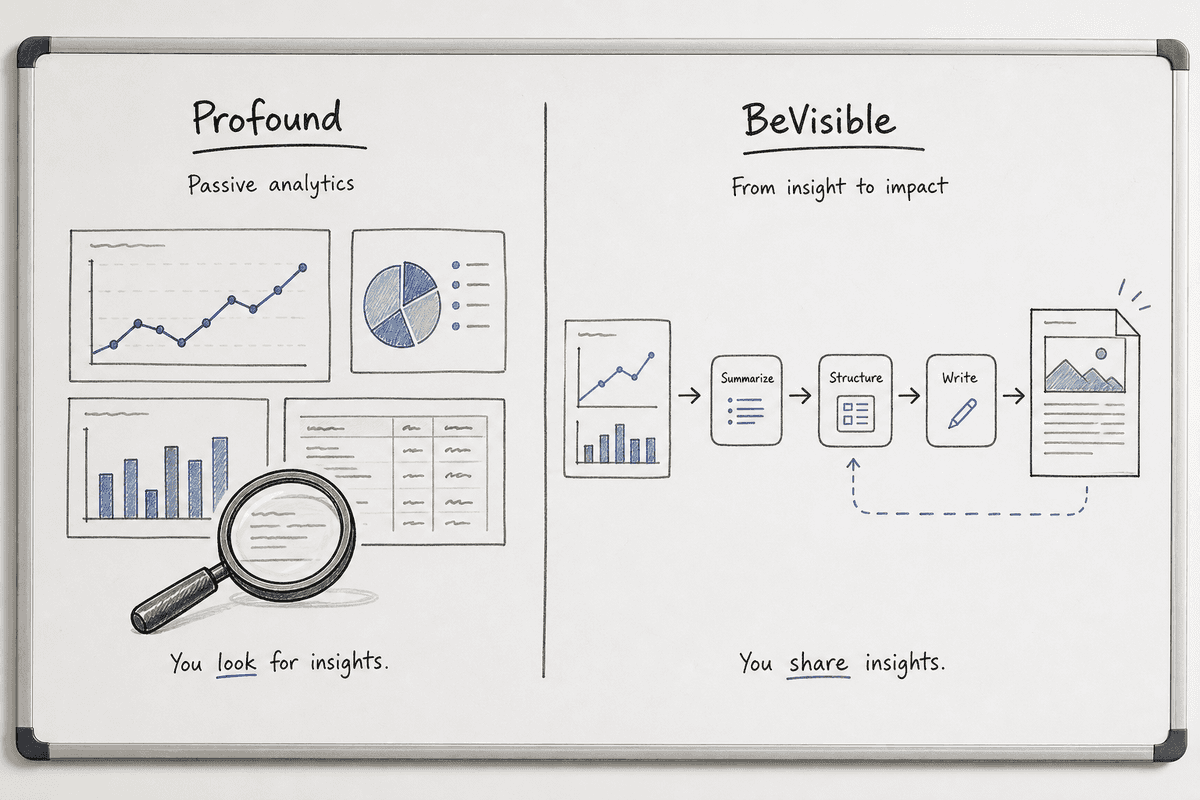
Both BeVisible and Profound monitor AI-generated content to track where traffic and citations are originating. However, their underlying philosophies differ significantly. Profound is built primarily as an analytics and monitoring dashboard. BeVisible is built as a complete execution engine—bridging the gap between discovering a missing citation and publishing the content required to earn it.
What is Profound?
Profound is an AI visibility platform designed to track how brands and products are represented across various generative AI models. It acts as a measurement tool, helping brands understand their "share of voice" within AI-generated answers.
Key Strengths:
- Citation Tracking: Extracts and aggregates the URLs that AI models use to construct their answers.
- Share of Voice Metrics: Quantifies how often your brand is mentioned compared to competitors.
- Multi-Model Support: Tracks responses across major LLMs to provide a baseline of AI visibility.
The Limitations: Profound excels at telling you what is happening, but it leaves the how to fix it up to your team. Once you see that you have a 0% citation rate for a critical buyer prompt, the tool's job is largely done. Your team must then manually export the data, figure out why the competitor won the citation, draft a brief, assign it to a writer, and manage the publication process. For lean growth teams, this creates a significant friction point between insight and action.
What is BeVisible?
BeVisible is an AI visibility monitoring and execution platform. Like Profound, it tracks ChatGPT, Gemini, Perplexity, AI Mode, and AI Overviews across your target buyer prompts to see how AI assistants answer questions, which brands they recommend, and which sources they cite.
However, BeVisible goes a step further by treating visibility gaps as project management triggers. It natively turns missing mentions, weak citations, and competitor wins into evidence-backed opportunities, automatically scheduling and managing the resulting article, review, or publishing work.
Key Strengths:
- Comprehensive Engine Coverage: Native tracking for Google AI Overviews, Perplexity, ChatGPT (with web search), Gemini, and AI Mode.
- Execution Workflows: Turns a "visibility gap" into a tangible task (e.g., "Publish an integration guide," "Update G2 reviews," "Create a comparison page").
- Evidence-Backed Content Strategy: Eliminates the guesswork of what to write by directly linking content creation to lost AI citations.
- Integrated Scheduling: Manages the pipeline from gap discovery to published work.
Feature Deep Dive
To understand which tool fits your tech stack, we need to look at how both platforms handle the core mechanics of AI visibility tracking.
1. Data Retrieval and Engine Coverage
AI models update their training weights and retrieval architectures frequently. A tool that only checks ChatGPT's base model is virtually useless for modern SEO, as most commercial queries trigger Retrieval-Augmented Generation (RAG)—where the AI browses the live web to construct an answer.
Both tools track the major engines, but BeVisible focuses specifically on the environments where buyers actually conduct research:
- Google AI Overviews (AIO): The most critical battleground for traditional SEOs. AI Overviews blend traditional ranking signals with generative synthesis.
- Perplexity AI: The fastest-growing conversational search engine, which natively provides inline citations for every claim.
- ChatGPT (SearchGPT capabilities): OpenAI's web-enabled search functionalities.
- Gemini: Google's standalone conversational interface.
BeVisible allows teams to upload hundreds of buyer prompts and run them across these engines simultaneously, mapping the exact URLs cited in the output.
2. Measuring Sentiment and Brand Recommendation
Citation tracking is only half the battle. If Perplexity cites your website to support a claim that your software is outdated, that is a highly visible negative result.
Tracking tools must parse the context of the citation. BeVisible analyzes the generated answer to determine whether the brand was recommended, neutrally mentioned, or heavily criticized. It also identifies why a competitor was recommended. Did the AI favor them because of pricing? Integrations? Customer reviews? Extracting this reasoning is crucial for your counter-strategy.
3. The Execution Gap (From Analytics to Publishing)
This is the most significant divergence between BeVisible and Profound.
Imagine you discover that your primary competitor is cited in 85% of ChatGPT responses for the prompt "Enterprise cloud security posture management tools," while your brand is cited 0% of the time.
The Profound Workflow:
- View the dashboard and see the 0% metric.
- Export the competitor URLs that won the citations.
- Move to a separate project management tool (Jira, Asana, Monday).
- Create a task for the content team to analyze the competitor pages.
- Draft a brief to create a new page or update an existing one.
- Write, edit, and publish the content.
- Wait for indexing, then manually check the AI monitoring tool weeks later to see if the metric improved.
The BeVisible Workflow:
- Dashboard identifies the 0% citation gap and highlights the exact competitor articles winning the AI retrieval.
- BeVisible converts this gap into an "Opportunity."
- The platform automatically drafts the requirements for the necessary asset (e.g., a technical integration guide) based on the evidence of what the AI model prefers.
- The task is scheduled and assigned within BeVisible's publishing workflow.
- Once published, BeVisible tracks the prompt continuously to report when the new asset successfully captures the AI citation.
 By unifying the measurement and the execution, BeVisible prevents insights from dying in a spreadsheet. If you find a visibility gap, you can immediately begin building the SEO landing page needed to fill it.
The Technical Reality: How AI Models Choose Citations
To effectively use tools like BeVisible or Profound, growth teams must understand why an AI model cites a specific source over another. It is not just about domain authority, though that plays a role.
When a user prompts an AI search engine, the system uses Retrieval-Augmented Generation (RAG). The process looks like this:
- Query Understanding: The AI breaks down the user's prompt to understand the intent.
- Vector Search / Keyword Search: The system queries an index (like Google's index or Bing's index for ChatGPT) to find documents that are highly relevant to the prompt.
- Chunking and Extraction: The AI extracts the most relevant "chunks" of text from those documents.
- Synthesis: The LLM generates a conversational answer using the extracted chunks.
- Citation: The LLM appends a link to the source document for the specific chunks it used.
To win a citation, your content must be highly retrievable during step two, and semantically dense enough to be extracted during step three.
Factors Influencing AI Citations
- Information Density: AI models prefer content that answers questions directly and concisely. Fluff-filled introductions are often ignored in favor of structured data, bullet points, and clear definitions.
- Consensus: If multiple high-authority sources agree on a fact, AI models are more likely to synthesize that consensus and cite the most authoritative origins.
- Formatting: Clean HTML structure, proper use of H2/H3 tags, and semantic markup make it easier for RAG systems to parse and extract your content. This is especially true for technical setups; implementing strong SEO for single page applications ensures that search crawlers and AI bots can actually render and read your JavaScript-heavy content.
- Primary Source Data: AI models frequently cite domains that host original research, proprietary statistics, or unique frameworks that other sites reference.
5 Visibility Metrics You Should Be Tracking
When evaluating your dashboard in BeVisible, staring at raw URL lists isn't enough. You need to track specific KPIs to prove ROI on your AI visibility campaigns.
- Prompt Share of Voice (SOV): Out of 100 high-intent buyer prompts in your niche, in what percentage does your brand appear in the AI-generated response?
- Citation Rate: When your brand is mentioned, how often is it backed by a direct, clickable citation to your website? (A mention without a link is good for brand awareness, but a citation drives referral traffic).
- Competitor Win Rate: How often is your primary competitor cited when you are omitted? This highlights immediate content gaps.
- Sentiment Score: Is the AI describing your tool as "expensive and clunky" or "robust and enterprise-ready"?
- Source Diversity: Is the AI only citing your homepage, or is it accurately pulling from your blog posts, documentation, and case studies? If it's only the homepage, your deep content isn't structured well for RAG.
How to Build a Content Pipeline from AI Citations
Tracking which sources AI cites is a diagnostic exercise. The treatment is publishing better content. Here is a step-by-step framework for using BeVisible to close visibility gaps.
Step 1: Map Your Buyer Prompts
Do not track generic keywords like "CRM software." Track the actual conversational prompts buyers use.
- "What is the best CRM for a 50-person marketing agency?"
- "Compare HubSpot vs Salesforce for B2B SaaS startups."
- "Which CRM integrates best with Outreach and Gong?"
Step 2: Run the Baseline and Identify Gaps
Input these prompts into BeVisible. The platform will query ChatGPT, Perplexity, and Google AIO.
Filter the results for prompts where your brand has 0% SOV, but a competitor has >50% SOV. This is your immediate priority list.
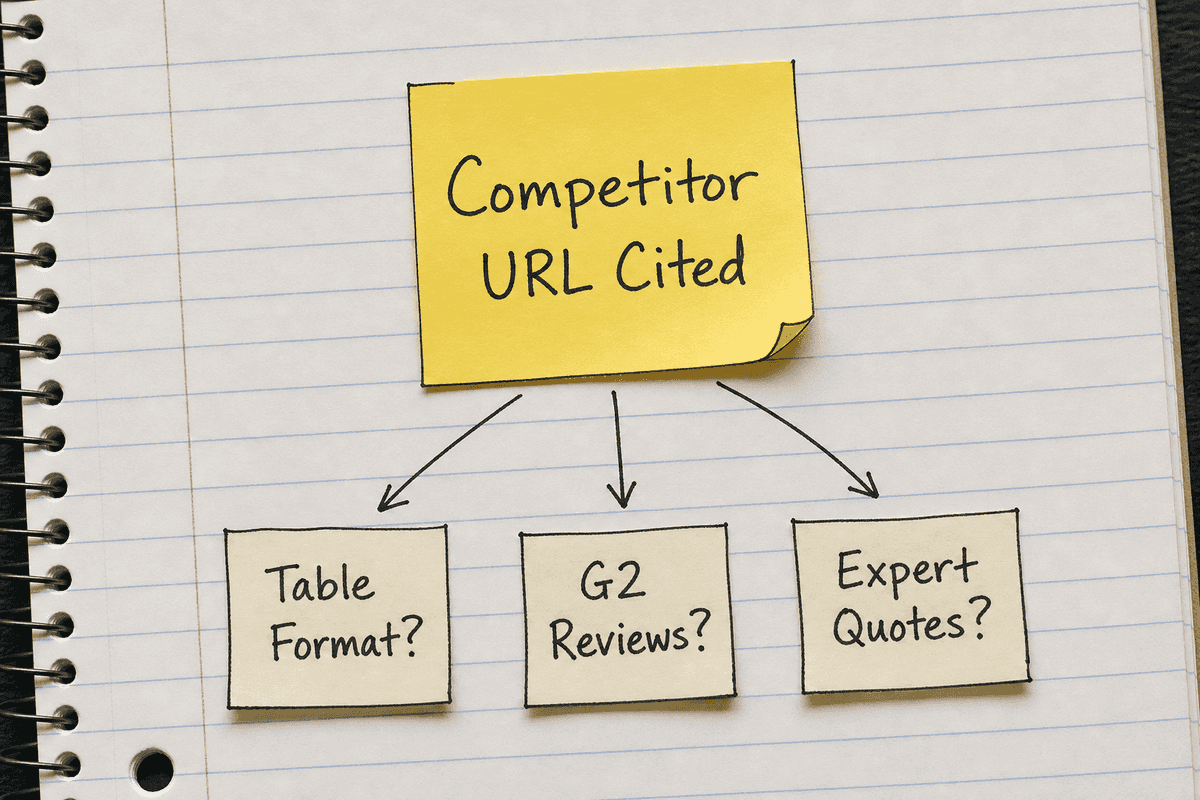
Step 3: Analyze the Winning Citations
Look at the exact URLs the AI models are citing for those failed prompts. What do those pages have that yours do not?
- Are they citing a massive comparison table?
- Are they pulling from a third-party review site like G2 or Capterra? (If so, your action item is a review generation campaign, not a blog post).
- Are they citing a specific list of industry resources that mentions your competitor?
Step 4: Schedule the Execution Work
Use BeVisible's built-in publishing workflow to create a task. If the AI is citing a competitor's pricing guide, schedule an "Ultimate Pricing Guide for 2026" for your own site. Assign it to your content team directly within the platform.
Step 5: Optimize for AI Retrieval (GEO)
When writing the new asset, optimize it for Generative Engine Optimization (GEO):
- Use direct, assertive language.
- Include a TL;DR summary at the top.
- Use clear table structures for comparisons.
- Cite your own statistics clearly.
Step 6: Publish and Monitor the Re-Crawl
Once published, it will take time for AI indices to update. Google AIO updates relatively quickly alongside its traditional index. ChatGPT and Perplexity rely on real-time web searches, so they can theoretically pick up the new content as soon as it is live and accessible. Keep the prompt active in BeVisible to watch the citation flip from the competitor to you.
Common Failure Modes in AI Visibility Campaigns
Even with the best tools, teams often fail to move the needle on AI citations. Here are the common red flags to avoid—similar to the red flags when hiring traditional SEO services.
1. Treating AI Engines as a Monolith
Google AI Overviews behave very differently than Perplexity. AIO is heavily biased toward traditional ranking factors (domain authority, backlinks). Perplexity is heavily biased toward information density and direct relevance, frequently citing low-authority domains if they have the exact right answer.
If you try to build a one-size-fits-all content piece, it might fail in both environments. Analyze the citations on a per-engine basis.
2. Ignoring Third-Party Validation
Often, tools like BeVisible will reveal that the AI isn't citing software vendors at all. For prompts like "What are the pros and cons of Tool X?", the AI will almost exclusively cite Reddit, G2, TrustRadius, and independent blogs.
If you see this pattern, writing another blog post on your own site won't work. You have to execute a digital PR or community management strategy. You need to get mentioned on the platforms the AI already trusts.
3. Disconnecting Tracking from Publishing
This is the fatal flaw of using pure monitoring tools. A dashboard full of red numbers (missed citations) creates anxiety, not revenue. If the person looking at the dashboard doesn't have the authority or the workflow to assign a content update, the tool is a waste of budget. Visibility data must flow directly into the content calendar.
Budgeting: Agency Rates vs Automation
When building an AI visibility capability, you have to decide whether to bring it in-house using software or outsource it to an agency.
Traditional SEO agencies are adapting, but their pricing models are often built around legacy deliverables (links, keyword volume). As seen in debates over SEO charges in the UK, agencies are struggling to price AI optimization because the workflows are so new.
Using a platform like BeVisible brings the capability in-house, combining the analytics of an enterprise SEO tool with the workflow management of a content agency. For SaaS founders and growth teams, this automation significantly lowers the cost of customer acquisition compared to paying an agency thousands of dollars a month just to manually test ChatGPT prompts.
Making the Choice: BeVisible or Profound?
Choosing between BeVisible and Profound comes down to your team's structure and goals.
Choose Profound if:
- You are a massive enterprise with a siloed analytics team that only needs to report on high-level share of voice metrics to the C-suite.
- You already have an incredibly rigid, immovable project management system for content, and you only need raw data exports to feed into it.
- You are primarily focused on PR crisis monitoring rather than proactive SEO/content growth.
Choose BeVisible if:
- You are a growth-focused B2B marketer, SaaS founder, or agency that needs to drive pipeline.
- You want to eliminate the friction between finding a missing citation and publishing the fix.
- You need to track a wide variety of engines (AIO, ChatGPT, Perplexity, Gemini) specifically for buyer-intent prompts.
- You want a tool that acts as an execution engine, automatically turning competitor wins into actionable content tasks.
FAQ: Tracking AI Search Citations
Can you track exactly how much traffic comes from an AI citation? It is difficult to get exact granular data because many AI tools strip referral parameters or lump traffic into "Direct" or "Organic Search" in Google Analytics. However, you can track the presence of the citation using BeVisible, and correlate that presence with spikes in landing page traffic.
Do AI Overviews cite sources differently than traditional Google Search? Yes. While AI Overviews often pull from the traditional top 10 blue links, they frequently cite domains ranking on page 2 or 3 if those pages have highly specific, structured text that perfectly answers the user's conversational query.
Will AI models cite Single Page Applications (SPAs)? Yes, provided the SPA is rendered correctly. If an AI web crawler encounters a blank JavaScript shell, it cannot extract text for RAG. Proper single-page application SEO is mandatory if you want AI engines to read and cite your web apps.
How long does it take an AI to update its citations after I publish new content? Web-connected models like Perplexity and ChatGPT can cite new content within minutes or hours of it being indexed by their respective web crawlers. Google AIO updates depend on standard Google crawling and indexing times.
AI search is replacing the traditional research phase for B2B buyers. If your brand is missing from the citations of ChatGPT, Perplexity, and AI Overviews, you are losing high-intent traffic to your competitors. Stop passively monitoring your visibility gaps. Use an execution platform like BeVisible to track exactly which sources AI cites, and turn those insights directly into published, citation-winning content.