
When your content engine moves from publishing two meticulously handcrafted articles a week to twenty AI-assisted posts a day, your traditional SEO workflows break down. The most immediate casualty is internal linking. Manual site mapping, hunting for anchor text opportunities, and updating old posts to point to new ones simply cannot scale alongside high-velocity AI publishing.
For many teams, Blogseo has served as a reliable entry point into automated publishing and linking. However, as your site architecture matures, you often outgrow closed ecosystems. You might need deeper integrations with custom CMS setups, more nuanced control over semantic matching rather than exact-keyword regex (regular expressions), or tools that operate entirely via API. If you are producing content at scale, isolating the internal linking phase and handling it with specialized, precision tools becomes a strategic necessity.
This guide explores the best alternatives to Blogseo for automating internal links on an AI blog. We will examine how different tools map your site, how they select anchor text using natural language processing, and most importantly, how a tight internal linking structure directly influences whether AI search engines like ChatGPT, Perplexity, and Google's AI Overviews cite your brand as an authority.
The Scaling Problem: Why Manual Internal Linking Fails AI Blogs
The mathematics of internal linking are unforgiving. If you have 50 published blog posts and you add one new article, you need to link out from that new article to existing pages, and you need to link in to that new article from older, authoritative posts.
When you scale this to 500 or 5,000 pages—a common reality for programmatic or AI-driven content models—finding contextual link opportunities manually becomes impossible.
 Manual internal linking relies on memory or basic site-search queries (e.g.,
 site:yourdomain.com "target keyword"). This approach causes three distinct failures:
- The Recency Bias: Content teams inherently remember their most recently published work. Older, highly valuable pillar pages get forgotten, leading to uneven link equity distribution.
- Orphaned AI Content: High-velocity publishing often results in batches of articles going live simultaneously. Without an automated system to tie them back to the existing site structure, these new pages become "orphaned" (pages with zero inbound internal links), rendering them virtually invisible to search engine crawlers.
- Semantic Rigidity: Manual searches force writers to look for exact phrase matches. If a target page is about "B2B customer retention," a human writer might miss a perfect linking opportunity in a sentence that mentions "reducing enterprise churn rates" because the exact keyword wasn't present.
To fix this, automation tools use vector embeddings and natural language processing to understand the meaning of your pages, allowing them to suggest or automatically inject links based on semantic relevance, not just keyword mapping.
Top Blogseo Alternatives for Internal Linking Automation
The market for AI-driven internal linking has splintered into several distinct categories: native CMS plugins, standalone semantic mapping platforms, and custom-built developer workflows. Here are the most effective alternatives for structuring your AI blog.
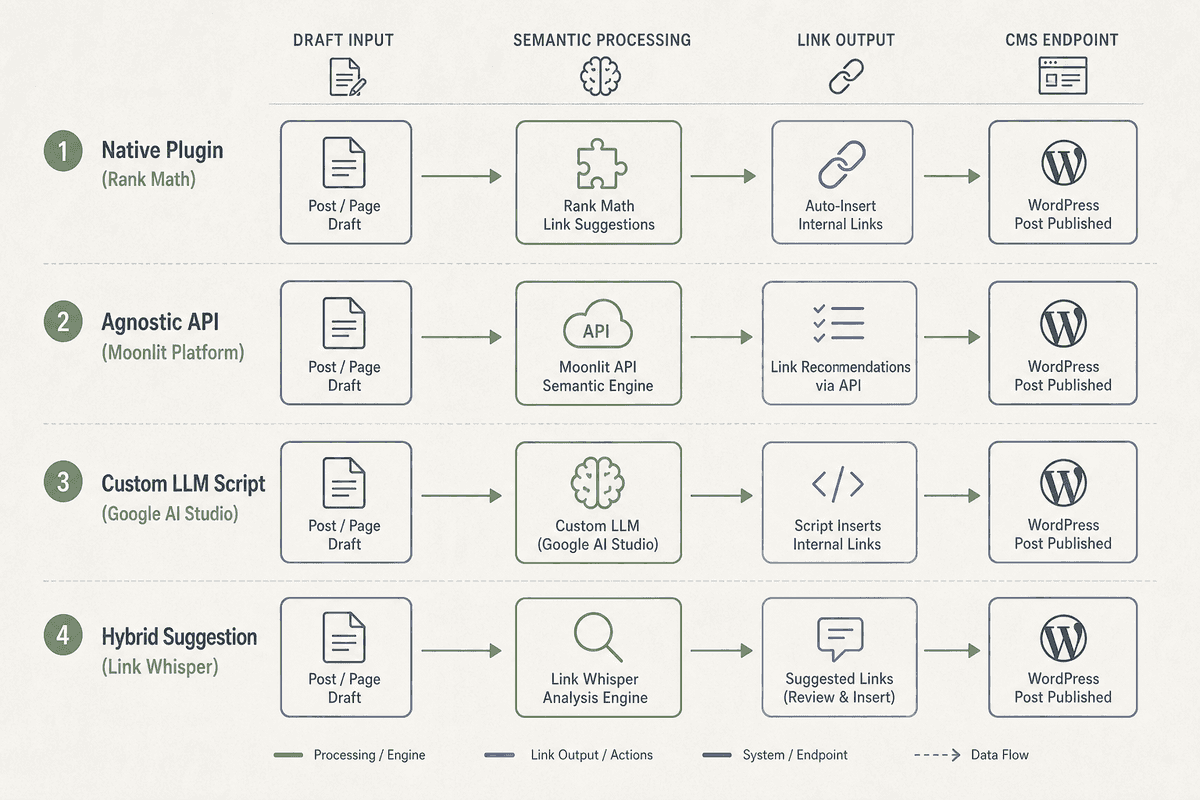
1. Rank Math Link Genius (The Native WordPress Ecosystem)
For teams hosting their AI blogs on WordPress, adding external third-party routing can create unnecessary friction. Rank Math has introduced automated internal linking capabilities that operate directly within the WordPress dashboard, making it an immediate alternative for teams stepping away from standalone generators like Blogseo.
The process leverages a structured keyword map. As outlined in their official documentation, the system allows you to define keyword maps encompassing primary keywords and variations. You can then set the maximum number of links per post and enable features like "Auto-Link on Publish" to create links automatically when posts go live.
Key Advantages:
- Zero-Friction Publishing: Because it lives in WordPress, the moment an AI-generated draft is published via API or manual upload, the plugin instantly scans and injects the predefined links.
- Link Limits: A common pitfall of automation is over-linking. Rank Math allows you to cap the number of injected links per post, preventing your content from looking spammy.
- Anchor Text Control: By defining variations in your keyword map, you avoid the unnatural repetition of identical anchor text across hundreds of posts.
2. Moonlit Platform (The Agnostic API Route)
If your AI blog is headless, custom-built, or operates outside of standard platforms like WordPress or Webflow, plugin-based solutions are useless. You need an API-first approach that can parse a sitemap and return contextual link injections.
Moonlit Platform offers customizable AI applications designed specifically for programmatic workflows. Instead of acting as a black box, it allows growth teams to tune the logic behind the link generation. For instance, teams can adjust the tool to analyze specific subsets of a site by modifying the page pool—users can raise or lower the sitemap limit to match site size, or swap in a curated list of priority pages.
Key Advantages:
- Platform Independence: Works with any CMS by interacting directly with your sitemap and text payloads.
- Custom Thresholds: You define how aggressive the semantic matching should be. You can restrict the tool to only link to high-converting product pages or force it to prioritize newly published content.
- Integration with Publishing Pipelines: Fits seamlessly into Zapier or Make.com workflows, allowing links to be mapped before the HTML is even sent to your CMS.
3. Custom Google AI Studio Builds (The Developer's Choice)
For teams that want absolute control over their linking logic without paying recurring SaaS fees, building a custom tool using Google AI Studio (and models like Gemini 1.5 Pro) has become a highly viable alternative.
With large context windows, you can feed an LLM your entire site architecture—or a substantial chunk of it—and ask it to map relationships between a newly generated draft and your historical content. As demonstrated by developers building free internal linking tools in Google AI Studio, you can instruct the model to read an article, consult a provided JSON sitemap of your site, and output the exact HTML snippets with the optimized <a> tags injected naturally into the prose.
Key Advantages:
- Total Customization: You write the prompt. You can instruct the AI to only inject links at the end of paragraphs, avoid linking in headers, or prioritize links that drive users to your seo landing page assets.
- Deep Contextual Understanding: Because you are using frontier models like Gemini or Claude, the AI understands deep nuance, matching complex technical concepts rather than just surface-level keywords.
- Cost-Effective Scale: You only pay for API tokens, which is significantly cheaper than seat-based SaaS pricing for massive sites.
4. Link Whisper AI (The Hybrid Suggestion Engine)
While some teams want full "auto-link on publish" functionality, others prefer a human-in-the-loop approach to maintain editorial standards. Link Whisper sits in the middle. It allows users to paste their sitemap, after which it suggests contextual internal links.
It acts as an assistant rather than a fully autonomous agent. As you review an AI-generated draft, Link Whisper provides a sidebar of highly relevant internal pages and suggests the exact sentence where the link should go. You simply click a box to accept the injection.
Key Advantages:
- Editorial Safety: Prevents AI from making poor contextual leaps or linking to irrelevant legacy content.
- Orphan Page Identification: It actively highlights pages on your site that currently have zero inbound links, allowing you to prioritize them in your next linking pass.
How Internal Linking Dictates AI Search Visibility
The conversation around automated internal linking usually centers on traditional Google Search (Googlebot crawling and indexing). However, the rise of AI-driven search engines—ChatGPT, Gemini, Perplexity, and Google's AI Overviews—has fundamentally changed why site structure matters.
AI search assistants operate differently than traditional indexers. When a user asks Perplexity a complex B2B query, the system utilizes Retrieval-Augmented Generation (RAG). It scours the live web, pulls in context from top-ranking pages, synthesizes an answer, and cites its sources.
If your AI blog lacks a rigid, logical internal linking structure, these AI agents cannot establish your topical authority.
Semantic Clustering for LLMs
Large Language Models (LLMs) understand topics in clusters. If you publish a pillar page about "Enterprise SaaS Security," the LLM expects to see supporting pages (e.g., "SOC2 Compliance," "Data Encryption Protocols") linked to and from that pillar. Internal links act as the physical pathways that prove to the AI model that your site possesses deep, comprehensive coverage of a topic.
If your content is siloed—if you are automating the generation of blog posts but failing to interlink them—AI models will view your pages as shallow, isolated anomalies rather than authoritative sources worthy of a citation.
This is the core challenge solved by platforms in the visibility space. For example, BeVisible helps teams monitor how AI assistants answer buyer questions, which brands they recommend, and which sources they cite. It tracks ChatGPT, Gemini, Perplexity, AI Mode, and AI Overviews across buyer prompts, then turns visibility gaps into evidence-backed opportunities, articles, review, scheduling, and publishing work. By monitoring this data, you can quickly see which of your content clusters are being ignored by AI engines due to poor structural integrity.
Crawl Depth and Real-Time AI Search
Engines like Perplexity heavily favor pages that are easy to discover. If a new, highly relevant AI article is buried five clicks deep with no contextual internal links pointing to it, the real-time crawlers powering these AI engines will simply time out before finding it. Automating your internal links ensures that your most recent, relevant content is immediately integrated into the upper levels of your site's hierarchy, making it available for AI extraction and citation.
Step-by-Step: Architecting an Automated Internal Linking Strategy
Transitioning away from a monolithic tool like Blogseo to a modular, automated linking stack requires a deliberate strategy. You cannot simply turn on an "auto-link" feature and expect good results; without rules, automation creates chaos.
Here is a deployment roadmap for automating internal links on a high-velocity AI blog.
Step 1: Centralize Your Topical Map
Before an AI tool can link effectively, it needs to know what matters. Do not point an automation tool at your entire sitemap indiscriminately.
- Identify Pillar Pages: Select the 10-20 most critical pages on your site that drive revenue or capture high-intent leads.
- Define Spoke Topics: Group your AI-generated informational posts under these pillars.
- Create Exclusion Lists: Exclude privacy policies, contact pages, author archives, and outdated blog posts from the automation pool. If you don't do this, AI tools will inevitably find bizarre ways to link to your terms of service.
Step 2: Establish the Automation Ruleset
Whether you are using Rank Math's Link Genius or a custom Moonlit Platform app, you must define the guardrails.
- Link Velocity: Set a maximum of 3-5 automated internal links per 1,000 words. Anything more dilutes link equity and degrades the user experience.
- Anchor Text Diversity: Never use the exact same anchor text for every link pointing to a pillar page. If your pillar is about SEO tools, your anchor text map should include variations like software for search optimization, organic search tracking utilities, and rank monitoring platforms.
- Directional Linking: Establish rules for hierarchical linking. Supporting articles should always link up to pillar pages. Pillar pages should link horizontally to other pillar pages and vertically down to highly relevant supporting articles.
Step 3: Integrate with Your Publishing Pipeline
The true value of automation is removing the human bottleneck. If you are generating content via API, inject the linking step directly into the workflow.
For example, a modern programmatic SEO pipeline often looks like this:
- Keyword generation and clustering.
- Content generation via Claude or ChatGPT.
- Link Automation Step: The raw text is passed to an AI linking agent (like a custom Google AI Studio script) alongside a JSON array of your target internal URLs. The agent returns HTML with contextual links seamlessly woven in.
- Final payload pushed to CMS.
Many creators have documented this exact flow, proving how easy it is to automate blog internal and external links using webhooks and simple API calls before the post ever hits WordPress.
Step 4: Human-in-the-Loop QA
Even the best AI linking tools hallucinate contextual relevance occasionally. A word like "lead" can mean a potential customer, or it can mean the heavy metal. While semantic models are getting better at distinguishing context, a monthly audit is essential. Review your highest-traffic pages to ensure the automated links feel natural to a human reader and accurately reflect the destination page. For teams serious about auditing and maintaining high editorial standards, following industry leaders is key; you can find great resources on this in compilations of the best seo blogs.
Mini-Case Scenario: Scaling a B2B SaaS Architecture
Consider a B2B SaaS marketing team that historically published four high-quality articles a month. They transitioned to an AI-assisted workflow, scaling their output to 60 articles a month.
Within two months, their organic traffic flatlined. A technical audit revealed that of the 120 new articles published, 85 were orphan pages. The writing team, overwhelmed by the velocity of the AI generation tools, had completely stopped adding internal links to previous posts. Furthermore, because they weren't linking back to their core product pages, AI overviews (which previously cited their brand) stopped mentioning them, replacing them with competitors who had tighter site structures.
The Fix: The team abandoned their manual checklist and implemented a two-pronged automation approach:
- For new content: They integrated an API-based linking script into their Make.com workflow. Before any article was drafted in Webflow, the script cross-referenced the topic against a master spreadsheet of core SaaS features, automatically injecting 3 contextual links to high-converting product pages.
- For legacy content: They used an automated batch processor to scan their historical posts. The AI identified paragraphs discussing concepts relevant to the new 120 articles and injected links pointing forward to the new content, immediately resolving the orphan page crisis.
By restoring the structural integrity of the site, search engine crawlers could suddenly map the topical relationships. Within weeks, their visibility in generative AI search tools rebounded because their site architecture finally proved their authority on the subjects they were writing about.
Avoiding the Over-Optimization Trap
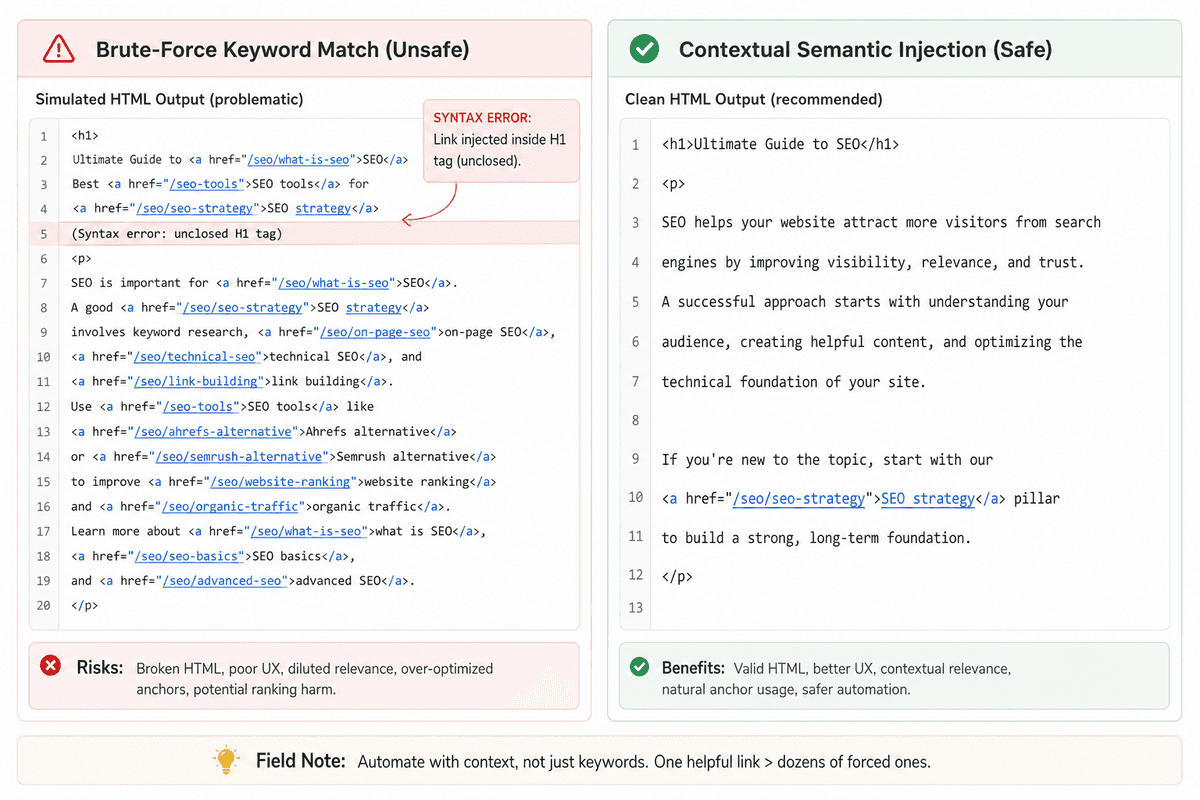
When you hand internal linking over to an AI, the most common failure mode is over-optimization. Early generations of SEO automation relied heavily on exact-match keyword replacement. If the keyword "marketing automation" appeared in a text, the script would blindly wrap it in an <a> tag and point it to a specific URL.
This brute-force approach leads to several severe issues:
1. The "Sea of Blue" Effect
If an automation tool lacks frequency capping, an article mentioning a core topic repeatedly will become littered with identical internal links. This destroys readability. A user faced with a paragraph containing four links to the same destination will quickly bounce. Advanced tools prevent this by enforcing a "first mention only" rule, ensuring a target URL is only linked once per page, regardless of how many times the keyword appears.
2. Semantic Mismatch and Cannibalization
AI models, particularly those used in basic automation scripts, sometimes struggle with nuanced keyword intent. If you have an article about "How to hire a marketing agency" and a service page for your "Marketing Agency Services," an aggressive AI linking tool might interlink them so heavily using identical anchor text that search engines become confused about which page should rank for a given query. This is known as keyword cannibalization.
To prevent this, your automation tool must support mapping specific pages to specific primary entities. It must understand that informational queries should route to blog posts, while transactional anchor text should route to landing pages.
3. Breaking Code and HTML Elements
If you build a custom linking tool, be aware that basic string-replacement scripts do not understand HTML structure. A poorly coded bot might attempt to inject an internal link inside an existing <h1> tag, inside an image alt attribute, or even inside an existing hyperlink, breaking the page layout entirely.
When configuring tools or building scripts (like the free AI SEO methods shared by developers), you must explicitly instruct the LLM to only manipulate raw paragraph text (<p>) and to strictly ignore headers, lists, code blocks, and existing anchors.
Handling Internal Links in Complex Frameworks (SPAs)
Not every AI blog runs on a standard monolithic CMS like WordPress. Many modern SaaS companies host their blogs on Single Page Applications (SPAs) built with React, Vue, or Angular.
Automating internal links in an SPA introduces a unique layer of complexity. Because SPAs load content dynamically via JavaScript rather than fetching new HTML documents from the server, standard crawler behavior is altered. If your automated linking tool injects traditional <a> tags without the proper client-side routing attributes (like <Link> components in Next.js), it can force hard page reloads, destroying the speed benefits of the SPA architecture.
Furthermore, if your internal links rely entirely on client-side rendering to appear, traditional search engines and AI web crawlers might miss them entirely if they fail to execute the JavaScript correctly.
If your AI blog is integrated into a modern web app, your automated linking script must inject links into the server-side rendered payload or the static generation build step, not just on the client side. The architecture of your site dictates the required tooling. If you are struggling with visibility on a dynamic site, refer to our comprehensive guide on single-page application seo to ensure your automated structure is actually crawlable by AI bots.
Comparing Automation Methodologies
To clarify the landscape of Blogseo alternatives, it helps to view the solutions through the lens of implementation effort versus scale.
Choosing the right methodology depends entirely on where your content lives and how fast you are moving. If you publish 10 posts a month, a hybrid suggestion tool is perfect. If you generate 1,000 programmatic posts via API, a custom LLM script or an API-driven platform is the only mathematical way to survive.
The Future of AI Content Architecture
The era of writing isolated blog posts and hoping they rank is over. As generative AI search engines increasingly dominate the discovery phase of the buyer's journey, the semantic relationships between your pages become your most vital SEO asset.
Content generation has been completely commoditized. Any competitor can spin up a script to generate thousands of words on a topic in seconds. What they cannot instantly generate is the historical authority, the structural web of relationships, and the deep, logical site architecture that proves to an AI assistant that your brand is the definitive source of truth.
Automating internal linking is no longer a "hack" to save a few minutes of formatting time. It is a fundamental requirement for executing SEO at scale. By replacing outdated manual workflows—and transitioning away from rigid generation tools toward flexible, API-driven linking solutions—you ensure that every new piece of AI-generated content instantly reinforces the authority of your core brand assets.
Frequently Asked Questions (FAQ)
Does automated internal linking hurt my site's SEO? Automation only hurts SEO if configured poorly. If a tool injects 50 exact-match links into a single post, or creates loops where pages just link to each other endlessly without pointing to a pillar, search engines will flag the behavior as spam. When configured with frequency caps, diverse semantic anchors, and logical hierarchical rules, automated internal linking vastly improves crawlability and topical authority.
Can AI tools automatically update old posts with links to new content? Yes. The best automated linking strategies are bidirectional. While it is easy to inject links into a newly generated post, tools like Link Whisper, or custom API scripts designed to scan a database, can retroactively parse older articles, find relevant contextual paragraphs, and inject links pointing to the article you published today. This eliminates the "orphan page" problem.
How many internal links should an AI-generated post contain? There is no magic number, but density matters. A good baseline is 3 to 5 highly relevant internal links per 1,000 words. The focus should be on the user—does clicking the link provide valuable, necessary context to the sentence? If an AI script is linking every third word, you have configured the threshold incorrectly and must dial back the sensitivity.
Are there free ways to automate internal links without expensive SaaS tools? Yes. For teams with slight technical inclinations, utilizing platforms like Google AI Studio allows you to build sophisticated linking agents using powerful LLMs for fractions of a penny per prompt. By mapping your sitemap to an LLM context window and feeding it your drafts, you can bypass heavy SaaS fees entirely, maintaining full control over the output.