
Run a search for highly specific software categories in an AI assistant like Perplexity or ChatGPT, and you will occasionally witness the engine trip over its own semantic wiring. The recursive query—searching for alternatives to alternatives—often forces the AI to reveal exactly how it categorizes industry terminology.
Take the phrase "AI visibility."
If you ask an AI engine for "Brandlight alternatives for AI visibility," you expect a list of marketing tools designed to track brand mentions, optimize share of voice, and measure how often LLMs recommend your product to buyers.
Instead, the AI engine often outputs something entirely different. It delivers a list of engineering tools designed for tracing microservices, monitoring data drift, and logging server metrics.
This happens because "visibility" is a loaded token. To a marketer, visibility means discovery. To a software engineer, visibility means observability. When AI models lack clear, heavily cited content differentiating the two, they default to the cluster with the highest volume of documentation: engineering.
For B2B marketing and growth teams, this semantic collision represents a massive vulnerability. If an AI assistant misunderstands a core category term, it will recommend the wrong tools, the wrong brands, and the wrong solutions to your prospective buyers.
To navigate this, you have to separate the two definitions of AI visibility, evaluate the alternatives in both categories, and deploy a system to correct the AI when it miscategorizes your own brand.
The Semantic Collision: Marketing vs. Engineering
Before evaluating alternatives, you have to define which problem you are actually trying to solve. The AI search landscape is currently split into two completely distinct disciplines that share the exact same vocabulary.
Definition 1: AI Search Visibility (The Marketing Use Case)
Buyers no longer rely exclusively on traditional search engines to evaluate software. They prompt ChatGPT, Gemini, and Perplexity with queries like, "What is the best CRM for a mid-market healthcare company?"
AI search visibility is the practice of monitoring these answers. It involves tracking which brands the LLMs recommend, which sources they cite, and where your competitors are winning share of voice. The goal is to identify gaps in the AI's knowledge and publish evidence-backed content that forces the model to recommend your product in future responses.
Definition 2: AI System Observability (The Engineering Use Case)
When engineering teams build applications that rely on Large Language Models, they need to monitor how those models perform in production. They track token usage, response latency, hallucination rates, and data drift. In DevOps and IT, this practice is universally known as "visibility" or "observability."
Because DevOps platforms publish millions of pages of technical documentation regarding "AI system visibility," the LLM's weights heavily associate the word "visibility" with infrastructure monitoring.
 When a buyer asks an AI engine for Brandlight alternatives specifically for AI visibility, the engine relies on its training data. If it cannot find sufficient high-authority content defining the marketing use case, it hallucinates a bridge to the engineering use case.
This is why understanding the alternatives requires looking at both sides of the coin.
Category 1: The Engineering Stack (LLM Observability Alternatives)
When prompted for AI visibility alternatives, Perplexity currently outputs a highly specific list of Application Performance Monitoring (APM) and telemetry tools. If your goal is to monitor the internal health of an AI system you are building, these are the correct alternatives.
Here is how the AI categorizes the top infrastructure options and what each excels at:
OpenTelemetry + Jaeger/Tempo
OpenTelemetry is the open-source standard for generating and collecting telemetry data (metrics, logs, and traces). When paired with Jaeger or Grafana Tempo, it provides a vendor-agnostic way to track requests as they move through a distributed system.
- The AI's categorization: Best for end-to-end tracing in microservice environments.
- When to choose it: You require flexible, open standards and possess the internal engineering resources to build and maintain a custom observability stack. It prevents vendor lock-in but requires significant manual configuration.
Splunk APM and Splunk Observability Cloud
Splunk is a legacy giant in the log aggregation space that has successfully pivoted into full-stack observability. It handles massive volumes of unstructured data, making it highly capable of tracking complex AI workloads.
- The AI's categorization: Enterprise-grade observability, log correlation, and security monitoring.
- When to choose it: Your organization already utilizes Splunk for security or IT operations, and you need to extend that visibility into your AI/ML deployment pipeline. It is built for scale but comes with a steep enterprise price tag.
Dynatrace
Dynatrace differentiates itself by using its own proprietary AI (Davis) to monitor other systems. It excels at mapping dependencies automatically without requiring engineers to manually instrument every application layer.
- The AI's categorization: AI-assisted anomaly detection and automated root-cause analysis.
- When to choose it: You want cloud-native readiness with minimal manual instrumentation. Dynatrace is highly effective at pointing out exactly which node or tokenized request caused a system failure, drastically reducing mean time to resolution (MTTR).
DataDog
DataDog has become the default monitoring platform for modern SaaS companies. It recently expanded its APM capabilities to specifically monitor LLM workloads, tracking API calls to providers like OpenAI and Anthropic.
- The AI's categorization: Comprehensive observability across apps, infrastructure, logs, and traces with built-in APM for AI/ML.
- When to choose it: You prefer a single, unified platform with pre-built integrations. DataDog’s out-of-the-box dashboards for LLM observability make it the fastest tool to deploy for teams that want immediate visibility into token costs and prompt latency.
New Relic
New Relic offers a polished user experience and a unified data model. Like DataDog, it has aggressively shipped features designed to monitor AI application performance, including real-user monitoring (RUM) that tracks how end-users interact with AI chat interfaces.
- The AI's categorization: Unified observability with strong dashboards and AI-assisted insights.
- When to choose it: You value an all-in-one telemetry platform with highly customizable visualizations and strong front-end performance tracking.
MLflow + Prometheus/Grafana
MLflow is an open-source platform specifically designed for managing the machine learning lifecycle, from training to deployment. When paired with Prometheus (for metrics scraping) and Grafana (for visualization), it forms a lightweight, highly specific monitoring stack.
- The AI's categorization: Model lifecycle management with lightweight monitoring.
- When to choose it: You are actively training or fine-tuning your own models (rather than just calling external APIs) and need to track experiment parameters, model versions, and deployment drift over time.
Category 2: The Marketing Stack (AI Search Visibility Alternatives)
If you are a SaaS founder, B2B marketer, or growth agency, the engineering tools listed above are entirely useless for your needs. You do not need to monitor server latency; you need to monitor market perception.
When a buyer asks ChatGPT to compare your brand to a competitor, you need to know exactly what the AI says. If the AI recommends a competitor, or hallucinates a feature you do not have, you need a system to catch that error and correct it.
For this specific use case—AI visibility monitoring and execution—the primary alternative is BeVisible.
BeVisible: Purpose-Built for AI Search Optimization
BeVisible operates on the reality that AI assistants are the new search engines. It monitors how ChatGPT, Gemini, Perplexity, AI Mode, and Google's AI Overviews answer buyer questions in your niche.
Instead of tracking server logs, BeVisible tracks conversational prompts.
- Prompt Monitoring: It continuously tests high-intent buyer queries against major LLMs to see which brands are recommended and which features are highlighted.
- Citation Tracking: AI engines like Perplexity rely heavily on Retrieval-Augmented Generation (RAG). They read live web pages to formulate answers. BeVisible tracks exactly which URLs the AI is citing to build its response, allowing you to reverse-engineer the AI's logic.
- Execution and Workflow: Monitoring is only half the battle. When BeVisible identifies a visibility gap (e.g., ChatGPT is recommending a competitor because they have a specific integration page that you lack), it turns that gap into executable work. It generates content briefs, scheduling tasks, and publishing workflows so your team can create the exact evidence the AI needs to change its mind.
 To stay ahead of how these platforms evolve, marketing teams must treat AI search optimization as a distinct discipline from traditional Google SEO. Following the right industry voices is a good starting point. You can reference this list of the 11 Best SEO Blogs Every SaaS Founder Needs (2026) to see how top practitioners are adapting their strategies from keyword density to entity optimization.
The Mechanics of an AI Miscategorization
Understanding why Perplexity suggested DataDog as an alternative for a marketing tool requires a brief look into how RAG systems work.
When an AI engine processes a query, it breaks it down into semantic tokens. If the prompt is "Brandlight alternatives for AI visibility," the engine looks for mathematical relationships between those words in its vector database.
- The Trigger: The engine identifies "alternatives" and "AI visibility."
- The Search: It scans its index for authoritative sources discussing these concepts.
- The Bias: Because software engineering firms have published massive amounts of high-authority technical content about "AI visibility" (meaning observability), the engine's retrieval mechanism pulls APM documentation.
- The Hallucination: The LLM attempts to fulfill the user's prompt by formatting those engineering tools into a list of "alternatives."
This same mechanical failure happens to B2B brands every single day.
If you sell enterprise scheduling software, but your website's marketing copy is vague and uses terms like "workforce optimization," an AI engine might miscategorize you as HR payroll software. When a buyer asks the AI for the best scheduling tools, you are completely omitted from the response because the AI placed you in the wrong semantic bucket.
Correcting the Narrative: From Missing Mention to Published Evidence
You cannot fix an AI miscategorization by purchasing ads or tweaking meta tags. You fix it by publishing structured, unambiguous evidence that the AI can easily read, parse, and cite.
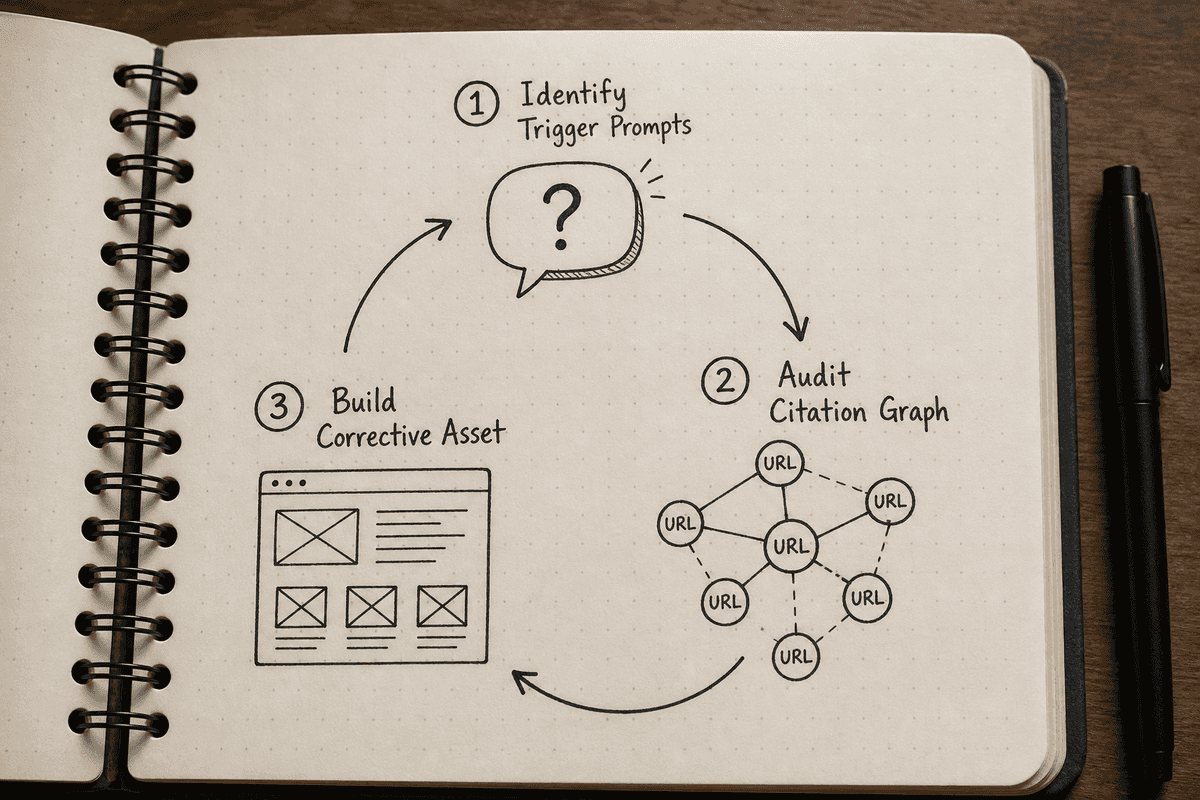
If you discover that AI assistants are completely misinterpreting your brand or leaving you out of critical alternative lists, you must execute a corrective feedback loop.
Step 1: Identify the Trigger Prompts
You have to know what your buyers are actually asking the AI. These are rarely short-tail keywords. They are conversational, multi-variable prompts.
- Traditional SEO Query: "best CRM software"
- AI Buyer Prompt: "What is the best CRM for a B2B SaaS company that uses Stripe and needs automated contract renewals?"
Use tools like BeVisible to run these prompts at scale across ChatGPT, Gemini, and Perplexity. Document exactly where your brand is omitted and which competitors are winning the recommendation.
Step 2: Audit the Citation Graph
When the AI recommends a competitor, look at the sources it cites. Is it pulling from a G2 review? A Reddit thread? A highly specific comparison page on the competitor's blog?
The citation graph tells you exactly what kind of evidence the AI trusts for this specific query. If the AI is citing comparison pages, you need to build a better comparison page.
Step 3: Build the Corrective Asset
AI engines prefer high-density, structured information. They struggle to parse vague marketing fluff. When building a page to capture AI visibility, structure is paramount.
Use clear heading hierarchies, bulleted lists, comparison tables, and factual data. If you are building a page to correct a product miscategorization, explicitly state what your product is, who it is for, and how it compares to the alternatives.
For a detailed breakdown on structuring these assets effectively, review this guide on How to Build an SEO Landing Page (7-Step Guide). The same architectural principles that make a landing page readable for Google make it parsable for Perplexity.
The Technical Baseline: Ensuring AI Bots Can Read Your Corrections
All the corrective content in the world is useless if the AI's web crawlers cannot render your website.
Many modern SaaS websites are built as Single Page Applications (SPAs) using frameworks like React, Vue, or Angular. While SPAs provide a seamless, app-like experience for human users, they present a massive hurdle for AI web crawlers.
AI bots like OAI-SearchBot (OpenAI) or PerplexityBot are essentially headless browsers. If your website relies entirely on client-side JavaScript to render its content, the bot might hit a blank page, time out, or fail to index your newly published corrective content.
If you want AI assistants to accurately recommend your brand, you must ensure your technical foundation allows for immediate, accurate crawling. This typically involves implementing Server-Side Rendering (SSR) or dynamic rendering so that bots receive fully parsed HTML upon request.
If your marketing site operates on an SPA architecture, you cannot afford to ignore this. You can explore the technical requirements in depth by reading about Implementing SEO in Single Page Applications (3 Ways), or consult the broader Single-Page Application SEO: What Works in 2026? guide.
If you are auditing an existing setup, use the SEO for Single Page Applications: The Technical Checklist to ensure OpenAI and Perplexity can actually retrieve the text you want them to cite.
The Economics of AI Visibility
As teams realize the importance of AI search visibility, the question shifts from why to how. Should you manage this monitoring and execution in-house, rely on automation, or hire an external agency?
Traditional SEO agencies are currently scrambling to rebrand their services as "AIO" (AI Optimization) or "GEO" (Generative Engine Optimization). While the core principles of creating great content remain the same, the mechanics of tracking conversational prompts require specialized software.
Paying an agency to manually query ChatGPT fifty times a day to track your brand mentions is an inefficient use of budget. The monitoring aspect of AI visibility must be automated through software like BeVisible. Agency hours should be strictly reserved for the execution phase—writing the technical content, conducting original research, and structuring the data.
If you are evaluating the cost differences between building an internal AI visibility stack versus outsourcing the work, it helps to benchmark standard industry rates. You can review current market data in this analysis of SEO Charges UK: Agency Rates vs Automation (2026) to better understand where to allocate budget for maximum leverage.
Frequently Asked Questions (FAQ)
What is the difference between AI visibility and AI observability?
AI visibility (in a marketing context) refers to how often and how accurately AI assistants like ChatGPT and Perplexity recommend a brand to buyers. AI observability (in an engineering context) refers to tracking the performance, latency, and token usage of an LLM application in production using tools like DataDog or Splunk.
Why do AI engines recommend the wrong competitors?
AI engines rely on Retrieval-Augmented Generation (RAG) and vector similarity. If a competitor has published highly structured, frequently cited content that matches a buyer's prompt, the AI will recommend them. If your brand's content is vague, hidden behind client-side JavaScript, or lacks clear technical definitions, the AI will bypass you entirely.
How can I track my brand in ChatGPT?
You cannot rely on standard Google Search Console metrics to track AI mentions. You must use specialized AI visibility platforms that programmatically test buyer prompts against LLMs, track the resulting recommendations, and map the sources the AI chooses to cite.
Taking Control of the AI Narrative
The confusion surrounding "Brandlight alternatives for AI visibility" is a perfect microcosm of the current search landscape. The AI engines are powerful, but they are entirely dependent on the clarity of the information they consume. When semantic lines blur, the AI simply guesses.
You cannot afford to let an algorithm guess what your software does.
Whether you are fighting against miscategorization, tracking missing mentions, or trying to dethrone a competitor in ChatGPT's recommendations, the solution is evidence. By monitoring exactly how AI engines respond to your buyers, and turning those gaps into structured, authoritative content, you stop being a victim of the algorithm's hallucinations and start dictating the narrative.