
The term "AI visibility" is currently suffering from a massive identity crisis. If you are evaluating tools to boost your visibility in the age of artificial intelligence, searching for a Brandlight alternative often drops you at a confusing crossroads.
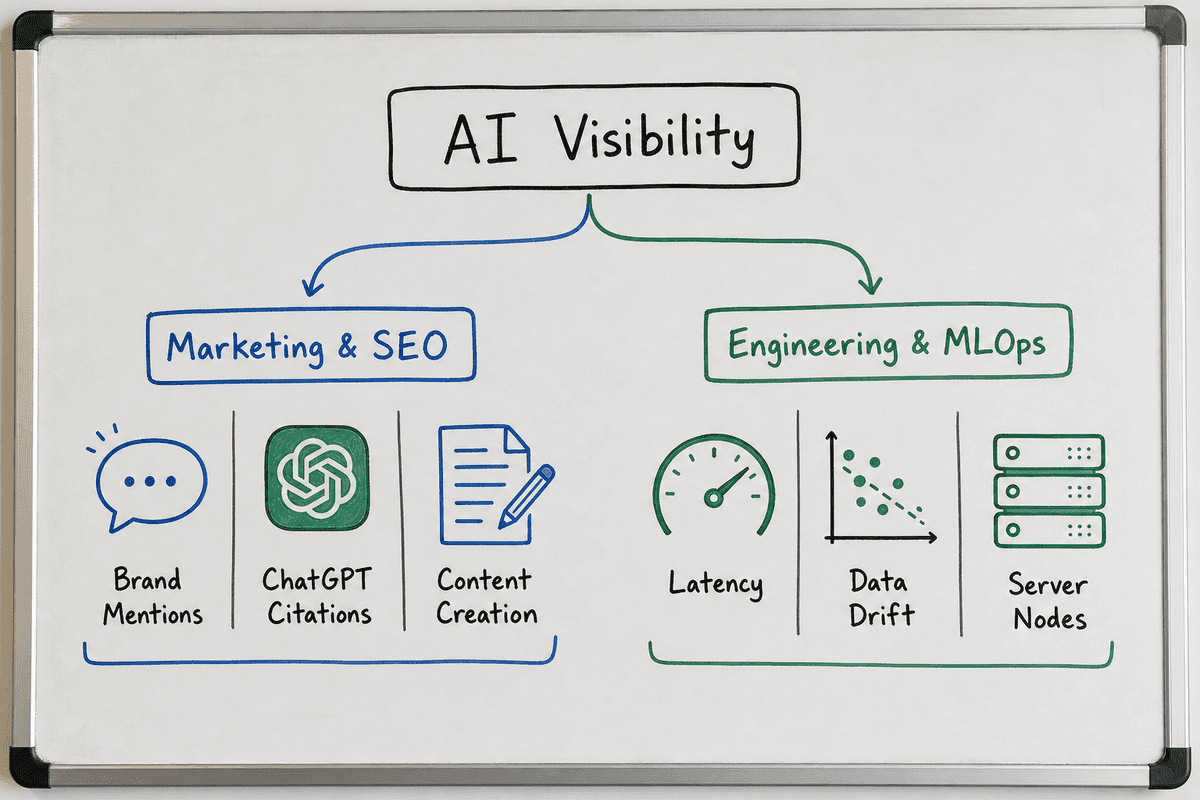
Half of the industry uses the term to describe technical AI observability—meaning the monitoring, telemetry, tracing, and governance of deploying machine learning models. The other half uses it to describe search AI visibility—meaning whether ChatGPT, Gemini, or Perplexity actually recommends your brand to buyers instead of your competitors.
If you buy a tool meant for DevOps when you actually need a tool for B2B marketing, you will waste thousands of dollars on latency dashboards when what you really needed was citation tracking.
In this guide, we break down the best Brandlight alternatives across both divides. Whether you need to monitor data drift in your proprietary LLM or you need to track how AI assistants answer buyer questions, this breakdown will help you align your tech stack with your actual business goals.
The Two Types of AI Visibility
Before signing a contract with any vendor, you need to diagnose your exact visibility problem. The market is split into two distinct categories that solve entirely different problems.
1. Search & Brand AI Visibility (The Marketing Need)
When buyers ask ChatGPT or Perplexity for software recommendations, agency reviews, or workflow solutions, they bypass traditional search engines entirely.
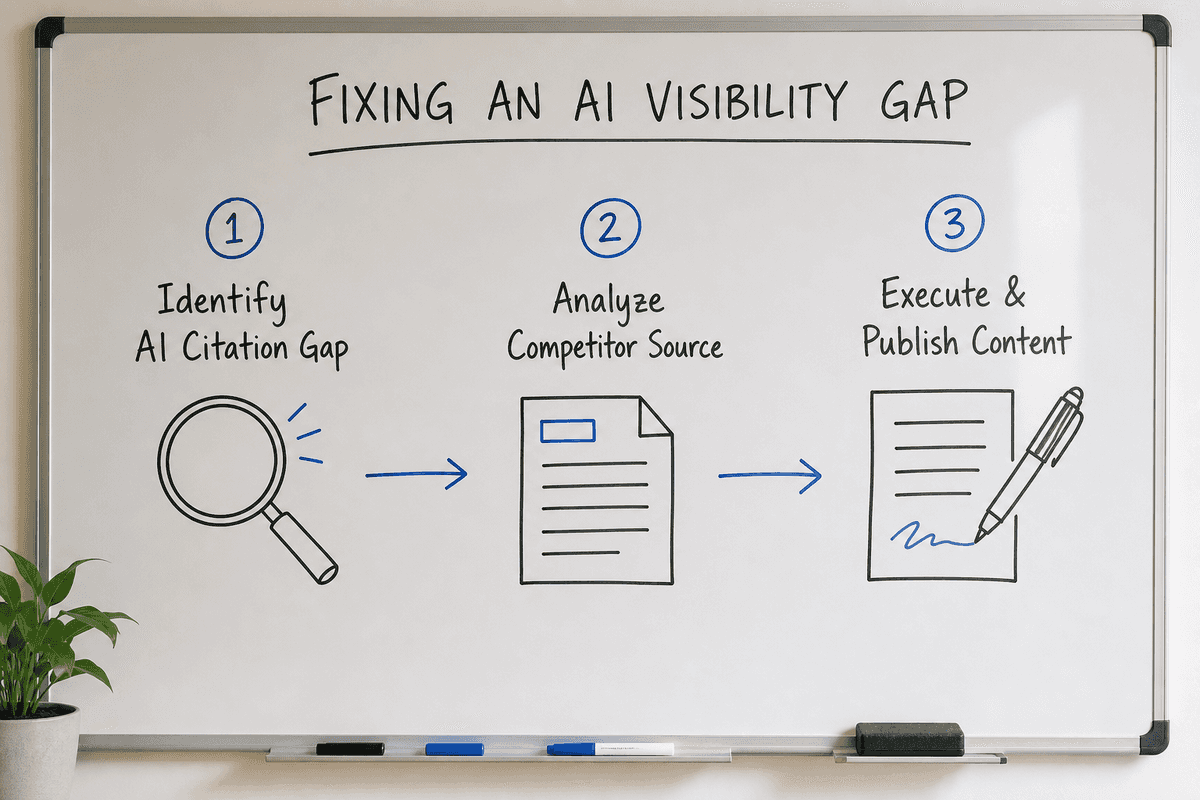
For SaaS founders, B2B marketing teams, and growth agencies, "AI visibility" means knowing exactly how those AI models respond. You need to know which brands they recommend, which URLs they cite as sources, and where the visibility gaps are so you can publish targeted content to win those citations.
2. Technical AI Observability (The Engineering Need)
If you are building and deploying AI tools, "AI visibility" means peering inside the black box of your models. Engineers need to track system health, prompt latency, token usage, data drift, and algorithmic explainability. This is the realm of APM (Application Performance Monitoring) and MLOps.
Top Alternatives for Search & Brand AI Visibility
If your goal is to influence what AI engines say about your company, technical tracing tools will not help you. You need platforms built for the new era of Retrieval-Augmented Generation (RAG) SEO—tools that track mentions, analyze citations, and turn missing coverage into actionable publishing workflows.
BeVisible: The Execution-Driven Alternative
Most rank-tracking tools simply tell you where you are invisible. BeVisible is designed to fix the problem.
BeVisible specializes in monitoring how AI assistants (like ChatGPT, Gemini, Perplexity, and AI Overviews) answer specific buyer prompts. But rather than just handing you a dashboard of missing mentions, it turns those visibility gaps into evidence-backed opportunities, content briefs, and publishing workflows.
What it excels at:
- Engine-Specific Tracking: Monitoring visibility across distinct AI ecosystems. ChatGPT pulls information differently than Gemini; BeVisible tracks the nuances of each.
- Citation Gap Analysis: Identifying exactly which sources the AI relies on to form its answers, allowing you to target those domains for PR or outrank them with better content.
- Action-Driven Output: Turning weak citations into scheduling, review, and publishing work. If ChatGPT recommends a competitor because they have a specific comparison page, BeVisible helps you structure the work to build a competing asset.
When to choose it: You are a growth team, SaaS founder, or content agency that needs to measure AI-search visibility and actively execute on the missing mentions and competitor wins. It bridges the gap between monitoring and actually building an SEO landing page that AI engines will cite.
The Cost Factor: Software vs. Agencies
Historically, companies hired PR firms or traditional search agencies to manage brand sentiment. But the shift to AI search has changed the economics. If you rely on traditional retainers to manually prompt ChatGPT and report back, you are overpaying for outdated methods.
As explored in our breakdown of SEO Charges UK: Agency Rates vs Automation (2026), leveraging an automated AI visibility platform like BeVisible drastically reduces the cost of discovery, allowing your budget to go toward actual content creation and execution.
Top Alternatives for Technical AI Observability
If your definition of AI visibility aligns with MLOps—meaning you need monitoring, observability, tracing, and governance for AI systems—Brandlight's traditional feature set likely won't cover your deep infrastructure needs.
Based on current market architecture, here are the most robust technical alternatives for model monitoring, data drift, explainability, and deployment observability.
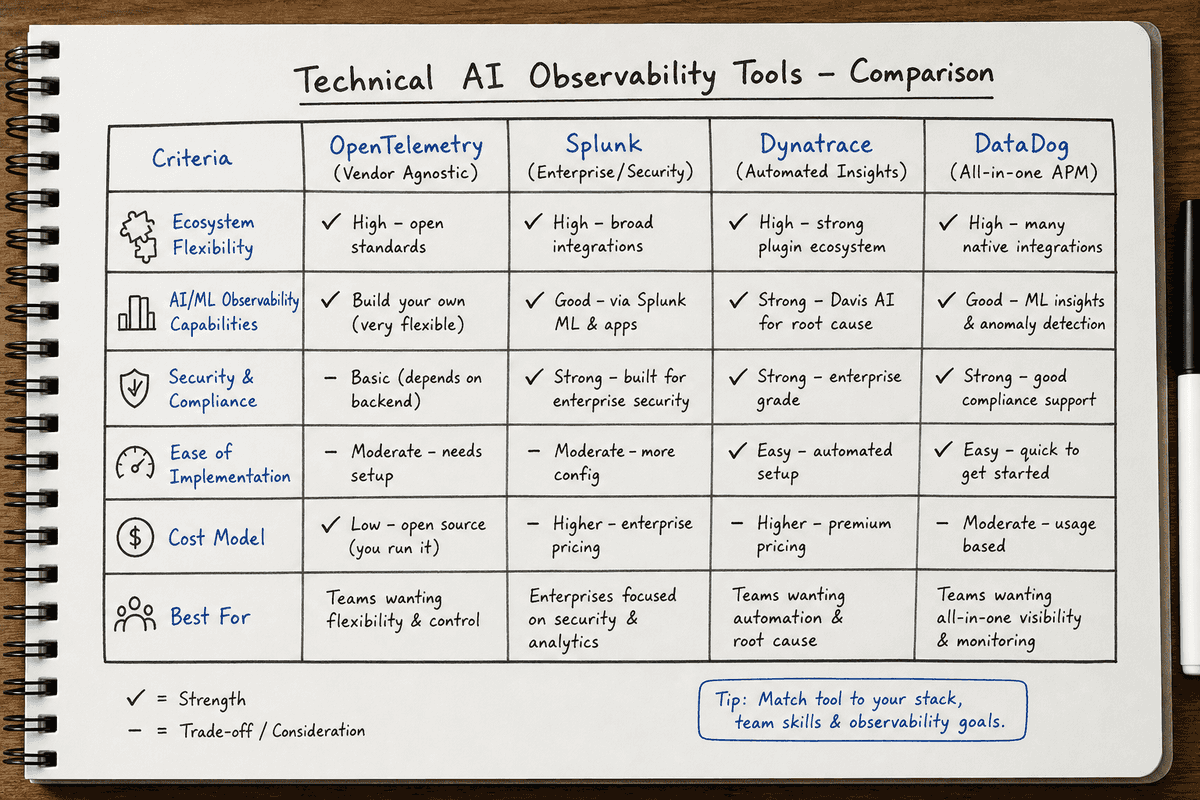
1. OpenTelemetry + Jaeger/Tempo
OpenTelemetry has become the gold standard for generating and collecting telemetry data, while Jaeger and Tempo handle the backend tracing.
- What it’s good for: End-to-end tracing and telemetry collection in microservice environments. It is completely vendor-agnostic and highly customizable.
- The technical advantage: You aren't locked into a proprietary data format. You can instrument your AI application once and route the telemetry data to any backend you choose.
- When to choose: You want flexible, open standards for distributed tracing and have the engineering resources to build and maintain a tailored observability stack.
2. Splunk APM and Splunk Observability Cloud
Splunk remains a heavyweight in enterprise environments, particularly where security and operations overlap.
- What it’s good for: Strong enterprise-grade observability, high-cardinality log correlation, and security monitoring. Splunk offers incredibly robust dashboards and alerting mechanisms for large-scale AI deployments.
- The technical advantage: It handles massive volumes of unstructured data effortlessly, making it ideal for monitoring verbose LLM prompt-and-response logs.
- When to choose: You are operating in a heavily regulated industry, already use Splunk for legacy systems, or require deep security and IT operations integration alongside your AI visibility.
3. Dynatrace
Dynatrace differentiates itself through automation, leaning heavily on its own proprietary AI (Davis) to monitor other systems.
- What it’s good for: AI-assisted anomaly detection, automated root-cause analysis, and full-stack observability with cloud-native readiness.
- The technical advantage: It requires remarkably little manual instrumentation. The platform automatically discovers dependencies and maps the topology of your AI microservices.
- When to choose: You have a complex, dynamic cloud environment and want strong automated insights with minimal manual setup and maintenance.
4. DataDog
DataDog is often the default choice for modern DevOps teams, and their expansion into AI/ML observability has been aggressive.
- What it’s good for: Comprehensive observability across apps, infrastructure, logs, and traces. It features a built-in APM specifically tuned for AI and machine learning workloads.
- The technical advantage: It provides a "single pane of glass." You can monitor the CPU usage of your GPU clusters, the latency of your API gateway, and the token count of your LLM calls in one dashboard.
- When to choose: You prefer a single platform with broad integrations, out-of-the-box AI/ML dashboards, and a relatively shallow learning curve for new engineers.
5. New Relic
New Relic offers a highly polished, developer-friendly approach to telemetry.
- What it’s good for: Unified observability with strong dashboards, deep real-user monitoring (RUM), and AI-assisted insights.
- The technical advantage: Its pricing model and unified data platform make it easy to correlate frontend user experiences (like a user waiting for an AI chat response) with backend model latency.
- When to choose: You value a polished UX, need deep insights into how end-users interact with your AI tools, and want an all-in-one telemetry platform.
6. MLflow + Prometheus/Grafana
This combination represents the classic open-source MLOps stack.
- What it’s good for: Model lifecycle management (training, deployment, packaging) coupled with lightweight, highly efficient monitoring via Prometheus and visualization through Grafana.
- The technical advantage: MLflow handles the specific nuances of model versions and parameters, while Prometheus efficiently scrapes time-series metrics.
- When to choose: You are running a dedicated data science team that needs rigorous model lifecycle management and you prefer proven, lightweight open-source monitoring tools.
Crucial Execution Failures in AI Visibility
Regardless of which side of the visibility divide you fall on, simply buying a tool does not solve the underlying business problem. Visibility without action is just expensive data storage.
Here are the most common failure modes teams experience after migrating away from legacy tools:
1. Treating AI Engines Like Traditional Search Crawlers
Many marketing teams assume that if a page ranks well on Google, it will naturally be cited by ChatGPT or Perplexity. This is a fundamental misunderstanding of how Large Language Models ingest data.
AI bots (like PerplexityBot or ChatGPT-User) often struggle with heavily scripted, dynamic websites. If your content is buried behind complex JavaScript rendering without proper server-side fallbacks, the AI simply cannot read it to cite it.
This is especially critical for SaaS companies building web apps. If you are struggling with this, refer to our SEO for Single Page Applications: A 5-Step Guide (2026) and ensure your technical foundation is sound before you try to optimize for AI citations. You can also explore Implementing SEO in Single Page Applications (3 Ways) to evaluate different rendering strategies that AI bots prefer.
2. Monitoring Without a Publishing Workflow
If your marketing tool tells you that Gemini is recommending a competitor because of a specific "Pricing Comparison" article they published, that insight is useless unless your team actually writes and publishes a better version.
Great visibility tools must connect to your execution layer. When you identify a gap, the immediate next step should be generating a content brief, scheduling the work, and getting it live. (If you're looking for inspiration on who is doing this well, check out the 11 Best SEO Blogs Every SaaS Founder Needs to see how top teams structure their content workflows).
3. Outsourcing to the Wrong Partners
As AI search optimization becomes a buzzword, many traditional agencies are rebranding themselves as "AI Visibility Experts" without actually changing their methodologies.
If you are hiring external help to manage your AI brand presence, you need to be ruthless in your vetting. Look for partners who understand RAG SEO, entity optimization, and API-driven content delivery. If an agency promises to "rank you in ChatGPT" using legacy keyword stuffing, run the other way. We highlight similar warning signs in our guide to Hiring SEO Services in Phoenix? 5 Red Flags (2026).
How to Build Your Visibility Stack in 2026
Choosing the right alternative to Brandlight requires a sober assessment of your team's capabilities and goals.
If your primary objective is technical stability: Evaluate your current cloud infrastructure. If you are heavily invested in open-source, the OpenTelemetry + Jaeger route offers the most flexibility. If you need immediate, out-of-the-box visibility with minimal configuration, DataDog or Dynatrace are your best bets.
If your primary objective is revenue and brand dominance: You need to shift your focus from server metrics to AI search citations. Implement a platform like BeVisible to track exactly what the AI assistants are telling your buyers. Identify the "Information Gain" gaps—the unique insights, proprietary data, or specific workflows that your competitors are missing—and aggressively publish content to fill those voids.
AI visibility is no longer a passive metric. It is an active battleground. The teams that simply monitor their dashboards will lose to the teams that turn those insights into published, authoritative content that AI models trust.