
Managing a single Google Business Profile is a minor administrative chore. Managing fifty locations, tracking local keyword rankings across a five-mile grid radius, and ensuring Apple Maps hasn't mistakenly pinned a client's flagship store to an abandoned lot across town is a logistical nightmare.
For over a decade, BrightLocal has been the default operating system for agencies, consultants, and multi-location brands trying to make sense of local search visibility. It built its reputation on manual citation building and highly accurate local tracking.
But the local SEO landscape has shifted dramatically. With Google's continuous updates to the Local Pack, the rise of AI-driven search behaviors, and new API-first competitors entering the market, practitioners are rightly asking: Is BrightLocal still the best local SEO platform in 2026?
In this comprehensive review, we strip away the marketing fluff to examine BrightLocal’s feature set, its real-world pricing constraints, its newest AI integrations, and how it stacks up against alternatives like Yext, Whitespark, and Moz Local.
What Is BrightLocal? (The 2026 Context)
At its core, BrightLocal is a specialized local SEO platform designed to help businesses rank higher in local search results, monitor their online reputation, and build accurate local citations (mentions of a business's Name, Address, and Phone number across directories).
Unlike broad-spectrum SEO tools that try to do everything for every type of website, BrightLocal is intensely focused on the geographic nuances of search. If you are a SaaS founder building a purely digital footprint, you might be better served learning about SEO for Single Page Applications. However, if your SaaS platform serves local businesses, or if you run a marketing agency managing brick-and-mortar clients, BrightLocal is specifically engineered for your use case.
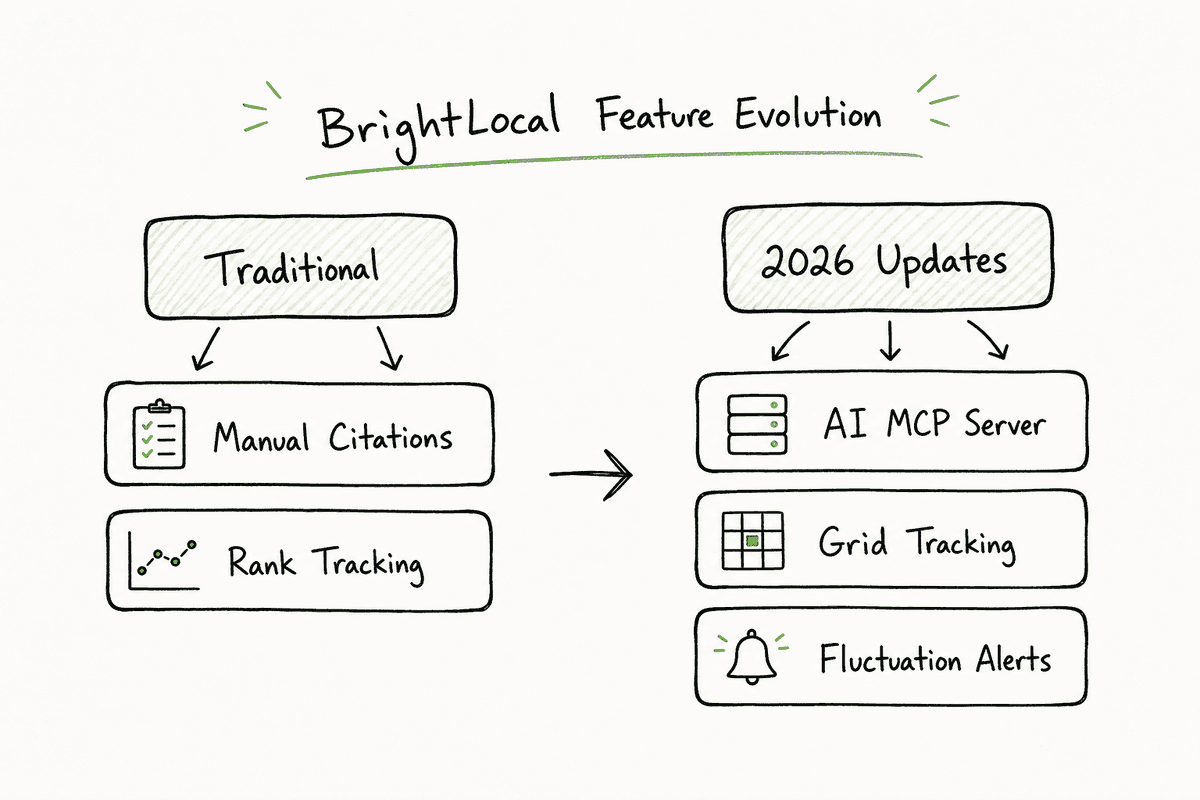
Recently, BrightLocal has aggressively modernized its stack. Beyond the traditional citation building, the 2026 iteration of the platform includes an innovative BrightLocal MCP Server—allowing agencies to talk to their local data and take action directly within their favorite AI tools—as well as advanced Rank Fluctuation Monitors and deeper Google Business Profile (GBP) auditing.
Core Features: Unpacking the BrightLocal Suite
To understand whether the tool justifies its subscription cost, we need to evaluate its primary modules. BrightLocal is effectively a bundle of five different tools unified under one dashboard.
1. Local Rank Tracking and the Local SERP Checker
Standard rank trackers tell you where you rank on a national level. Local SEO doesn't work like that. A plumber might rank #1 in the Local Pack when the searcher is standing in their zip code, but drop to #8 when the searcher is three miles down the road.
BrightLocal’s Local Rank Tracking solves this through precise geolocation.
- Grid Tracking: The platform provides visual "grid" reports, showing exactly how a business ranks across a specific geographic radius. This is visually impactful for client reporting and highlights exact neighborhoods where optimization is lagging.
- Mobile vs. Desktop: It cleanly separates mobile and desktop rankings, which is critical given that the vast majority of local intent searches ("near me") happen on mobile devices.
- Rank Fluctuation Monitor: A newer addition that alerts you to sudden drops in visibility, allowing you to react to algorithm updates or malicious competitor edits to your GBP before the client notices.
2. Citation Building and Auditing
Citations are the bedrock of local trust. If Yelp says your business opens at 9 AM, but Bing Places says 10 AM, search engines lose confidence in your data and may suppress your rankings.
BrightLocal handles citations differently than many competitors. While tools like Yext rely on API-based synchronization (which acts like a rental—stop paying, and your listings revert), BrightLocal uses a manual submission team.
- Citation Tracker: It crawls the web to find existing mentions of your business, flagging inconsistencies (e.g., an old phone number from five years ago).
- Citation Builder: You pay a per-site fee (or use credits), and BrightLocal’s team manually claims and updates the listings. The major benefit? You own these listings forever, even if you cancel your BrightLocal subscription.
- Data Aggregators: They also push your data to primary data aggregators (like Data Axle and Foursquare), which then distribute your information to hundreds of smaller directories automatically.
3. Review Monitoring and Generation
According to the Local Consumer Review Survey, star ratings keep rising in importance, and old reviews simply don't cut it anymore. Recency and volume are major ranking factors in the Local Pack.
- Centralized Monitoring: BrightLocal pulls reviews from Google, Yelp, Facebook, and dozens of niche-specific directories into a single inbox.
- Google Review Link Generator: A simple but highly effective tool that creates a frictionless, direct link for customers to leave a Google review.
- Review Campaigns: You can set up email or SMS campaigns to request reviews from recent customers, funneling happy clients to public review sites while directing unhappy clients to a private feedback form.
4. Google Business Profile (GBP) Auditing
Your Google Business Profile is arguably more important than your actual website for local search.
BrightLocal provides deep-dive GBP audits that analyze your profile against top-ranking competitors in your specific city. It checks category selections, photo counts, review velocity, and description optimization. It also flags "spammy" competitors—businesses keyword-stuffing their names (e.g., "Joe's Plumbing & 24/7 Emergency Drain Cleaning Durham")—making it easier for you to report them to Google and clear the path for your own legitimate rankings.
5. White-Label SEO Audit Reports
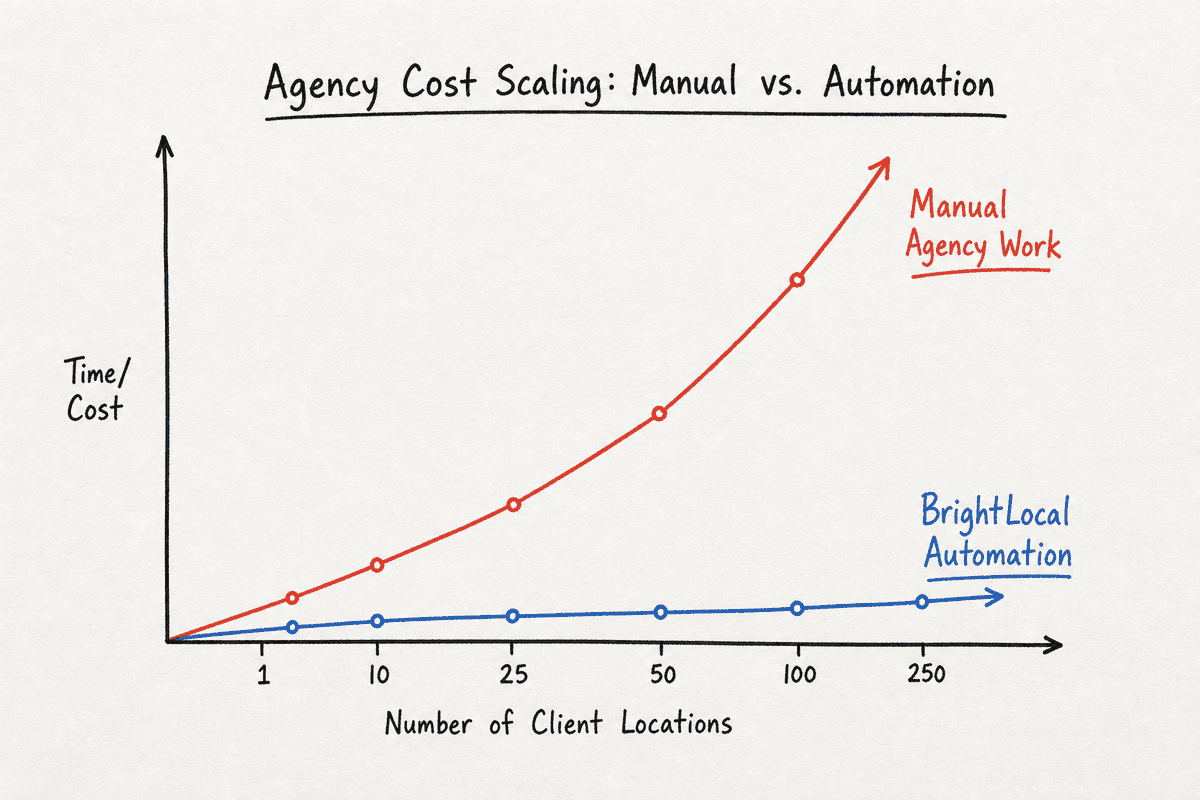
For agencies, the ability to generate automated, brandable reports is a massive time-saver. BrightLocal allows you to slap your agency logo on comprehensive location audits. These are frequently used as sales enablement tools; you can run a free audit for a prospect, show them their broken citations and poor grid rankings, and close the retainer.
As noted in our guide on SEO Charges UK: Agency Rates vs Automation, automating the reporting and auditing phase is critical for maintaining profitable margins in an agency.
The Pros: Where BrightLocal Shines
If you spend time in practitioner communities—such as the lively discussions on r/localseo—the consensus generally leans positive. Here is what keeps practitioners renewing their subscriptions.
Purpose-Built for Local SEO
Generalist tools like Ahrefs or Semrush are incredible for global keyword research and backlink analysis, but their local features are often bolted on as an afterthought. BrightLocal was built from the ground up specifically for the complexities of local search. Every feature, from the grid tracker to the review manager, is tailored for brick-and-mortar or service-area businesses.
Pricing Is Fair and Scalable
Unlike enterprise software that hides pricing behind "Book a Demo" buttons, BrightLocal is transparent. Their pricing is inherently scalable. Whether you are a single-location dentist or an agency managing 200 franchise locations, the tier structure makes sense. You aren't forced into an exorbitant contract just to access basic features.
Ownership of Citations
This cannot be overstated. By manually building citations rather than renting them via an API, BrightLocal saves businesses thousands of dollars in the long run. When an agency offboards a client, handing over permanent login credentials to local directories is a much better experience than watching the client's local presence disintegrate.
Agency-Friendly Infrastructure
The platform is heavily geared toward multi-tenant management. The white-label reporting, location dashboards, and client-friendly interfaces make it remarkably easy to justify retainer fees.
The Cons (Honestly): Where It Falls Short
No tool is perfect, and BrightLocal has a few distinct limitations that buyers need to understand before committing.
Not a Full SEO Suite
If your strategy involves heavy content marketing, national organic ranking, technical website architecture, or deep backlink profiling, BrightLocal will not suffice. It does not replace standard SEO tools. If you are building robust service pages, you will still need external tools to guide your SEO landing page architecture.
Citation Building Takes Time
Because BrightLocal relies on manual submission teams for citations, the process isn't instant. If a client rebrands or moves locations and needs their address updated across the web today, BrightLocal isn't the fastest route. Manual submissions can take weeks to fully process and go live across all directories.
No Social Media Management
While BrightLocal handles Google Business Profile posts reasonably well, it is not a social media management tool. You cannot schedule Instagram reels, TikToks, or complex multi-channel social campaigns from the platform. It is strictly search-and-reputation focused.
Learning Curve for Beginners
The dashboard is dense. While the data is incredibly valuable, a small business owner logging in for the first time might be overwhelmed by terms like "data aggregators," "NAP consistency," and "citation matrices." It is built more for marketers than for the average shop owner.
BrightLocal vs. The Alternatives in 2026
How does BrightLocal compare to the rest of the market? According to industry comparisons on sites like StrongSites and Research.com, the local SEO software space is highly segmented.
BrightLocal vs. Yext
Yext is the giant in the room, famous for its instant API-sync technology.
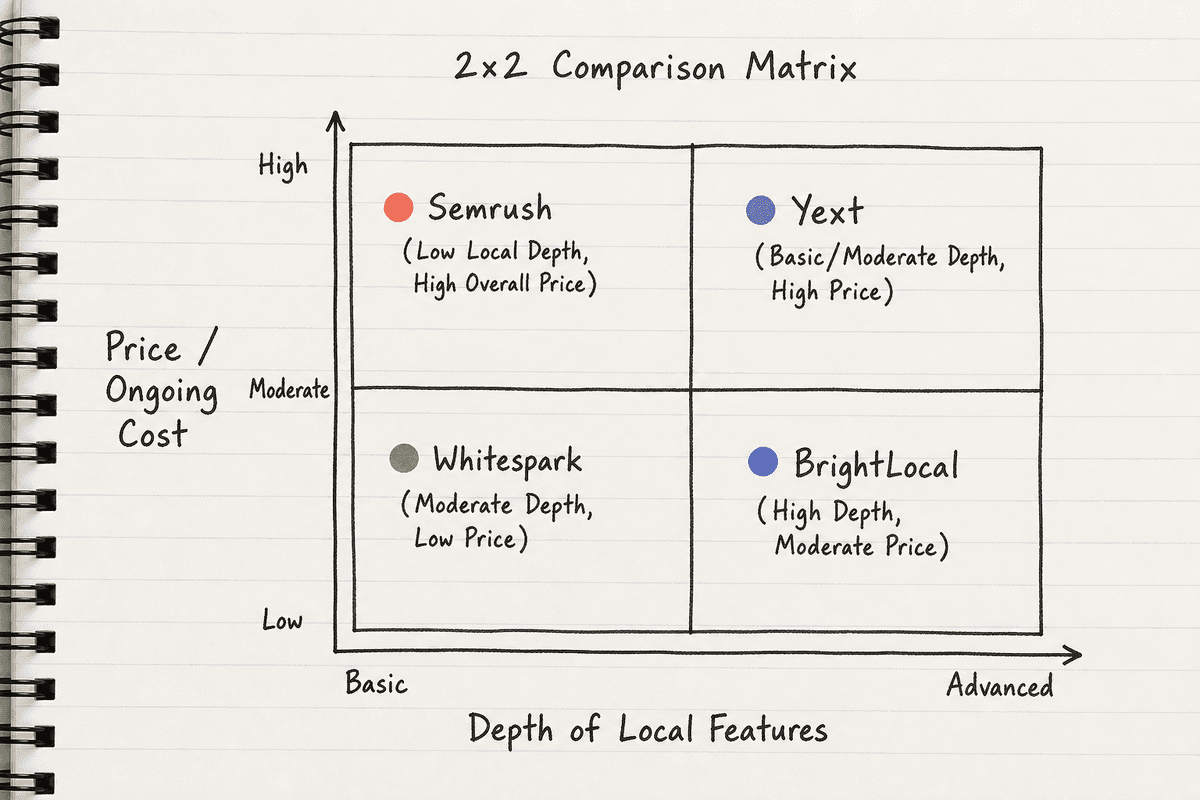
- The Difference: Yext updates your listings instantly across its network. However, you pay a steep annual fee per location. If you cancel Yext, the API connection breaks, and your listings often revert to their pre-Yext state. BrightLocal uses manual submissions; it takes longer, but you own the listings forever.
- The Verdict: Yext is better for massive enterprise brands (like a national bank with 1,000 branches) that need instant menu or holiday hour updates. BrightLocal is better for SMBs and agencies wanting permanent assets.
BrightLocal vs. Whitespark
Whitespark is BrightLocal's closest philosophical competitor. Both focus heavily on manual citation building and local rank tracking.
- The Difference: Whitespark's Local Citation Finder is arguably slightly more robust for uncovering niche, hyper-local directories. However, BrightLocal’s all-in-one dashboard (including review management and GBP auditing) is generally considered more cohesive.
- The Verdict: BrightLocal offers a better all-in-one suite, while Whitespark is fantastic if you only need a specialized citation and tracking utility.
BrightLocal vs. Moz Local
Moz Local operates similarly to Yext, acting as a data aggregator sync tool rather than a manual builder.
- The Difference: Moz Local is incredibly easy to use and has a very clean interface, but it suffers from the same "rental" problem as Yext. Furthermore, its reporting lacks the granular depth of BrightLocal's grid tracking.
- The Verdict: BrightLocal offers vastly superior tracking and auditing depth compared to Moz Local.
BrightLocal vs. Semrush (Local Module)
Semrush recently bolstered its local offerings, largely by white-labeling Yext's backend for its Listing Management tool.
- The Difference: Semrush is a global SEO powerhouse. If you already pay for Semrush for broad organic research, adding their local module is convenient. However, it lacks BrightLocal's specialized manual citation services and deep local community focus.
- The Verdict: Use Semrush if you want everything in one platform and prioritize national SEO. Use BrightLocal if local SEO is the primary driver of revenue.
Who Is BrightLocal Best For?
Based on its strengths and constraints, here is who should be subscribing in 2026:
- Marketing Agencies and Consultants: This is BrightLocal's core demographic. If you run one of the Top 7 Agencies for SEO in Durham (or anywhere else), the white-label reporting, margin-friendly citation pricing, and automated lead-gen widgets are indispensable.
- Multi-Location Brands: Regional franchises with 5 to 50 locations will find BrightLocal’s location dashboard perfect for managing reputation and tracking grid rankings without paying enterprise Yext prices.
- Local SaaS Platforms: If you are building software for local businesses (e.g., booking software for salons), integrating BrightLocal's API or utilizing their MCP Server can add immense value to your own users.
Who Should Look Elsewhere? Single-location e-commerce brands, global SaaS tools, and digital-only publishers do not need BrightLocal. If your business model involves selling Etsy SEO tools to a global audience, your money is better spent on Ahrefs or BeVisible's automated content generation.
Practical Framework: Setting Up Your First Campaign
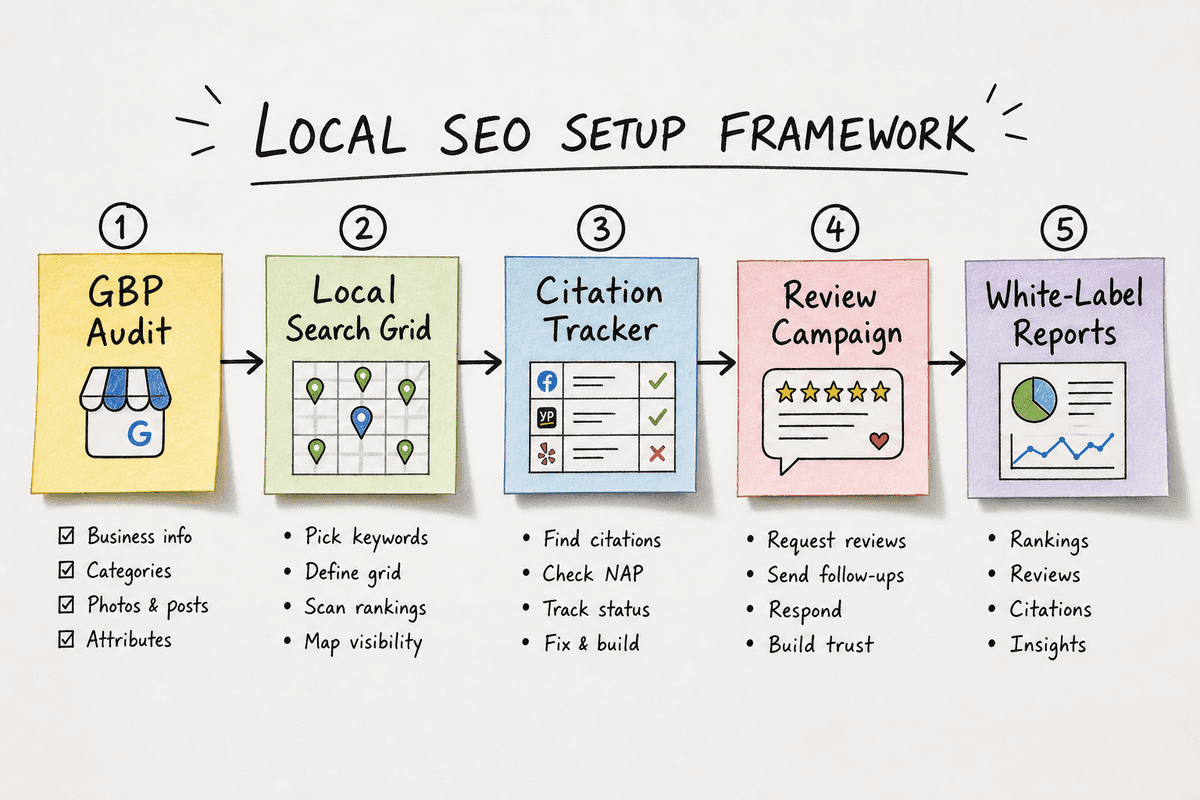
If you decide to move forward with BrightLocal, don't just dump all your clients in at once. Use this systematic approach to onboard a location effectively.
Step 1: Run the Baseline GBP Audit
Connect the client's Google Business Profile to BrightLocal. Run the automated audit to establish a baseline. Look specifically for missing primary categories, empty Q&A sections, and low-quality images.
Step 2: Configure the Local Search Grid
Set up the rank tracker using a 3x3 or 5x5 mile grid around the business's physical address. Input their top three money keywords (e.g., "emergency plumber near me"). This creates the visual "before" picture you will show the client in three months.
Step 3: Trigger the Citation Tracker
Run a scan to find existing NAP (Name, Address, Phone) inconsistencies. Create a spreadsheet of the crucial Tier 1 aggregators (Data Axle, Foursquare) and Tier 2 directories (Yelp, Bing) that have incorrect data.
Step 4: Launch a Review Campaign
Upload a list of the client's recent satisfied customers into the Review Generation tool. Set up a simple two-step SMS or email sequence asking for feedback, linking directly to the Google Review form.
Step 5: Schedule Monthly White-Label Reports
Configure BrightLocal to automatically generate a PDF report on the 1st of every month, featuring the updated Rank Grid, new reviews acquired, and citations fixed. Send this automatically to the client to prove ongoing ROI and avoid the headaches commonly associated with poor agency communication (a major issue noted in our guide on Hiring SEO Services in Phoenix? 5 Red Flags).
Final Verdict: Does BrightLocal Still Dominate?
Yes. In 2026, BrightLocal remains the most practical, cost-effective, and feature-rich platform specifically dedicated to local SEO.
While AI is changing how content is generated, the fundamental pillars of local search—proximity, prominence, and relevance—still require meticulous management of data aggregators, citations, and reviews. BrightLocal handles the unglamorous, tedious backend of local SEO better than anyone else, freeing up practitioners to focus on strategy and client relationships.
If local search is a meaningful part of your revenue, or your clients' revenue, BrightLocal is not just a tool; it is operational infrastructure. It remains the standard to beat.