
If a buyer complains about your software on Twitter, an alert pops up on your screen within seconds. But what happens when a procurement manager asks ChatGPT to recommend the top three tools in your category, and your brand is entirely omitted from the output?
For most B2B marketing teams, the answer is nothing.
Traditional brand monitoring and reputation management platforms like Evertune have long been the gold standard for social listening, sentiment analysis, and online brand risk. They scrape forums, analyze social media chatter, and monitor news publications. But as buyer behavior shifts away from traditional search engines and social networks toward AI assistants like Perplexity, ChatGPT, and Google’s AI Overviews, a massive visibility gap has emerged.
Today, you don't just need to know what angry customers are tweeting; you need to know what AI models are telling your prospects.
This article breaks down the best Evertune alternatives on the market in 2026. We will explore the top traditional social listening tools that match Evertune’s core capabilities, and more importantly, introduce the next generation of AI brand monitoring platforms designed to track, measure, and execute on AI answer engine visibility.
The Fallacy of "AI-Powered" vs. "AI Monitoring"
Before diving into the alternatives, we need to address a critical point of confusion in the monitoring software market: the difference between AI-powered analytics and AI answer engine monitoring.
When you read the feature pages for legacy monitoring tools, nearly all of them claim to be "AI brand monitoring tools." What they usually mean is that they use Artificial Intelligence on the backend to process data. They use natural language processing (NLP) to determine if a tweet is happy or sad (sentiment analysis), or they use image recognition to spot your logo in a TikTok video.
That is not the same thing as monitoring AI engines.
 Monitoring AI engines means actively tracking how Large Language Models (LLMs) perceive, recommend, and cite your brand when users prompt them with buying questions.
If you are evaluating Evertune alternatives, you must ask yourself what you are actually trying to solve:
- Are you trying to upgrade your social listening and crisis management? (You need a traditional alternative like Brandwatch or Meltwater).
- Are you trying to see how ChatGPT and Perplexity are answering buyer questions about your niche? (You need a dedicated AI visibility execution tool like BeVisible).
Let’s explore the best options for both scenarios.
Top 7 Traditional Evertune Alternatives (The Baseline)
If your primary goal is to replicate or upgrade Evertune's core functionality—monitoring social media, blogs, newsrooms, and forums for brand mentions and risk—these seven platforms are the industry leaders. They offer robust data sets, enterprise reporting, and AI-assisted analytics.
1. Brand24
Brand24 is one of the most accessible and widely used social listening tools on the market. It excels at real-time monitoring across social media platforms, blogs, video networks, forums, and podcasts. For teams that find Evertune too complex or expensive, Brand24 offers a highly intuitive dashboard that gets you up and running in minutes.
Core Strengths:
- Volume Tracking: Excellent at spotting sudden spikes in brand mentions, making it a great early-warning system for PR crises.
- Influencer Detection: Automatically assigns an influencer score to the users mentioning your brand, helping you identify advocates or high-risk detractors.
- Sentiment Analysis: Uses machine learning to categorize mentions into positive, negative, or neutral buckets.
Best For: Mid-market SaaS companies and agencies that need reliable, fast, and shareable reporting without an enterprise price tag.
The Blind Spot: Brand24 is strictly focused on public web and social data. It cannot tell you if Claude 3.5 is recommending your competitor instead of you.
2. Mention
Mention functions exactly as its name suggests—it tracks who is mentioning you, where, and in what context. It bridges the gap between social listening and basic web monitoring, offering multi-language support that makes it ideal for global brands.
Core Strengths:
- Multi-Language Monitoring: Highly effective for brands operating across European and Asian markets, picking up local nuances that other tools miss.
- Competitive Benchmarking: Makes it easy to set up "Share of Voice" dashboards comparing your brand's volume against three or four competitors.
- Publishing Capabilities: Unlike Evertune, Mention includes basic social media publishing tools, allowing you to respond to mentions directly from the interface.
Best For: Distributed teams and global brands that need a localized understanding of brand sentiment.
The Blind Spot: Mention relies heavily on RSS feeds, web scraping, and API access to social networks. As platforms lock down their APIs (like Reddit and X), data fidelity has become a challenge.
3. Sprout Social (Advanced Listening)
Sprout Social is primarily known as a social media management and publishing platform, but its Premium Listening add-on is a formidable Evertune alternative. It combines the operational workflow of managing social accounts with deep, query-based listening.
Core Strengths:
- Unified Workflow: Your social media managers don't have to switch between a listening tool and a publishing tool; it's all in one unified inbox.
- Audience Demographics: Provides deep insights into the age, location, and interests of the people discussing your brand.
- Team Collaboration: Superior routing rules allow you to flag a negative mention and assign it instantly to customer support or legal.
Best For: Large marketing teams that want to consolidate their tech stack and keep social publishing, customer care, and brand monitoring under one roof.
The Blind Spot: It is heavily biased toward social media. While it pulls in some web articles, it is not a comprehensive media monitoring tool, nor does it address AI search engine visibility.
4. Brandwatch (Now part of Cision)
Brandwatch is the enterprise heavyweight. If you are migrating away from Evertune because you need more data, deeper analytics, and custom integrations, Brandwatch (formerly Crimson Hexagon) is the logical step up.
Core Strengths:
- Historical Data: Offers access to years of historical social data (particularly from X/Twitter and Reddit), allowing you to analyze long-term brand trends.
- Topic Modeling: Its AI backend can identify emerging themes and topics within millions of mentions without you having to pre-define the keywords.
- Vizia Dashboards: Offers command-center-style data visualization that looks great on screens in the marketing department.
Best For: Fortune 500 companies, enterprise SaaS, and global PR agencies dealing with millions of data points a month.
The Blind Spot: The learning curve is steep, the price tag is massive, and setup often requires dedicated onboarding engineers.
5. Talkwalker
Talkwalker is a global media monitoring and social listening platform that leans heavily into visual intelligence. While most tools read text, Talkwalker excels at "watching" images and video.
Core Strengths:
- Visual Listening: Its AI image recognition can scan millions of images and videos across the web to find your brand logo, even if the user didn't mention you in the text caption.
- Global Reach: Covers 187 languages and claims to monitor over 150 million data sources.
- Automated Reporting: Strong automated insights that send executive-ready reports straight to your inbox.
Best For: Hardware brands, event sponsors, and consumer-facing B2B brands where logo visibility in imagery is a key KPI.
6. Meltwater
Meltwater approaches brand monitoring from a traditional Public Relations (PR) and media communications background. If your main concern is tracking how Tier 1 publications, industry blogs, and news outlets cover your brand, Meltwater is often preferred over Evertune.
Core Strengths:
- Journalist Database: Includes a massive directory of journalists and influencers, allowing you to not just monitor the news, but actively pitch the people writing it.
- Media Impact Scoring: Goes beyond simple mention counting to calculate the actual PR value and reach of an article.
- Newsroom Integrations: Deep integration with traditional media wires and press release distribution networks.
Best For: PR teams, corporate communications directors, and investor relations teams who prioritize editorial coverage over social media chatter.
7. NetBase Quid
NetBase Quid is built for market researchers and consumer insights teams. It focuses on contextualizing data—understanding why people are saying things, rather than just counting how many people are saying them.
Core Strengths:
- Deep Semantic Analysis: Uses advanced NLP to understand complex sentence structures, sarcasm, and slang better than rudimentary sentiment trackers.
- Market Mapping: Can visually map out industry trends, showing how different concepts, competitors, and products relate to each other in the minds of consumers.
- Competitive Intelligence: Excellent for analyzing a competitor's product launch to see exactly what features the market loves or hates.
Best For: Product marketing managers and market research firms looking to guide product development based on public feedback.
The Missing Metric in Traditional Tools: AI Answer Engine Visibility
If you implement any of the seven tools above, you will have exceptional visibility into what humans are saying about you on social media, in forums, and in the press.
But here is the critical failure mode of the modern B2B tech stack: Buyers are no longer asking humans. They are asking AI.
Consider a standard B2B buying journey today. A VP of Engineering isn't going to Twitter to ask for a list of single-page application frameworks. They aren't going to Reddit to evaluate SEO tools.
Instead, they open Perplexity, ChatGPT, or Google's AI Overview and type: "What are the most reliable enterprise SEO tools for single-page applications, and how do their technical features compare?"
The AI model parses its training data, browses the live web, synthesizes a response, and outputs a neatly formatted list of three recommended vendors, complete with pros, cons, and citations.
 If your brand is not on that list, you have lost the sale before you even knew the prospect was looking. And here is the terrifying part for marketing teams relying solely on traditional Evertune alternatives:
Brandwatch will not alert you to this. Meltwater will not flag it. Sprout Social does not track it.
Traditional tools monitor the publicly accessible, indexable web (social feeds, blogs, news). AI chats are private, ephemeral, one-to-one sessions between a user and an LLM. You cannot "scrape" ChatGPT to see how many times it mentioned your brand today.
You have to monitor the model's behavioral outputs across specific, high-intent buyer prompts.
BeVisible: The Evertune Alternative for AI Search Execution
If you want to protect your brand and monitor your visibility in 2026, you must track the AI engines. This is exactly what BeVisible was built to do.
BeVisible is not a social listening tool; it is an AI visibility monitoring and execution platform. It helps SaaS founders, B2B marketing teams, and content agencies monitor how AI assistants answer buyer questions, which brands they recommend, and which sources they cite.
How BeVisible Closes the Evertune Gap
Instead of tracking mentions on X or LinkedIn, BeVisible tracks ChatGPT, Gemini, Perplexity, AI Mode, and Google AI Overviews across your most critical buyer prompts.
Here is how the workflow functions differently from legacy tools:
1. Prompt-Based Monitoring vs. Keyword Scraping
Traditional tools scrape the web for the keyword "YourBrand." BeVisible actively queries the major AI models with the questions your buyers are asking, such as: "What are the top alternatives to [Competitor]?" or "Which platforms are best for [Niche Use Case]?"
2. Tracking Recommendations and Citations
BeVisible analyzes the AI's response to determine:
- Did the AI recommend your brand?
- Did it recommend your competitors?
- What specific features, pros, or cons did the AI associate with your product?
- Crucially: What external sources (articles, blogs, documentation) did the AI cite to formulate that answer?
3. Turning Visibility Gaps into Published Work
This is where BeVisible truly separates itself from passive monitoring tools. A tool like Evertune gives you a dashboard and leaves you to figure out what to do next.
BeVisible turns missing mentions and weak citations into evidence-backed execution. If Perplexity recommends your competitor because it cited an outdated Reddit thread, BeVisible highlights the visibility gap and provides the contextual evidence needed to create corrective content—whether that means publishing a new technical article, updating your SEO landing page, or launching a targeted review campaign.
The Mechanics of AI Recommendations: Why Content Matters
To understand why BeVisible focuses heavily on execution (articles, scheduling, and publishing work), you have to understand how LLMs formulate their answers.
AI engines do not have personal opinions. They generate recommendations based on:
- Training Data Weight: How often your brand is contextually associated with a concept in their baseline training data.
- Live Web Retrieval (RAG): When an AI searches the live web to answer a prompt, it relies heavily on high-authority, semantically rich content.
If you want to influence ChatGPT, you cannot just run a social media ad campaign. You have to publish deep, authoritative, technically sound content that AI models can read, understand, and cite.
For example, if you are a SaaS company struggling to get AI models to recommend you for complex web architectures, you don't need a PR blast. You need highly specific, expert-led content. A piece like Implementing SEO in Single Page Applications (3 Ways) or a Technical Checklist for Single Page Application SEO acts as prime "feed" for an AI model looking to cite authoritative sources.
BeVisible identifies exactly what content you need to write to capture the AI's attention for specific prompts.
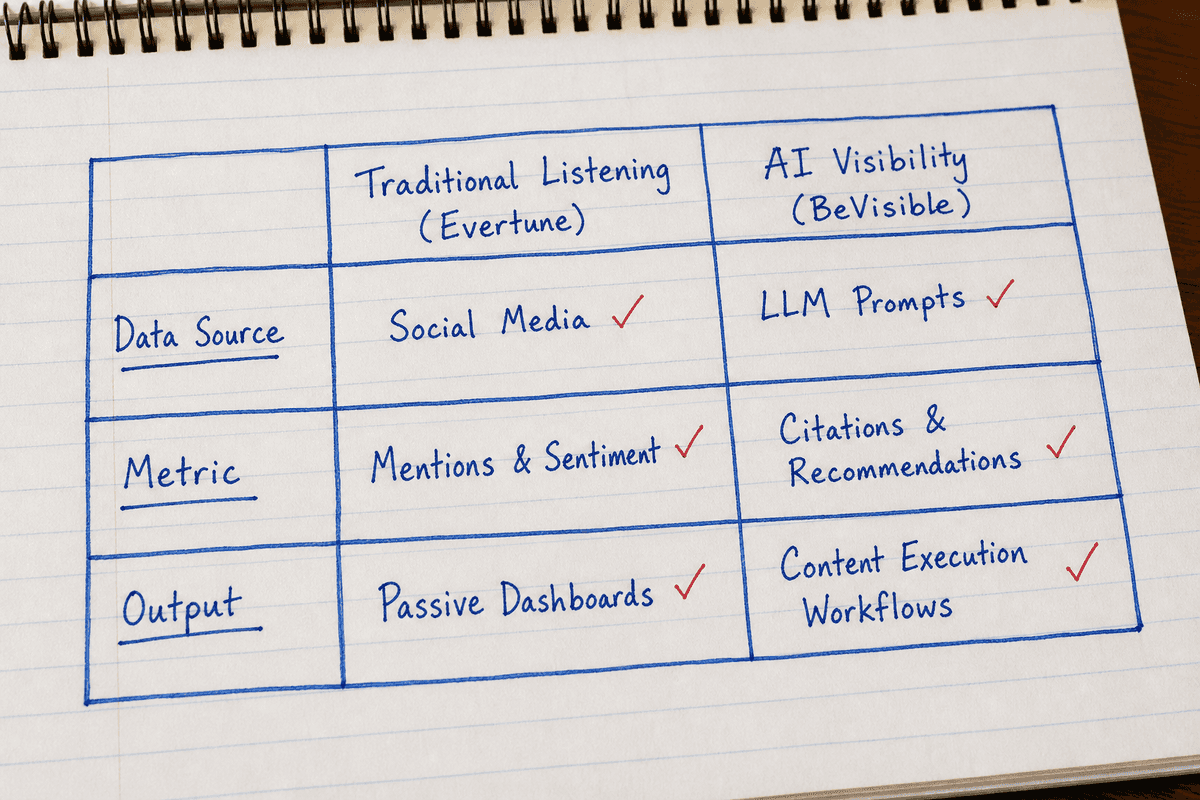
Comparison Table: Traditional Monitoring vs. AI Visibility
To make the distinction clear, let's look at a feature-by-feature comparison of how traditional Evertune alternatives stack up against a dedicated AI visibility platform like BeVisible.
4 Steps to Build a Future-Proof Brand Monitoring Stack
So, do you completely abandon social listening and only monitor AI engines?
No. The most sophisticated B2B marketing and growth teams in 2026 are running a bifurcated, hybrid tech stack. They use a traditional tool for crisis management and human sentiment, and an AI execution tool for pipeline generation and search visibility.
Here is a step-by-step framework for building a modern monitoring stack.
Step 1: Audit Your Buyer Journey
Before buying any software, map out how your buyers actually find you.
- Are they influenced by viral Twitter threads and LinkedIn thought leadership?
- Are they highly technical buyers who research tools via Perplexity and specialized SEO blogs?
- Are they relying on local searches (e.g., searching for "Top agencies for SEO in Durham")?
Understanding the touchpoints dictates where you need visibility.
Step 2: Select a "Base Layer" for Social and News
Choose one of the traditional Evertune alternatives to serve as your defensive base layer.
- If budget is a major concern, start with Brand24.
- If PR and newsroom tracking is your priority, go with Meltwater.
- If you want an all-in-one social management tool, choose Sprout Social.
Set up alerts for your brand name, key executives, and major competitors. This handles your immediate PR crisis monitoring.
Step 3: Implement an "Execution Layer" for AI Search
Next, implement BeVisible to serve as your offensive execution layer.
Instead of keyword matching, compile a list of the top 50 "high-intent" prompts your buyers use. These are the queries that indicate someone is ready to buy (e.g., "Best automated [Category] tools for enterprise," or "Compare [Competitor A] vs [Competitor B]").
Feed these prompts into BeVisible to establish your baseline AI visibility score. You will immediately see where ChatGPT and Gemini are leaving you out of the conversation.
Step 4: Create the Feedback Loop
Data without execution is just overhead. The final step is building a workflow that turns monitoring insights into published assets.
If BeVisible shows that Perplexity is consistently recommending your competitor because it cites their pricing page, your execution step is clear: you need to build a more comprehensive, transparent pricing guide. If the AI model hallucinates a limitation about your software (e.g., falsely claiming your platform lacks an API), your content team must publish highly optimized documentation addressing that exact limitation to retrain the model's retrieval system.
This workflow turns monitoring from a passive "cost center" into an active revenue driver.
A Case Study in Resource Allocation: Agencies vs. Automation
Let’s ground this in a practical scenario. Marketing budgets are finite. When a company is evaluating monitoring tools, they are often comparing the cost of software against the cost of human capital.
Consider the landscape of SEO charges in the UK or the US. An agency might charge thousands of dollars a month to manually check search engine rankings and monitor brand sentiment.
If you are paying an agency solely to monitor traditional SERPs (Search Engine Results Pages) and social mentions, you are paying for an incomplete service. The landscape has shifted. If your agency is not using tools like BeVisible to track AI Overviews and LLM citations, their reports are missing a massive chunk of the buyer journey.
When hiring external help—whether you are looking at national firms or looking into hiring SEO services in Phoenix—one of the biggest red flags in 2026 is an agency that cannot articulate their AI visibility strategy. Your software stack and your agency partners must be aligned on the reality of AI-driven search.
Edge Cases and Nuance in AI Monitoring
It is important to acknowledge the limitations and nuances of the current AI ecosystem. AI monitoring is not a perfect science, and platforms claiming 100% deterministic control over LLMs are overpromising.
1. Hallucinations vs. Hard Truths Sometimes an AI model will recommend a competitor simply because the LLM hallucinated. BeVisible helps identify these hallucinations so you can counteract them with factual, easily parsed content (like tables and lists), but fixing a hallucination requires sustained content publication, not a quick settings toggle.
2. The Client-Side Rendering Problem If your website relies heavily on client-side rendering (like many SaaS apps), AI web crawlers (like ChatGPT's browsing bot) may struggle to read your content in real-time. You can have the best content in the world, but if the bot can't render the JavaScript, it can't cite you. This is why mastering SEO for single page applications is a prerequisite for good AI visibility. You must ensure your technical foundation allows AI bots to efficiently crawl and index your site.
3. Niche vs. Mainstream Recognition LLMs tend to favor massive, mainstream brands because they appear more frequently in the training data. If you are a niche player (for example, creating specialized Etsy SEO tools), you have to work twice as hard to build semantic relevance. You can't rely on broad brand awareness; you must rely on hyper-specific, highly optimized content hubs that answer long-tail questions perfectly.
Frequently Asked Questions (FAQs)
Can Evertune or Brandwatch track ChatGPT mentions?
No. Traditional social listening tools rely on APIs and web scrapers to read publicly accessible content like tweets, Reddit posts, and news articles. ChatGPT, Gemini, and Claude user sessions are private. To track AI visibility, you need a specialized platform like BeVisible that actively queries the models with buyer prompts to analyze their output behavior.
What is the difference between AI sentiment analysis and AI search monitoring?
AI sentiment analysis (used by tools like NetBase Quid or Talkwalker) uses artificial intelligence to read human-written posts and determine if the author is happy, angry, or neutral. AI search monitoring (like BeVisible) tracks what the AI models themselves are generating and recommending when users ask them questions.
Is traditional social listening dead?
Absolutely not. Social listening is essential for PR crisis management, customer support routing, and real-time event monitoring. If your server goes down, angry customers will flock to X/Twitter, not ChatGPT. You need traditional listening for real-time human chatter, and AI monitoring for the long-term, high-intent B2B buying journey.
How long does it take to fix an AI visibility gap?
Unlike traditional SEO, which can take months to show results, AI retrieval-augmented generation (RAG) models can sometimes cite new content within days of it being indexed by a search engine. However, fundamentally changing how an LLM inherently "understands" your brand based on its core training weights requires a sustained content strategy over multiple quarters.
The New Standard for Brand Protection
The definition of brand monitoring has fundamentally changed. Just a few years ago, protecting your brand meant ensuring nobody was saying terrible things about you on social media. Today, protecting your brand means ensuring AI answer engines actually know who you are, what you do, and why you are the best choice for the buyer.
Traditional Evertune alternatives like Brand24, Brandwatch, and Mention remain incredibly valuable for PR and social management. But they are only half of the equation.
If you are a B2B SaaS founder, a growth marketer, or a content agency, you cannot afford to have a blind spot where your buyers are making their most critical decisions. By integrating an AI visibility execution platform like BeVisible into your tech stack, you can finally monitor the prompts that matter, uncover the visibility gaps costing you pipeline, and turn missing citations into targeted, revenue-driving content.
The future of search isn't a list of blue links; it's a direct answer. Make sure your brand is the one being recommended.```