
When modern buyers evaluate B2B software, consumer products, or enterprise services, their first stop is no longer just a traditional Google search or a social feed. Instead, buyers open ChatGPT, Perplexity, Gemini, or Google AI Overviews and ask direct questions: "What are the top CRM tools for mid-market teams?" or "Which security platforms integrate seamlessly with AWS?"
If your brand is mentioned—and recommended—in those AI answers, you gain immediate authority. If your competitors appear while your brand is omitted, you lose pipeline long before a prospect ever visits your website. This shift has forced marketing and growth teams to re-evaluate their brand monitoring stack.
While legacy tools like Evertune and traditional social listening platforms focused heavily on social media mentions, web press releases, and general sentiment analysis, modern brand monitoring requires an entirely new capabilities matrix. You need software that tracks how AI models answer buyer prompts, pinpoints the third-party sources AI engines cite, and provides a clear playbook to fix visibility gaps.
This guide breaks down the leading alternatives to Evertune for brand monitoring, comparing traditional social listening platforms with next-generation AI visibility platforms. We examine features, trade-offs, pricing dynamics, and implementation strategies to help you choose the right solution for your growth team.
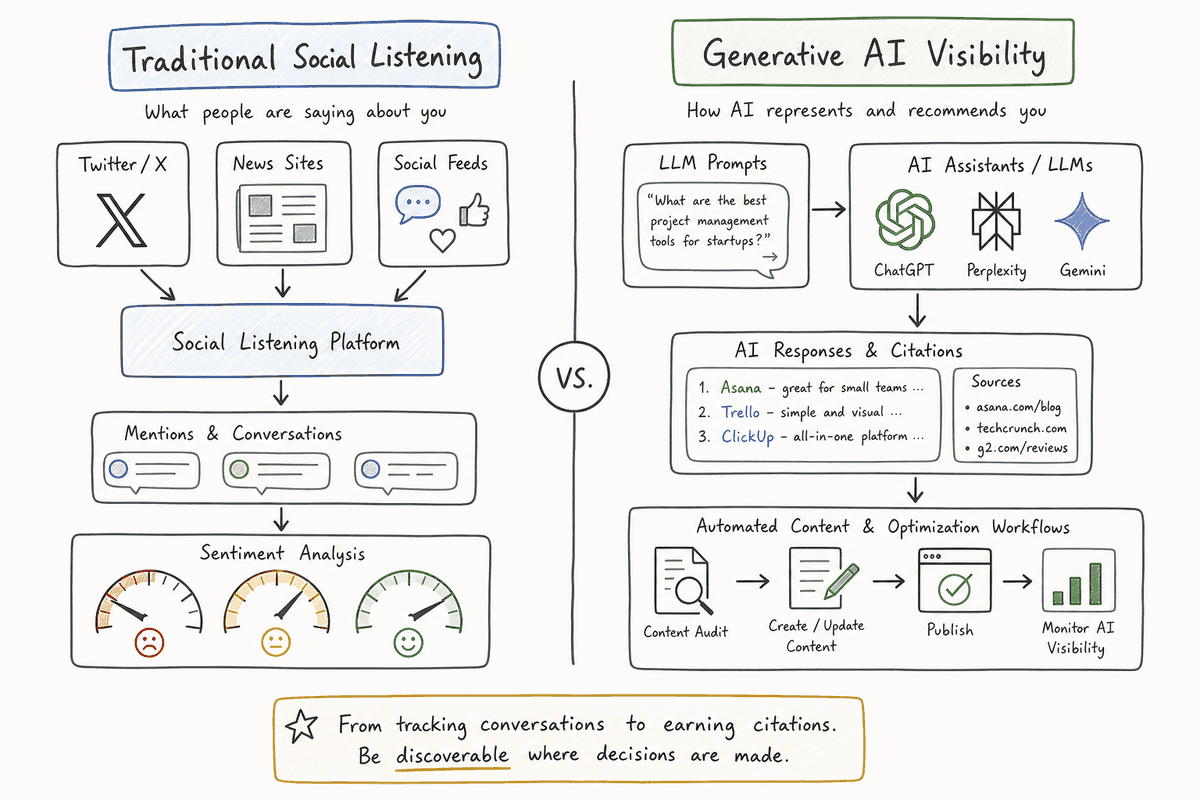
Social Listening vs. Generative AI Visibility: What Changed?
To choose the right monitoring platform, you must first understand the fundamental split in the market between traditional web listening and AI engine visibility tracking.
Historically, brand monitoring platforms tracked public web pages, news outlets, Twitter/X, Reddit, and blogs to detect where your brand name appeared. They measured sentiment (positive, negative, neutral) and volume over time. While this remains valuable for PR risk management and social engagement, it leaves a massive blind spot in buyer discovery.
AI assistants like ChatGPT, Claude, Gemini, and Perplexity do not simply report web mentions. They synthesize information from hundreds of web sources to generate structured answers, direct recommendations, and vendor shortlist tables.
Here is how traditional media monitoring differs from AI search visibility monitoring:
Legacy platforms alert you after someone tweets about your product. Generative AI monitoring platforms reveal what AI models tell prospective buyers before those buyers ever reach out to sales.
Top Alternatives to Evertune for AI Brand Monitoring
Whether you need deep PR sentiment analysis across social networks or end-to-end prompt visibility tracking across major AI models, the following alternatives offer tailored capabilities for different organizational needs.
1. BeVisible
Best for: SaaS founders, growth teams, and B2B marketers who need to monitor AI assistant recommendations and turn visibility gaps into published content.
BeVisible is designed specifically for the generative AI era. Rather than parsing social media threads, BeVisible tracks how AI assistants—including ChatGPT, Gemini, Perplexity, Google AI Mode, and AI Overviews—answer high-intent buyer prompts across your category.
Key Features
- Prompt-Level AI Tracking: Monitors specific buyer prompts to measure how often your brand is recommended versus direct competitors.
- Citation & Source Auditing: Identifies the exact blogs, documentation sites, review platforms, and news articles that AI engines pull from when generating answers.
- Evidence-Backed Execution Workflows: Automatically translates missing brand mentions and weak citations into concrete opportunities, generated articles, review workflows, and publishing schedules.
- Multi-Engine Comparison: Provides side-by-side visibility dashboards across ChatGPT, Gemini, Perplexity, and Google search AI features.
Strengths
- Directly bridges the gap between insight and execution by turning visibility gaps into publishable, structured assets.
- Focuses on revenue-generating buyer prompts rather than generic social noise.
- Clear reporting on source attribution so content teams know exactly which domains to target for backlinking and digital PR.
Considerations
- Built primarily for search visibility, SEO, and growth teams rather than enterprise PR crisis monitoring on social feeds.
2. Brand24
Best for: Small to mid-sized businesses needing real-time web monitoring, social listening, and sentiment analytics.
Brand24 is one of the most accessible web monitoring platforms on the market. It gathers mentions across news sites, social networks, blogs, podcasts, and video descriptions, providing immediate alerts whenever your company or brand name is referenced online.
Key Features
- Real-Time Mention Feed: Aggregates posts and articles mentioning target keywords in near real-time.
- AI-Powered Sentiment Analysis: Categorizes mentions as positive, negative, or neutral using machine learning.
- Presence Score & Discussion Volume: Benchmarks your brand presence against competitors on social channels.
Strengths
- Quick setup with intuitive dashboards and automated PDF reports.
- Affordable entry tiers for startups and boutique agencies.
- Excellent for tracking brand reputation spikes during product launches.
Considerations
- Does not query LLM APIs or monitor non-public ChatGPT / Perplexity prompt outputs.
- Limited utility for teams focused specifically on AI search engine optimization (GEO).
3. Mention
Best for: Marketing agencies and mid-market brands seeking unified media monitoring and social media management.
Mention combines web monitoring with basic social scheduling, making it a functional operational hub for communications teams. It tracks millions of sources across social media, forums, and online publications.
Key Features
- Boolean Search Queries: Allows complex keyword filtering to eliminate noise and false positives.
- Competitive Analysis: Tracks competitor brand names to compare web coverage volume.
- Integrated Social Publishing: Enables teams to draft and schedule posts directly from the platform.
Strengths
- Broad multi-language support across international news outlets.
- Team collaboration features for assigning mentions to customer support or PR reps.
Considerations
- Lacks generative prompt tracking for conversational AI search engines.
- Requires refined Boolean queries to avoid irrelevance on common brand names.
4. Brandwatch (by Cision)
Best for: Enterprise corporations needing deep consumer research, trend analysis, and global media intelligence.
Brandwatch is a heavy-duty enterprise platform that indexes massive historical archives of online conversation data. It provides advanced data visualization and consumer insights for enterprise research teams.
Key Features
- Consumer Research Suite: Deep historical data analysis across web archives, forums, and major social channels.
- Iris AI Analytics: Automated topic clustering to surface emerging macro trends and industry shifts.
- Custom Dashboards: Highly flexible reporting interfaces designed for enterprise stakeholders.
Strengths
- Industry-leading database breadth and historical depth.
- Sophisticated audience segmentation and demographic insights.
Considerations
- High annual commitment and steep learning curve.
- Focuses on human consumer conversations rather than synthetic output from AI models.
5. Talkwalker
Best for: Global enterprises requiring image/logo recognition and multi-channel media intelligence.
Talkwalker provides comprehensive social listening and media intelligence, featuring advanced visual recognition capabilities that detect brand logos in video and images across the web.
Key Features
- Visual Listening: Identifies brand logos in images and video streams across social platforms.
- Blue Silk AI Engine: Automated sentiment analysis and data categorization across enterprise datasets.
- Global Coverage: Monitors print, broadcast, online news, and social feeds across 187 languages.
Strengths
- Exceptional image and video visual detection capabilities.
- Great for sponsorship tracking and global offline-to-online media campaigns.
Considerations
- Enterprise pricing structure pricing out smaller SaaS teams.
- Not configured to track conversational AI assistant recommendation engines.
6. Meltwater
Best for: Corporate PR, communications, and media relations professionals tracking broadcast, print, and digital coverage.
Meltwater combines media intelligence with influencer management and PR outreach tools. It helps communications leaders track journalists, press releases, and traditional news coverage globally.
Key Features
- Integrated Media Contacts Database: Direct access to journalist and publication directories for press outreach.
- Custom PR Reporting: Measures advertising value equivalency (AVE) and earned media value.
- Executive Dashboards: High-level executive summary generation for quarterly board reviews.
Strengths
- Unrivaled press and traditional media monitoring capabilities.
- Strong PR workflow integration from distribution to measurement.
Considerations
- Expensive corporate licensing models.
- Tailored for PR professionals rather than growth marketers targeting AI search engines.
7. NetBase Quid
Best for: Product strategists and innovation teams analyzing market trends, patent data, and consumer sentiment.
NetBase Quid applies contextual AI to massive datasets spanning social media, news, patent filings, and company profiles to map entire market dynamics.
Key Features
- Contextual Network Maps: Visualizes connections between consumer themes, technological developments, and brand perception.
- Market Intelligence: Maps competitive positioning across adjacent software and product categories.
Strengths
- Deep strategic analytics for enterprise product innovation and M&A research.
- Sophisticated natural language processing models.
Considerations
- Complex user interface that requires specialized training.
- Not an operational tool for content production or daily prompt visibility execution.
Comparing Platform Capabilities
To simplify your decision process, the table below highlights how these platforms evaluate across crucial capability criteria:
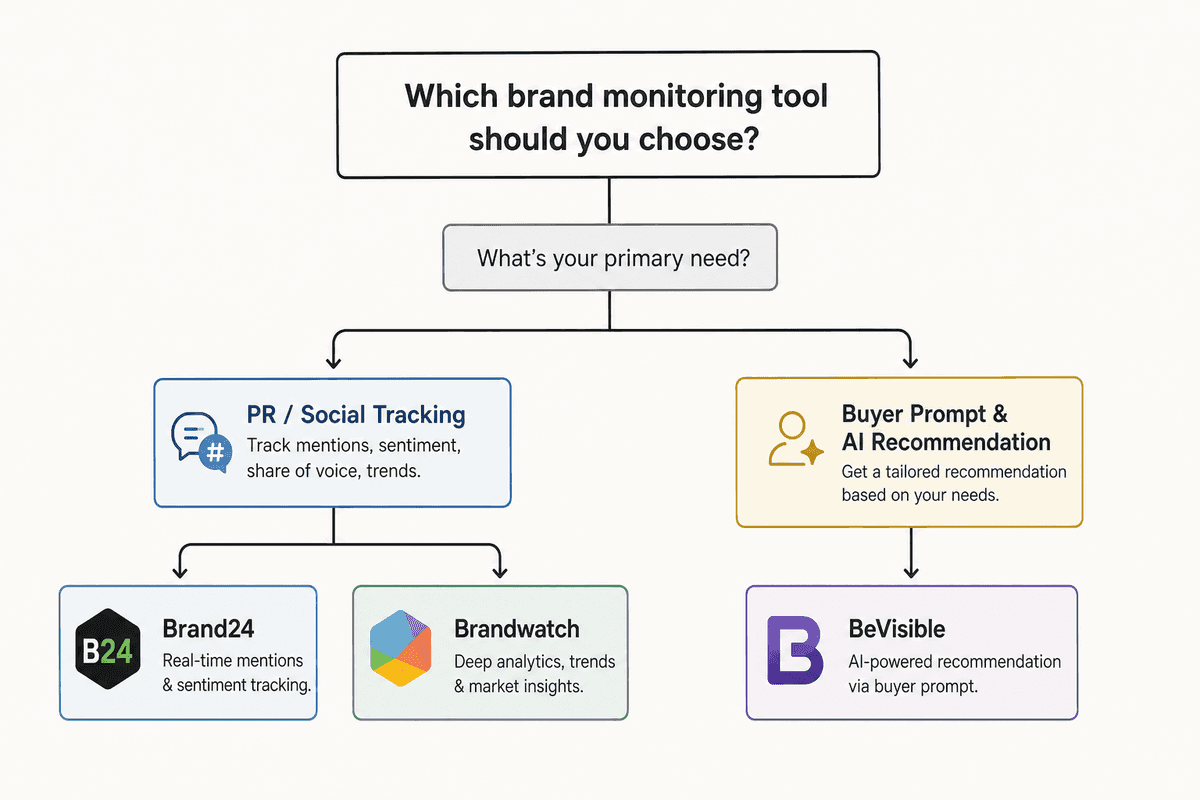
Evaluation Framework: How to Choose the Right Tool
Selecting the right alternative depends on your team's primary business outcomes. Follow this five-step framework to determine which architecture matches your goals.
                                    [Determine Core Goal]
                                              |
                     +------------------------+------------------------+
                     |                                                 |
           [Track Social / PR Noise]                          [Drive Buyer Recommendations]
                     |                                                 |
          (Select Social Listening)                          (Select AI Visibility Engine)
                     |                                                 |
         +-----------+-----------+                             +-------+------+
         |                       |                             |              |
    [SMB Budget]         [Enterprise Budget]                 [Monitoring]   [Monitoring + Publishing]
         |                       |                             |              |
    (Brand24/Mention)   (Brandwatch/Meltwater)               (AI Tracking)   (BeVisible)
Step 1: Identify Your Primary Channel Vulnerability
Ask your growth team: Where are prospective buyers making product comparison decisions?
If prospective customers find you via social channels like X, LinkedIn, or online forums, traditional media monitoring platforms like Brand24 or Mention provide sufficient coverage.
However, if prospective customers use conversational search tools to query software categories (e.g., "Compare top single-page application hosting solutions" or "Best AI monitoring platforms for enterprise"), legacy social listening tools will leave you blind. You need an AI-native visibility platform.
Step 2: Determine Your Execution Requirements
Monitoring without execution creates operational clutter. When evaluating software, look closely at what happens after a gap is detected:
- Data-Only Tools: Send email alerts or update dashboards when mentions change. Your team must manually research the cause, write content, and figure out how to influence search models.
- Execution-Driven Platforms: Identify the missing brand mention, map the citations driving the competitor's inclusion, and generate the structured content assets required to bridge the visibility gap.
If you want to read more about content architecture strategies, explore our guide on building targeted landing pages designed for high search intent.
Step 3: Assess Data Sourcing Transparency
AI assistants do not invent recommendations out of thin air. They fetch ground-truth information from high-authority blogs, review platforms, documentation sites, and news sources.
Ensure your target platform doesn't just give you a static "visibility score." It must list the exact URL sources and domain authority networks that the AI assistant referenced when generating its answer.
Step 4: Evaluate Pricing vs. ROI Alignment
Enterprise social listening tools charge between $20,000 and $100,000+ annually for vast historical social archives. If your marketing budget is focused on customer acquisition, paying enterprise prices for PR social listening may yield poor return on investment.
Investing in AI search visibility directly targets buyers at the consideration stage, delivering higher pipeline impact per dollar spent.
Practical Case Scenario: How AI Visibility Intelligence Drives Revenue
Consider a mid-market B2B HR software company called TalentPulse.
For years, TalentPulse used standard social listening software. Their dashboards tracked social sentiment and alerted them whenever someone tweeted about HR tech. However, quarterly organic pipeline growth began to plateau despite high brand sentiment scores.
The Discovery
When TalentPulse audited AI search engines using an AI visibility platform, they discovered a major revenue leakage point.
When prospective buyers asked ChatGPT: "What are the top automated onboarding software options for remote companies?", the AI generated a bulleted list featuring five key competitors. TalentPulse was completely omitted.
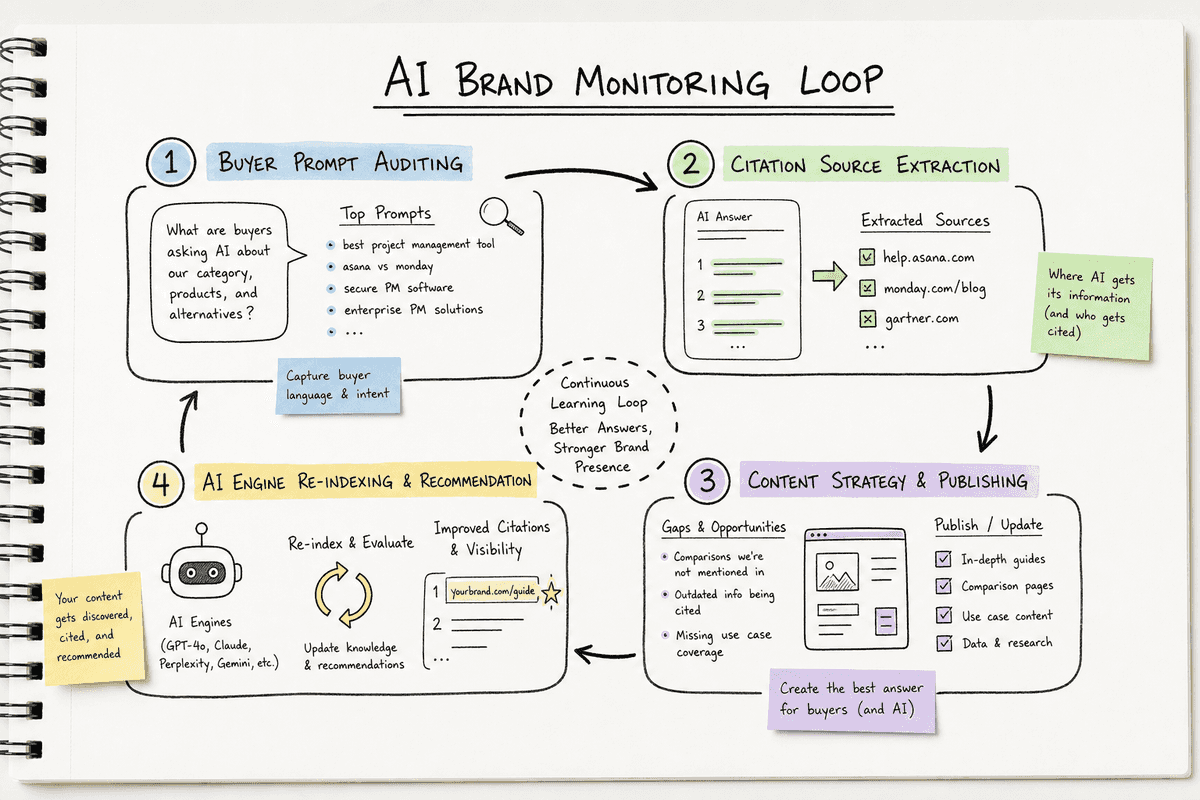
The Investigation
By analyzing the source citations behind the AI model's response, TalentPulse identified three critical factors:
- The AI engine heavily relied on three comparison roundups published on industry blogs.
- Competitors were frequently mentioned in specific Reddit threads and technical documentation sites.
- TalentPulse's own feature documentation lacked structured Schema markups clear enough for LLM web crawlers to parse effectively.
The Execution Strategy
Instead of reacting to social media comments, TalentPulse took targeted execution steps:
- Source Acquisition: Reached out to the authoritative industry blogs cited by Perplexity and ChatGPT to secure inclusion in their comparison reviews.
- Content Expansion: Published dedicated comparison guides and technical feature breakdowns on their domain.
- Entity Structuring: Updated product landing pages with clear, machine-readable structured summaries.
The Result
Within six weeks, as AI crawlers re-indexed updated sources, ChatGPT and Perplexity began recommending TalentPulse in 78% of remote onboarding buyer queries. Organic demo requests increased by 34% over the following quarter.
This scenario highlights the strategic difference between tracking PR mentions and optimizing for AI recommendation engines.
Common Myths in AI Brand Monitoring
As marketing teams adapt to generative search engines, several misconceptions persist regarding brand tracking software.
Myth 1: "Social Listening Sentiment Scores Tell You What AI Engines Think"
Fact: Social listening sentiment tools run natural language processing over public user posts. AI engines (like ChatGPT or Gemini) do not read your social listening dashboard; they evaluate authority signals across thousands of web documents, user reviews, and structured web data. A positive Twitter sentiment score will not guarantee inclusion in an AI buyer guide.
Myth 2: "AI Brand Monitoring Is Just Traditional SEO Under a New Name"
Fact: Traditional SEO focuses on keyword rankings and blue-link SERP positioning on Google. AI brand monitoring focuses on synthetic answers, multi-source synthesis, entity recommendation frequency, and prompt variations. To keep up with industry developments, review curated resources like our round-up of the best SEO blogs for SaaS founders.
Myth 3: "AI Models Update Their Brand Knowledge Instantly"
Fact: AI assistants combine parametric memory (pre-trained model knowledge) with real-time web retrieval (RAG - Retrieval-Augmented Generation). While RAG updates quickly via live web searches, core model representations update across indexing cycles. Tracking visibility trends over time is necessary to measure actual impact.
Pitfalls to Avoid When Implementing AI Brand Monitoring
Avoid these common execution mistakes when setting up your monitoring framework:
- Tracking Irrelevant Broad Prompts: Monitoring ultra-generic prompts like "What is HR software?" wastes resources. Focus instead on decision-stage prompts like "Best HR software with payroll integration for 100-500 employees."
- Ignoring Citation Sources: Focusing solely on the final AI answer text while ignoring the underlying web sources means you miss the actionable path to fixing your visibility.
- Failing to Connect Insight to Content Creation: Discovering that your brand is missing from an AI answer is only step one. If your team lacks an agile workflow to publish missing content, the gap will persist.
- Over-relying on Single-Prompt Tests: AI models exhibit variance. Querying a prompt once yields an incomplete picture. You need continuous tracking across multiple prompt variations to measure true Share of Voice.
Implementation Checklist for AI Brand Tracking
Use this checklist to set up your AI brand monitoring and execution process:
- Define High-Intent Buyer Prompts: List 20-50 core prompts your target prospects ask when looking for solutions in your niche.
- Audit Baseline Visibility: Run queries across ChatGPT, Gemini, Perplexity, and Google AI Overviews to calculate your baseline inclusion rate.
- Map Competitor Share of Voice: Identify which direct competitors dominate recommended vendor lists.
- Extract AI Source Citations: Document the top 10 external web domains and articles cited by AI assistants across your prompt cluster.
- Identify Content Gaps: Pinpoint specific product features or comparison points where your website lacks comprehensive coverage.
- Publish Targeted Content Assets: Create clear, well-structured articles and comparison pages that address missing buyer prompts.
- Establish Continuous Tracking: Monitor prompt inclusion trends weekly to confirm when AI engines update their answers.
Frequently Asked Questions
Can traditional social listening tools track ChatGPT and Perplexity answers?
No. Traditional social listening tools rely on public APIs and web scraping from social media networks, forums, and news sites. They do not simulate conversational buyer queries or parse real-time output from LLM APIs like ChatGPT, Gemini, or Perplexity.
What is Prompt Share of Voice (SOV)?
Prompt Share of Voice measures the percentage of AI-generated answers within a specific prompt category that recommend your brand compared to your direct competitors. If an AI engine is asked 10 buyer prompts in your niche and recommends your software in 7 of them, your Prompt SOV is 70%.
How frequently do AI search engines change their recommendations?
AI engines that utilize Retrieval-Augmented Generation (RAG) update their citation sources in real time as web search indexes refresh. Model baseline recommendations update periodically as new web crawls and model fine-tuning occur. Monitoring weekly ensures you capture both real-time web shifts and baseline model updates.
What content format is best for influencing AI brand recommendations?
AI models prioritize well-structured, clear, authoritative content. Formats that perform best include detailed comparison tables, clear heading hierarchies (H2/H3), bulleted product feature lists, direct answers to buyer questions, and clear Schema markup.
Strategic Next Steps for Growth Teams
As conversational interfaces replace traditional search feeds, brand visibility is being redefined. Being absent from AI assistant recommendations means losing deals before your sales team ever gets a chance to present.
If your main priority is PR tracking, media relations, and social media sentiment monitoring, traditional alternatives like Brand24, Mention, or Brandwatch are effective choices.
However, if your primary goal is capturing high-intent buyers, tracking recommendations across ChatGPT, Gemini, and Perplexity, and systematically closing visibility gaps, you need an AI-native visibility engine built for execution.
Audit your core buyer prompts today, identify where your brand is missing, and establish a publishing strategy that keeps your company at the top of AI-generated buyer shortlists.