
When content teams first explore Generative Engine Optimization (GEO), they usually start by asking a simple question: "Are AI assistants like ChatGPT, Gemini, and Perplexity recommending our product when buyers ask questions?"
Tools like Evertune were among the early entrants to help enterprise brands monitor AI search visibility. Evertune gives executive teams high-level visibility scores, brand sentiment tracking, and macro-level share of voice across major Large Language Models (LLMs).
For content writers, growth marketers, and SaaS content managers, high-level scores quickly run into a operational wall. Knowing that your brand appears in 18% of buyer queries on ChatGPT gives you a metric for your quarterly slide deck, but it does not tell your content team what to write, which missing citations to target, or how to turn visibility gaps into published, indexable work that shifts AI recommendations in your favor.
Content teams require more than executive dashboards. They need a GEO platform that bridges the gap between AI visibility monitoring and content execution.
This guide evaluates the top Evertune alternatives for content teams, analyzing how each platform handles LLM prompt tracking, citation source mapping, content gap identification, and workflow integration.
The Core Shift: Why Content Teams Outgrow Pure Visibility Dashboards
Traditional Search Engine Optimization (SEO) relied on tracking keyword ranks, search volume, and backlinks. Generative Engine Optimization shifts the focus to conversational AI assistants, generative search engines, and synthetic answers. Buyers no longer type "best project management software" into a Google box and click the top three blue links. They ask ChatGPT, Perplexity, Gemini, or Google AI Overviews to compare tools based on specific constraints, budget requirements, and technical integrations.
According to industry discussions on growth marketing, GEO focuses on making a brand an intrinsic part of the AI-generated answer, driving immediate credibility and discovery within conversational interfaces (GEO 101 Guide).
+-------------------------------------------------------------------------------+
|                       TRADITIONAL SEO vs. GEO WORKFLOW                        |
+-------------------------------------------------------------------------------+
| TRADITIONAL SEO                                                               |
| [ Keyword Research ] --> [ Write Article ] --> [ Rank #1-3 ] --> [ Clicks ]   |

+-------------------------------------------------------------------------------+
| GENERATIVE ENGINE OPTIMIZATION (GEO)                                          |
| [ Buyer Prompts ] --> [ LLM Answers & Citations ] --> [ Source Ingestion ]   |
|         ^                                                       |             |
|         |-------- [ Evidence-Backed Content Published ] <---------|             |

+-------------------------------------------------------------------------------+
 Pure visibility monitoring tools like Evertune capture top-level statistics about where a brand stands today. They show macro trends in brand presence across AI platforms. When a content team logs in to take action, they frequently hit three major bottlenecks:
- The Action Gap: Seeing that a competitor is cited in 40% of queries for "enterprise HR automation" does not reveal which specific source articles or entity associations led to that recommendation.
- Disconnected Content Workflows: Monitoring tools live in a vacuum. Writers have to copy prompt outputs into external spreadsheets, write draft responses manually, and figure out where to publish them without feedback on whether the new content changes LLM responses.
- Prompt Surface Limitations: LLM answers vary drastically based on exact prompt phrasing, user context, and follow-up questions. Monitoring static keywords misses the long-tail conversational prompts buyers actually use.
A content team needs a GEO platform built around an execution loop: discovering prompt gaps, inspecting cited sources, creating evidence-backed content, and tracking the resulting changes in AI recommendations over time.
Evaluation Criteria: What Makes a GEO Platform Built for Content Teams?
When evaluating Evertune alternatives, marketing leaders and content strategists should look past vanity visibility metrics and evaluate platforms against five core operational criteria.
+-------------------------------------------------------------------------------+
|                    5 CORE CRITERIA FOR CONTENT-LED GEO PLATFORMS              |
+-------------------------------------------------------------------------------+
|  1. Multi-LLM Coverage  |  Tracks ChatGPT, Gemini, Perplexity, AI Overviews   |
|  2. Citation Mapping    |  Identifies external domains driving AI answers     |
|  3. Actionable Insights |  Translates visibility gaps into content briefs     |
|  4. Native Execution    |  Offers review, scheduling, and direct publishing   |
|  5. Closed-Loop Recrawl |  Verifies content updates actually change answers   |

+-------------------------------------------------------------------------------+
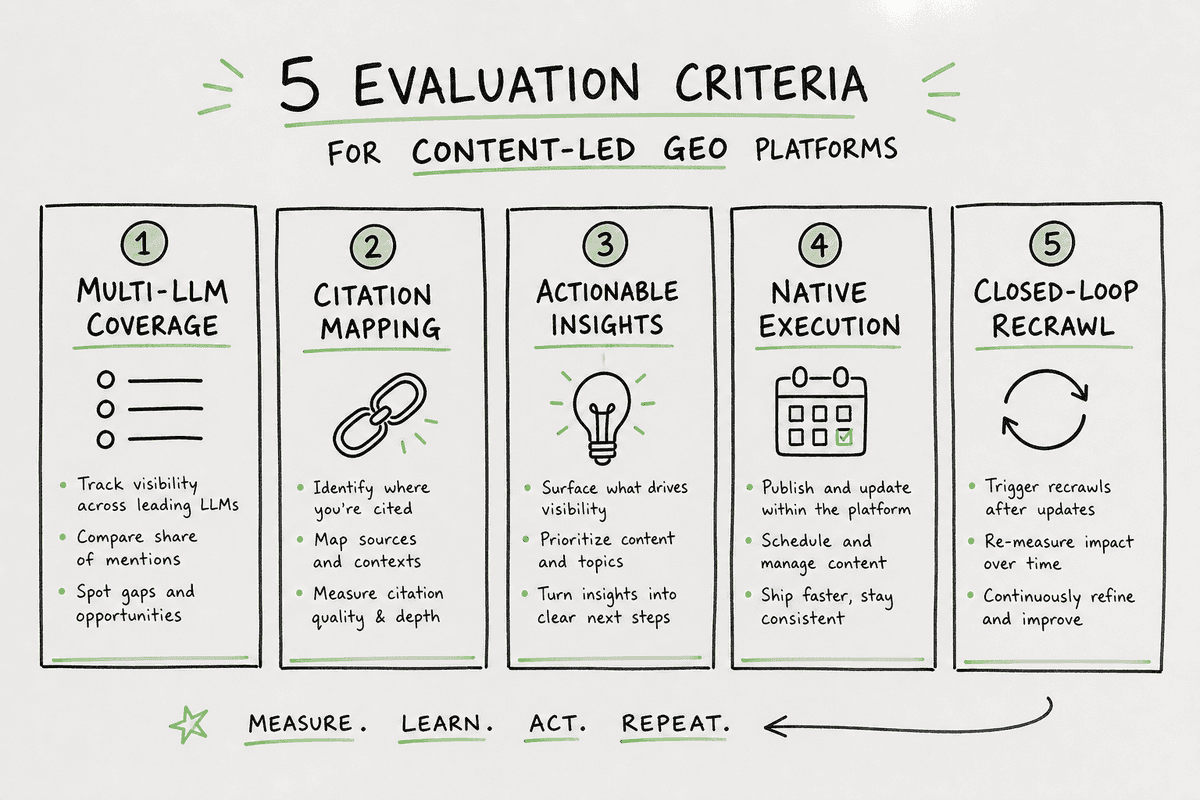
1. Multi-LLM & Multi-Surface Coverage
AI search is fragmented. Your ideal customer might use Perplexity for technical research, ChatGPT for vendor shortlisting, and Google AI Overviews for quick feature checks. A viable platform must track buyer prompts across all major conversational surfaces: ChatGPT, Gemini, Perplexity, AI Mode, and AI Overviews.
2. Deep Citation & Source Mapping
LLMs rarely invent vendor recommendations from scratch. They summarize high-authority sources, industry comparisons, Reddit threads, review sites, and expert guides. Effective GEO tools extract the exact URL sources cited by AI engines during prompt evaluation, showing content teams precisely which pages influence the model's answer.
3. Gap-to-Content Workflow
A content team should not waste hours interpreting raw data. The platform should automatically flag missing mentions, weak citations, and competitor advantages, converting those gaps into evidence-backed topic briefs, article outlines, or strategic content updates.
4. Direct Content Execution and Publishing
The biggest friction point in GEO is execution speed. Platforms designed for content operations include built-in editorial review, scheduling, and publishing workflows so teams can draft, verify, and launch optimized articles without jumping between five separate tools.
5. Closed-Loop Visibility Tracking
After publishing an updated guide or new article targeting a buyer prompt, content teams need to know if the LLM's answer changed. Closed-loop tracking re-queries target prompts across AI models to verify whether your brand gained a new citation, improved its recommendation ranking, or displaced a competitor.
Comparison Matrix: Evertune vs. Top GEO Alternatives
The table below outlines how Evertune compares to top alternative platforms across focus, tracking depth, content execution capabilities, and target team sizes.
The 5 Best Evertune Alternatives for Content Teams
1. BeVisible: Best for End-to-End AI Visibility Monitoring & Content Execution
BeVisible is designed specifically for SaaS founders, growth marketers, and content teams that need to turn AI search gaps into published, revenue-generating content.
+-------------------------------------------------------------------------------+
|                       BEVISIBLE CLOSED-LOOP WORKFLOW                          |
+-------------------------------------------------------------------------------+
| [ Monitor Buyer Prompts ]  --> [ Detect Citation Gaps & Competitor Wins ]     |
|                                                                     |         |
| [ Publish Optimized Work ] <-- [ Generate Evidence-Backed Articles ] <--------|

+-------------------------------------------------------------------------------+
 While traditional GEO platforms stop at monitoring, BeVisible combines deep multi-LLM tracking with a native content execution layer. It tracks how AI assistants answer buyer questions across ChatGPT, Gemini, Perplexity, AI Mode, and Google AI Overviews.
Core Strengths for Content Teams
- Evidence-Backed Opportunity Generation: BeVisible does not just report that you are unranked for a prompt like "best API monitoring tool for fintech." It analyzes the sources currently cited by LLMs, pinpoints missing claims or key feature comparisons, and generates detailed, evidence-backed content briefs.
- Integrated Review, Scheduling, and Publishing: Content teams can move directly from prompt gap analysis to writing, reviewing, scheduling, and publishing content. This eliminates the disconnect between monitoring tools and CMS platforms.
- Multi-Engine Visibility Tracking: Monitors visibility across all major AI models simultaneously, giving teams a single source of truth for conversational search performance.
- Competitor Source Interception: Identifies which third-party sites, blogs, and portals supply competitors with AI citations, giving your team a clear roadmap for outreach and content co-occurrence.
Strategic Fit
BeVisible is the ideal choice for content teams, B2B SaaS growth marketers, and digital agencies that want an all-in-one solution to track AI search presence and immediately execute content strategies to claim missing citations. If you want to understand how to structure high-ranking content pages, exploring guides on building an SEO landing page provides foundational concepts that apply directly to GEO positioning.
2. Evertune: Benchmark for Enterprise Executive Reporting
Evertune remains a well-known option in the AI brand visibility space, particularly for large enterprise organizations seeking high-level brand intelligence.
+-------------------------------------------------------------------------------+
|                         EVERTUNE ENTERPRISE SCOPE                             |
+-------------------------------------------------------------------------------+
| [ Executive Reporting ] --> [ Macro Visibility Score ] --> [ Brand Sentiment ]|
|                                                                               |
| * Note: Requires external content teams to execute updates manually.          |

+-------------------------------------------------------------------------------+
Core Strengths
- Macro-level visibility tracking across major enterprise LLMs.
- Executive dashboarding suited for quarterly board decks and corporate brand positioning summaries.
- Brand sentiment analysis within generative AI responses.
Where Content Teams Hit Friction
- No Direct Content Execution: Evertune identifies where your brand is missing or mispositioned, but offers no native capabilities to draft, edit, or publish responsive content.
- Enterprise Complexity and Cost: Designed for large enterprise budgets, making it heavy and cost-prohibitive for nimble content teams or scaling B2B marketing departments.
- Data-to-Action Delays: Content managers must export reports, manually analyze source citations, and build briefs in external tools like Notion or Google Docs before writers can begin work.
3. Scrunch: Best for SEO Teams Transitioning to GEO
Scrunch is highlighted in industry discussions as a practical platform for traditional SEO professionals transitioning into generative search optimization (Reddit Discussion on AI Visibility Tools).
+-------------------------------------------------------------------------------+
|                          SCRUNCH DUAL-TRACK FOCUS                             |
+-------------------------------------------------------------------------------+
| [ Traditional Google SEO Data ]  +  [ LLM Prompt Tracking & Hallucinations ]  |
|                                                                               |
| --> Best for technical SEO specialists validating AI search readiness.        |

+-------------------------------------------------------------------------------+
Core Strengths
- Hybrid Search Tracking: Connects traditional search engine performance metrics with generative AI prompt visibility.
- Hallucination Detection: Flags instances where LLMs return incorrect, outdated, or misleading information about a brand.
- AI Readiness Scoring: Evaluates website architecture and content structures to determine how easily AI crawlers can digest and index your site's information.
Tradeoffs for Content Teams
Scrunch excels at technical auditing and hybrid tracking, but lacks integrated content drafting, scheduling, and direct CMS publishing features. It is best suited for technical SEO specialists rather than writers and content managers focused on output velocity.
4. Peec: Best for Small Teams and Agencies Needing Lightweight Benchmarks
Peec offers a lightweight, budget-friendly entry point for marketing agencies and smaller teams that need quick visibility snapshots without committing to enterprise software contracts.
+-------------------------------------------------------------------------------+
|                            PEEC LIGHTWEIGHT SCOPE                             |
+-------------------------------------------------------------------------------+
| [ Quick Prompt Benchmarks ] --> [ Periodic Snapshot Reports ]                 |
|                                                                               |
| --> Ideal for small teams needing fast, low-cost visibility checks.          |

+-------------------------------------------------------------------------------+
Core Strengths
- Rapid Benchmarking: Quickly test specific buyer prompts across ChatGPT and Claude to get baseline visibility scores.
- Affordable Pricing: Accessible pricing tiers designed for freelance strategists and small boutique agencies.
- Simple Interface: Minimal setup required; users can paste prompts and view AI recommendations within minutes.
Tradeoffs for Content Teams
Peec is primarily a diagnostic utility. It lacks automated citation deep-dives, competitive gap alerts, and content generation workflows. Teams managing multi-channel content engines will quickly outgrow its feature set.
5. SixthShop: Best for E-Commerce Product Discovery in AI Engines
SixthShop focuses specifically on the e-commerce sector, helping online retailers ensure their product catalogs are discoverable and accurately recommended by AI shopping assistants.
+-------------------------------------------------------------------------------+
|                         SIXTHSHOP E-COM ENGINE FOCUS                          |
+-------------------------------------------------------------------------------+
| [ Product Feed Catalog ] --> [ Structured Data Schema ] --> [ E-Com AI Engines]|
|                                                                               |
| --> Specialized for e-commerce SKU indexing and shopping prompt discovery.    |

+-------------------------------------------------------------------------------+
Core Strengths
- Catalog Feed Structuring: Optimizes product metadata, technical specifications, and inventory information for generative search algorithms.
- Shopping Prompt Tracking: Monitors buyer prompts specifically related to e-commerce, product comparisons, and retail availability.
- Marketplace Citation Analysis: Maps how AI engines pull product details from third-party retail channels and review hubs.
Tradeoffs for Content Teams
SixthShop is built exclusively for e-commerce catalog managers. It is not designed for B2B SaaS, content marketing teams, or agencies managing editorial content strategies.
Practical Framework: The 4-Step GEO Content Pipeline
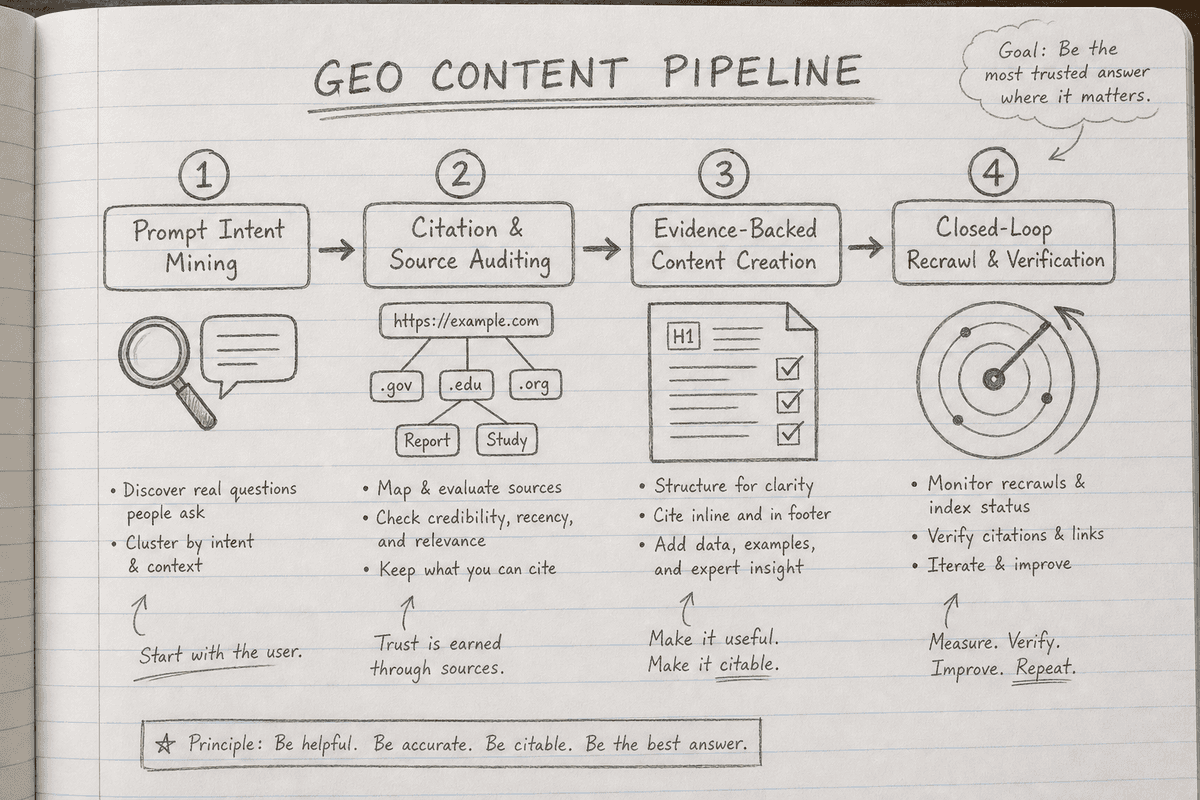
To turn AI visibility monitoring into published search wins, content teams need a repeatable operational framework. This four-step pipeline illustrates how leading marketing teams use dedicated GEO platforms to capture share of voice in conversational engines.
+-------------------------------------------------------------------------------+
|                         THE 4-STEP GEO CONTENT PIPELINE                       |
+-------------------------------------------------------------------------------+
| STEP 1: Prompt Intent Mining                                                  |
| Identify transactional, comparison, and technical buyer queries.             |
|                                                                               |
| STEP 2: Citation & Source Auditing                                            |
| Extract URLs and third-party hubs powering current AI answers.                |
|                                                                               |
| STEP 3: Evidence-Backed Content Creation                                     |
| Draft content rich in entity relationships, structured data, and facts.       |
|                                                                               |
| STEP 4: Closed-Loop Recrawl & Verification                                    |
| Publish, index, and re-query AI engines to verify citation acquisition.       |

+-------------------------------------------------------------------------------+
Step 1: Prompt Intent Mining
Start by cataloging the exact prompts your target buyers ask AI engines during their purchasing journey. Categorize prompts into three distinct operational buckets:
- Transactional Prompts: "What is the best automated invoicing tool for mid-market SaaS?"
- Comparison Prompts: "Compare Brand A vs. Brand B on pricing, API support, and compliance."
- Problem-Solving Prompts: "How do I fix cross-border tax compliance issues in Stripe?"
Step 2: Citation & Source Auditing
Run target prompts through your GEO platform to identify which web pages are cited in the AI outputs. As noted in research on generative engine optimization strategies, AI engines depend heavily on high-authority web pages, niche publications, and clear source material to build synthesized answers (Kontent.ai GEO Analysis).
Analyze the top cited URLs to discover:
- What specific claims, statistics, or feature matrices are being extracted?
- Are there third-party review sites or industry blogs cited repeatedly?
- Is your brand omitted because your own pages lack clear, extractable information?
Step 3: Evidence-Backed Content Creation
LLMs prefer content structured for easy semantic parsing. When updating an existing article or writing a new piece to target a prompt gap, structure your content with direct answer statements, structured comparison tables, bulleted lists, and clear entity relationships.
For example, instead of writing vague marketing copy like "Our software makes project management effortless," write structured, verifiable statements: "Platform X provides native automated timeline scheduling, supporting up to 500 concurrent project tasks with direct Jira integrations."
Step 4: Closed-Loop Recrawl & Verification
Once your content is published, trigger a re-crawl and re-query cycle within your GEO platform. Verify whether the target AI assistants update their synthesized answers to include your brand name, cite your URL, or quote your data points. If the AI model continues to omit your brand after several weeks, audit secondary source domains (such as industry review sites or co-citation articles) to strengthen your external web presence.
Real-World Scenario: How a B2B SaaS Growth Team Reclaimed AI Share of Voice
To illustrate how an execution-oriented GEO platform operates in practice, consider the scenario of a mid-market cybersecurity SaaS company specializing in API security compliance.
+-------------------------------------------------------------------------------+
|                   CASE SCENARIO: BEFORE vs. AFTER GEO EXECUTION               |
+-------------------------------------------------------------------------------+
| BEFORE GEO EXECUTION                                                          |
| * Target Prompt: "Best API compliance tools for fintech apps"                 |
| * Perplexity & ChatGPT Output: Recommending 3 direct competitors.             |
| * Primary Cited Sources: 2 comparison blogs, 1 Reddit thread, 1 vendor guide. |
| * Brand Mention Rate: 0%                                                      |

+-------------------------------------------------------------------------------+
| AFTER GEO EXECUTION (Using BeVisible Pipeline)                                |
| * Action Taken: Published evidence-backed comparison guide & updated docs.     |
| * Citation Acquisition: Captured primary citation link in Perplexity.          |
| * Brand Mention Rate: Promoted to top 2 recommended vendor list.              |

+-------------------------------------------------------------------------------+
The Problem
The growth team noticed a sudden drop in qualified demo requests from enterprise buyers. Customer interviews revealed that prospective buyers were asking ChatGPT and Perplexity: "What are the best automated API compliance platforms for financial technology companies?"
When the team tested the prompt manually, AI assistants recommended three direct competitors. The cybersecurity brand was completely absent from the generated recommendations.
The Diagnostic Phase
Using Evertune, the marketing VP obtained a macro score showing that their brand's AI share of voice in the compliance category was only 8%. However, the dashboard offered no concrete steps to fix the gap.
The content team switched to BeVisible to analyze the specific cited sources. The platform revealed that Perplexity and ChatGPT consistently cited three specific web sources when answering that prompt:
- A detailed 2025 comparison post on an engineering blog.
- An enterprise security documentation page hosted by a competitor.
- A recurring Reddit thread discussing fintech regulatory audits.
The AI engines were pulling structured feature comparison tables directly from the competitor’s security documentation page.
The Execution Phase
Using BeVisible's opportunity engine, the team generated an evidence-backed content plan:
- Owned Content Update: The team published a comprehensive, well-structured guide on their website titled "FINRA & SOC2 API Compliance Requirements for Fintech: Platform Comparison." They included detailed comparison tables, explicit feature support checklists, and code snippet references.
- Entity Co-occurrence Strengthening: They updated their primary product pages to clearly state compliance certifications in structured schema markup and plain text headers.
- Distribution & Indexing: Using BeVisible's built-in publishing features, the team launched and indexed the new content directly.
The Results
Within three weeks of publication, the closed-loop tracking system verified a shift in LLM outputs:
- Perplexity: Updated its synthesized answer to include the brand as a top recommended vendor, citing the new compliance guide as a primary source link.
- ChatGPT: Added the company to its top three vendor list for fintech API compliance prompts.
- Inbound Pipeline: Qualified inbound inquiries from prospective fintech buyers increased by 27% over the following quarter.
Common GEO Failure Modes (And How to Avoid Them)
When teams adopt Generative Engine Optimization, they often bring old SEO habits that fail in conversational search environments. Staying informed on industry insights by reading top-tier industry resources, such as those listed in our roundups of the best SEO blogs, can help teams stay ahead of evolving search strategies.
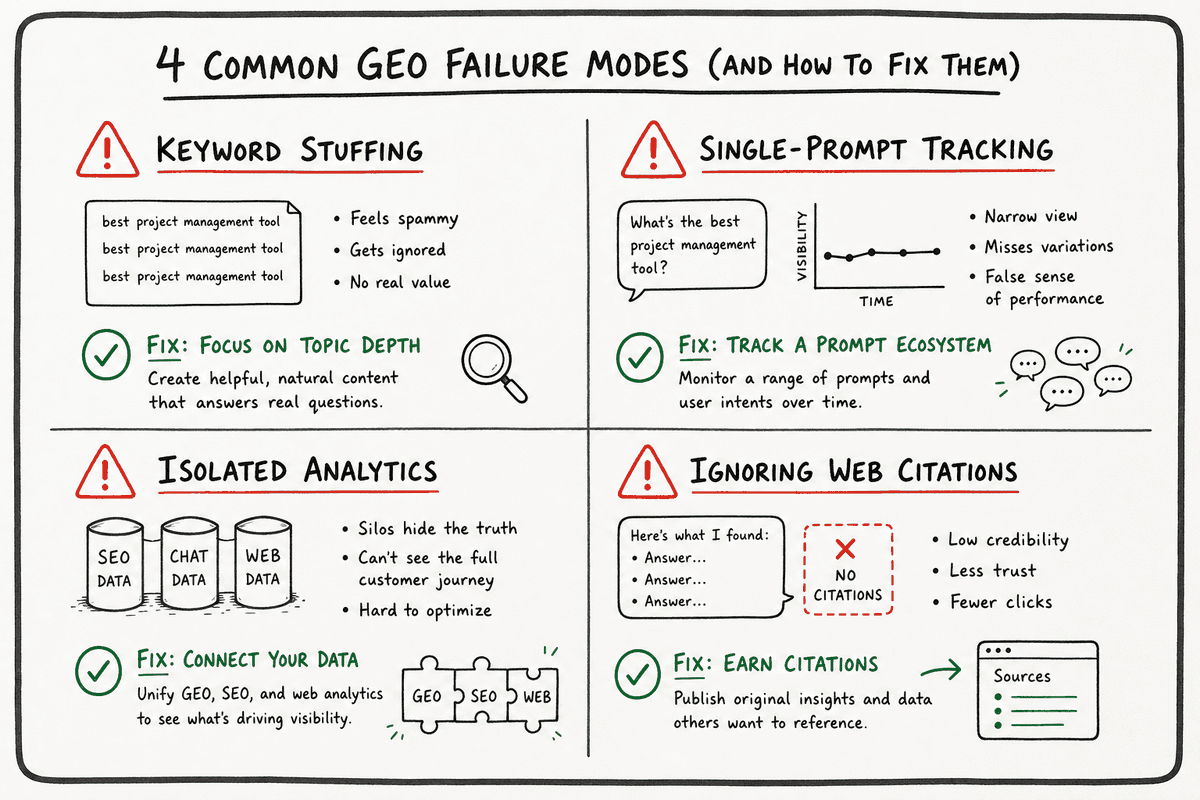
Here are four common failure modes content teams must avoid:
+-------------------------------------------------------------------------------+
|                         4 COMMON GEO FAILURE MODES                            |
+-------------------------------------------------------------------------------+
| FAILURE MODE 1: Treating GEO like Traditional Keyword Stuffing                |
| Solution: Focus on entity relationships, exact data, and concise answers.     |

+-------------------------------------------------------------------------------+
| FAILURE MODE 2: Relying on Static Single-Prompt Tracking                      |
| Solution: Track dynamic, conversational prompt clusters across multiple LLMs. |

+-------------------------------------------------------------------------------+
| FAILURE MODE 3: Isolating Visibility Data from Content Workflows             |
| Solution: Use a unified platform that connects tracking directly to execution. |

+-------------------------------------------------------------------------------+
| FAILURE MODE 4: Ignoring External Source Citations                            |
| Solution: Audit third-party review sites, press, and blogs feeding LLM feeds. |

+-------------------------------------------------------------------------------+
Failure Mode 1: Treating GEO like Traditional Keyword Stuffing
Traditional SEO often rewarded repeating exact-match keywords across headers and body copy. LLMs operate on vector embeddings and semantic entity structures. Repeating "best CRM software" twenty times in an article will not convince ChatGPT to recommend your product. Instead, focus on clear attribute mapping: define explicitly what your product does, who it is for, its exact pricing model, and its key technical integrations.
Failure Mode 2: Static Single-Prompt Tracking
Buyers rarely ask a single prompt and accept the first answer. They engage in multi-turn conversations:
- Initial Prompt: "What are the top email marketing tools?"
- Follow-Up Prompt: "Which of these have native Shopify integrations and cost under $100/month?"
- Decision Prompt: "Compare Tool A and Tool B on deliverability rates."
If your GEO tool only tracks single, isolated keywords, you miss the conversational context where buying decisions are actually made. Ensure your platform tracks dynamic prompt clusters.
Failure Mode 3: Isolating Visibility Data from Content Workflows
Storing GEO visibility data in a standalone analytics dashboard creates an operational bottleneck. When visibility tracking is separate from your content management system, insights get lost in transit. Content managers forget to update old articles, writers lack context on why they are making specific edits, and growth teams lose track of which content changes actually drove improvements. Choose a platform that unifies tracking and content creation.
Failure Mode 4: Ignoring Third-Party Source Citations
LLMs synthesize answers from across the entire web, relying on third-party review platforms, niche tech blogs, news publications, and industry forums (How to Win AI Search Without Losing Your Brand). If your GEO strategy focuses exclusively on editing your own website, you ignore half of the ecosystem feeding the AI engine. Use your GEO platform to track external domain citations and target third-party publications for PR and co-mention opportunities.
Decision Matrix: Choosing the Right GEO Platform for Your Workflow
Selecting the right Evertune alternative depends on your team's structure, primary objectives, and current operational bottle-necks. Use the decision matrix below to identify the best fit for your team.
+-------------------------------------------------------------------------------+
|                          PLATFORM SELECTION MATRIX                            |
+-------------------------------------------------------------------------------+
| IF YOUR PRIMARY GOAL IS...               | THEN CHOOSE...                     |
+------------------------------------------+------------------------------------+
| Turn AI visibility gaps into published,  | BeVisible                          |
| evidence-backed content & articles       |                                    |

+------------------------------------------+------------------------------------+
| Executive brand sentiment reporting &    | Evertune                           |
| enterprise macro visibility metrics      |                                    |

+------------------------------------------+------------------------------------+
| Bridge traditional Google SEO audits with | Scrunch                            |
| basic LLM hallucination tracking         |                                    |

+------------------------------------------+------------------------------------+
| Fast, low-cost prompt checks for small   | Peec                               |
| agencies or solo consultants             |                                    |

+------------------------------------------+------------------------------------+
| Structure e-commerce product catalogs    | SixthShop                          |
| for conversational shopping feeds        |                                    |

+------------------------------------------+------------------------------------+
Scenario A: You run a B2B SaaS content or growth team
If your priority is increasing qualified inbound leads from AI search tools by identifying missing buyer prompts and immediately creating, editing, and publishing content to capture share of voice, BeVisible is purpose-built for your needs.
Scenario B: You are a Fortune 500 VP of Communications
If you need high-level enterprise sentiment reports for corporate executives and care less about weekly content publishing velocity, Evertune offers macro-level visibility monitoring.
Scenario C: You are a Technical SEO Director
If your primary concern is website technical structure, AI crawler access, and bridging Google Search Console data with AI readiness scores, Scrunch offers useful dual-track auditing tools.
Frequently Asked Questions (FAQs)
What is the primary difference between SEO and GEO platforms?
Traditional SEO platforms (like Ahrefs or Semrush) focus on Google keyword ranks, monthly search volume, backlink profiles, and SERP click-through rates. GEO platforms focus on conversational AI assistants (ChatGPT, Gemini, Perplexity, AI Overviews), tracking whether an AI model recommends your brand, which sources it cites, and how it synthesizes answers in response to complex buyer prompts.
Can traditional SEO tools replace a dedicated GEO platform?
No. Traditional SEO tools rely on Google’s historical keyword databases and link graphs. They cannot simulate conversational LLM sessions, map real-time citation sources across models like Perplexity or ChatGPT, or track multi-turn prompt interactions. Dedicated GEO platforms are required to measure generative visibility accurately.
How often do LLMs update their citations and recommendations?
Citation updates vary by platform. Web-connected AI search engines like Perplexity and Google AI Overviews refresh their cited sources continuously based on real-time search indexes. Offline or model-cached assistants like standard ChatGPT update their knowledge base periodically when new training snapshots or web-browsing updates are deployed. Tracking prompt visibility weekly ensures you catch citation changes as they occur.
Why do content teams need native publishing capabilities in a GEO tool?
Disconnecting analytics from execution creates operational friction. When a GEO platform includes native drafting, editing, review, scheduling, and publishing features, content teams can act on visibility gaps immediately. This direct workflow shortens the time between discovering an unranked buyer prompt and publishing an evidence-backed article designed to win that citation.
Taking Action on AI Visibility
Generative Engine Optimization is no longer a speculative strategy; buyers use conversational AI tools daily to evaluate vendors, compare software features, and make purchasing decisions.
While monitoring platforms like Evertune provide macro-level visibility scores, modern content teams require tools that turn data into action. By choosing a GEO platform like BeVisible that combines multi-LLM tracking, source citation mapping, and direct content execution, your growth team can systematically claim missing citations, outposition competitors, and capture valuable AI search share of voice.