
A prospective enterprise buyer opens Perplexity, ChatGPT, or Gemini and types a highly specific bottom-of-the-funnel question: "What are the most secure data routing platforms for healthcare compliance?"
If you are a vendor in that space, your traditional SEO dashboard might show you ranking #1 for "healthcare data routing." But in the AI interface, the model recommends three of your competitors and cites a two-year-old Reddit thread. Your brand is completely absent.
This is an AI content gap.
For years, marketing and growth teams have relied on traditional content gap analyses to find missing keywords. But as conversational AI platforms become primary research engines, identifying where AI fails to provide comprehensive answers—or where it fails to cite your brand—is the new battleground for visibility.
While tools like Otterly.ai have popularized early AI tracking, SaaS founders and B2B marketing teams are quickly realizing they need more than just a snapshot of a missing mention. They need tools and workflows that turn missing mentions, weak citations, and competitor wins into published work.
Here is a comprehensive look at how to find content gaps in AI answers, the methodologies that actually work, and the best tools to use in 2026.
The Anatomy of an AI Content Gap
Before analyzing the tool landscape, it is critical to understand that an AI content gap looks fundamentally different from a traditional search gap. In classic SEO, a gap means your domain does not rank for a specific keyword phrase. In the AI ecosystem, a gap occurs within the Retrieval-Augmented Generation (RAG) pipeline or the underlying Large Language Model (LLM) training data.
 AI visibility gaps typically manifest in four distinct ways:
- The Complete Omission: The AI model is asked for category leaders, solutions, or workflows, and it simply does not know your brand exists or does not retrieve your content to formulate its answer.
- The Weak Citation: The AI mentions your brand, but bases its description on outdated, inaccurate, or shallow information, often missing your core value proposition.
- The Competitor Hallucination: The AI engine gives a competitor credit for a feature, integration, or compliance standard that only your product actually possesses, simply because the competitor has better semantic coverage of that topic.
- The Unanswered Persona Query: The AI system returns a "low confidence" response or flat-out refuses to answer a complex industry question because the source material does not exist anywhere on the web in a digestible format.
Understanding these failure modes is the first step in bridging the gap. If you cannot measure where the model is struggling to understand your market, you cannot feed it the right information.
Why the Standard "Otterly.ai Approach" Leaves Money on the Table
Otterly.ai has been a helpful early entrant for tracking brand mentions in AI chatbots. It gives marketers a baseline understanding of whether ChatGPT knows who they are. However, for serious B2B growth teams and agencies, merely knowing you are missing is not enough.
The problem with a pure monitoring approach is the execution chasm. Knowing that Perplexity did not recommend you for a specific buyer prompt is a diagnostic metric. The actual value comes from understanding why the AI chose a competitor and generating the exact blueprint required to fix it.
Do you need to publish a deeply technical comparison page? Do you need more third-party reviews mentioning specific features? Does your developer documentation lack structured data?
Advanced teams are moving beyond basic mention-tracking. They are looking for workflow platforms that monitor AI assistants across a wide array of buyer prompts, analyze the sources the AI did cite, and translate those visibility gaps into evidence-backed opportunities for content creation, review generation, and publishing.
Top Tools to Find Content Gaps in AI Answers (2026)
The software landscape for identifying these gaps is fragmenting into specialized platforms. Here are the most effective tools and methodologies for finding AI content gaps, starting with the most actionable.
1. BeVisible (The Execution-Focused Alternative)
When it comes to turning AI visibility data into actionable marketing operations, BeVisible is designed specifically for teams that need to execute. BeVisible helps teams monitor how AI assistants answer buyer questions, tracking platforms like ChatGPT, Gemini, Perplexity, AI Mode, and Google's AI Overviews.
Instead of just reporting a missing mention, BeVisible tracks which brands the AI recommends and crucially, which sources it cites. It then bridges the gap between tracking and doing. It turns these visibility gaps into evidence-backed opportunities, creating a direct pipeline to article creation, review management, scheduling, and publishing work. If Gemini cites a competitor's weak blog post to answer a prompt about your industry, BeVisible highlights exactly what you need to publish to override that citation.
2. Semrush (The Hybrid Search-AI Strategy)
While historically known for traditional search data, Semrush remains a vital part of the AI visibility stack. Because RAG-based AI models (like Perplexity and AI Overviews) pull real-time data from top-ranking search results, traditional content gaps directly inform AI content gaps.
Running a standard content gap analysis in Semrush allows you to identify where your competitors possess topical authority. If a competitor dominates the traditional SERPs for a cluster of informational queries, the AI models are highly likely to retrieve that competitor's content when constructing conversational answers. Using Semrush alongside an AI-specific monitor ensures you cover both the retrieval source (search) and the final output (the AI response).
3. Conductor (For Enterprise Search Intelligence)
Conductor has aggressively moved into analyzing how AI impacts enterprise search performance. They provide deep insights into how generative AI engines process and surface content. Their platform is particularly useful for identifying the overlap between traditional search dominance and AI visibility.
As noted in their education series on finding content gaps in AI search, content teams frequently struggle with prioritizing what to write next. By analyzing where AI models rely on shallow or low-quality sources to answer complex queries, enterprise teams can prioritize long-form, highly structured content that AI models naturally prefer to ingest.
4. HighLevel / Custom Knowledge Base Analyzers
For businesses using AI to power their own customer support or internal operations, finding gaps in local AI knowledge bases is just as critical as external search. Platforms that allow you to host internal AI agents often include diagnostic tools that track "unanswered questions" or "low confidence" scores.
Reviewing system logs for questions users frequently ask that the AI cannot currently answer is a direct method for identifying missing gaps in your AI knowledge base. This localized gap analysis often reveals broader industry confusion, providing perfect topics for your public-facing blog or documentation.
4 Steps to Manually Audit AI Visibility Gaps
If you are not ready to deploy dedicated software, or if you want to understand the mechanics behind the tools, you can manually audit your AI visibility. This requires a systematic approach to prompting and data mapping.
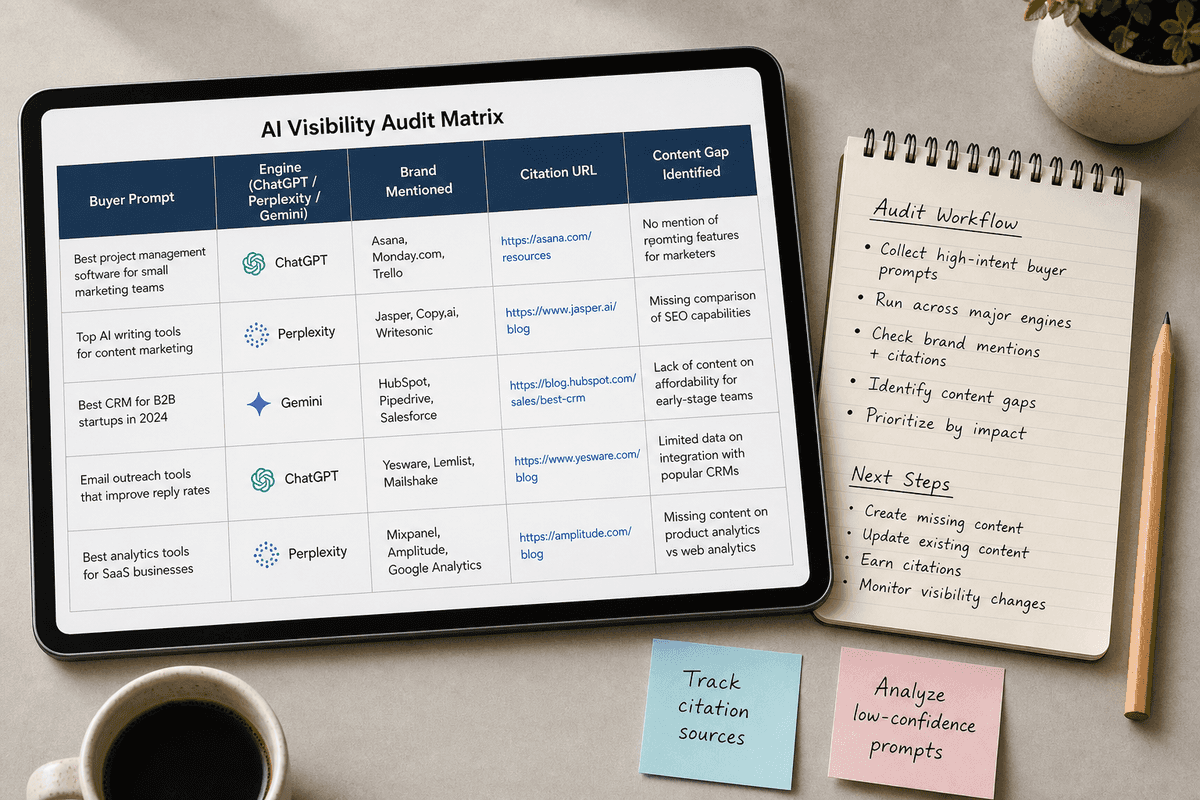
Step 1: Map the Buyer Prompt Journey
AI users do not search with shorthand keywords like "manufacturing CRM." They use conversational, intent-heavy prompts like, "I run a 50-person manufacturing company. We need a CRM that integrates with our legacy ERP and tracks field sales. What are the top 3 options, and what are their hidden costs?"
You need to build a matrix of these long-tail, contextual prompts. Brainstorm 50 to 100 questions your ideal buyers would ask an AI when researching your category, evaluating competitors, or troubleshooting a pain point.
Step 2: Test and Record Responses Across Engines
Run your matrix of prompts through ChatGPT (Plus), Gemini Advanced, and Perplexity. You must record three specific data points for every prompt:
- Brand Presence: Were you mentioned? Was your competitor mentioned?
- Sentiment and Accuracy: If you were mentioned, was the information correct, positive, and up-to-date?
- Citation Sources: Which URLs did the AI provide as references?
Step 3: Analyze Content-Level Weaknesses
When you analyze the results, you are looking for specific vulnerabilities in the AI's response. Industry experts frequently categorize these content-level AI visibility gaps into missing topics, weak answer optimization, lack of conversational content, and outdated information.
If the AI engine answers a complex prompt with a shallow, bulleted list pulled from a low-authority directory site, that is a massive visibility gap. The AI is desperate for a comprehensive, expert-authored pillar page on that exact topic.
Step 4: Reverse-Engineer the Citation
Look closely at the sources the AI chose to cite when it recommended your competitor.
- Is it a G2 or Capterra review page?
- Is it a specific technical whitepaper?
- Is it a digital PR placement in a major publication?
By reverse-engineering the citations, you understand the "diet" the AI relies on for your specific niche. If Perplexity always cites Reddit for a specific pain point, it means no SaaS company has published an authoritative guide that satisfies the model's quality threshold.
Bridging the Gap: Turning AI Insights into Published Work
Identifying the gap is merely diagnostic. The true return on investment comes from execution. Once you know exactly what the AI models are missing, you have to feed them the right data.
Upgrade Thin "SEO Content" to "AI-Ready Content"
For years, marketers wrote 800-word blog posts optimized for a single keyword density. AI models often skip these posts because they lack structural depth and semantic richness.
To bridge an AI content gap, your content must be structured for entity extraction. This means:
- Using clear, definitive statements. (e.g., "The integration process takes two weeks," not "Depending on various factors, integration can sometimes take a couple of weeks.")
- Structuring data using markdown tables, bulleted lists, and clear H2/H3 hierarchies.
- Directly answering the specific, long-tail questions you identified in your prompt matrix.
Target the "Information Gain" Metric
AI models, particularly those connected to real-time search, prioritize "information gain." This means they favor sources that provide new data, original statistics, or unique perspectives not found in the consensus of other articles.
If every article on a topic says the same five things, the AI will arbitrarily pick one to cite. To guarantee your content is retrieved to fill a gap, you must include proprietary data, custom frameworks, or strong contrarian opinions backed by evidence. If you want to see how top-tier content operations structure their output for maximum authority, reviewing the 11 Best SEO Blogs Every SaaS Founder Needs (2026) can provide excellent structural templates.
Broaden Your Citation Footprint
AI models do not just read your website. They read the entire internet. If ChatGPT thinks your competitor is the best tool for a specific use case, it is often because that competitor is mentioned across a wider variety of third-party domains.
Bridging this gap requires a proactive digital footprint strategy:
- Ensure your brand is listed accurately on all software review aggregators.
- Publish case studies that explicitly detail the specific use cases the AI currently associates with competitors.
- Get your executives quoted in industry publications discussing the very topics the AI is struggling to answer accurately.
The Role of Traditional Content Strategies in an AI World
It is easy to assume that AI has rendered traditional SEO gap analysis obsolete. This is a dangerous misconception. The fundamental principles of content strategy still govern how information is organized, ranked, and ultimately fed into AI models.
When conducting a comprehensive content gap analysis, the goal has always been to build topical authority and align with search engine priorities. In 2026, building topical authority on your own domain is the most reliable way to train third-party AI models.
If your domain comprehensively covers every facet, edge case, and technical specification of a topic, search engines rank it highly. Because search engines rank it highly, RAG-based AI models pull it into their context windows when users ask related questions. The execution might be changing, but the necessity of being the most helpful, authoritative source on the internet remains the same.
For agencies and consultants transitioning their clients from traditional SEO retainers to AI visibility retainers, the pricing and resource allocation models are shifting. You can see how this evolution is impacting agency operations and client expectations in our breakdown of SEO Charges UK: Agency Rates vs Automation (2026). Automated tracking and execution tools are replacing hours of manual SERP scraping, allowing teams to focus their budgets on producing high-signal, authoritative content that actually moves the needle in AI engines.
Frequently Asked Questions
How do you measure AI visibility?
AI visibility is measured by tracking three core metrics across major LLMs (ChatGPT, Gemini, Perplexity) based on specific buyer prompts: Brand Mention Rate (how often you appear), Recommendation Share (how often you are positioned as the best choice vs. competitors), and Citation Quality (the authority and accuracy of the sources the AI uses to describe your brand).
Does traditional SEO still matter for AI answers?
Yes. AI models that use Retrieval-Augmented Generation (like Perplexity and AI Overviews) actively search the web to formulate their answers. If you rank highly in traditional search for long-tail queries, you drastically increase the likelihood that the AI will retrieve your content to build its response.
How often should I monitor AI content gaps?
Because AI models continuously update their training sets and pull real-time data from the web, AI answers can change weekly. High-growth B2B teams should automate their monitoring to track prompt variations on a weekly basis, catching competitor surges or shifting AI narratives before they impact pipeline.
Why is ChatGPT hallucinating features my competitor doesn't have?
This happens when a competitor has aggressively optimized for a specific keyword or feature cluster without actually building the feature, or when the AI misinterprets dense, unstructured marketing copy. Finding this gap allows you to publish a clear, factual comparison page that the AI can ingest to correct its future outputs.
Moving From Diagnostic to Operative
Finding content gaps in AI answers is rapidly becoming a standard requirement for B2B growth. Relying on tools that simply ping you when your brand is missing from a ChatGPT prompt is no longer a competitive advantage.
The companies that will dominate AI search in the coming years are those that treat visibility monitoring not as a reporting function, but as an execution trigger. By identifying exactly what questions the AI struggles to answer, analyzing the weak sources it currently relies on, and publishing superior, structured content to fill the void, you transition from reacting to AI trends to actively shaping them.