
E-commerce growth teams face a persistent bottleneck: search engines and AI assistants demand massive volumes of authoritative, intent-matched content, but human writing teams scale linearly while content gaps multiply exponentially. To bridge this divide, many brands turn to automation. The allure is obvious—deploy software that learns a website's catalog, writes SEO-optimized blog posts that mimic the brand’s voice, and publishes them on a weekly schedule.
This is the exact value proposition tools like Frizerly offer to the market. The idea of an "auto-blogger" that handles the entire content lifecycle—from keyword research to WordPress publishing—sounds like the ultimate solution for a lean marketing team 5.
However, relying on closed-loop, fully automated publishing systems often creates a new set of problems. Without strategic oversight, these tools can hallucinate product features, cannibalize existing high-performing pages, and completely miss the emerging frontier of search: AI visibility. Today, successful e-commerce brands are scaling their blogs not by outsourcing their strategy to a single auto-publisher, but by building modular AI workflows. They use AI to accelerate research, augment human drafting, and explicitly target visibility gaps in engines like ChatGPT, Perplexity, and Gemini.
If you are evaluating Frizerly alternatives, you first need to understand how top-tier e-commerce brands actually use AI to scale their content engines sustainably.
How E-commerce Brands Actually Use AI to Scale Blogs in 2026
The conversation around AI in e-commerce has shifted rapidly. It is no longer just about writing passable product descriptions. E-commerce brands are shifting away from manual, error-prone content creation toward automated, data-driven production pipelines 4. The goal is to produce high-quality, targeted content at a velocity that small teams simply could not achieve previously.
1. Identifying Content and Visibility Gaps at Scale
Before a single word is drafted, AI is used to map the terrain. Traditional keyword research relied on static search volumes, but the modern buyer journey involves conversational queries. E-commerce brands use AI clustering tools to analyze thousands of search terms, grouping them by intent rather than exact-match phrases.
More importantly, teams are analyzing how Large Language Models (LLMs) answer buyer questions. If a consumer asks ChatGPT, "What are the most durable hiking boots for wide feet under $200?" and the AI engine recommends three competitors but ignores your brand, that is a critical visibility gap. Brands use platforms like BeVisible to monitor these AI assistants, track which brands they recommend, and see which sources they cite. When a missing mention or weak citation is identified, it instantly becomes a data-backed brief for the content team. The blog post is then explicitly designed to provide the structured data and clear answers that AI engines need to cite your brand in future queries.
2. Retrieval-Augmented Generation (RAG) for Brand Accuracy
The biggest failure mode of generic AI writing tools is that they lack context. If you ask an LLM to write a blog post about "the benefits of vitamin C serum," it will write a generic, Wikipedia-style article. It will not mention your specific formulation, your clinical trial results, or your unique packaging.
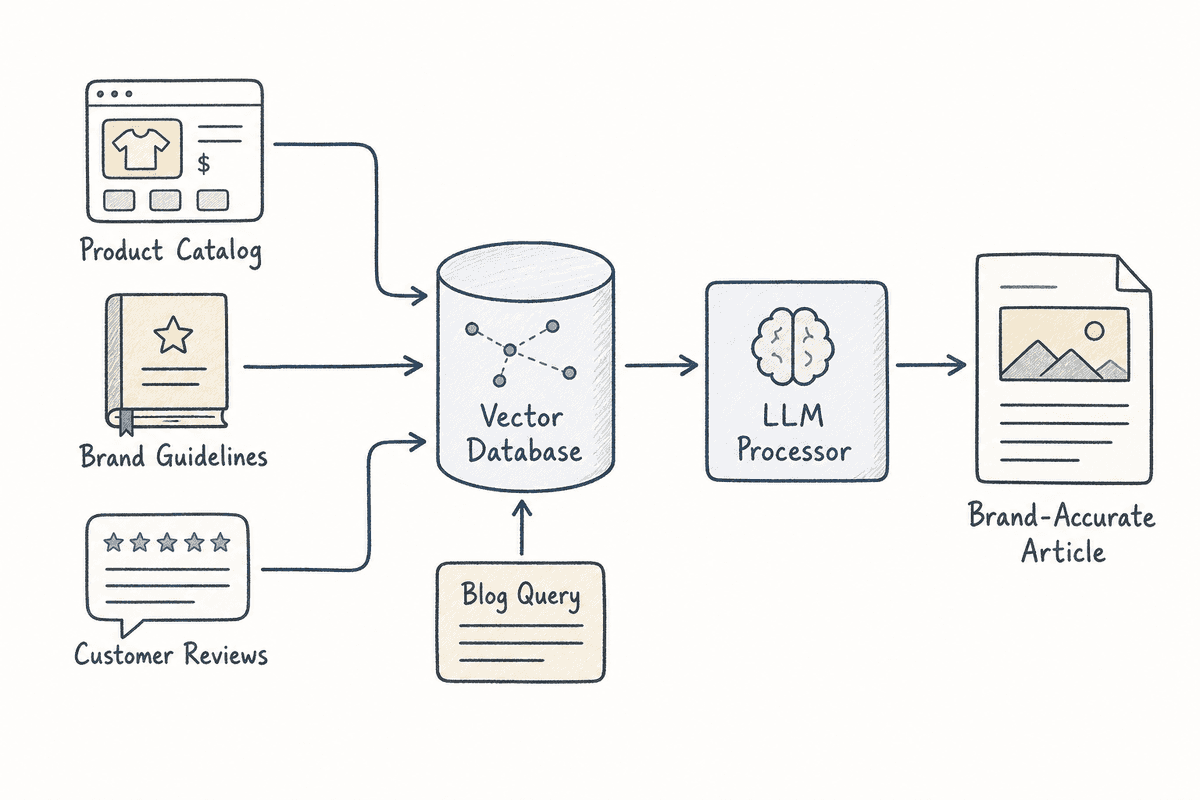
To scale effectively, e-commerce brands use RAG architectures. They feed their entire product catalog, brand guidelines, customer reviews, and historical high-performing blog posts into a vector database. When the AI generates a new post, it first retrieves the specific product details from this database. This ensures the output actually sells your product, rather than just educating the reader on the general concept.
3. Hyper-Personalized Content Hubs
AI marketing allows e-commerce brands to move beyond broad, one-size-fits-all campaigns and create highly targeted content hubs 2. Instead of writing one massive guide on "How to Choose a Mattress," brands use AI to spin up dozens of specific, localized, or persona-driven variations: "How to Choose a Mattress for Side Sleepers with Lower Back Pain," or "The Best Cooling Mattresses for Florida Summers."
By automating the drafting of these long-tail variations, brands capture highly specific commercial intent that has much higher conversion rates than broad, top-of-funnel traffic.
The Problem with the "Auto-Blogger" Model
If tools like Frizerly promise to handle all of this automatically, why seek alternatives? The primary issue lies in the lack of editorial control and the risk of index bloat.
When an AI tool operates as a black box—crawling your site and directly publishing to your CMS without human intervention—several risks emerge:
- Hallucination and Liability: In verticals like supplements, skincare, or technical equipment, stating an incorrect fact can lead to returns, damaged trust, or regulatory issues. Fully automated tools struggle to distinguish between a marketing claim and a medical claim.
- Cannibalization: An auto-blogger might notice "running shoes" is a good topic and publish five articles on variations of that theme over a month. This can confuse search engines, splitting link equity and causing your pages to compete against each other.
- The "Sea of Sameness": If your brand sounds exactly like the AI baseline, you lose your unique tone of voice. Auto-publishers often fall back on predictable structures, overused phrases, and a synthetic tone that sophisticated buyers immediately recognize and distrust.
- Ignoring AI Engine Dynamics: Publishing a post solely for Google's traditional index misses half the battle. If you aren't monitoring how ChatGPT or Gemini processes that information, you are flying blind. BeVisible turns missing mentions into published work, whereas a blind auto-publisher just guesses what topics might drive traffic.
When you weigh these risks, it becomes clear that the best Frizerly alternatives aren't necessarily other auto-publishers. Instead, the alternative is a modular AI content stack.
Strategic Frizerly Alternatives: The Modular Approach
To scale an e-commerce blog to significant revenue, you need tools that accelerate workflows rather than entirely replacing them 1. Here is how you can build a more robust, controlled, and effective alternative to a single auto-publishing tool.
Alternative 1: The Visibility-Led Content Engine (BeVisible + Specialized LLMs)
Instead of letting an AI guess what to write based on broad SEO metrics, base your content calendar on actual AI visibility data.
How it works: Use BeVisible to monitor how AI assistants answer the specific prompts your buyers are using. Track ChatGPT, Perplexity, AI Overviews, and Gemini. When BeVisible alerts you that an AI engine is citing a competitor for a key product category—or providing an outdated answer because no good source exists—you have found your content opportunity.
You take that specific gap and feed it into a specialized LLM workflow (like Claude 3.5 Sonnet or a customized GPT) along with your product data. The prompt isn't "Write a blog post." The prompt is: "AI search engines are currently recommending [Competitor] for the query [Buyer Prompt] because they highlight [Feature]. Write a comprehensive, 1,500-word article about [Topic] that explicitly details our [Specific Feature], formatted with clear H2s and bullet points so it is easily parsed by AI retrieval systems."
This approach ensures every piece of content you publish serves a distinct, measurable purpose: capturing mindshare in generative AI answers.
Alternative 2: Headless CMS + API-Driven Workflows
For e-commerce brands running on Shopify Plus or custom tech stacks, integrating directly with OpenAI or Anthropic APIs offers infinitely more control than a third-party auto-blogger.
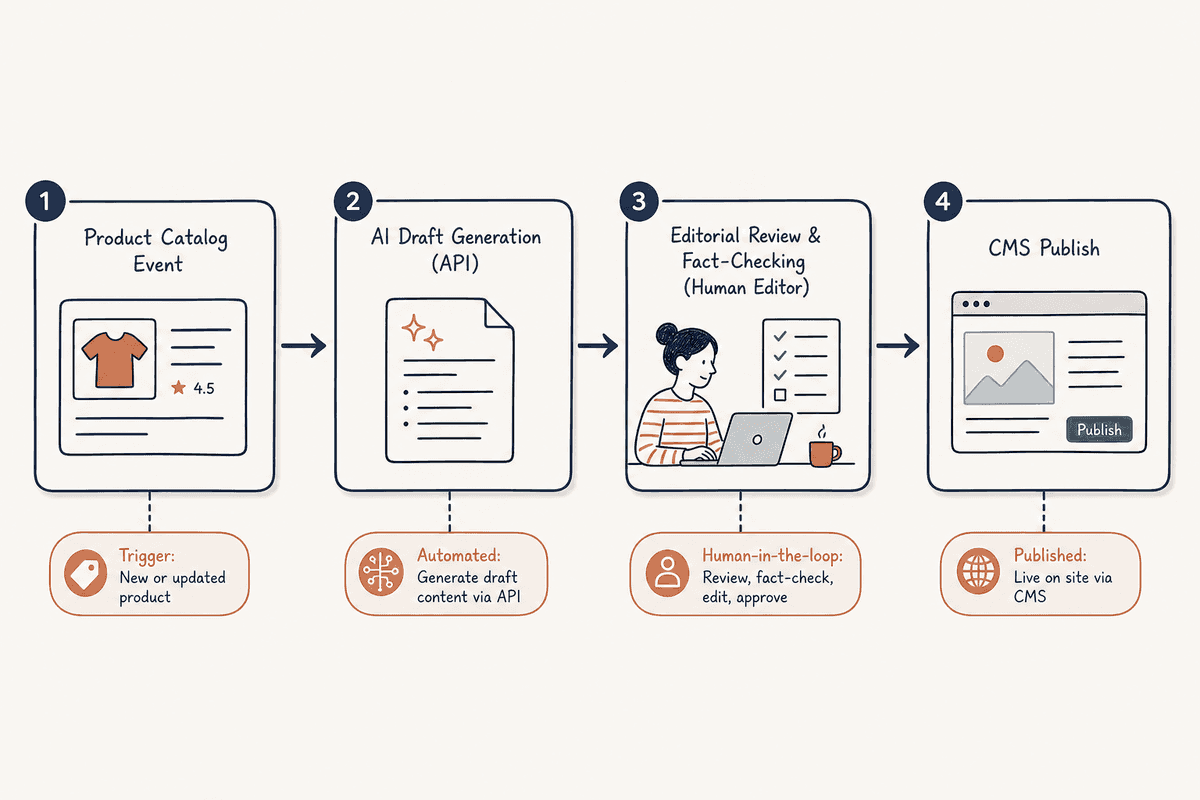
How it works: Using a headless architecture, your development team can script workflows where product data automatically populates content briefs. When a new product category is launched, the system triggers a request to the API to draft a cluster of supporting blog posts.
These drafts are not published immediately. They are pushed to a "Drafts" queue in your CMS (like Contentful or Sanity). A human editor reviews the content, injects brand-specific anecdotes, verifies the technical claims, and hits publish. This marries the speed of AI generation with the quality assurance of human oversight. It's particularly useful if you are managing complex technical architectures, where you might also be navigating Single-Page Application SEO: What Works in 2026?.
Alternative 3: AI-Augmented Editorial Teams
Many $1M+ e-commerce brands prefer to keep the writing in-house but use specialized AI tools to dramatically increase their team's output 3.
How it works: Writers use tools like Jasper or Writer.com, which allow for strict brand voice guidelines, custom style guides, and terminology databases. The AI acts as a co-pilot. The writer outlines the piece, and the AI expands on the bullet points, drafts the metadata, and formats the HTML. This approach ensures the brand's unique point of view is maintained while still realizing a 3x to 5x increase in content production speed.
Building an AI Content Workflow That Ranks in Traditional and AI Search
If you are abandoning the idea of a simple "set it and forget it" tool, you need a reliable process. Here is a step-by-step framework for scaling your e-commerce blog using a modular AI approach.
Step 1: Discovering Buyer Questions and Visibility Gaps
Do not rely solely on traditional keyword volume. Traditional metrics often lag behind actual consumer behavior. Instead, look at customer support tickets, live chat logs, and AI visibility monitoring.
If your BeVisible dashboard shows that ChatGPT consistently fails to recommend your brand when users ask "how to maintain carbon steel pans," that is your priority topic. You know the exact prompt, you know the current answer being generated, and you know which competitor is winning the citation.
Step 2: Structuring the Master Brief
An AI model is only as good as the context you provide. A robust content brief for an LLM should include:
- The Target Query: The exact buyer question you are trying to answer.
- The Brand Objective: "Position our Pan X as the easiest to maintain."
- Required Inclusions: Specific product specs, links to internal category pages, and mentions of your warranty.
- Formatting Constraints: "Use standard markdown, short paragraphs, and include a step-by-step numbered list for the maintenance process."
Step 3: Drafting with Context
Execute the draft using your chosen LLM. If you are doing this at scale, you might have hundreds of these running via an API.
Pro Tip: Do not ask the AI to write the entire 3,000-word article in one prompt. LLMs degrade in quality and focus as the output length increases. Instead, prompt section by section. Ask it to write the introduction. Then provide the specific data for H2 number one and ask it to write that section. This "chained prompting" drastically reduces hallucinations and improves depth.
Step 4: The Human-in-the-Loop Polish
This is where the magic happens and where auto-bloggers fail. A human editor steps in to:
- Inject Nuance: Add a real customer quote or a brief story about how the founder designed the product.
- Verify Links: Ensure internal links point to the correct product pages and How to Build an SEO Landing Page (7-Step Guide) strategies are respected.
- Format for Readability: Break up text walls, add custom imagery, and ensure the UI/UX of the blog post is engaging.
Step 5: Measuring and Iterating
Once published, you measure success differently. You look at organic traffic from Google, yes, but you also return to your visibility monitoring tools. Does ChatGPT now cite your new article when asked the target prompt? If not, the content may need to be restructured to be more easily parsed by retrieval systems.
A Mini-Case Study: Scaling a D2C Blog Safely
Consider a D2C brand selling high-end espresso machines. In an effort to capture long-tail traffic, they initially experimented with a fully automated AI publishing tool. They fed the tool their sitemap, and it began publishing five articles a day on coffee roasting, brewing temperatures, and water quality.
Within two months, their organic impressions spiked, but their conversions flatlined. Worse, their customer service team started receiving angry emails because one of the automated blog posts recommended using a specific type of descaling acid that actually eroded the internal boiler of their flagship machine. The AI had scraped generic advice from the web that did not apply to their specific product materials.
They immediately halted the auto-blogger and shifted to a modular approach. They used BeVisible to discover that buyers were frequently asking AI engines, "Which espresso machines under $1,500 have dual boilers?" The AI engines were recommending a competitor.
The brand's content team created a highly detailed, accurate comparison article specifically answering that prompt, highlighting their dual-boiler model. They used an LLM to outline the piece and draft the technical comparisons based strictly on a provided spec sheet. A human expert reviewed the draft, added original photography, and published it. Within three weeks, BeVisible alerted them that Perplexity and AI Mode had begun citing their new article as the definitive source for that query. Traffic volume was lower than the automated spam, but the conversion rate jumped by 400%, and the brand's reputation remained intact.
The Financial Tradeoffs: AI vs. Agencies
When considering how to scale your blog, cost is always a factor. Relying entirely on traditional agencies can be expensive, especially if you need hundreds of category-supporting articles. As explored in SEO Charges UK: Agency Rates vs Automation (2026), the hybrid model usually offers the best ROI.
Paying an agency just to write basic, top-of-funnel content is becoming obsolete. Instead, brands are reallocating that budget toward strategic oversight, technical SEO, and visibility monitoring, while using AI to handle the heavy lifting of raw word generation. You are no longer paying for the words; you are paying for the strategy, the prompting architecture, and the editorial review.
If you run a complex e-commerce site, perhaps relying heavily on JavaScript frameworks, the technical delivery of your content is just as vital as the words themselves. An auto-blogger won't help you if your site structure is invisible to crawlers. Ensuring your foundation is solid—which you can learn more about in SEO for Single Page Applications: A 5-Step Guide (2026)—is a prerequisite before scaling AI content.
Common Myths About AI E-commerce Content
As AI adoption scales, several pervasive myths continue to misguide e-commerce founders.
Myth: Google penalizes AI content. Reality: Google penalizes unhelpful, spammy content. Google's official guidelines explicitly state that the appropriate use of AI is not against their guidelines, provided the content is created to help people, not manipulate search rankings. If your AI content is deeply researched, fact-checked, and provides a better answer than the competition, it will rank.
Myth: AI can replicate your brand voice perfectly with just a URL. Reality: While tools claim they can "learn your website," inferring a nuanced brand voice from a few product pages is incredibly difficult for an LLM. True voice replication requires fine-tuning a model on thousands of examples of your best writing or using strict, highly detailed system prompts that define your tone, vocabulary, and structural preferences.
Myth: If I publish enough AI content, I will eventually capture the market. Reality: Volume without direction is just noise. In 2026, the internet is flooded with mediocre AI content. The winners are not those who publish the most; the winners are those who publish the most relevant answers to specific visibility gaps. This is why tools that turn missing mentions into published work are outperforming tools that just generate random blog posts.
FAQs on Using AI for E-commerce Blogs
How do I stop AI from making up facts about my products?
You must use a Retrieval-Augmented Generation (RAG) approach or strict prompting frameworks. Do not rely on the LLM's internal memory (its pre-training data) for facts. Provide the exact specs, pricing, and features in the prompt and instruct the AI: "Rely exclusively on the provided text for product specifications. Do not invent or infer any features not explicitly listed."
Can AI write product roundups and comparison posts?
Yes, but they require careful orchestration. E-commerce platforms often use AI to aggregate reviews and summarize the pros and cons of various products. However, if you are comparing your product to a competitor, the AI must be fed accurate data about both products to avoid publishing false claims that could lead to legal or reputational trouble. For specific platforms like Etsy, combining external tools with AI insights can be highly effective, as detailed in 7 Best Etsy SEO Tools to Boost Sales in 2026.
How do I measure the ROI of my AI content?
Traditional metrics like organic traffic, time on page, and conversion rate still apply. However, you must add AI Share of Voice (SOV) to your reporting. Track how often your brand is mentioned across major LLMs for your core non-branded keywords. A successful AI content strategy will result in a measurable increase in AI engine citations.
Moving Beyond Auto-Publishing
The desire to scale an e-commerce blog rapidly is justified. The mechanics of search and discovery have changed, and staying relevant requires high-cadence, high-quality publishing. However, the path to sustainable growth does not lie in handing the keys to a black-box auto-blogger.
By treating AI as a powerful component within a larger, visibility-driven strategy, e-commerce brands can scale their output without sacrificing quality. They can monitor the actual conversations happening in AI search engines, identify precisely where their brand is missing, and deploy augmented workflows to fill those gaps with precise, helpful, and authoritative content. This modular approach protects your brand reputation, maximizes your specific product advantages, and ensures you aren't just creating content for the sake of it, but creating content that actually gets cited by the engines driving modern commerce.