
Search for "Google AI Catalyst" today, and you will find a surprisingly fragmented landscape. You will see Devpost hackathons for enterprise partners, Reddit threads from early-career engineers dissecting interview processes, and press releases from B2B companies launching brand-new AI features.
For a busy SaaS founder, it looks like corporate noise. But dismissing it is a strategic mistake.
Google is actively deploying massive capital, specialized talent pipelines, and aggressive partner incentives to embed its AI stack (Vertex AI and Gemini) deep into the B2B ecosystem. This "catalyst" initiative is simultaneously changing how enterprise software is built, how engineering talent is trained, and—most importantly for growth teams—how buyers discover software through AI search engines.
If you want your SaaS platform to survive the shift from traditional search to AI-driven discovery, you need to understand what the Google AI Catalyst ecosystem actually is, how it affects your hiring, and how it dictates your visibility in AI Overviews.
Unpacking the "Google AI Catalyst" Ecosystem
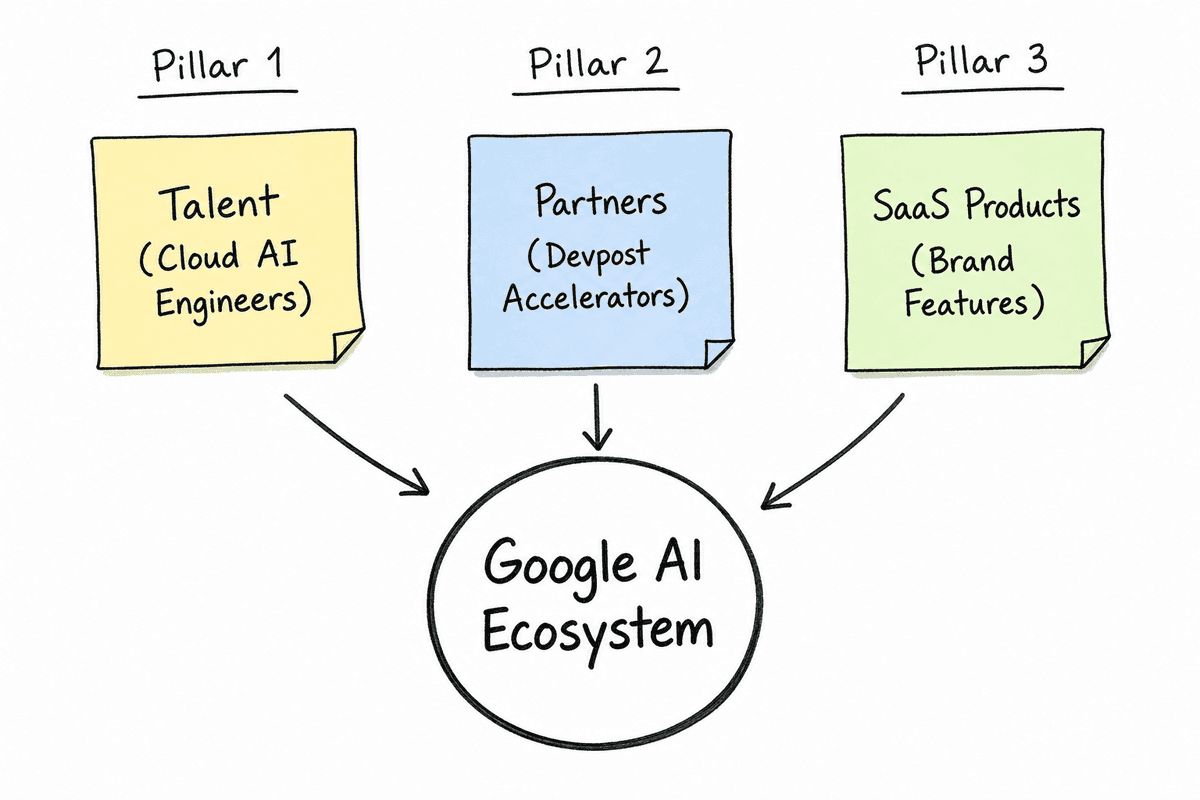
To understand the implications for your startup, you first have to decode what Google actually means by "Catalyst." The term is currently functioning as an umbrella for three distinct, but deeply connected, market movements.
1. The Talent Engine: Google Cloud AI Catalyst Program
If you look at engineering job boards, the most prominent use of the term is the Google Cloud AI Catalyst Program (often targeting Software Engineer II, Early Career roles).
Historically, Google ran the famous Google Brain Residency—a highly academic bridge program designed to turn top-tier STEM graduates (physicists, mathematicians, biologists) into elite machine learning researchers publishing at NeurIPS.
Today, the focus has shifted from pure academic research to commercial deployment. The current Cloud AI Catalyst programs are designed to train engineers specifically on integrating Google's cloud infrastructure and AI models into real-world applications. For SaaS founders, this is a massive signal: Google is subsidizing the training of the next generation of applied AI engineers, and they are learning to build natively on Google's stack.
2. The Partner Accelerator: AI Partner Catalyst
Google isn't just training internal engineers; they are aggressively courting Independent Software Vendors (ISVs). Initiatives like the AI Partner Catalyst challenge (often hosted on platforms like Devpost) are designed to accelerate innovation among B2B startups.
These programs offer cloud credits, direct mentorship from Google engineers, and co-marketing opportunities for SaaS companies willing to build their AI features on Vertex AI rather than defaulting to OpenAI or Anthropic.
3. The Naming Collision: B2B SaaS Features
Because of the heavy marketing around these initiatives, "Catalyst" has become a trending naming convention in the SaaS world. Recent press releases show companies like Castor and Foresite launching entirely new AI-powered modules branded as "Catalyst" platforms (e.g., "Castor Launches Catalyst Built with Google Cloud AI").
If you are planning to name your new AI feature "Catalyst," you are now competing directly with Google's own program pages and heavily funded enterprise startups for search visibility.
Why SaaS Founders Must Pay Attention to the Catalyst Push
When a trillion-dollar company decides to catalyze an ecosystem, the ripple effects hit startups quickly. Here is why this specific push matters to your bottom line.
The Baseline for Product Expectations Has Changed
Through partner catalyst programs, Google is essentially lowering the barrier to entry for enterprise AI. By providing pre-packaged machine learning models, secure data enclaves, and ready-to-use APIs, they are allowing your competitors to ship advanced AI features in weeks rather than months.
Buyers no longer consider natural language querying, predictive analytics, or automated reporting to be "premium" features. They are rapidly becoming table stakes. If your SaaS platform isn't leveraging an ecosystem like Google's to stay at feature parity, your churn rate will eventually reflect it.
The Shift in Engineering Hiring
As engineers cycle out of Google's early-career Catalyst programs, they disperse into the broader startup ecosystem. These developers bring a strong bias toward Google's tooling. If your startup builds on an entirely agnostic or competing stack, you may face friction in onboarding this specific pool of elite, applied-ML talent.
Conversely, aligning your startup with the Google Cloud ecosystem makes it significantly easier to recruit engineers who already know the nuances of Vertex AI deployment.
The Hidden Threat: AI Search Visibility
While talent and product features are critical, the most immediate threat to SaaS founders is how the AI Catalyst era is fundamentally breaking traditional go-to-market strategies.
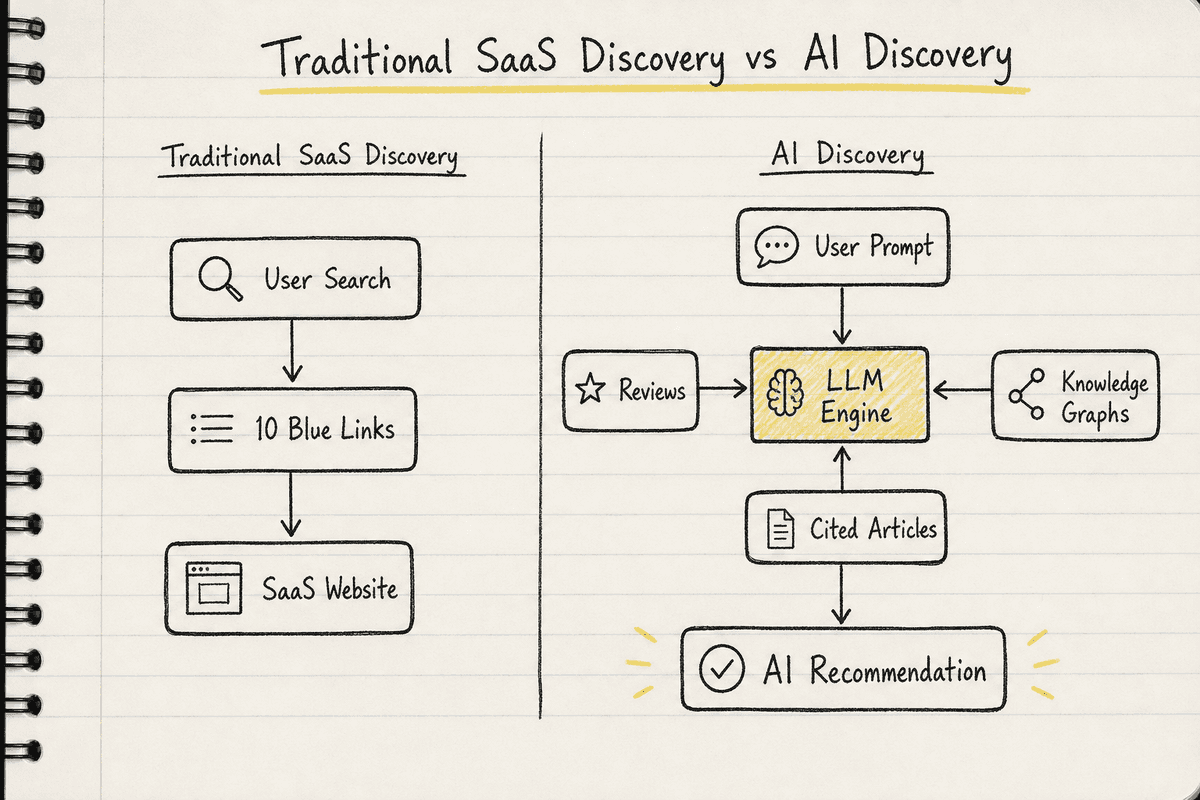
Google is training millions of users—and engineers—to rely on AI assistants. Buyers are no longer typing "best CRM software for healthcare" into a search bar and clicking through ten blue links. They are asking Gemini, Perplexity, and Google's AI Overviews highly specific, conversational questions.
When a hospital administrator asks Gemini, "Which clinical trial SaaS platforms integrate natively with Google Cloud AI?", the LLM synthesizes an answer based on its training data, knowledge graphs, and cited sources.
If your marketing team is still only optimizing for traditional keyword volume, you are invisible in this new paradigm.
Where B2B Marketing Teams Fail
Most growth teams treat AI Answer Engines like traditional search engines. They assume that if they rank #1 on traditional Google, they will automatically be cited by Gemini or ChatGPT. This is a fatal assumption.
LLMs recommend software based on entirely different criteria:
- Entity Confidence: Does the AI clearly understand what your software does, who it is for, and how it integrates with major ecosystems like Google Cloud?
- Consensus: Do authoritative third-party sites, reviews, and directories agree on your software's capabilities?
- Contextual Depth: Is your technical documentation, API reference, and use-case library easily parsable by an AI crawler?
If your website relies on heavy, client-side rendering without proper server-side fallbacks, AI bots cannot even read your feature pages. (If your dashboard or marketing site is built this way, you urgently need to review Single-Page Application SEO: What Works in 2026?).
The SaaS Founder's Catalyst Checklist (Actionable Framework)
To survive and thrive in an ecosystem dominated by AI catalysts, you must bridge the gap between product integration and AI visibility. Here is a step-by-step framework to align your startup.
Step 1: Decide Your Infrastructure Strategy
Before marketing your AI capabilities, you need to decide if you are building proprietary models or leaning into an ecosystem like Google's.
If you join a partner accelerator, you gain speed to market and co-marketing leverage. If you build agnostic pipelines, you avoid vendor lock-in but shoulder the entire R&D burden.
Step 2: Shift to Answer Engine Optimization (AEO)
You must ensure that language models actually understand your product’s relationship to these AI trends. Update your product pages to explicitly state your integrations, the specific models you use (if advantageous), and the concrete business outcomes you drive.
Don't just write for humans; structure your content so AI can parse it. Use clear, semantic HTML. Build dedicated landing pages for specific integration use cases. If you need a framework for structuring this content, follow a proven How to Build an SEO Landing Page (7-Step Guide) to ensure both traditional search and AI bots can index your value proposition.
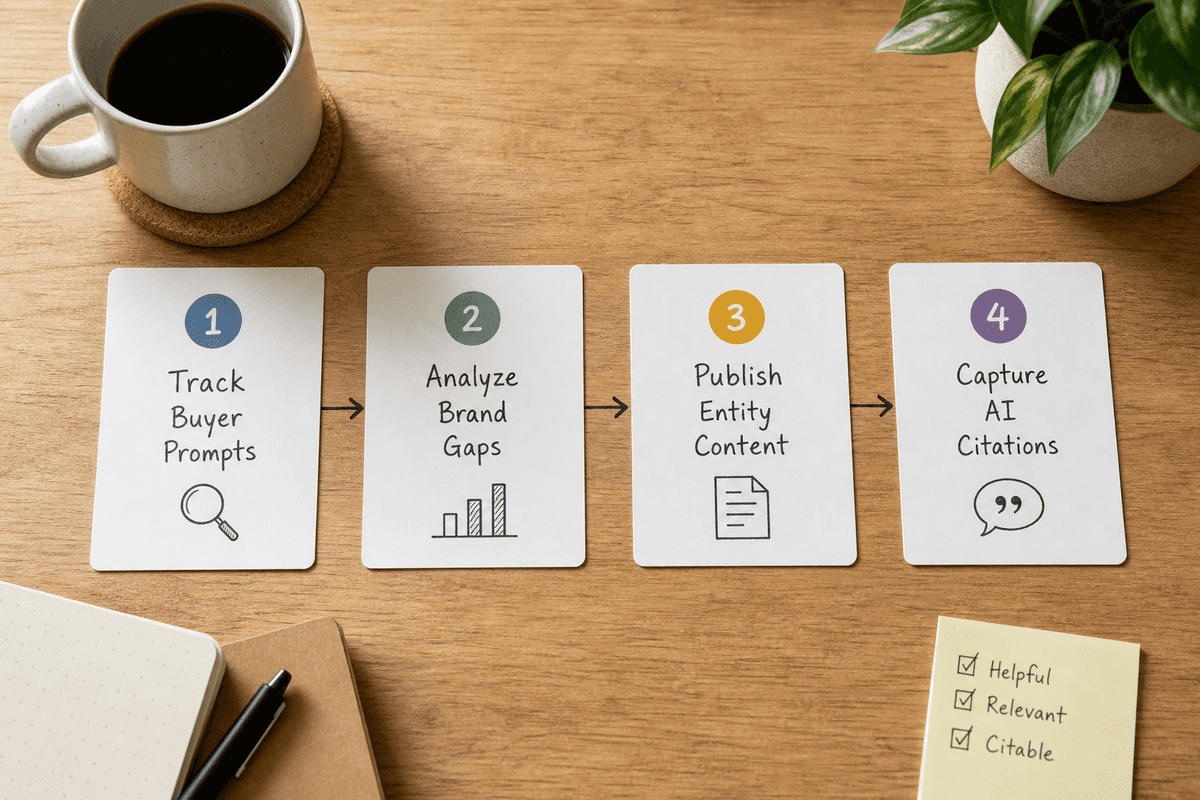
Step 3: Monitor Your Brand’s AI Mentions Relentlessly
You cannot improve your AI visibility if you do not know where you currently stand. When a buyer prompts an AI with a bottom-of-the-funnel question, you need to know if your competitors are being recommended instead of you.
This is where specialized tooling becomes necessary. BeVisible helps teams monitor how AI assistants answer buyer questions, which brands they recommend, and which sources they cite. It tracks ChatGPT, Gemini, Perplexity, AI Mode, and AI Overviews across buyer prompts, then turns visibility gaps into evidence-backed opportunities, articles, review, scheduling, and publishing work.
If you discover that Gemini consistently recommends a competitor because it cites an outdated Reddit thread, you can immediately commission targeted content to correct the narrative.
Step 4: Keep Your Content Strategy Opinionated
AI models are incredibly good at summarizing generic information. To ensure your brand is cited as an authoritative source, your content must provide novel insights, proprietary data, and strong opinions that an LLM cannot generate on its own.
If you write generic fluff, the AI will absorb it without crediting you. If you write highly specific, data-backed industry analysis, the AI is forced to cite you as the source of the insight. Staying ahead of these shifts requires constant education; make sure your marketing leadership is following the 11 Best SEO Blogs Every SaaS Founder Needs (2026).
Edge Cases and Failure Modes
As you adapt to the Google AI Catalyst ecosystem, watch out for these common failure modes:
- The "Catalyst" Branding Trap: As mentioned earlier, do not name your new AI feature "Catalyst." You will immediately cannibalize your own search visibility by competing against Google's official documentation and high-authority SaaS companies that already own the term.
- Gating Technical Documentation: Many SaaS companies put their best API documentation and integration guides behind a login or a "Request a Demo" wall. If an AI crawler cannot access your documentation, it cannot confidently recommend your software to a developer asking technical questions in ChatGPT or Gemini.
- Ignoring Non-Google Ecosystems: While Google's Catalyst push is massive, over-indexing purely on Gemini and Vertex AI visibility leaves you vulnerable if a buyer prefers Perplexity or OpenAI's ecosystem. Ensure your visibility monitoring spans across all major LLMs.
FAQs on Google's AI Programs
Is the Google Cloud AI Catalyst program a paid position? Yes. The engineering track of the Google Cloud AI Catalyst program (often targeting Software Engineer II, Early Career) is a full-time, paid role. It is designed to bridge the gap for talented engineers moving into specialized machine learning deployment.
Can my startup join the AI Partner Catalyst? Generally, yes, but it requires active participation in the Google Cloud ecosystem. Startups typically need to be enrolled in Google Cloud Partner Advantage and actively building scalable B2B solutions leveraging tools like Vertex AI or Gemini to qualify for specific devpost challenges or accelerator funding.
Does building on Google Cloud AI improve my AI Search Visibility? Not automatically. While building on Google's stack gives you access to co-marketing and marketplace advantages, Gemini and AI Overviews do not automatically rank your software higher just because you use Google Cloud. You still must actively manage your entity SEO, structure your content for LLMs, and monitor your AI citations to ensure visibility.
The AI Catalyst era is no longer an abstract concept relegated to academic research papers or elite developer hackathons. It is fundamentally rewriting how enterprise software is built, funded, and discovered. Your success in this new landscape depends entirely on your ability to integrate swiftly and monitor your visibility relentlessly.