
When a high-intent software buyer prompts Gemini or ChatGPT with a hyper-specific question like, "is there a hands free alternative to koalawriter?", the resulting AI output dictates market share. If you are a competitor in the AI writing space and your brand is missing from that answer, you have a zero percent visibility score for a direct purchasing decision.
Buyers are bypassing traditional search engine results pages entirely. Instead of sifting through ten blue links and affiliate blogs, they are asking conversational AI assistants to evaluate workflows, compare pricing, and recommend specific tools. The AI synthesizes the answer, categorizes the options, and hands the buyer a shortlist.
Understanding how AI assistants answer these queries—and knowing how to optimize your brand to become the recommended solution—is the new baseline for B2B growth. By analyzing the exact output generative engines provide for this query, we can unpack the dominant alternatives, evaluate the mechanics of "hands-free" content generation, and blueprint a strategy for monitoring and capturing AI-driven visibility.
Deconstructing the "Hands-Free" Query
When users ask for a "hands-free" alternative to a popular content generation tool like KoalaWriter, AI engines immediately recognize that the user is trying to eliminate workflow friction. KoalaWriter is powerful, but it often requires a guided, step-by-step approach: configuring the outline, selecting the tone, and verifying the SERP analysis before hitting publish.
For portfolio managers running dozens of sites, this manual intervention creates a bottleneck.
AI models like Gemini categorize the "hands-free" intent into two distinct operational models:
- Total Automation (Autopilot): The user wants to input a target keyword or upload a massive CSV file, walk away, and have the system automatically generate, optimize, format, and push hundreds of articles directly to a Content Management System (CMS) via API.
- Voice-Driven (Dictation): The user wants to step away from the keyboard entirely, dictating thoughts, brainstorming aloud, and letting the AI format the spoken words into structured SEO content.
 Most B2B and programmatic SEO operators fall into the first category. They are looking for mechanical scale. The AI engines consistently recommend three specific platforms to answer this demand: Byword.ai, Autoblogging.ai, and SEOwriting.ai.
Evaluating the AI-Recommended Alternatives
If you are monitoring AI visibility for content automation software, you will quickly notice that these three tools monopolize the recommendations for automated publishing. Here is how the AI positions them to buyers, and the technical realities behind those recommendations.
Byword.ai: The Programmatic SEO Standard
When the AI identifies a user looking for industrial-scale automation, Byword is typically the first citation. It is engineered specifically for bulk generation and programmatic SEO deployments.
The workflow completely removes the human editor from the generation phase. Users upload a CSV containing thousands of keywords, secondary keywords, and intent modifiers. Byword processes this list asynchronously. It builds structurally sound articles mapped to the provided data and syncs them directly to WordPress, Webflow, or Ghost without requiring a single click per article.
Why AI recommends it as hands-free:
- It operates entirely on batch processing.
- Direct CMS integrations eliminate the need to copy, paste, or format markdown.
- Internal linking logic can be automated across the batch.
The trade-offs: Operating at this scale requires exact keyword mapping. If the initial CSV contains overlapping intents or ambiguous terms, Byword will dutifully generate cannibalizing content. The "hands-free" nature of the tool means quality control happens post-publication, which can be risky for single-brand domains with high domain authority.
Autoblogging.ai: The Affiliate Specialist
For users running portfolio affiliate sites, Autoblogging.ai surfaces as the primary recommendation. AI assistants highlight this tool because it minimizes user input for highly specific, complex content types like Amazon product roundups and structured reviews.
Instead of requiring the user to prompt the AI on how to structure a "Top 10" list, Autoblogging relies on rigid, pre-configured workflows. A user drops in a list of product URLs or broad topic clusters, and the system executes the scraping, summarizing, and formatting automatically.
Why AI recommends it as hands-free:
- 1-click generation features specifically built for affiliate marketers.
- Heavily automated scraping capabilities that pull live data without manual research.
- Automated feature comparison tables built directly into the output.
SEOwriting.ai: The High-Speed Budget Option
SEOwriting.ai bridges the gap between KoalaWriter's quality focus and Byword's massive scale. AI engines position it as the best alternative for bulk creators on a tighter budget.
It allows operators to queue up dozens of articles, apply broad configuration rules (like tone, image generation frequency, and formatting preferences), and execute the batch. While it still requires slightly more configuration than a raw CSV upload, it requires far less manual intervention per article than standard AI writers.
Why AI recommends it as hands-free:
- Streamlined batch queueing system.
- Native 1-click WordPress publishing.
- Lower price floor for bulk generation compared to enterprise programmatic tools.
If you are evaluating these tools for an agency setting, understanding the cost disparity between manual oversight and full automation is critical. To contextualize these operational costs, you can review current industry baselines in our guide on SEO Charges UK: Agency Rates vs Automation (2026).
The Hidden Lesson: AI Visibility and Market Share
Analyzing the features of Byword or SEOwriting.ai is only half the equation. The more critical takeaway for B2B growth teams is how we know these are the recommended tools.
We know because we track the AI prompts.
If your company developed a bulk AI writing tool that competes with SEOwriting.ai, and a buyer asks Gemini for a "hands-free alternative to Koalawriter," your product must be in that output. If the AI returns a detailed comparison of Byword, Autoblogging, and SEOwriting, and omits your brand, you have lost the prospect before they ever reached a search engine.
 This is the core of AI visibility monitoring. B2B marketing teams can no longer rely solely on traditional rank tracking. You must measure how ChatGPT, Gemini, Perplexity, and Google's AI Overviews answer your target audience's specific, conversational questions.
The Mechanics of an AI Visibility Gap
An AI visibility gap occurs when an AI assistant's synthesized answer fails to mention your brand for a highly relevant, commercial intent query. In the provided SERP insights for this specific query, the AI's response yielded a visibility score of zero for competing but unmentioned brands.
This happens for several reasons:
- Weak Entity Association: The AI's training data does not strongly associate your brand entity with the concept of "hands-free" or "bulk automation."
- Lack of Semantic Mentions: Your existing site content relies on generic marketing jargon rather than the specific vocabulary users and AI engines use (e.g., using "workflow optimization" instead of "hands-free bulk publishing").
- Citation Deficits: The AI cross-references authoritative sources to build its answers. If highly ranked software review sites, technical blogs, and comparison matrices do not mention your tool alongside KoalaWriter, the AI will not either.
To stay ahead of these shifts and understand how technical optimization impacts entity recognition, growth teams need to consistently monitor authoritative industry analysis. A curated list of resources can be found in our breakdown of the 11 Best SEO Blogs Every SaaS Founder Needs (2026).
Converting Visibility Gaps into Published Work
Discovering that your software is missing from an AI recommendation is only the diagnostic phase. The execution phase requires turning that missing mention into evidence-backed, published content designed to train the AI and capture the user intent.
When you identify a zero-visibility score for a query like "is there a hands free alternative to koalawriter," you must launch a targeted content offensive.
Step 1: Build the Dedicated Answer Page
Do not try to force this highly specific, long-tail query onto your homepage or a broad features page. Build a dedicated landing page or editorial post specifically engineered to answer this exact prompt.
The page must directly address the concepts the AI already associates with the query. If Gemini breaks the answer down into "Autopilot" and "Voice-Driven," your page should adopt a similar structural taxonomy. This makes it easier for the AI's retrieval-augmented generation (RAG) systems to parse and cite your page in future queries.
For a comprehensive framework on structuring these high-intent assets, reference our methodology on How to Build an SEO Landing Page (7-Step Guide).
Step 2: Engineer the Comparison Matrix
AI models love structured data. When an AI attempts to answer a "versus" or "alternative to" query, it looks for definitive comparisons.
Build a clear, un-styled markdown table on your page that compares your tool against KoalaWriter, Byword, and SEOwriting.ai. Focus on the exact metrics buyers care about in this context:
- Setup time per article.
- API integration depth.
- Batch processing limits.
- Intervention rate (how many clicks required to publish).
By providing this data cleanly, you increase the likelihood that a system like Perplexity will pull your proprietary data table directly into its generated answer, citing your domain as the source.
Step 3: Seed the Vocabulary
Adjust your product marketing to match the user's prompt. If your current positioning focuses on "AI writing assistance," pivot the language on your comparison pages to emphasize "hands-free automation," "zero-click publishing," and "autopilot content generation."
You are not just writing for a human reader; you are reinforcing semantic relevance for the Large Language Model's index. The more tightly your brand entity is clustered with these specific phrases in the training data, the higher your visibility score will climb during subsequent AI evaluations.
The Trade-offs of Unsupervised AI Publishing
While the allure of a hands-free workflow is strong, teams implementing tools like SEOwriting.ai or Byword must acknowledge the operational risks. Recommending a tool is one thing; deploying it responsibly is another.
Content Indexation and Crawl Budgets
Pushing thousands of hands-free articles to a CMS via API can severely impact your domain's technical health. Search engines allocate a specific crawl budget to your site based on its authority and historical update frequency. Flooding the architecture with 5,000 automated pages overnight often results in a massive indexation backlog. Search engines will crawl a fraction of the new URLs, assess the automated nature of the content, and potentially de-prioritize crawling the rest.
The Feedback Loop of Hallucination
When you remove the human from the generation process entirely, you invite compounding errors. If an AI model hallucinates a fact in an automated batch of 500 articles, you now have 500 factual inaccuracies permanently embedded in your site's architecture.
Worse, if these articles generate traffic and are eventually scraped by future AI models for training data, you contribute to a degenerative feedback loop where AI engines learn from their own unverified outputs.
Strategic Keyword Cannibalization
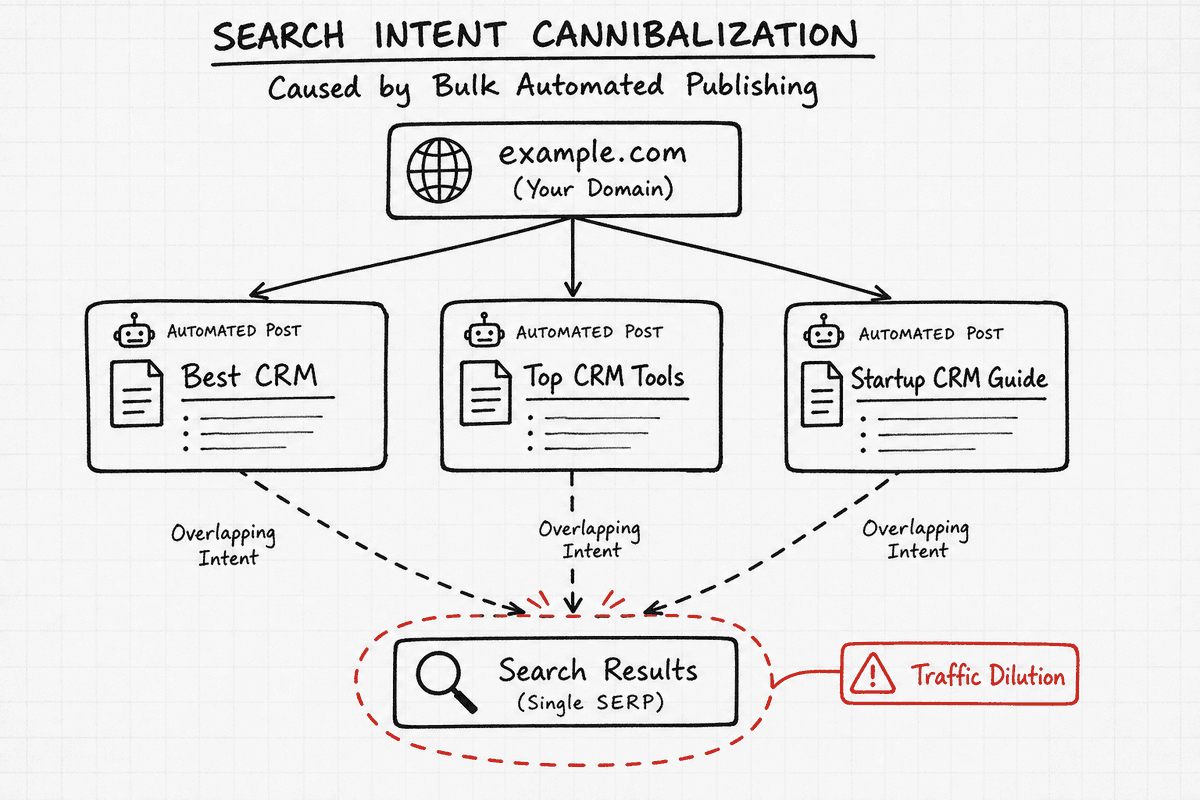
Hands-free tools execute commands blindly. If you upload a keyword list containing "best CRM for startups," "top CRM software for small business," and "startup CRM tools," a tool like Autoblogging.ai will generate three distinct articles. Because it operates on autopilot, it does not consolidate overlapping search intents. This results in keyword cannibalization, where your own automated pages compete against each other, diluting your site's overall ranking power.
Implementing a Hybrid Workflow
The most effective B2B marketing teams do not rely purely on hands-free automation, nor do they rely entirely on manual drafting. They build hybrid workflows that leverage the speed of tools like SEOwriting.ai while retaining rigorous editorial oversight.
- Automated Brief Generation: Use programmatic tools to extract SERP data, generate structural outlines, and map secondary keywords.
- Human-Guided AI Drafting: Use the generated briefs as inputs for tools that allow incremental generation, ensuring the narrative remains cohesive and aligned with the brand voice.
- Manual Fact-Checking and Formatting: Route the output through a subject matter expert for validation before pushing it to the CMS.
This approach sacrifices the instantaneous gratification of a "1-click" workflow but protects the domain from algorithmic penalties and maintains a standard of quality that builds actual trust with human buyers.
Frequently Asked Questions
Does SEOwriting.ai offer direct CMS integration?
Yes. One of the primary reasons AI engines recommend SEOwriting.ai as a hands-free alternative is its ability to connect directly to WordPress via a dedicated plugin or API, allowing users to queue bulk generation and publish natively without manual formatting.
How do I check my AI visibility score for specific commercial queries?
Monitoring AI visibility requires querying target prompts across multiple LLMs (ChatGPT, Gemini, Perplexity, Claude) and tracking brand mentions, sentiment, and citation frequency. Platforms dedicated to AI visibility monitoring automate this process, tracking performance over time and identifying gaps where competitors are being recommended instead.
Can programmatic SEO tools generate technical content accurately?
Currently, hands-free programmatic tools struggle with highly technical, niche B2B content. They excel at top-of-funnel informational queries and structured affiliate roundups. For complex software engineering topics, medical compliance, or nuanced financial analysis, unsupervised AI generation consistently produces superficial or inaccurate outputs.
Final Thoughts on AI Search Dynamics
The query "is there a hands free alternative to koalawriter" is a perfect microcosm of modern B2B search behavior. Buyers are outsourcing their software evaluation to AI engines. They are asking complex, multi-variable questions and expecting immediate, definitive recommendations.
If your growth strategy still revolves entirely around traditional search engine optimization and ignores how generative models synthesize answers, you are optimizing for a shrinking pie. The SaaS teams that will dominate their categories in the coming years are the ones actively monitoring these AI prompts, measuring their visibility gaps, and aggressively publishing the exact evidence the algorithms need to recommend them.