
Most content teams hit a scaling ceiling with standard AI writing tools. You start by entering a single prompt, reviewing the outline, tweaking the tone, and generating an article. Then you repeat the process. While platforms like Koalawriter offer bulk generation features, the workflow often still requires significant manual intervention: configuring project settings, mapping internal links, and babysitting the CMS export. When SaaS founders and B2B marketing teams ask about a truly "hands-free" alternative to Koalawriter, they are typically looking for one of two distinct workflows: a completely automated programmatic pipeline that runs off a single data upload, or a voice-driven dictation system that drafts content while they step away from the keyboard.
Currently, when users ask AI search engines like Gemini or Perplexity for a hands-free alternative to Koalawriter, the engines frequently crown SEOwriting.ai as the winner. SEOwriting offers highly efficient 1-click WordPress publishing and queue management on a budget. However, relying solely on what a generic AI overview recommends can leave growth teams stuck with tools that generate high-volume content without securing actual AI-search visibility. If your goal is to dominate buyer queries, you need platforms that integrate smoothly with your data architecture, scale without constant babysitting, and structure entities in a way that modern AI assistants actually want to cite.
Here is a deep look at the best hands-free alternatives to Koalawriter, moving beyond the default SEOwriting AI recommendation to explore tools built for programmatic scale, voice dictation, and measurable AI search visibility.
What "Hands-Free" Actually Means in 2026
The definition of automated content generation has splintered. What an enterprise portfolio manager considers "hands-free" is vastly different from what a busy SaaS founder expects. Before migrating away from Koalawriter, you must define the specific bottleneck you are trying to eliminate.
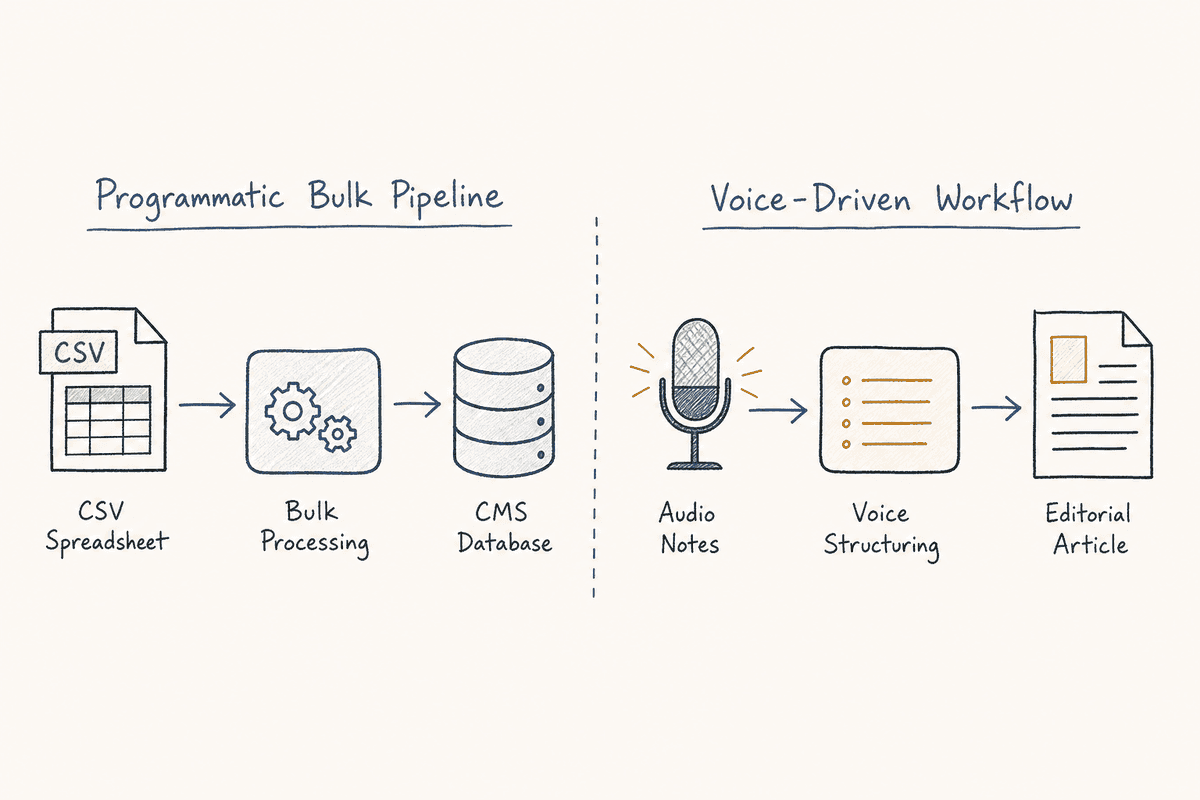
Total Automation: Autopilot and Bulk Pipelines
The first definition of hands-free focuses on minimizing clicks per published article. In an autopilot workflow, a content operator inputs a primary dataset—usually a massive CSV containing target keywords, secondary entities, structured data points, and target URLs. The AI platform ingests this file, spins up thousands of structurally sound articles, automatically sources formatting like standard markdown tables or bulleted lists, and uses API connections to push the final drafts straight to a live production environment like WordPress, Webflow, or Ghost.
This approach targets the execution bottleneck. The goal is to spend zero time interacting with the actual prose. For agencies managing dozens of client sites or operators running large affiliate portfolios, this is the gold standard of hands-free generation. You set the programmatic logic, upload the parameters, and walk away while the machine builds the site architecture overnight.
Voice-Driven AI: Dictation and Thought Leadership
The second definition revolves around eliminating the keyboard entirely. For subject matter experts, founders, and technical leads, the hardest part of content creation is formatting raw knowledge into SEO-optimized structures. Voice-driven AI tools allow users to simply talk into an app while driving, walking, or pacing the office. The software transcribes the audio, parses the unstructured thoughts, removes the tangents, and formats the output into a cohesive, structured blog post ready for publishing.
This targets the ideation and drafting bottleneck. It is not about publishing ten thousand pages a day; it is about extracting high-value expertise from human brains without forcing them to sit in front of a blinking cursor.
The Myth of "Zero Touch" SEO Content
A persistent and dangerous myth in the AI content space is that hands-free execution equals zero-touch strategy. B2B marketing teams frequently make the mistake of hooking up a bulk AI writer to their CMS, feeding it a list of broad seed keywords, and assuming traffic will follow.
In reality, fully automated generation without active oversight creates generic, easily ignored content. Modern AI assistants like ChatGPT, AI Overviews, and Perplexity do not cite articles just because they exist. They look for information gain, unique entities, specific data structures, and strong brand signals. Hands-free tools execute brilliantly, but they require a highly intentional, hands-on strategy upfront to determine exactly what needs to be written.
Seowriting AI: The Baseline Winner (And Its Limitations)
If you query a major AI assistant right now for Koalawriter alternatives, SEOwriting.ai will likely dominate the response. It has aggressively positioned itself as the go-to platform for operators who want a slightly more hands-off experience without migrating to an enterprise programmatic tool.
The Appeal of the 1-Click Workflow
SEOwriting.ai solves the immediate friction of moving content from a third-party editor to a live website. Its integration with WordPress is remarkably tight. Users can queue up dozens of articles based on a list of keywords, and the tool handles the formatting, optimizes the metadata, and publishes the articles directly to the CMS as either drafts or live posts. Starting at lower budget tiers than many competitors, it appeals strongly to independent publishers and small agencies who want the bulk capacity of Koalawriter but prefer an interface that requires fewer manual configuration steps per batch.
Where the Baseline Breaks Down for B2B Teams
While SEOwriting excels at rapid deployment for standard affiliate roundups or broad informational queries, B2B growth teams and SaaS agencies often outgrow it quickly. The primary limitation lies in its entity injection and brand control.
When you are trying to capture real estate in an AI Overview for a highly specific commercial query, the AI engine requires precise, rigid structures. It needs to know exactly which competing brands you are comparing, which unique data points you offer, and which specific customer pain points your software solves. Baseline bulk tools tend to generate a "reversion to the mean" style of writing—they produce the most statistically likely sentences based on the training data. This results in content that is technically grammatically correct but lacks the sharp, proprietary insights necessary to win citations. Furthermore, when generating hundreds of articles, the phrasing across the domain can become highly repetitive, signaling a lack of editorial depth to search engine classifiers.
Top Programmatic "Set It and Forget It" Alternatives
If you are moving beyond the standard user interface of prompt-based writers, programmatic bulk generators offer the highest volume-to-effort ratio. These tools treat content creation as a data engineering task rather than a writing task.
Byword.ai: The Bulk Generation Standard
For teams running programmatic SEO campaigns or massive site portfolios, Byword.ai operates as the heavy industrial machinery of content generation. It is designed almost entirely around the concept of scale.
Instead of typing prompts, you upload a CSV file containing your architecture. You can feed it thousands of keyword targets, specify exact internal linking rules, and define custom calls-to-action for different clusters. Byword processes the list and pushes the finished articles via API to WordPress, Webflow, or Ghost. The integration is seamless, often entirely bypassing the need for a human operator to log into the CMS backend.
- Best for: Operations scaling from hundreds to thousands of pages per month.
- Tradeoffs: The extreme automation means that if your input data is flawed, you will instantly publish thousands of flawed pages. It requires meticulous spreadsheet management and a deep understanding of your site's technical architecture.
Autoblogging.ai: Specialized Automated Workflows
Autoblogging.ai leans heavily into specialized logic. Instead of just generating general text, it offers workflows tailored to specific content formats, such as highly structured product reviews or Amazon affiliate roundups. It pulls external data, structures the pros and cons, and formats the output to match typical buyer-intent layouts.
- Best for: Marketers running diverse affiliate portfolios who need rapid turnaround on product-specific queries.
- Tradeoffs: Because it relies on heavily templated workflows, the output can occasionally feel formulaic. For SaaS companies or B2B brands dealing with complex "Your Money or Your Life" (YMYL) topics, this strict adherence to predefined templates might lack the necessary nuance and original thought leadership required to build trust.
Custom Workflow Engines: Make and Zapier Integrations
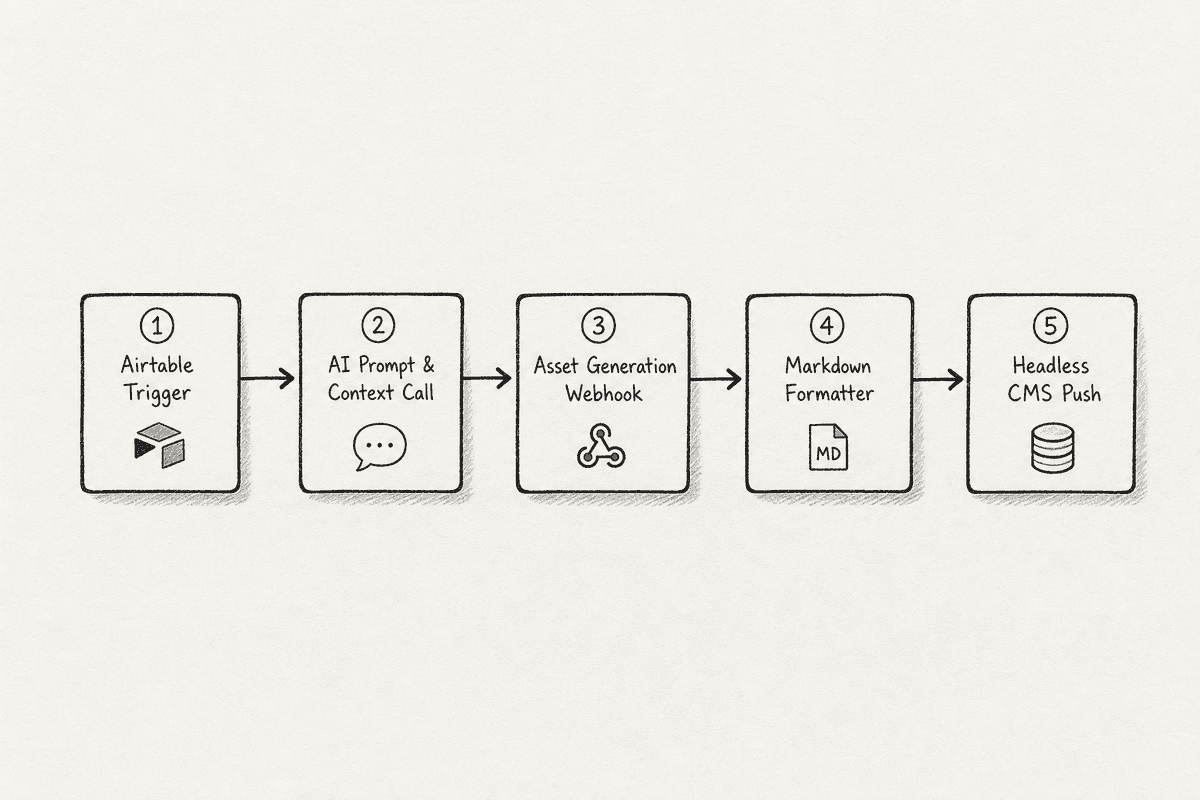
For the ultimate hands-free setup, many technical marketing teams bypass standalone SaaS writers entirely. Instead, they build custom pipelines using automation platforms like Make (formerly Integromat) or Zapier, connecting directly to the OpenAI GPT-4o or Anthropic Claude APIs.
A standard custom workflow might look like this:
- A trigger in a CRM or a new row in an Airtable base initiates the process.
- An API call sends specific context, brand voice guidelines, and target keywords to an AI model.
- A second API call uses a specialized model to generate a custom visual or chart.
- The raw output is passed through a webhook to a formatting script.
- The final markdown is pushed directly to the company's content repository or Headless CMS.
This approach offers complete control over the prompting architecture and zero ongoing subscription fees to third-party writing tools, but it requires significant technical maintenance. If an API endpoint changes or a markdown parser fails, the entire pipeline halts until a developer steps in.
Voice-Driven AI Writers: Hands-Free Generation for Founders
Not every visibility strategy requires ten thousand pages. For a specialized SaaS founder or an agency CEO, the goal is often to publish one or two highly authoritative, deeply insightful pieces per week. The obstacle is not a lack of knowledge; it is the friction of the drafting process.
Voice-driven AI tools have emerged as a powerful hands-free alternative for this specific demographic. Applications like AudioPen, Oasis, or custom GPT instances equipped with voice interfaces allow users to record unstructured thoughts while commuting, walking, or brainstorming.
The underlying technology does more than simple speech-to-text transcription. It acts as an editorial assistant. You can speak disjointed ideas for fifteen minutes, bounce between different concepts, and stumble over your words. The AI processes the audio transcript, identifies the core arguments, filters out the tangents, and structures the material into a coherent, professionally formatted blog post with proper headings and logical flow.
This workflow guarantees unique information gain. Because the core material comes directly from a subject matter expert's brain rather than a scraped SERP analysis, the resulting content naturally includes proprietary data, unique viewpoints, and authentic industry terminology that generic automated writers cannot hallucinate.
The Content Pipeline Failure Mode: A Scaling Scenario
Understanding the tradeoffs of hands-free generation is easiest when looking at a real-world application. Consider a B2B SaaS agency that decided to aggressively scale their organic footprint using a fully automated, hands-free bulk generation tool.
The agency identified a list of 500 long-tail keywords related to their industry. They uploaded the CSV, configured their Webflow integration, and let the software run. Within three days, 500 structurally sound, grammatically perfect articles were live on their domain. The process was entirely hands-free.
For the first month, nothing happened. By the second month, their organic impressions had slightly increased, but their actual visibility in AI search engines—like ChatGPT and Gemini—remained at absolute zero. They were generating answers, but the AI engines were completely ignoring them in favor of competitors with older, shorter content.
The failure was not in the generation tool; the failure was in the targeting context. The agency had published generic answers to broad questions. They did not realize that when a buyer asked an AI assistant, "What is the best way to handle technical debt in a specific framework?", the AI assistant wasn't just looking for a definition of technical debt. It was actively seeking citations that mentioned specific legacy migration protocols and exact compliance standards. Because the agency's hands-free tool was only fed a generic seed keyword, it never generated the specific entity relationships the AI engines required.
They had to pivot. Instead of blindly generating content, they implemented an AI visibility monitoring system to analyze how the AI assistants were currently answering those exact buyer prompts. They tracked the missing mentions, the weak citations, and the competitor wins. Once they identified the specific data gaps—the exact phrases and frameworks the AI engines wanted but couldn't find—they fed that highly specific context back into their hands-free generation tool.
The result was a pipeline that ran autonomously but produced highly targeted, evidence-backed content that actually captured AI citations.
Integrating Hands-Free Generation with AI Visibility Tracking
The era of publishing generic content and hoping it ranks is over. If you are deploying hands-free alternatives to Koalawriter, those tools must be connected to a robust visibility strategy. You have to know what the machine learning models want to read before you instruct your own machine learning models to write it.
This is where AI visibility monitoring and execution platforms like BeVisible become critical. BeVisible helps teams monitor how AI assistants answer buyer questions, which brands they recommend, and which sources they cite. By tracking ChatGPT, Gemini, Perplexity, AI Mode, and AI Overviews across buyer prompts, teams can see exactly where their brand is missing.
Once you have this data, you turn those visibility gaps into evidence-backed execution. A typical workflow combining visibility tracking with hands-free generation involves several strict steps:
- Monitor the Prompt Landscape: Track the exact commercial queries your buyers are typing into Perplexity or Gemini.
- Identify the Gaps: Determine why your current content is not being cited. Are you missing a specific feature comparison? Do you lack proprietary statistics? Is a competitor winning because they address a specific integration you ignored?
- Create the Execution Context: Take these exact gaps and formulate strict operational guidelines. Do not just tell your automated writer to write about "CRM software." Tell it to write about "CRM software limitations regarding multi-tenant data architecture," explicitly highlighting the specific data points your visibility tracking uncovered.
- Deploy the Hands-Free Tool: Feed this enriched, highly specific context into your programmatic tool of choice (like Byword or a custom API script) to handle the actual drafting, formatting, and publishing.
By bridging the gap between monitoring and execution, BeVisible ensures that the content your hands-free tools produce is actually engineered to capture AI citations, transforming raw generation capacity into measurable brand authority.
Connecting Hands-Free Tools to Your Technical Stack
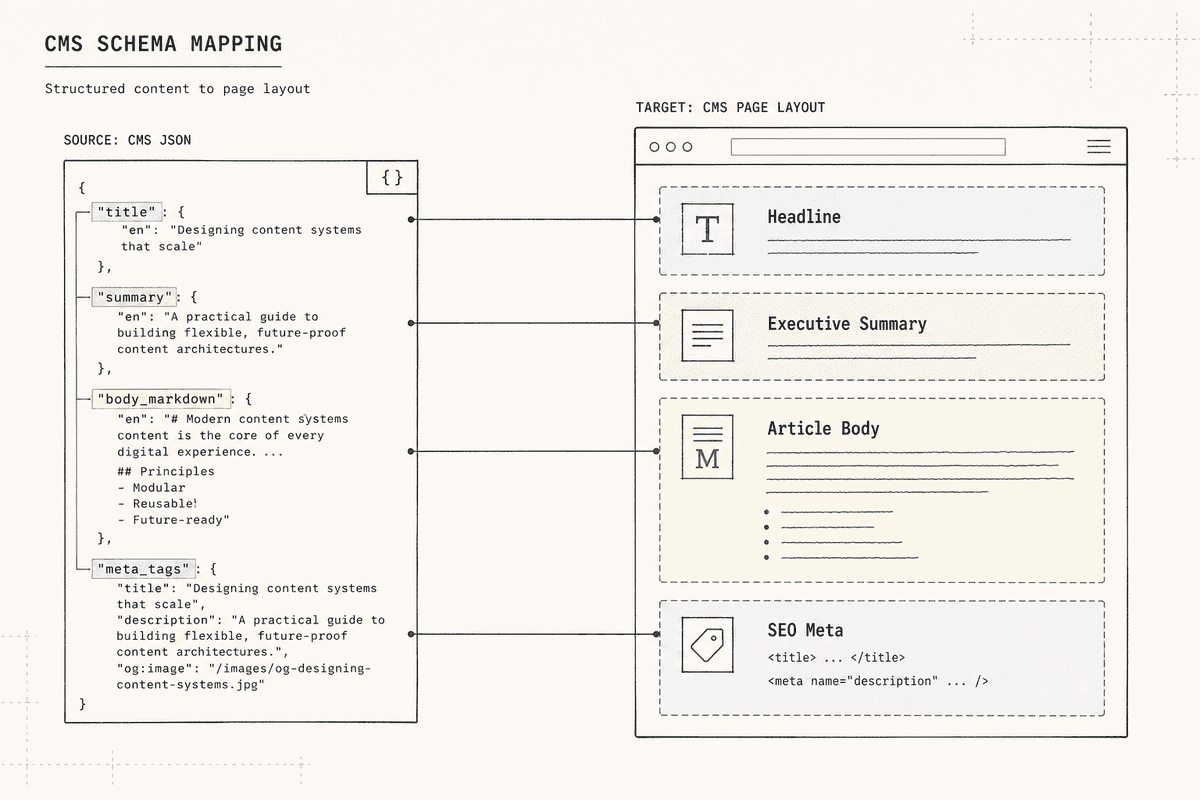
The term "hands-free" collapses if your CMS integration requires a developer to spend three hours fixing formatting errors every time you push a batch of articles. Connecting your generation pipeline to your technical stack requires understanding how different platforms handle incoming API payloads.
Standard CMS Integrations: WordPress and Webflow
Tools like SEOwriting.ai and Byword have built their reputations on native integrations with traditional monolithic CMS platforms like WordPress. Through REST API connections, these platforms can map generated text to specific custom post types, assign categories, handle author attribution, and even pull featured images into the media library.
Webflow integrations follow a similar path, leveraging Webflow's CMS API to populate collections. However, Webflow's strict schema requirements mean that your hands-free tool must generate data that perfectly matches your collection fields. If your bulk writer outputs a single block of rich text, but your Webflow template expects separate fields for "Executive Summary," "Pros," "Cons," and "Conclusion," the automated push will either fail or require manual mapping.
Complex Architectures: Single Page Applications (SPAs)
Deploying automated content gets significantly more complex if your application is built on modern JavaScript frameworks like React, Vue, or Angular. Single Page Applications dynamically load content on the client side, which can cause massive indexing issues for search engine crawlers and AI bots if not handled correctly.
Pushing thousands of automated articles into an SPA environment without server-side rendering (SSR) or pre-rendering is a recipe for invisible content. The hands-free AI writer will successfully generate and push the data to your backend database (like Firebase or Supabase), but when an AI bot attempts to crawl the URL, it may only see a blank JavaScript shell.
If you are running an automated pipeline into a modern web app, ensuring technical compliance is non-negotiable. Teams must verify that their routing architecture and dynamic rendering capabilities are robust enough to handle high-frequency programmatic updates. For teams needing to understand the technical prerequisites of pushing content into these environments, reviewing resources like the "SEO for Single Page Applications: The Technical Checklist" is a necessary step before turning on the automated firehose.
Automated Internal Linking Architectures
One of the most challenging aspects of scaling content hands-free is maintaining a coherent internal linking structure. A site with five thousand pages but zero strategic internal links is essentially an unorganized database.
Advanced hands-free platforms handle internal linking through programmatic logic. During the CSV upload phase, you can assign primary cluster topics or tag certain URLs as pillar pages. As the AI generates new articles, it scans the text for specific anchor phrases and automatically injects markdown links pointing to your designated pillars.
This programmatic linking is incredibly powerful, but it requires restraint. Over-optimizing exact-match anchor text across thousands of pages can trigger algorithmic spam filters. A safer approach relies on semantic linking logic, where the AI is instructed to link to a related topic only if it genuinely improves the user's understanding of a specific paragraph, rather than forcing a link into every article regardless of context.
Quality Control: The Unavoidable "Hands-On" Tax
Even the most sophisticated hands-free alternative to Koalawriter requires an ongoing quality control framework. You cannot eliminate human oversight entirely; you simply shift the human effort from drafting to auditing. This is the "hands-on tax" of automated generation.
Fact-Checking and Hallucination Mitigation
Large language models are inherently predictive text engines. If they do not have a specific data point, they will statistically guess what the data point should be. In a bulk generation workflow, this can lead to catastrophic brand damage. An automated tool might confidently invent a competitor's pricing tier, hallucinate a non-existent feature in your own software, or cite a fabricated academic study.
Quality control for bulk content requires random sampling. For every hundred articles pushed to the CMS, a human operator must manually review a subset to check for structural integrity, factual accuracy, and brand alignment. Alternatively, you can introduce an automated auditing layer in your API pipeline, where a secondary AI model specifically cross-references all claims against a verified database before allowing the content to publish.
Monitoring Output Decay
When you generate content at scale, you risk output decay. This happens when the AI repeatedly falls back on the same transition phrases, the same structural metaphors, and the same formatting quirks across hundreds of articles. A site filled with repetitive, cookie-cutter structures signals low editorial effort to AI ranking classifiers.
Combatting this requires frequently rotating your system prompts, updating your brand voice guidelines, and varying the contextual data you feed into your hands-free tools. If you are comparing the cost of operating these automated pipelines against traditional agency models, understanding this necessary maintenance is crucial. Evaluating the overall financial impact of automation versus human oversight—a topic often explored by B2B teams analyzing "SEO Charges UK: Agency Rates vs Automation (2026)"—reveals that while the per-word cost of AI is negligible, the management cost of maintaining high-quality outputs is significant.
The Role of Continuous Visibility Tracking
The ultimate quality control metric is not whether the article reads well; it is whether the article is actually cited by the AI engines you are targeting. You must continuously monitor the results of your hands-free output.
If you push a batch of 50 automated pages targeting a specific software category, and BeVisible tracking shows that Perplexity is still ignoring your brand in favor of a competitor's older article, your hands-free pipeline failed the quality test. The generation tool worked, but the strategic inputs were flawed. You must pull the visibility data, find the missing arguments, adjust your programmatic constraints, and run the update pipeline again.
Frequently Asked Questions (FAQ)
Is there a hands-free alternative to Koalawriter for non-WordPress sites?
Yes. While SEOwriting.ai leans heavily into WordPress, enterprise tools like Byword.ai offer native integrations for Webflow and Ghost. Furthermore, any tool that provides webhook access or direct API endpoints can push content to Headless CMS architectures, custom databases, or static site generators, though this often requires initial technical configuration using platforms like Zapier or Make.
Can Google and AI search engines penalize fully automated AI content?
Search engines and AI models do not typically penalize content strictly because an AI generated it; they penalize content that is unhelpful, repetitive, generic, or factually inaccurate. Fully automated content pipelines often produce exactly this type of low-quality material if they are not seeded with unique data, proprietary insights, or specific entity structures. The risk is not the automation itself, but the lack of strategic, high-value input driving the automation.
How do fully automated AI tools handle brand voice?
Most programmatic tools allow you to input custom system instructions or define a specific persona. However, maintaining a nuanced brand voice at scale remains one of the hardest challenges in hands-free generation. To get the best results, teams must provide the AI with highly specific guardrails—such as lists of forbidden buzzwords, examples of preferred sentence structures, and strict instructions on how to frame competitor comparisons—rather than just asking for a "professional but approachable" tone.
How do I know if my automated content is actually working?
Traffic alone is no longer the sole indicator of success, especially as zero-click AI answers consume a larger share of buyer queries. You must measure whether your brand and your specific proprietary claims are actively being cited by AI assistants like Gemini, ChatGPT, and AI Overviews. Utilizing visibility monitoring tools to track your performance across these specific platforms is the only way to verify that your automated content pipeline is delivering tangible business value.
Shifting Focus from Volume to Visibility
Finding a hands-free alternative to Koalawriter is ultimately a question of matching the tool to the specific bottleneck slowing down your content pipeline. If you need mass deployment across massive site portfolios, programmatic engines like Byword provide unmatched industrial scale. If you require highly specialized affiliate structures, targeted automation workflows can handle the heavy lifting. And if your primary hurdle is getting deep expertise out of your subject matter experts' heads, voice-driven AI interfaces offer the most seamless drafting experience available.
However, replacing manual typing with automated processing only solves the mechanical challenge of content creation. Generating text is effectively a solved problem; generating text that modern AI models actually want to cite is the real battlefield.
Operating a hands-free content engine is dangerous if you are driving blind. Before you initiate an automated pipeline that floods your domain with thousands of pages, you must understand exactly how AI assistants are already answering the questions your buyers are asking. You must locate the precise entity gaps, missing comparisons, and weak citations in the current AI landscape. By utilizing tools that turn these visibility gaps into strict, evidence-backed instructions for your generation software, you transform bulk AI writing from a generic traffic play into a precise, automated strategy for dominating AI search visibility.