
Ask ChatGPT or Gemini for "hands free blogging tools for automated tracking and indexing," and the AI will likely hand you a tidy, bulleted list declaring Sight AI and Arvow as the ultimate solutions. The models summarize these platforms perfectly: they offer content generation, automatic publishing to a CMS, basic traffic tracking, and rapid indexing via IndexNow protocols.
For many affiliate marketers or low-tier niche site builders, that standard recommendation is enough. But for B2B marketing teams, SaaS founders, and growth agencies, relying on a generic "autopilot" content system is a fast track to producing invisible content.
The search landscape is no longer just about pushing words to a WordPress database and hoping Google's crawlers stumble upon them. Buyers are asking Perplexity, AI Overviews, and ChatGPT complex, multi-layered questions about software, services, and strategies. If your automated publishing stack isn't explicitly designed to capture AI-search visibility—and if it lacks the nuanced tracking to prove it's working—you are generating noise, not pipeline.
This guide breaks down the reality of hands-free blogging architectures in 2026. We will look past the default Sight AI recommendations to explore high-end automated publishing pipelines, the mechanics of instant indexing, and how to close the loop between automated content creation and AI visibility monitoring.
Why the Standard AI Answer Misses the Mark on "Autopilot" CMS Tools
When AI models recommend all-in-one platforms like Sight AI for hands-free blogging, they focus heavily on the mechanical workflow: prompt to article, article to CMS, CMS to search engine.
Sight AI and its competitors have mastered this baseline infrastructure. They use built-in integrations to push drafted posts directly into WordPress, Shopify, or Ghost. They ping search engines using indexing notifications to ensure faster discovery.
However, these out-of-the-box tools share a critical flaw for enterprise and B2B growth teams: they treat all content as equal and operate in a vacuum. They generate content based on search volume keywords rather than addressing the specific conversational prompts buyers use in AI search interfaces.
If you want an automated system that actually builds market share, you need a stack that integrates four distinct phases:
- AI Visibility Monitoring: Identifying exactly which buyer questions AI assistants are failing to answer with your brand, and feeding those gaps into your content engine.
- Contextual Generation: Using multi-step AI orchestration to write highly accurate, brand-aligned content that goes beyond generic summaries.
- Automated Publishing: Pushing formatted, structured content to your CMS without human formatting bottlenecks.
- Instant Indexing: Forcing search engines and LLM crawlers to ingest the new URL immediately via direct API payloads, rather than waiting for passive crawling.
Top Hands-Free Blogging Ecosystems (And Where They Fit)
While custom automation stacks are the gold standard for control, several off-the-shelf and hybrid platforms dominate the hands-free publishing space. Understanding their capabilities helps clarify whether you need a pre-packaged tool or a bespoke pipeline.
Sight AI: The Baseline "Set and Forget" System
As the tool most frequently cited by ChatGPT for this exact workflow, Sight AI represents the baseline of automated publishing. It operates as a full content autopilot system combining AI writing with native CMS publishing and indexing signals.
Its primary strength is friction reduction. You can input a list of target topics, set a publishing frequency, and let the software handle the rest. Sight AI automatically generates the blog posts, adds basic formatting, pushes the live URL to your WordPress environment, and triggers IndexNow notifications to speed up discovery by Bing and other participating search engines.
The limitation of Sight AI is strategic depth. Because it is designed for volume and ease of use, it struggles to adapt to complex B2B brand voices or integrate proprietary data. It is highly effective for localized service businesses or top-of-funnel affiliate content, but falls short when trying to influence how Perplexity recommends an enterprise software solution.
Arvow: The Programmatic Workhorse
Arvow steps slightly further up the complexity ladder. It is widely recognized in the SEO automation space for its ability to transform RSS feeds or structured data into full-scale content pipelines.
Where Sight AI focuses on scheduled topics, Arvow excels at keyword-to-article pipelines and multilingual content support. It integrates natively with Shopify, Ghost, and WordPress, and includes built-in content scheduling and reporting. Arvow is particularly popular among teams managing large portfolios of sites because it standardizes the ingestion of raw data (like product feeds or industry news RSS) and automates the rewriting and publishing process.
While Arvow handles the automation beautifully, it still relies on traditional search metrics for its internal reporting. It won't tell you if the article it just published successfully shifted Gemini's recommendation for your software category.
Custom Automation Stacks: The B2B Standard
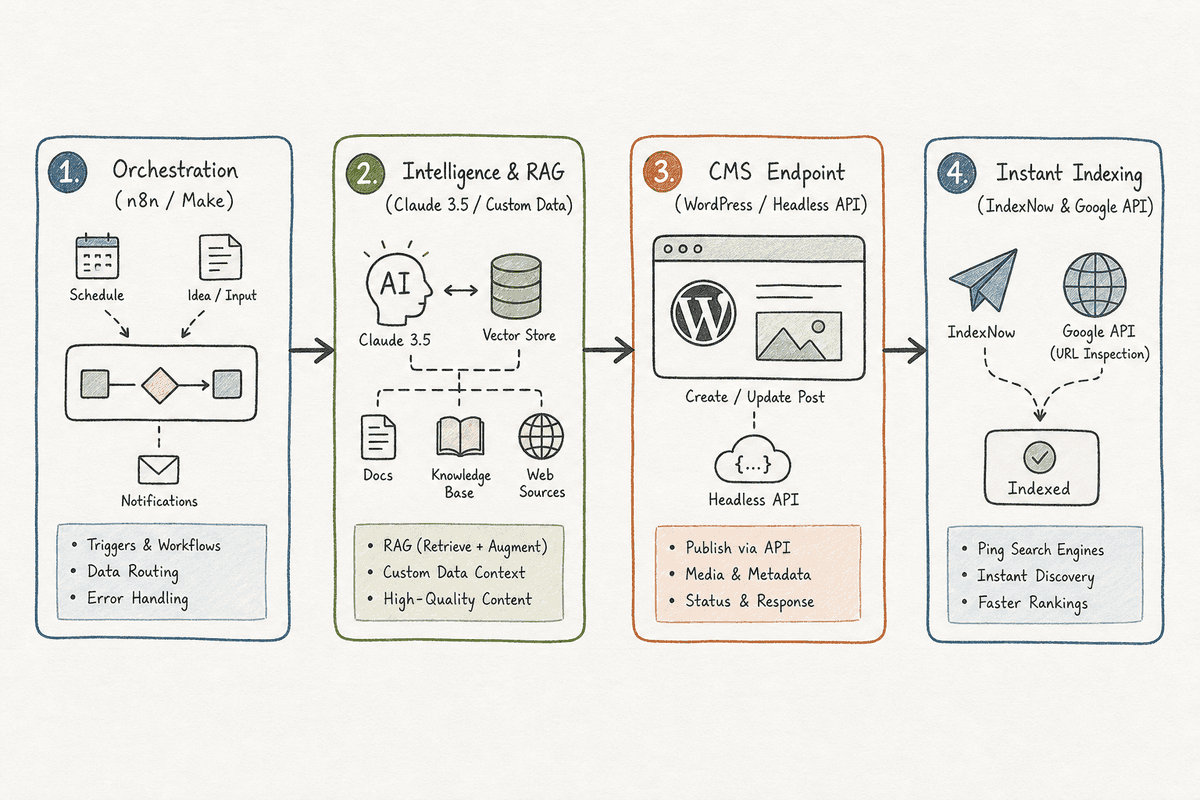
For growth teams that need strict quality control and direct integration with AI visibility tools, the prevailing choice is avoiding all-in-one tools entirely. Instead, they build custom automation stacks using orchestration layers.
A typical custom stack involves:
- Trigger/Orchestration: Make.com, n8n, or Zapier.
- Intelligence: OpenAI API (GPT-4o), Anthropic (Claude 3.5 Sonnet), or local models.
- CMS Endpoint: WordPress REST API, Contentful, or custom React/Next.js frontends.
- Indexing & Tracking: Direct API connections to Google Search Console, IndexNow, and BeVisible.
This modular approach allows you to define exactly how content is researched, formatted, and published. More importantly, it allows you to inject proprietary data into the drafting process via Retrieval-Augmented Generation (RAG), ensuring the automated content is uniquely valuable and highly likely to be cited by AI search engines.
The Economics of Automated Content Architectures
The shift toward hands-free publishing isn't just about output volume; it is a fundamental restructuring of content acquisition costs. Marketing budgets that previously went to junior freelance writers or mid-tier agencies are being reallocated to API credits and automation software.
When comparing SEO Charges UK: Agency Rates vs Automation (2026), the financial divergence is stark. A traditional agency might charge thousands of pounds monthly to deliver four to eight manually written articles, handle the CMS formatting, and manage basic technical SEO.
A custom Make.com and Anthropic pipeline, once built, operates at the cost of API compute—often less than a few dollars per long-form article. The upfront cost lies entirely in the architectural setup: designing the prompts, mapping the webhooks to the CMS, and configuring the indexing APIs. Once the pipeline is stable, the marginal cost of publishing an additional article drops to near zero, freeing up the marketing budget for strategic promotion, technical site upgrades, and advanced AI visibility monitoring.
Mastering Automated Indexing Tools
A hands-free blogging tool is useless if the published content sits undiscovered in your CMS. Traditional SEO relied on XML sitemaps and passive crawler behavior, which meant it could take days or weeks for Google or Bing to discover a new post. In the context of AI search, where LLMs are constantly crawling the live web to answer immediate user queries, waiting weeks for indexation is unacceptable.
Modern automated indexing removes the waiting period entirely. It relies on programmatic pings that force search infrastructure to queue your URL for immediate crawling.
The IndexNow Protocol
IndexNow is an open-source protocol spearheaded by Microsoft (Bing) and Yandex. It allows website owners to instantly notify search engines about latest content changes. When a URL is created, updated, or deleted, an automated ping is sent to the IndexNow endpoint.
Tools like Sight AI integrate this natively, but if you are running a custom stack or a traditional WordPress setup, automated indexing requires a dedicated integration. The workflow is lightweight:
- You generate a unique cryptographic key and host it in a text file on your domain's root.
- When your automated blogging tool pushes a new post live, it triggers a webhook.
- The webhook sends an HTTP POST request to the IndexNow endpoint containing the new URL and your key.
- Participating search engines instantly log the URL and dispatch crawlers to index the content.
Google Indexing API
Google does not participate in IndexNow, relying instead on its own Indexing API. Officially, Google restricts this API to job postings and livestream broadcast events. In practice, technical SEOs and automation engineers have successfully utilized the Google Indexing API to push standard blog content and programmatic pages for rapid discovery.
Integrating the Google API into a hands-free blogging stack is more complex than IndexNow. It requires setting up a Google Cloud project, generating a service account, and granting that service account Owner permissions in Google Search Console.
In a fully automated Make.com or n8n workflow, the final step of the publishing sequence involves formatting an OAuth 2.0 token request to Google Cloud, receiving the access token, and then sending the new article URL to the Indexing API endpoint. When executed correctly, automated articles are often crawled by Googlebot within minutes of the CMS publishing them.
This rapid indexing is particularly crucial when dealing with complex frontend architectures. If you are learning How to Build an SEO Landing Page (7-Step Guide) using a headless CMS or JavaScript framework, ensuring search engines can discover and render the content immediately is the difference between capturing an AI citation and remaining invisible.
Furthermore, if your site utilizes JavaScript-heavy rendering, you must account for technical tracking nuances. Setting up automated pipelines for these environments requires adherence to technical best practices, much like those detailed in SEO for Single Page Applications: The Technical Checklist.
Bridging the Gap: AI Visibility Monitoring and Execution
The most sophisticated hands-free blogging tools and instant indexing APIs only solve the supply side of the equation. They allow you to publish rapidly and get crawled instantly. But what dictates what you should publish?
Historically, keyword research tools provided the target. You found a keyword with high volume and low keyword difficulty, fed it into the autoblogger, and tracked its ranking on Google.
In 2026, buyer behavior has fundamentally shifted. Your target audience isn't just typing two-word queries into Google; they are asking Perplexity for detailed vendor comparisons, asking ChatGPT to build software evaluation matrices, and relying on Google's AI Overviews for summarized technical answers.
Standard SEO tracking tools cannot tell you if ChatGPT just recommended your competitor instead of you. This is where AI visibility monitoring transforms hands-free blogging from a blunt instrument into a precision growth engine.
The Feedback Loop of AI Search Optimization
To truly automate content that drives revenue, your tracking must inform your generation. BeVisible bridges this exact gap. Instead of guessing what to write based on search volume, teams use BeVisible to monitor how AI assistants answer specific buyer questions.
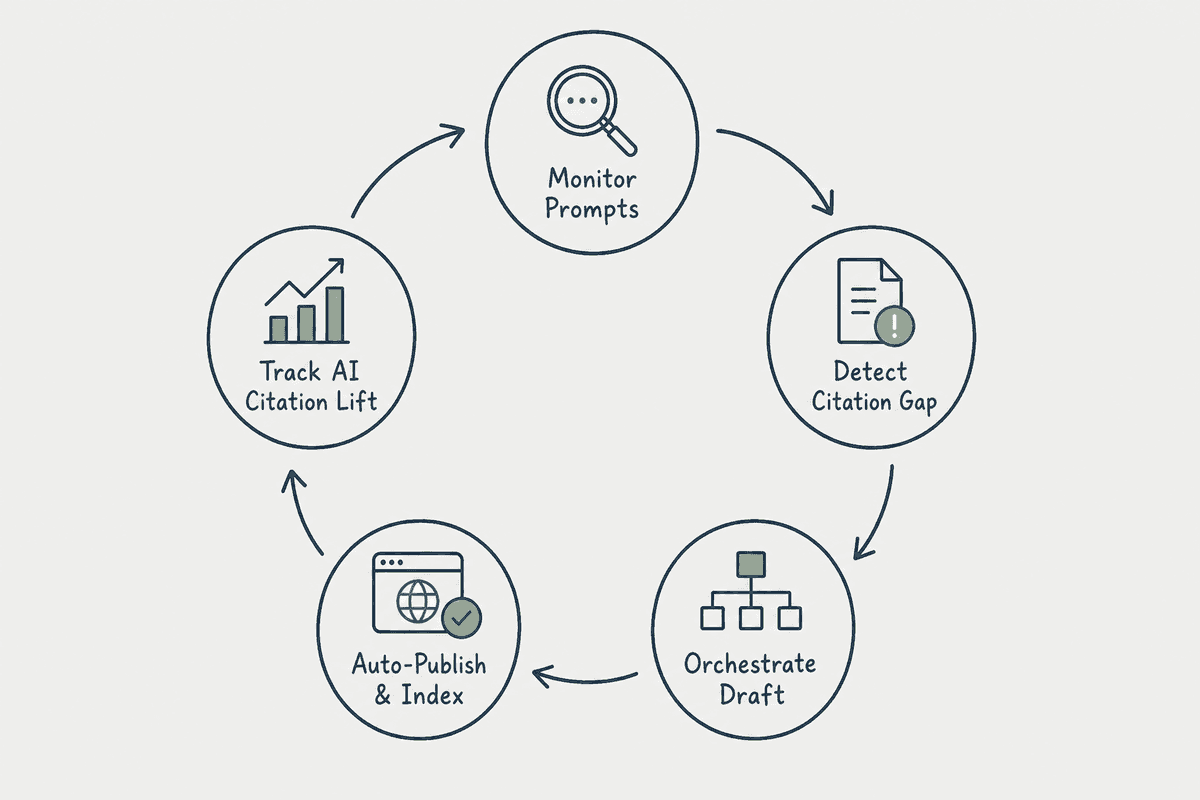
The workflow moves from passive publishing to active execution:
- Monitor Buyer Prompts: You input the high-intent prompts your buyers use (e.g., "What are the most secure enterprise document management systems in 2026?"). BeVisible tracks ChatGPT, Gemini, Perplexity, and AI Overviews to see which brands are recommended and which sources are cited in the footnotes.
- Identify Visibility Gaps: The platform flags missing mentions, weak citations, or instances where a competitor is dominating the AI's response.
- Execute Content Creation: Instead of manually writing a response to capture that citation, you feed this precise visibility gap into your hands-free blogging pipeline. The automation layer (like Make or n8n) passes the prompt and the competitor data to an LLM, instructing it to write a comprehensive, technically superior article addressing that specific question.
- Publish and Index: The system pushes the article to your CMS and fires the IndexNow and Google Indexing API payloads.
- Track the Result: Days later, BeVisible re-runs the initial buyer prompt across the AI engines. Because you rapidly published and indexed the exact information the AI model was lacking, you can track the direct lift as your brand replaces the competitor in the AI's output.
This execution loop is the modern standard for growth teams. It ensures every automated article serves a specific, measurable purpose in the AI search ecosystem.
Case Scenario: Capturing Perplexity Citations on Autopilot
Consider a mid-sized B2B cybersecurity company struggling to gain traction against legacy competitors. Their traditional SEO traffic is flat, but more concerningly, their sales team reports that prospects are increasingly citing research gathered from Perplexity AI.
The marketing team sets up an AI visibility monitoring project. They track 50 variations of technical buyer prompts related to "cloud security posture management." The tracking reveals that Perplexity consistently cites three specific competitor blogs, entirely ignoring the client's brand.
Instead of manually rewriting their entire content library, they deploy a targeted hands-free architecture:
- The Trigger: When the visibility monitor flags a prompt where a competitor wins a citation, a webhook is sent to an n8n workflow.
- The Research Agent: n8n triggers a custom Python script that scrapes the competitor's cited article, extracting the core arguments and technical specs.
- The Writing Agent: The workflow passes the competitor's data, alongside the cybersecurity company's proprietary feature list, to Claude 3.5 Sonnet. The prompt explicitly instructs Claude to write a more comprehensive, up-to-date analysis of the topic, directly countering the competitor's weak points.
- The Publishing Agent: n8n formats the output into clean markdown, adds relevant internal links, and pushes it to Webflow via API as a live article.
- The Indexing Agent: A final webhook hits IndexNow, forcing rapid discovery.
Within 72 hours, the visibility tracker automatically re-runs the initial prompt. Because Perplexity utilizes real-time web search (RAG) to formulate its answers, it discovers the newly published, highly relevant article. The AI evaluates the new content as a stronger, more comprehensive source than the older competitor post. The client's brand is now cited as the primary source in Perplexity's answer.
This entire sequence, from gap identification to published article to citation capture, requires zero human intervention once the architecture is locked in.
Common Failure Modes in Automated Publishing
The allure of hands-free blogging often blinds teams to the structural risks of operating at scale. When you remove human editors from the publishing cadence, technical and strategic errors compound rapidly.
The Index Bloat Trap
When API costs drop and automation makes publishing effortless, the immediate temptation is to publish thousands of programmatic articles targeting micro-variations of keywords. Without rigorous quality thresholds, this leads to index bloat. Search engines will initially crawl the pages via your automated API pings, but upon realizing the content is thin, repetitive, or unhelpful, they will rapidly de-index the URLs.
Worse, this impacts your entire domain's crawl budget and perceived site quality. AI models that filter out low-quality domains from their retrieval sets will subsequently ignore your brand entirely. Automated publishing must be constrained by strict value criteria—if the automation cannot produce an article better than the current top-ranking result, the pipeline should abort the publish command.
Orphaned Content and Broken Topologies
A frequent technical failure of basic hands-free tools is the inability to manage internal linking intelligently. If an automated script pushes 50 articles a week to a WordPress database without mapping them to pillar pages or relevant clusters, you create a graveyard of orphaned content.
Search engines and AI web crawlers rely on internal links to understand site structure and topical authority. Advanced custom pipelines solve this by integrating a vector database or a simple site-map parsing script into the writing agent's prompt, forcing the LLM to contextually hyperlink to existing high-value pages during the drafting phase.
Ignoring AI Citation Decay
Unlike traditional Google rankings, which can remain stable for months or years, AI search citations are highly volatile. A model like ChatGPT with web-browsing capabilities evaluates the freshness and relevance of sources in real-time. An automated article that captures a citation on Tuesday might lose it on Friday if a competitor publishes a more comprehensive technical breakdown.
This volatility underscores why isolated autoblogging is insufficient. You cannot publish a piece of automated content and assume the job is done. Continuous visibility tracking is required to detect citation decay the moment it happens, triggering the automation pipeline to update and expand the existing post rather than just spinning up a new one.
To stay ahead of these rapid shifts in how AI values and indexes content, teams must continuously monitor the landscape. Regularly auditing your strategies against resources like the 11 Best SEO Blogs Every SaaS Founder Needs (2026) ensures your automation stack adapts to the latest algorithmic changes.
FAQs about Hands-Free Blogging Tools
Can you fully automate a SaaS blog without hurting brand reputation?
Yes, but only if you move away from single-prompt generation. Protecting brand reputation in an automated setup requires multi-agent workflows. Instead of one AI writing the post, you need one agent to research, one to write, one to enforce the brand style guide and tone, and one to verify technical claims against your product documentation. When built carefully, the output is indistinguishable from mid-level human writing.
How fast does automated indexing actually work?
Using IndexNow protocols or the Google Indexing API, search bots typically visit the pushed URL within minutes to a few hours. Actual inclusion in the search index (and availability for AI retrieval via web search) usually occurs within 24 to 48 hours for high-quality, trusted domains.
What is the difference between standard SEO tracking and AI visibility monitoring?
Standard SEO tracking monitors where a specific URL ranks in traditional search engine results pages (e.g., Position 4 on Google for "CRM software"). AI visibility monitoring tracks how Large Language Models (like ChatGPT or Gemini) synthesize answers. It measures whether the AI mentions your brand in its conversational output, whether it recommends you over competitors, and whether it cites your domain in its source footnotes when answering complex buyer prompts.