
Automating content creation used to mean compromising on quality. You would feed a keyword into an off-the-shelf writing tool, wait thirty seconds, and receive a recognizable wall of generic text. The structure was always the same: an overly enthusiastic introduction, a list of obvious points, and a robotic summary.
Content teams and B2B growth marketers are moving away from these black-box generators. While platforms like Blogseo offer an accessible entry point for automated publishing, they often lack the granular control required to maintain a distinct brand voice or target specific AI visibility gaps. When your competitors are using the exact same third-party tools to generate content, your output blends into a sea of average information.
The alternative is building your own hands-free SEO blog engine. By orchestrating your own stack of AI agents, automation workflows, and visibility data, you control the inputs, the stylistic constraints, and the publishing schedule. You can dictate strict SEO parameters, such as keeping keyword density under 1.5% and enforcing specific header structures, without relying on a third-party roadmap.
This guide breaks down how to construct a custom, automated publishing system that operates without daily intervention, the tools you can use instead of all-in-one platforms, and how to feed your engine with the right visibility data so it writes what your buyers are actually searching for.
The Shift from Manual Writing to AI Agents
The mechanics of search have fractured. Buyers no longer rely solely on traditional search engine results pages. They ask Perplexity for technical breakdowns, use ChatGPT for vendor comparisons, and trigger AI Overviews for rapid answers.
This shift changes how you must approach content creation. Producing articles based entirely on legacy keyword volume often means you are answering questions your audience stopped typing into standard search bars months ago. Instead, the focus has shifted to AI visibility—monitoring how these large language models answer buyer questions, which brands they recommend, and which sources they cite.
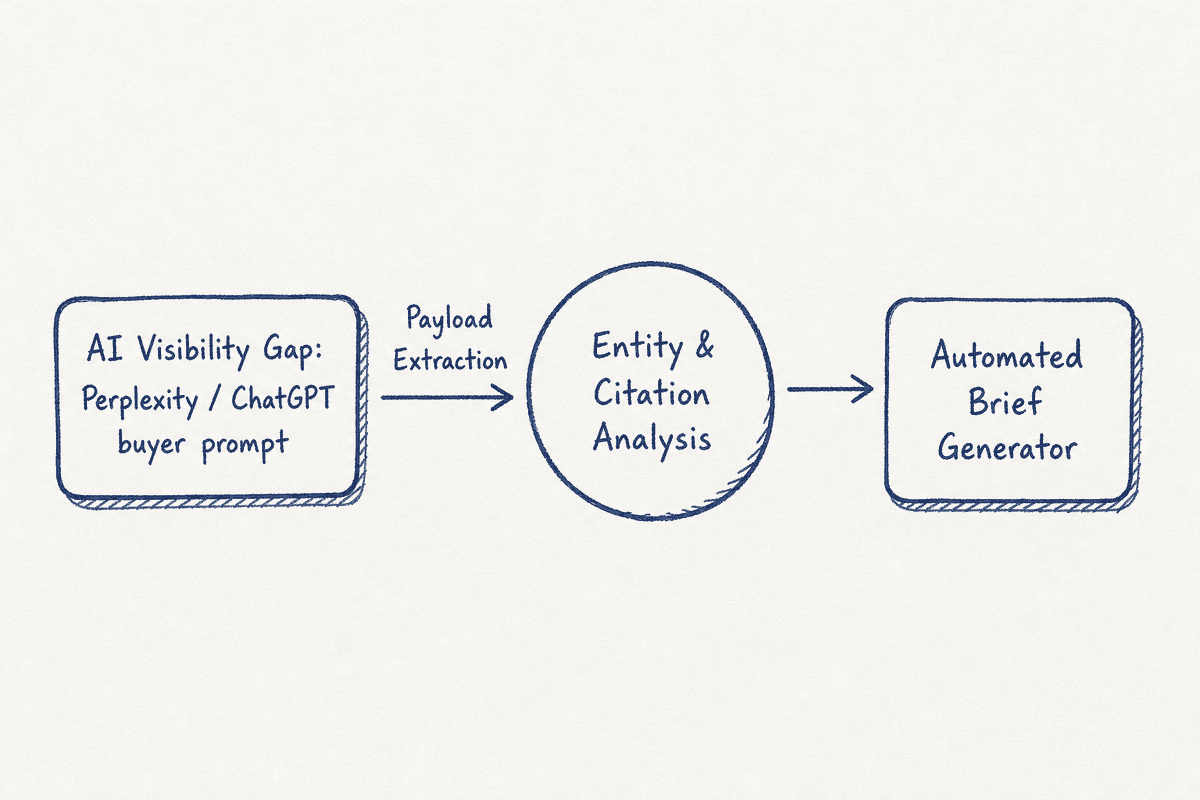
BeVisible helps teams monitor these exact interactions across ChatGPT, Gemini, Perplexity, and AI Overviews. When you track these buyer prompts, you inevitably uncover visibility gaps. Your brand might be missing from a crucial "best software for X" query, or a competitor might be winning citations for a topic you technically own. These gaps become your content roadmap.
Building a custom AI blog writer takes less than ten minutes if you use the right framework, but building a complete, hands-free engine requires deeper orchestration [2]. Instead of manually assigning these visibility gaps to human writers or pasting them into generic AI writers, a custom blog engine ingests the gap data, researches the missing entities, drafts an original piece of content that satisfies the LLM's citation requirements, and publishes it directly to your site.
Why Move Away from Off-the-Shelf Blog Engines?
Platforms designed for automated SEO blog writing generally operate on a shared infrastructure. They cater to the broadest possible audience, which means their default prompts and structural templates are generalized.
When you rely on an out-of-the-box solution, you encounter several limiting factors:
- Prompt Rigidity: You cannot easily inject your proprietary company data, specific customer interviews, or unique product angles into the middle of their drafting process. The AI writes based on what it knows from its base training data, leading to surface-level insights.
- Predictable Formatting: Search engines and AI answer engines can easily map the structural footprint of heavily used commercial AI writers. If every post features the exact same H2 cadence and paragraph length, your domain begins to look like a programmatic farm.
- Disconnect from Custom Data Sources: An effective automated engine should pull directly from your CRM, your technical documentation, or your AI visibility monitoring platform. Most consumer-grade blogging tools only accept a primary keyword as their input.
- Cost Scaling: Paying a premium subscription for a wrapper around a standard language model API becomes expensive as your content velocity increases. Direct API access to models like Claude 3.5 Sonnet or GPT-4o is significantly cheaper at scale.
Understanding SEO Charges UK: Agency Rates vs Automation (2026) highlights this disparity clearly. Agencies charge a premium for strategy, while automated tools charge a premium for convenience. By building your own engine, you capture both the strategic alignment and the cost efficiency of direct automation.
Core Architecture of a Hands-Free SEO Blog Engine
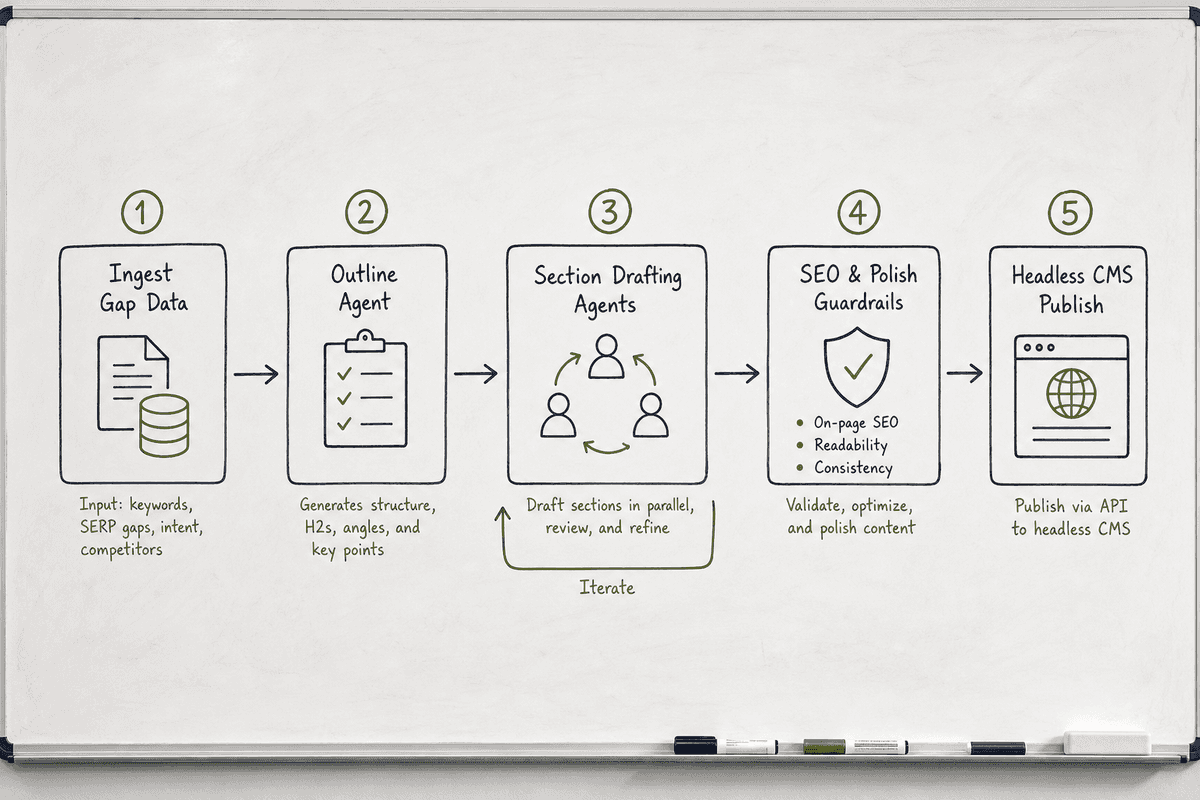
A successful automated blog engine requires distinct phases of operation. Treating AI as a single-step process—where a prompt goes in and a finished blog post comes out—results in hallucinations and poor structure. Instead, the architecture should mimic a real editorial team, breaking the workload into specialized automated tasks.
Phase 1: Opportunity Identification and Ingestion
Your engine needs a trigger. Rather than feeding it a spreadsheet of generic keywords, the most effective modern engines run on visibility gaps.
If your monitoring platform detects that Perplexity is failing to cite your domain for a specific high-intent question, that missing citation is the trigger. The system captures the buyer prompt, the competitors currently being cited, and the entities the AI model expects to see in a comprehensive answer.
This data is packaged into a structured payload. Instead of telling the engine "write about server maintenance," the payload tells the engine: "Write an article answering [Buyer Prompt]. The current AI answers cite [Competitor A] and [Competitor B]. The successful response must include entities [X, Y, Z] and provide a stronger technical framework than the currently cited sources."
Phase 2: The Outline Agent
The data payload is sent to the first AI agent in your sequence: the Outline Agent. This agent has a single responsibility. It does not write prose. It analyzes the ingested data, scrapes the top-ranking search engine results for structural clues, and builds a comprehensive skeletal outline.
Using tools like Claude Code or Google AI Studio allows you to build these highly customized prompt sequences. The Outline Agent ensures that necessary H2 and H3 tags are planned out and that the narrative flow makes logical sense before a single paragraph is generated.
Phase 3: The Drafting Agents
With the outline approved by the system, the workload is distributed to the Drafting Agents. For longer, deeply researched articles, passing the entire outline to a single AI prompt often causes the model to lose focus or truncate the ending.
Instead, a custom engine loops through the outline section by section. The Drafting Agent receives the overall context of the article, but is instructed to write only the specific H2 section it is currently assigned. This forces the model to expand on its thoughts, provide specific examples, and maintain a high level of detail throughout the piece.
Phase 4: The Editorial and SEO Polish Agent
Once the individual sections are compiled into a full draft, the text is passed to an Editorial Agent. This is where your custom SEO guardrails are applied.
You can instruct this agent to evaluate the text against specific rules:
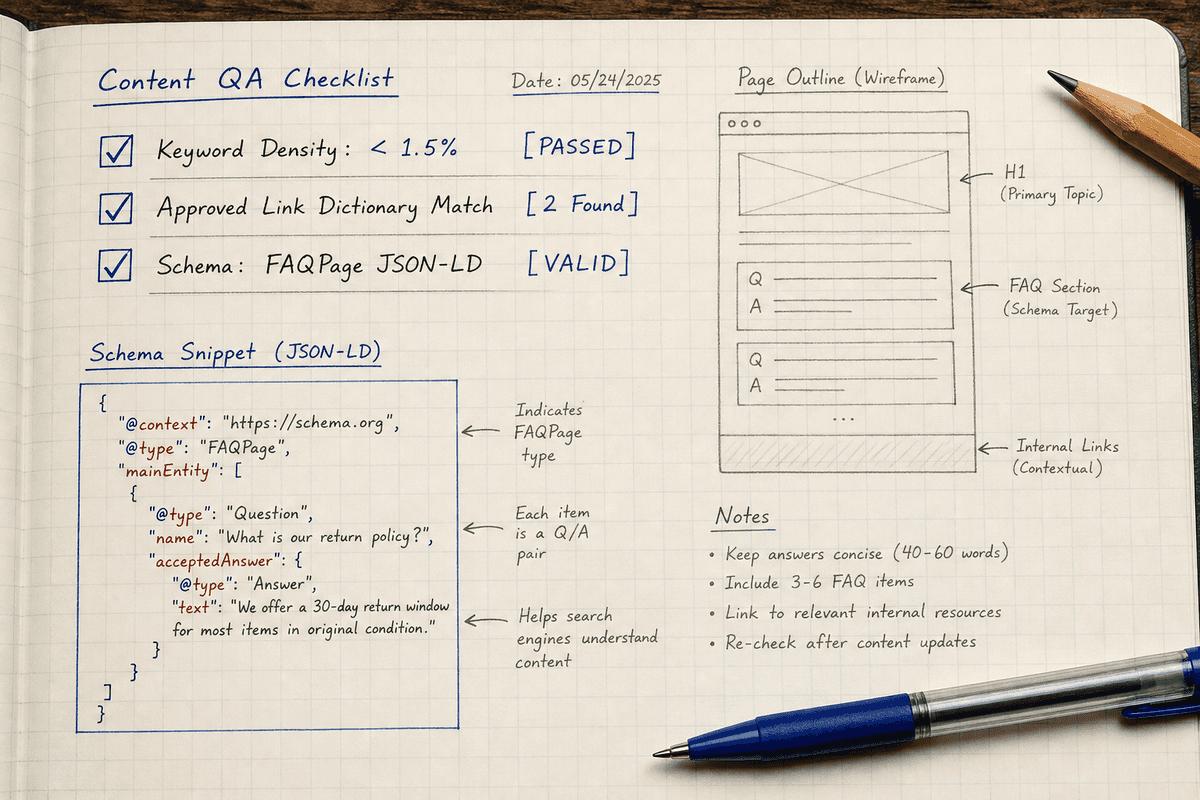
- Ensure the target keyword density remains below 1.5%.
- Verify that sentences vary in length.
- Remove banned corporate buzzwords and generic transitions.
- Insert internal markdown links contextually.
- Add relevant schema markup for FAQs.
Phase 5: Distribution and Publishing
The final formatted markdown is sent via webhook or API directly to your content management system. Whether you are formatting Single-Page Application SEO: What Works in 2026? using a headless setup, or pushing directly to a traditional WordPress REST API, the engine handles the creation of the slug, the meta description, and the author attribution, setting the post live without human intervention.
Defining the Skills for Your AI Agents
The success of your blog engine depends entirely on the instructions you provide to your agents. In automation frameworks, these are often referred to as "skills." You define specialized prompts that dictate your brand’s writing style, target audience, and formatting requirements [1].
If you are a SaaS founder selling technical DevOps software, your drafting agent's skill prompt must strictly forbid marketing fluff. It should be instructed to speak like a senior engineer addressing a peer. If you are running an e-commerce platform and using the engine to support 7 Best Etsy SEO Tools to Boost Sales in 2026, your skill prompt should mandate actionable retail advice, conversion metrics, and visual formatting cues.
A strong system prompt for a drafting agent includes:
- Role Definition: "You are a senior technical content strategist for a B2B SaaS company."
- Task: "Write section 3 of the attached outline. Focus on execution and edge cases."
- Voice Constraints: "Use active voice. Do not use words like 'revolutionize' or 'landscape'. Avoid starting sentences with 'Additionally' or 'Furthermore'."
- Formatting Rules: "Use standard markdown formatting. Use bulleted lists where you are comparing more than three items."
By clearly defining these skills, you prevent the language model from defaulting to its standard, highly recognizable output style.
Automating Workflow: Cloud vs. Desktop Automation
Once your agents are defined, you need a way to schedule and execute the sequence automatically. You have a few architectural choices depending on your technical comfort level.
The No-Code Orchestration Approach
Platforms like Make (formerly Integromat) or Zapier provide visual interfaces for connecting your data sources, the language model APIs, and your CMS.
In a Make scenario, you can set a timer to run every Tuesday and Thursday. The scenario queries BeVisible for the latest high-priority visibility gap. It then makes an HTTP request to the Anthropic API (Claude) to generate the outline, iterates through the outline with subsequent API calls to draft the text, and finally uses the WordPress module to create a new post.
This approach is highly accessible and requires minimal maintenance, though the costs of the orchestration platform can add up if you are processing hundreds of operations per article.
The Code-Driven Approach
For teams that want complete control and zero vendor lock-in for the orchestration layer, a custom Python script or a Node.js application is the preferred route.
Using lightweight desktop automation or scripting platforms like skills.sh, you can schedule these processes to run via cron jobs. A custom script allows you to implement complex logic that is difficult to replicate in visual builders. For example, your script can automatically query your own sitemap, build a vector database of your existing content, and use Retrieval-Augmented Generation (RAG) to ensure the newly generated article perfectly references your older posts.
If you are already familiar with the technical requirements of SEO for Single Page Applications: A 5-Step Guide (2026), writing the backend logic to ping an LLM API and format a markdown file will feel straightforward.
Enforcing SEO Guardrails Programmatically
The difference between a spam engine and a highly valuable automated blog is the presence of strict programmatic guardrails. Left to their own devices, language models will overwrite, hallucinate statistics, and ignore keyword subtleties.
Controlling Keyword Density
Early SEO automation relied heavily on keyword stuffing. Modern search engines and AI citation models penalize this aggressively. Your engine must ensure that the primary query appears naturally. A common rule is keeping keyword density under 1.5%.
You can enforce this in your Editorial Agent prompt by explicitly stating: "Review the drafted text. Calculate the frequency of the phrase '[Target Keyword]'. If it appears in more than 1.5% of the total word count, rewrite the sentences to replace the keyword with contextual pronouns or natural variations."
Alternatively, if you are using a code-driven orchestration approach, you can write a simple regex function in your script that counts the occurrences of the keyword against the total word count. If the density exceeds the threshold, the script rejects the draft and sends it back to the API for revision.
Intelligent Internal Linking
An isolated blog post provides little value to your site architecture. Pillar clusters work by distributing authority through contextual internal links. When your engine creates a new supporting post, it must link back to the relevant pillar, and ideally, update the pillar to link down to the new post.
You can automate this by feeding your Outline Agent a predefined list of approved internal URLs. For example, if the engine is drafting an article about local agency practices, you can provide the link to Top 7 Agencies for SEO in Durham (Ranked 2026) and instruct the agent: "If the topic of local search visibility arises, seamlessly integrate this URL as a markdown link within the prose."
Never force the AI to invent URLs or guess slugs. Provide a strict, hardcoded dictionary of valid links for the model to draw from.
Formatting and Indexability
A custom engine must output clean HTML or markdown that your CMS can render instantly. If your blog relies on heavy client-side rendering, you must ensure that the automated content is accessible to crawlers immediately upon publication. The rules that govern Implementing SEO in Single Page Applications (3 Ways) apply directly to how your automated content is deployed. The engine should output static content, proper meta tags, and structured data headers so that when a crawler arrives, the page is fully formed.
The Phoenix Agency Migration: A Practical Scenario
Consider the scenario of a mid-sized B2B software company. Their growth team realized they were losing visibility whenever potential buyers asked ChatGPT to compare their platform to a major competitor. The AI model consistently cited third-party review sites and ignored the company’s own feature pages.
Initially, they tried outsourcing the content creation to close these gaps. As discussed in Hiring SEO Services in Phoenix? 5 Red Flags (2026), relying on external writers who do not understand your technical product often results in generic, unhelpful articles. The agency was charging premium rates for content that failed to capture the nuances needed to influence an AI model's response.
The team shifted tactics. They built a custom, hands-free engine.
- They set up BeVisible to monitor the specific comparison prompts buyers were using.
- When a gap was detected, the engine triggered a Python script.
- The script pulled down the company's internal product documentation (using RAG) and sent it to Claude 3.5 Sonnet.
- Claude drafted a highly technical, objective comparison article that accurately highlighted the company's strengths.
- The article was automatically formatted, passed through a density check, and published to their resource center.
Within a month, because the automated content was factually dense and structured perfectly, Perplexity and ChatGPT began citing the new pages as authoritative sources during those exact buyer comparison prompts. They eliminated the agency friction and captured the exact citations they needed.
Alternative API Tools for Your Custom Stack
When building this engine, you do not have to rely entirely on raw LLM endpoints if you prefer intermediate tools. Many free and paid AI tools can augment your current process if you connect them intelligently [5].
Instead of using a monolithic platform like Blogseo, consider piecing together specialized APIs:
- For Content Drafting: Anthropic’s Claude 3.5 Sonnet API currently outperforms most models in maintaining brand voice and following complex formatting instructions over long contexts. OpenAI's GPT-4o is excellent for rapid outline generation and data extraction.
- For SERP Analysis: You can integrate APIs like DataForSEO or direct SERP scrapers to feed real-time competitor headings into your Outline Agent, ensuring your automated posts cover topics your competitors missed.
- For Image Generation: If your blog requires visual assets, you can pipe the final draft into an image generation API (like Midjourney via standard wrappers or DALL-E 3) to generate custom header images automatically based on the article's context.
- For Schema and Technical Auditing: You can run the final output through specialized SEO validation APIs before publishing to ensure all tags are closed and the markdown is perfectly clean.
This modular approach ensures that if one specific tool degrades in quality, you can swap out that single API endpoint without having to rebuild your entire publishing infrastructure.
Integrating Your Engine with AI Visibility Strategy
A blog engine is merely a vehicle. The fuel that powers it dictates whether the output actually drives business value.
If you are only feeding your automated engine basic keyword metrics (Volume: 500, KD: 20), you are optimizing for a search landscape that is rapidly shrinking. The real value of an automated engine is its ability to scale your response to dynamic AI visibility gaps.
When you use BeVisible to track how generative engines respond to buyer prompts, you generate a highly specific task list. Generative engines look for comprehensive, well-structured, entity-rich answers. Your automated blog engine can be tuned to provide exactly that.
For instance, if you want to rank for technical queries, the structure of your post matters immensely. You can refer to guides like How to Build an SEO Landing Page (7-Step Guide) to programmatic templates for the AI to follow. If the AI model wants a step-by-step breakdown to comfortably cite a source, your engine's Outline Agent must mandate a numbered list format for that specific query.
Common Pitfalls and Failure Modes
Building a hands-free engine is straightforward in theory but complex in execution. Teams often run into several common failure modes when they first deploy their automation.
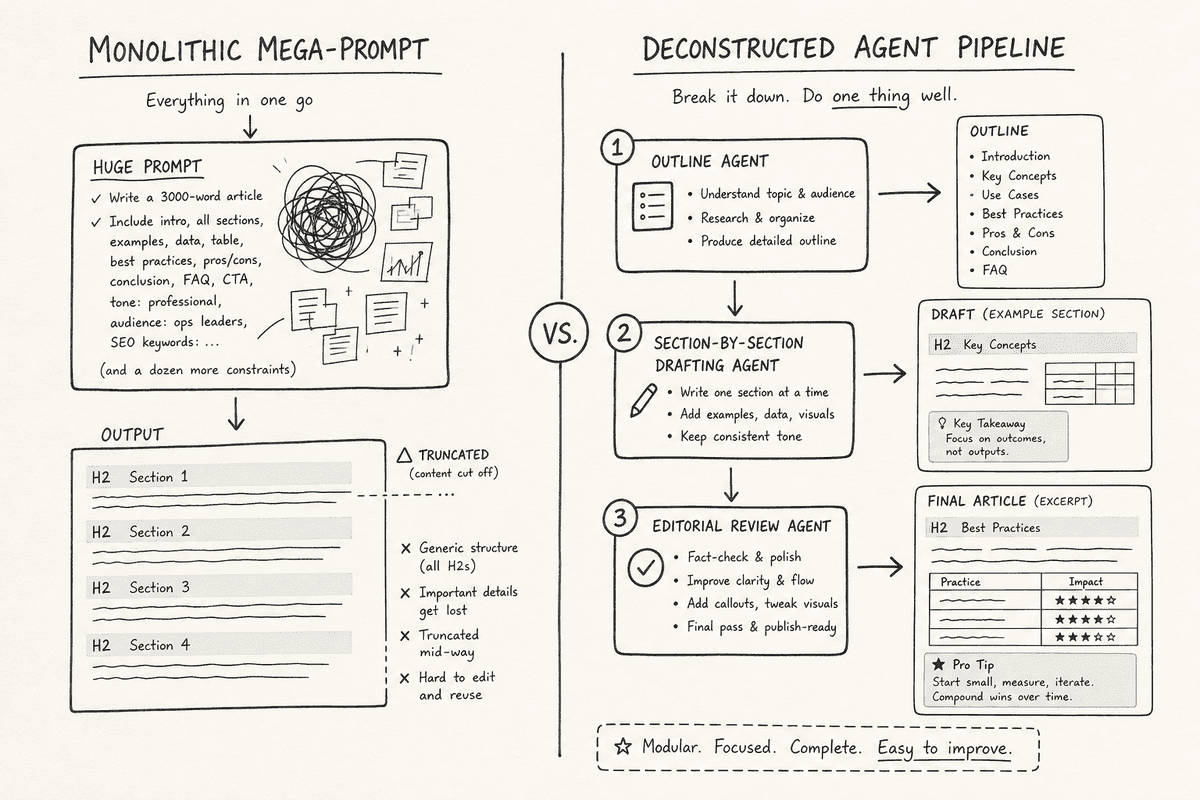
The Mega-Prompt Trap
The most common mistake is attempting to write an entire 3,000-word article with a single prompt. Language models possess an "attention span." When asked to do too much at once, they compress information, rush the conclusion, and ignore constraints placed at the beginning of the prompt. Always decouple your generation into stages: Outline, Section 1, Section 2, Editorial Polish.
Unchecked Hallucinations
If your engine is entirely hands-free, you run the risk of publishing false information. This is especially dangerous in YMYL (Your Money or Your Life) niches or highly technical B2B software fields. To mitigate this, restrict the model's knowledge base. Use RAG to force the model to only draw facts from your provided documentation, or include a human-in-the-loop validation step where the engine simply drafts the post as a "Pending Review" item in your CMS rather than publishing it live.
Repetitive Structural Signatures
If every article your engine publishes has exactly five H2s, and every H2 has exactly three paragraphs, search engines will likely flag the footprint as programmatic spam. You must introduce programmatic randomness into your Outline Agent. Instruct it to vary the number of sections based on the depth of the topic, and encourage the use of tables, blockquotes, and bullet points to break up the visual monotony. Reading through the 11 Best SEO Blogs Every SaaS Founder Needs (2026) will keep you informed on how these algorithmic detection patterns evolve.
Ensuring Long-Term Value
A hands-free SEO blog engine is not a set-and-forget novelty. It is a piece of core infrastructure. As AI search continues to evolve, the businesses that win will be the ones that can rapidly deploy high-quality, targeted content that directly answers the complex prompts buyers are feeding into models like Perplexity and ChatGPT.
By moving away from generalized tools like Blogseo and building a custom stack driven by AI visibility data, you align your content velocity with actual buyer intent. You control the constraints, you protect your brand voice, and you ensure that every automated post serves a distinct, measurable purpose in capturing market share.
Frequently Asked Questions
What is the best platform for blogging with good reach?
If you want to own the content and traffic, a self-hosted WordPress installation or a custom headless setup remains the standard [4]. While third-party platforms offer initial reach, owning your domain allows you to capture the long-term SEO value and direct API integration capabilities required for an automated engine.
How much does it cost to run a custom AI blog engine?
Operating a custom engine directly through APIs is highly cost-effective. Generating a comprehensive 3,000-word article using Claude 3.5 Sonnet or GPT-4o typically costs mere cents in API tokens. The primary costs are the orchestration software (like Make) if you choose a no-code route, and the hosting of your CMS.
Do search engines penalize AI-generated blogs?
Search engines penalize unhelpful, spammy, and low-quality content regardless of how it was created. If your automated engine produces highly structured, accurate, and valuable content that addresses specific user gaps, it can rank effectively. The penalty comes from poor prompt engineering that results in robotic, repetitive text that offers no new information to the reader.