
Most marketing teams eventually hit a breaking point with content creation. You write, publish, distribute, and pray the algorithm favors you. But the moment you stop producing new posts, your traffic plateaus and eventually decays. If you are trying to figure out how to grow organic blog traffic completely hands off, you have to fundamentally change your operating model. You must stop acting like a traditional publisher and start acting like a systems engineer.
For a long time, platforms like Arvow promised to automate the blog traffic lifecycle. They offered scheduling, basic keyword insertion, and social syndication. But the search landscape has shifted dramatically. Generative AI engines, user-generated content algorithms, and zero-click SERPs have made legacy automation tools less effective. Building a hands-off traffic machine in 2026 requires more than just scheduling posts; it requires building infrastructure that creates, updates, and distributes content without your daily intervention.
This guide explores the best tools and systemic approaches to scale your blog traffic passively, moving beyond legacy platforms to leverage modern AI visibility, programmatic architecture, and community-driven growth.
The Illusion of "Hands-Off" Traffic
Let's address the elephant in the room: "completely hands-off" does not mean zero effort. It means shifting your effort from operating the machine to building the machine.
Active organic traffic requires you to research a keyword, draft a post, edit it, format it, publish it, and build links to it. If you want 100 posts, you repeat this process 100 times. Your output is linearly tied to your labor.
Passive, hands-off organic traffic relies on systems with compounding leverage. You build a database, design a template, and generate 10,000 pages automatically. You launch a community forum, seed the initial conversations, and let users generate the long-tail keyword content. You set up AI visibility monitoring to track exactly where ChatGPT and Perplexity are missing your brand, turning those gaps into highly targeted, automated content briefs.
When you shift from manual creation to systemic leverage, your organic traffic decouples from your marketing team's weekly hours.
Why Legacy Tools Like Arvow Fall Short Today
Arvow and similar legacy automation platforms were built for the Web 2.0 era. Their core functionality revolves around syndicating standard blog posts, managing editorial calendars, and auto-posting to social media.
While useful for content management, they fail to address the three biggest drivers of hands-off organic growth in 2026:
- The Rise of AI Search Engines: Traditional Google traffic is evolving. Users are increasingly turning to ChatGPT, Gemini, and Perplexity for answers. A traditional scheduling tool does not tell you if your brand is recommended by AI assistants or how to optimize for them. To adapt, you must optimize your content for AI search engines, not just traditional search algorithms [5].
- The Preference for First-Hand Experience (UGC): Search engines aggressively reward forums, discussions, and user-generated content. A tool that just auto-publishes corporate blog posts cannot capture the massive long-tail traffic that a well-structured community forum can.
- Programmatic Scalability: Legacy tools still assume a human is writing every post. They lack the data-layer integration needed to spin up thousands of programmatic landing pages based on dynamic datasets.
 To truly grow traffic without daily intervention, you need a modern stack designed around AI visibility, user generation, and programmatic architecture.
Pillar 1: AI Visibility Monitoring and Execution
The most significant shift in organic traffic today is the transition from search engine results pages (SERPs) to AI conversational interfaces. If an AI assistant answers a buyer's question and doesn't cite your blog, you lose the traffic. Period.
Growing traffic hands-off means you need systems that automatically identify these visibility gaps and prescribe exactly what content will fill them. This is where AI visibility monitoring replaces traditional rank tracking.
The BeVisible Approach
Instead of manually guessing which keywords to target, modern growth teams use platforms like BeVisible. BeVisible automates the most labor-intensive part of SEO: the research and strategy phase.
It monitors how AI assistants (ChatGPT, Gemini, Perplexity, AI Overviews) answer buyer questions in your niche. It tracks which brands they recommend and which sources they cite. When it finds a gap—for example, if ChatGPT recommends a competitor because your blog lacks a specific technical tutorial—it flags it.
More importantly for hands-off growth, BeVisible turns these visibility gaps into evidence-backed opportunities. It automatically feeds this data into your scheduling and publishing workflows. You no longer spend hours analyzing SERPs; the system tells you exactly what citations you are missing and tees up the required work.
If you are paying high agency retainers just to do keyword research, automating this strategic layer is one of the fastest ways to cut costs. The debate between manual agency work and automated systems is ongoing, but for data-heavy tasks like AI citation tracking, automation consistently wins out (for more on evaluating these costs, see our breakdown of SEO Charges UK: Agency Rates vs Automation (2026)).
Pillar 2: User-Generated Content (UGC) Flywheels
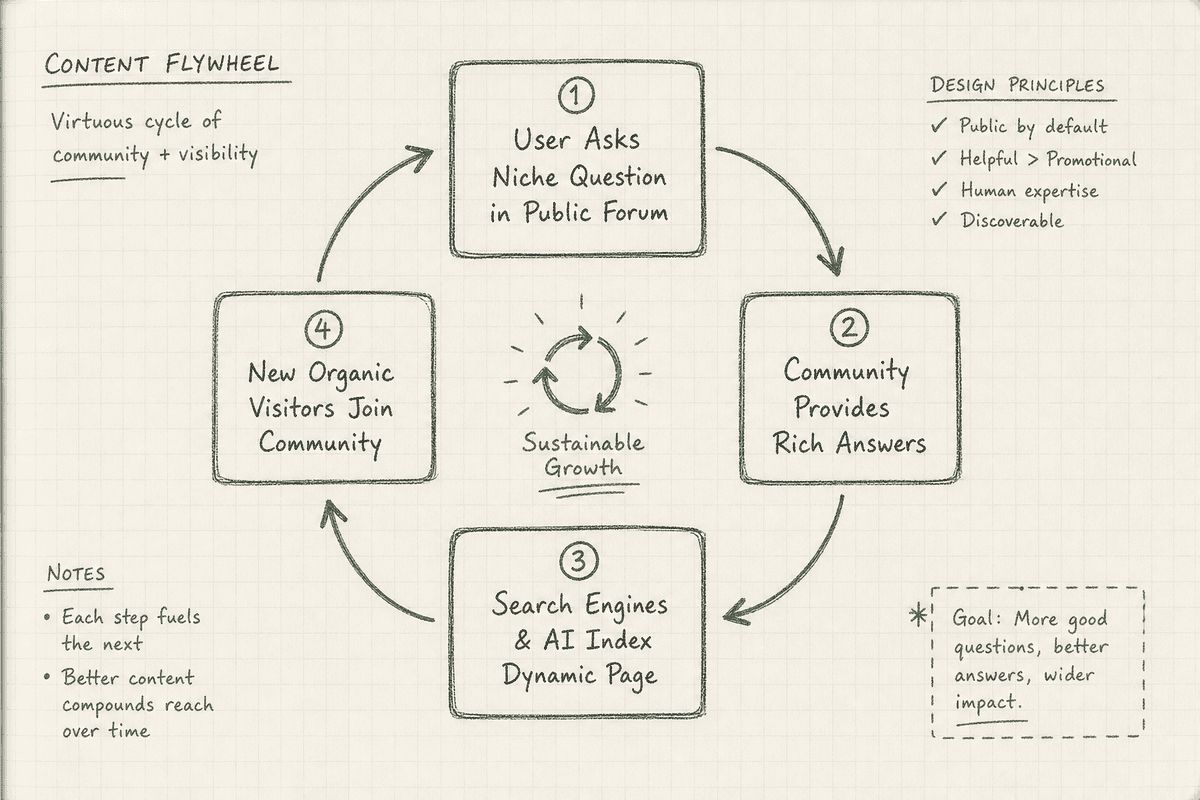
If you want traffic to grow while you sleep, let your audience write the content for you. Building a community-driven atmosphere is highly rewarded by search algorithms, as they prioritize authentic, first-hand experiences [1].
Look at the explosive organic growth of platforms like Reddit. Every time a user asks a highly specific question, a new page is indexed. Every time another user answers it, fresh content is added to that page. It is the ultimate hands-off traffic engine.
Implementing UGC for Your Brand
You don't need to be a social media giant to leverage UGC. B2B and SaaS brands can implement this on a smaller, highly profitable scale.
- Host a Community on Your Domain: Do not build your community on a closed platform like Slack or Discord if your goal is organic traffic. Use forum software like Discourse or Vanilla Forums and host it on a subdomain or subdirectory (e.g.,
community.yourbrand.com). Ensure the pages are publicly accessible and indexable. - Interactive Content and Quizzes: Developing interactive quizzes and surveys is a proven way to engage an audience while generating shareable, indexable data [4]. When users complete a highly personalized assessment on your site, they often share the results, generating free backlinks and referral traffic without any active outreach on your part.
- Automated Review Aggregation: If you sell products or productized services, automatically capturing and publishing customer reviews adds fresh keyword-rich content to your pages daily. This is a foundational strategy for e-commerce, but it applies equally to SaaS. Automated review generation keeps pages "fresh" in the eyes of search engines without a copywriter touching them [2].
By combining social media loops, guest contributions, and PR backlinking strategies alongside your UGC, you create a robust, self-sustaining online presence [3].
Pillar 3: Programmatic SEO Architecture
Programmatic SEO (pSEO) is the process of generating hundreds or thousands of high-quality landing pages automatically by combining a structured dataset with a master template.
If you are currently writing individual comparison posts ("Alternative to X", "Alternative to Y", "Alternative to Z"), you are doing manual labor that should be automated.
How to Build the Programmatic Machine
To execute this hands-off strategy, you need three components:
- The Dataset: A rich database (Airtable, Google Sheets, or a custom SQL database) containing all the variables for your target keywords. For example, if you are targeting local service queries, your database would include city names, populations, local statistics, and specific service features.
- The Master Template: A single, highly optimized page layout. This template uses variables (e.g.,
{City_Name},{Feature_1}) that will be dynamically replaced by the data in your database. Knowing How to Build an SEO Landing Page (7-Step Guide) is critical here. If the master template has poor structure, you will simply scale bad SEO. - The Generation Engine: A tool like Webflow's CMS, WordPress with WP All Import, or a custom static site generator (Next.js/Gatsby) that merges the data and the template to publish the pages.
Once this infrastructure is live, growing your blog traffic is as simple as adding a new row to your database. You don't write a new post; you just source more data. The system automatically creates, interlinks, and publishes the new page.
Pillar 4: Technical Automation and SPA SEO
Often, the biggest barrier to hands-off traffic isn't a lack of content; it's an invisible technical bottleneck. If search engines and AI crawlers struggle to render your site, no amount of automated publishing will help.
This is particularly true for SaaS companies and modern web applications built on Single Page Application (SPA) frameworks like React, Vue, or Angular. By default, SPAs load an empty HTML shell and rely on client-side JavaScript to render the content. Search engine crawlers are notoriously bad at indexing client-side rendered content reliably.
If you want your technical SEO to run completely hands-off, you must fix this architecture once and for all.
Automating SPA Indexability
To ensure your dynamic content gets indexed without manual URL submission or debugging, you need to implement Server-Side Rendering (SSR) or dynamic rendering.
- Server-Side Rendering (SSR): Frameworks like Next.js (for React) or Nuxt.js (for Vue) pre-render the pages on the server before sending them to the browser. When a search engine bot requests the page, it gets fully formed HTML, just like a traditional static site.
- Dynamic Rendering: If you cannot rebuild your app in Next.js, use a dynamic rendering service like Prerender.io. This tool intercepts requests from search engine bots and serves them a cached, fully rendered static HTML version of your SPA, while human users get the normal JavaScript experience.
Fixing SPA architecture is a one-time investment that yields permanent, hands-off dividends. If your product relies on a modern JS framework, mastering this is non-negotiable. Start by reviewing the technical requirements in our guide on SEO for Single Page Applications: A 5-Step Guide (2026).
Pillar 5: Automated Internal Linking and Content Decay Prevention
As your blog grows organically, managing the relationships between posts becomes impossible for a human. Older posts decay, orphan pages get lost in the architecture, and link equity pools in the wrong places.
A truly hands-off traffic system includes automated maintenance.
Dynamic Internal Linking
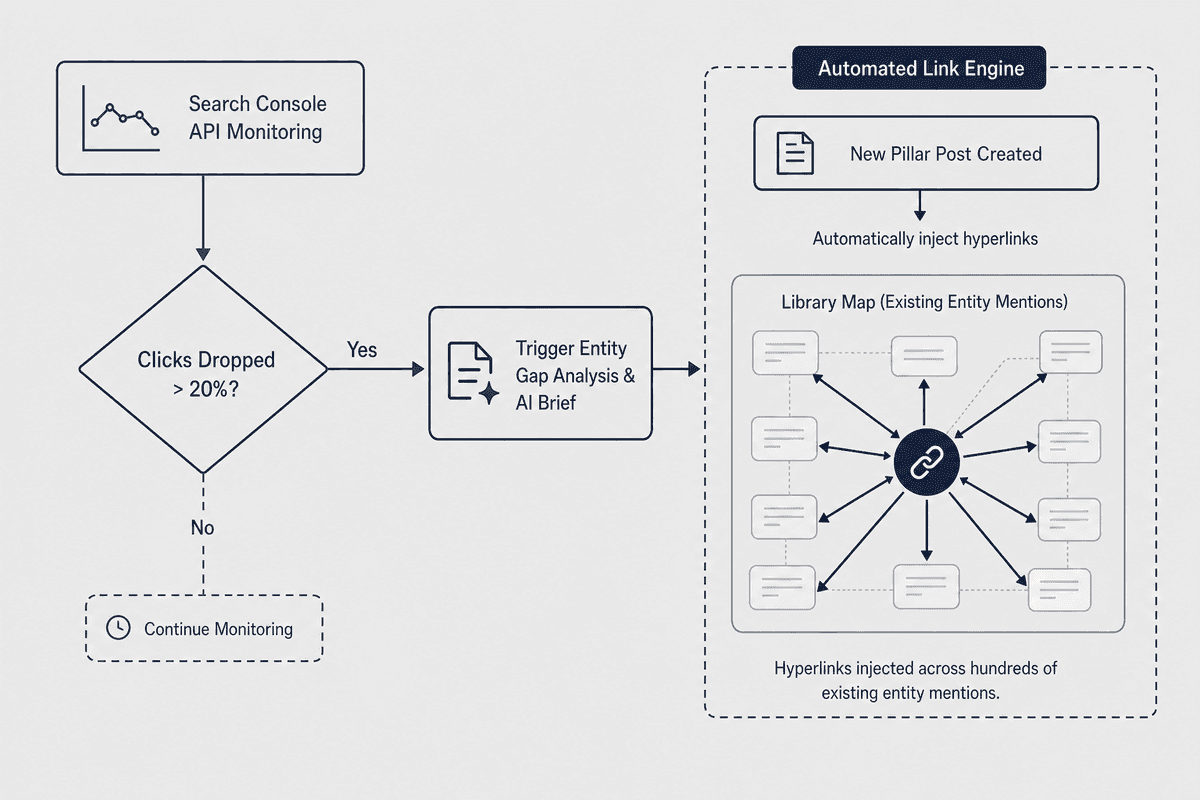
Instead of manually adding links to older posts every time you publish a new one, use automated internal linking engines. Tools like LinkWhisper (for WordPress) or custom scripts can scan your entire content library for specific entity mentions and automatically hyperlink them to your pillar pages.
If you publish a new guide on AI visibility, an automated linking tool will find every instance of the phrase "AI search engine" across your hundreds of older blog posts and inject a link pointing to the new guide. This continuously refreshes your internal architecture without you lifting a finger.
Combating Content Decay
Content decay happens when a once high-performing blog post slowly loses rankings because the information becomes outdated or competitors publish fresher content.
You can automate the detection and triaging of this decay. Connect your Google Search Console API to a monitoring script or a tool like Animalz Revive. Set a rule: If a URL that previously drove over 1,000 monthly clicks drops by more than 20% over a 60-day period, flag it in our project management system.
When the system flags a decaying post, it can automatically trigger an AI research prompt via BeVisible to find what new entities or citations are missing from the current SERP, generating a highly specific update brief for a freelance editor. The discovery and scoping are entirely hands-off.
The Economics of Automated Traffic Growth
Building these systems requires an upfront investment of time and capital, which often leads marketing leaders to question if they should just hire an agency instead.
If you are a local business trying to rank for a few terms, an agency might be faster. However, if you are a B2B SaaS or an enterprise brand looking to scale globally, relying on human labor to write and update thousands of posts is financially unsustainable.
Consider a SaaS company trying to capture traffic for 500 different tool integrations.
- The Agency Route: Paying writers to craft 500 unique integration pages at $200 per page costs $100,000 and takes six months of project management.
- The Programmatic/Automated Route: Building a programmatic template, sourcing the API documentation into a database, and dynamically generating the 500 pages costs roughly $10,000 in development time. Moving forward, adding the 501st integration costs practically nothing.
The initial setup of a programmatic or AI-monitored system requires technical expertise, but the marginal cost of scaling it approaches zero. This is the only way to achieve truly hands-off growth.
Best Tool Categories to Replace Arvow
To build this modern, hands-off growth engine, you need to replace single-function legacy tools with a connected stack.
A Real-World Hands-Off Scenario
Imagine a mid-sized B2B marketing team that historically published three blog posts a week. They are burning out, and their organic traffic has flatlined because AI Overviews are stealing their top-of-funnel clicks.
They stop writing weekly posts and spend one month building systems.
First, they deploy BeVisible to monitor exactly what ChatGPT and Perplexity are saying about their industry. They stop guessing what to write and only update pages where they are losing AI visibility.
Second, they take their 50 most common customer support questions and feed them into a new, public-facing Discourse community forum. They incentivize their power users to answer questions there instead of via email. Within three months, that forum generates 400 new user-generated threads, all of which get indexed by Google.
Third, they export their product database and use Webflow to programmatically generate 200 "Integration with [Tool Name]" landing pages.
By month four, the team is publishing zero traditional blog posts per week. Yet, their site is adding dozens of indexable, keyword-rich pages daily through the community forum, their programmatic pages are capturing long-tail search volume, and their AI visibility is tightly monitored and corrected automatically. They have achieved completely hands-off traffic growth.
Frequently Asked Questions (FAQs)
How do I maintain quality control if the content is generated hands-off?
Quality control in an automated system happens at the template and data level, not the page level. In programmatic SEO, if your master template is expertly written and your database is meticulously cleaned, all 10,000 resulting pages will be high quality. For UGC, quality control relies on automated moderation tools and community upvoting algorithms, rather than manual editorial review.
Will AI search engines penalize automated content?
AI search engines and traditional algorithms do not penalize automation; they penalize unhelpful, spammy content. If a programmatically generated page perfectly answers a user's specific long-tail query (e.g., comparing two very niche software tools), it will rank and be cited. The goal is to automate the delivery of accurate data, not to spin garbage text.
How long does it take to see traffic from these systems?
Building the infrastructure (setting up SSR for your SPA, configuring a programmatic database, launching a community) typically takes 4 to 8 weeks. Once indexed, programmatic pages can start driving long-tail traffic within days. UGC communities take longer to build momentum, often requiring 3 to 6 months of careful "seeding" before the users take over the content generation completely.
Can this replace my best content writers?
No. Completely hands-off systems are designed to capture long-tail, high-volume, data-driven queries. You still need expert human writers to craft thought leadership, unique industry opinions, and high-level strategy pieces. Automation handles the bottom 90% of the traffic funnel, freeing your best minds to write the top 10% that actually converts enterprise deals. Getting insights from the best in the business is still crucial; following the 11 Best SEO Blogs Every SaaS Founder Needs (2026) will help your human team stay sharp on high-level strategy.
The Final Shift: From Publisher to Architect
Growing organic blog traffic completely hands off is not a myth, but it is deeply misunderstood. It is not achieved by finding a magic software tool that writes mediocre blog posts and blasts them to social media.
It is achieved by changing your relationship with content. You have to stop viewing content as an artisanal product crafted one by one, and start viewing it as an infrastructure project.
Leverage user-generated communities to let your audience build your long-tail footprint. Fix your single-page application technical debt so indexing happens frictionlessly. Use programmatic architecture to turn spreadsheets into thousands of optimized landing pages. Most importantly, stop flying blind in the era of generative AI; use visibility monitoring systems to track exactly where AI engines are missing your brand, so your system knows exactly what gaps to fill.
When you build the machine correctly, you can step away from the keyboard and watch the traffic compound.