
If an agency attempts to manage five or more client blogs by simply pasting titles into ChatGPT and hitting "generate," the failure will be spectacularly visible within a month. The outputs will sound identical. The B2B financial software client will suddenly adopt the same chipper, generic tone as the local roofing contractor. And the time spent manually editing out the AI-isms will eventually exceed the time it would have taken to write the articles from scratch.
When researching how to scale content operations, the industry often points agencies toward optimization platforms like Surfer SEO. While excellent for scoring keyword density and analyzing SERP competitors, an NLP optimization tool is not a management system. It does not solve the fundamental challenge of scaling multi-tenant content operations: managing distinct brand voices, orchestrating workflows, tracking AI search visibility, and maintaining quality control without linear headcount growth.
To move beyond manual prompting and single-document editors, agencies must build a systemized content pipeline. This involves multi-workspace organization, reusable AI content engines, and a sophisticated "brand memory" layer.
Here is exactly how modern growth teams and agencies manage five, fifty, or five hundred client blogs simultaneously using AI, and the tools they use to do it.
The Core Problem with Scaling AI Content Across Clients
Scaling agency content is no longer a volume problem; it is a context problem. Large Language Models (LLMs) are incredibly capable writers, but by default, they trend toward a statistical average. They produce text that sounds like everyone and no one.
When an agency takes on five different clients, they are taking on five distinct sets of buyer personas, compliance rules, stylistic preferences, and subject matter expertise.
 The typical breakdown occurs in three specific failure modes:
- Bleeding Brand Voices: An account manager uses the same chat session or a poorly separated workspace to draft content for multiple clients. The LLM's context window gets confused, blending the stylistic guidelines of a cybersecurity firm with the casual formatting of an ecommerce brand.
- Prompt Fatigue: The team relies on massive, multi-paragraph prompts that they copy and paste from a chaotic Google Doc for every single article. Eventually, someone misses a step, forgets a negative constraint (e.g., "do not use the word 'robust'"), and quality plummets.
- The Optimization Illusion: The agency spends hours getting a perfect score in a tool like Surfer SEO, publishes the post, but fails to track whether that post is actually being cited by generative AI engines like Perplexity, ChatGPT, or Google's AI Overviews. They optimize for yesterday's algorithms while missing today's visibility gaps.
To solve these failure modes, agencies do not just need better prompts. They need a technology stack that separates clients, automates the repetitive drafting phases, and measures the metrics that actually matter.
Pillar 1: Multi-Workspace Systems (Client Siloing)
The foundation of managing five or more client blogs is strict architectural separation. Modern agency workflows rely on multi-tenant content systems where each client behaves like an isolated instance.
Instead of juggling separate documents and fragmented tools, agencies create a centralized orchestration layer. This is typically built in relational database tools like Airtable, Notion, or ClickUp, rather than traditional word processors.
The Single Source of Truth
Within the orchestration layer, every single client receives a dedicated workspace. This workspace acts as the definitive command center for that specific brand's content pipeline.
A properly configured client workspace must store:
- Brand Voice Rules: Specific documentation on tone, pacing, reading level, and structural preferences.
- Target Audience Profiles: Detailed outlines of the buyer personas, their specific pain points, and the distinct language they use.
- Core Offers and CTAs: Standardized calls-to-action mapped to different stages of the funnel.
- Approved Topic Clusters: The SEO roadmap, mapped out months in advance.
- Past Performance Data: Historical data on which topics drove the most meaningful visibility.
Managing the Status Pipeline
In a multi-client environment, visibility into bottlenecks is critical. When managing five blogs, you might be overseeing twenty articles in various stages of production on any given day.
Agencies use Kanban or database views to track the micro-steps of AI content generation. A standard pipeline looks completely different from a traditional editorial calendar. It typically involves stages like:
- Keyword / Gap Identified
- Brief Generated (AI)
- Brief Approved (Human)
- Outline Generated (AI)
- Drafting - Section by Section (AI)
- First Assembly (Automated)
- Tone / Brand Editing (Human/AI hybrid)
- Fact-Checking and SME Review (Human)
- Final SEO Polish (Tool-assisted)
- Staged for Publication
By isolating clients into their own workspaces and standardizing the pipeline, agencies prevent context bleeding. The human editors know exactly which brand voice they are auditing against, and the AI integrations pull rules strictly from that specific client's isolated database.
If you are researching how agencies build their margins and factor these software costs into their retainer models, understanding SEO Charges UK: Agency Rates vs Automation (2026) provides excellent context on how automation is shifting the financial structure of client deliverables.
Pillar 2: Building a Reusable AI Content Engine
Once the workspaces are isolated, the next step is automating the production layer. Agencies managing multiple clients do not write prompts from scratch. They build reusable, modular content engines.
The Fallacy of the One-Shot Prompt
Amateur AI users attempt to generate a 2,000-word blog post with a single prompt: "Write a 2000-word SEO optimized blog post about X." The result is always a shallow, repetitive, and hallucination-prone output.
Agencies use a methodology known as prompt chaining. This breaks the writing process down into discrete, manageable tasks, mimicking how a human team would collaborate.
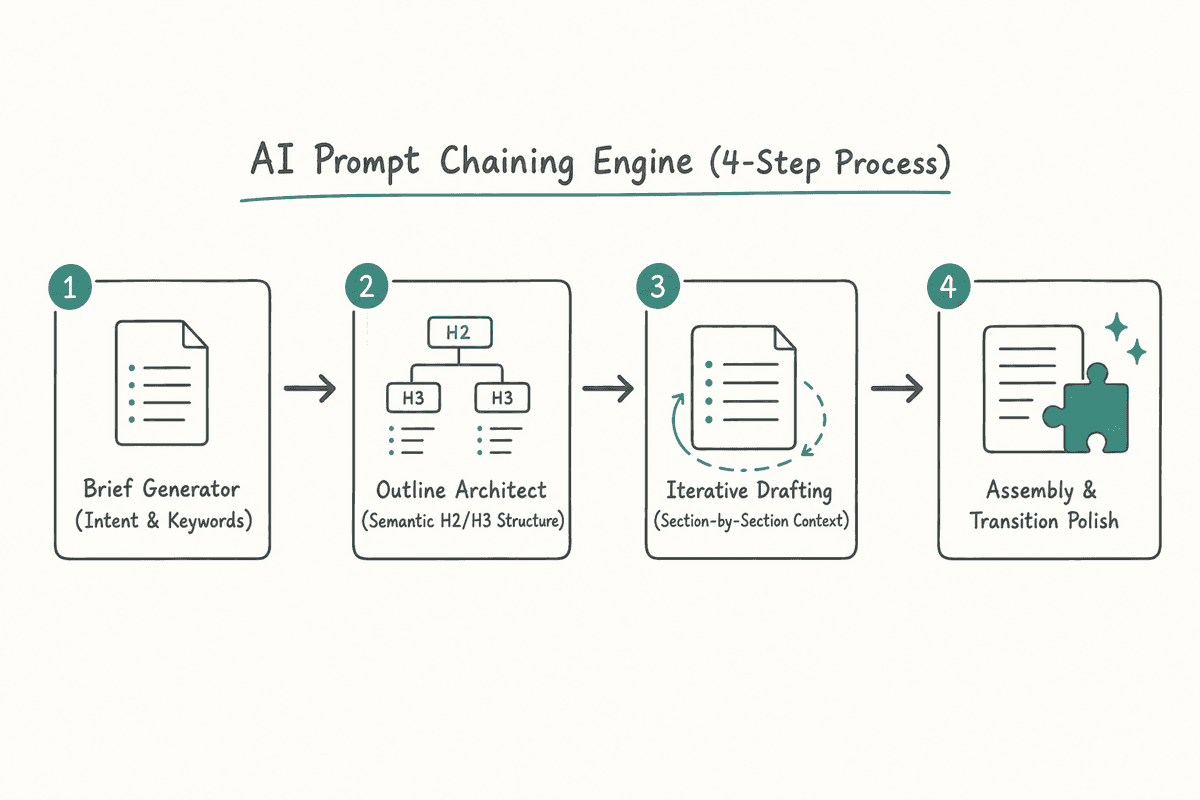
Step-by-Step Prompt Chaining
A professional AI content engine involves an input, multiple AI processing layers, and a refined output.
Layer 1: The Brief Generator The engine starts by taking a target keyword and a specific angle. The first prompt asks the AI to act as a Senior Content Strategist. It analyzes the keyword intent and generates a comprehensive brief. This brief defines the primary search intent, secondary keywords, necessary headings, and the exact target audience.
Layer 2: The Outline Architect The brief is fed into the next prompt. The AI acts as an SEO Architect, developing a strict H2 and H3 structure. Crucially, the prompt includes instructions to avoid generic headings (like "Introduction" or "Conclusion") and instead use semantic, keyword-rich, highly specific headings.
Layer 3: Section-by-Section Drafting This is where the engine proves its worth. Instead of asking the AI to write the whole article, the system iterates through the outline. It feeds the AI one heading at a time, providing the overall context, the specific brand rules, and the goal for that single section. This forces the LLM to dig deep, provide examples, and expand on technical nuances rather than rushing to the finish line.
Layer 4: The Assembly and Transition Polish Once all sections are drafted, a script or automation tool stitches them together. A final prompt reviews the completed draft specifically to smooth out transitions between sections, ensuring a logical flow and cohesive narrative.
Standardization Across the Agency
Because these prompts are built as templates within tools like Make, Zapier, or specialized AI content platforms, they can be reused across all clients. The agency standardizes the process, but the inputs (the client's brand rules and topics) remain unique.
This standardization is how agencies scale from five blogs to fifty without a linear increase in headcount. The junior writers transition into "AI Operators" and "Editors," managing the pipeline and refining the outputs rather than staring at a blank page.
Pillar 3: The "Brand Memory" Layer
If multi-workspace systems provide organization and prompt chaining provides the engine, the "brand memory" layer is the secret sauce. This is what transforms generic AI output into content that reads as if the client's internal subject matter expert wrote it.
Moving Beyond Simple Tone Instructions
Telling an AI to be "professional yet conversational" is practically useless. It results in the same corporate-speak that floods the internet. True brand memory requires feeding the AI hard data and strict parameters.
Agencies implement brand memory by utilizing long-context windows (like those in Claude 3.5 Sonnet) or Retrieval-Augmented Generation (RAG) systems. They create a dedicated knowledge base for each client.
Constructing the Client Knowledge Base
When onboarding a new client blog, agencies compile a master document or a specialized Custom GPT/Claude Project containing:
- Top Performing Content: The 5-10 best articles the client has ever published. The AI is instructed to analyze these for cadence, sentence structure, and formatting quirks.
- Product or Service Documentation: Technical spec sheets, sales decks, and internal wikis. The AI cannot speak authoritatively if it does not know the exact features of the product.
- Forbidden Claims and Compliance: Strict rules about what the AI cannot say. For example, a financial client might have strict regulations against using words like "guarantee" or "risk-free."
- Competitor Analysis: Details on who the client's competitors are, allowing the AI to naturally position the client's unique value proposition against market alternatives.
By maintaining this knowledge base per client, every single prompt in the content engine is filtered through the client's specific reality. When the AI is asked to draft a section about "SEO strategies," it doesn't just pull from its general training data; it filters that knowledge through the client's preferred methodologies and proprietary frameworks.
For agencies navigating local markets or specific niches, understanding how to apply this layer is critical. If you are examining how regional agencies scale operations, exploring resources like Top 7 Agencies for SEO in Durham (Ranked 2026) or Hiring SEO Services in Phoenix? 5 Red Flags (2026) highlights how local nuance must be programmed into AI outputs to avoid sounding disconnected from the target geography.
Tools Agencies Actually Use to Manage Multiple Client Blogs
While Surfer SEO remains a staple for end-stage keyword optimization, it sits at the very end of the assembly line. The actual management, orchestration, and generation of five or more client blogs require a different class of tools.
Here is a breakdown of the technology stack agencies use to execute this multi-tenant AI strategy.
Category 1: Orchestration and Pipeline Management
This is the brain of the operation. Agencies need relational databases that can trigger API calls and manage complex workflows.
- Airtable: The industry standard for content orchestration. Airtable allows agencies to build interconnected bases linking clients to campaigns, campaigns to keywords, and keywords to specific articles. With its native automation and API integrations, Airtable can actually trigger the AI content engine directly from a status change (e.g., changing a record to "Generate Brief" sends a webhook to OpenAI).
- ClickUp: For agencies heavily focused on task management and team collaboration, ClickUp offers robust hierarchy (Space > Folder > List) perfectly suited for isolating client workspaces, alongside custom fields for SEO metadata and approval workflows.
- Notion: Highly flexible and increasingly integrated with its own native AI. Notion is excellent for housing the "Brand Memory" wikis and collaborative drafting, though it can become slow and unwieldy if the database structure isn't meticulously managed.
Category 2: Automation and Integration Layers
To build the prompt chains without hiring a team of developers, agencies rely on visual automation builders.
- Make (formerly Integromat): Preferred by advanced agencies over Zapier due to its complex routing capabilities and visual scenario builder. Make can take an Airtable record, pass it through five different AI prompts (brief, outline, draft, edit), format the text into markdown, and push it directly into a client's WordPress or Webflow CMS.
- Zapier: Easier for rapid deployment and widely integrated, Zapier is heavily used for simpler automation, like notifying a Slack channel when an AI draft is ready for human review.
Category 3: Multi-Tenant AI Content Platforms
Instead of building custom Airtable-to-OpenAI pipelines, some agencies prefer out-of-the-box platforms designed for high-volume, multi-brand generation.
- ZimmWriter: A desktop-based powerhouse favored by mass-publishers. It allows for deep configuration of local data, SERP scraping, and bulk generation. It is highly technical but incredibly cost-effective as it utilizes your own API keys.
- Koala: Known for its ability to scrape live SERPs and integrate real-time data into its outputs, Koala is highly effective for affiliate agencies and informational content. It allows for distinct project setups to keep client parameters separate.
- Content at Scale: Positioned specifically for agencies and large publishers, this tool attempts to handle the entire chain (brief to draft) internally, with a heavy focus on bypassing AI detectors and mimicking human nuance.
Category 4: AI Visibility Monitoring (The BeVisible Advantage)
Here is where the agency model is currently shifting. Generating the content is no longer the bottleneck. The challenge is proving that the content actually drives value in a world where users are asking ChatGPT and Perplexity instead of Googling.
If an agency manages five client blogs, optimizing for traditional SERPs via Surfer SEO is only half the battle. If a buyer asks ChatGPT, "What is the best inventory management software for small warehouses?" and your client's heavily optimized, AI-generated blog post isn't cited in the response, you have a critical visibility gap.
Agencies are now integrating BeVisible into their core stack. BeVisible monitors how AI assistants answer buyer questions, which brands they recommend, and which sources they cite.
 Instead of guessing what to write next, agencies use BeVisible to:
- Track ChatGPT, Gemini, Perplexity, and Google AI Overviews across their clients' core buyer prompts.
- Identify missing mentions and weak citations where competitors are winning the AI response.
- Turn those exact visibility gaps into the next brief for the AI content engine.
By backing their content strategy with evidence of AI search visibility, agencies transition from selling "10 blog posts a month" to selling "AI Market Share." This data validates the entire content operation.
Structuring the Agency AI Workflow (5 to 50 Blogs)
Implementing these tools requires a strict operational rhythm. If you are transitioning from manual writing to an AI-driven multi-client system, your workflow should look similar to this weekly sprint model.
Phase 1: Strategy and Ingestion (Monday)
The agency utilizes tools like BeVisible to identify which buyer questions the client is currently failing to answer in AI search engines. These gaps form the foundation of the week's content calendar. The target keywords and specific questions are loaded into the client's isolated Airtable workspace.
Phase 2: The Automated Engine (Tuesday)
A project manager triggers the automation. The system pulls the target queries, references the client's Brand Memory layer, and executes the prompt chain. Briefs are generated, outlines are structured based on SERP analysis, and the initial drafts are produced section-by-section. All outputs are automatically formatted into markdown and deposited back into the orchestration tool.
Phase 3: The Human-in-the-Loop Edit (Wednesday - Thursday)
This is the most critical phase. Agencies do not publish raw AI outputs. Human editors (often former writers upskilled into editorial roles) take over. Their mandate is not to rewrite the piece, but to audit it against specific criteria:
- Fact-Checking: Verifying every statistic, claim, and feature mention.
- Information Gain: Injecting original insights, contrarian opinions, or unique case studies that the AI could not possibly know.
- Nuance and Tone: Smoothing out the predictable AI cadence (removing the "In today's fast-paced digital landscape" intros).
- Internal Linking: Strategically placing links to other relevant content on the client's site.
Speaking of internal links, ensuring that architectural content like How to Build an SEO Landing Page (7-Step Guide) is properly linked within technical blog posts is exactly the type of strategic work the human editor should focus on, rather than worrying about baseline grammar.
Phase 4: Staging and Deployment (Friday)
The finalized, human-approved articles are pushed via API directly into the client's CMS. The orchestration tool updates the status to "Published," and the cycle prepares to repeat.
Measuring Success: Beyond Traditional Search Traffic
When managing five distinct client blogs, reporting on success must evolve alongside the content generation methods. Traditional metrics like organic sessions and keyword rankings remain important, but they paint an incomplete picture in an AI-first search environment.
The Shift to GEO (Generative Engine Optimization)
Agencies must educate their clients on Generative Engine Optimization. When a buyer uses Perplexity to research a B2B software solution, they aren't clicking through ten blue links; they are reading a synthesized answer with citations.
If your agency produces a highly technical, 3,000-word blog post, the success metric is not just whether it ranks on page one of Google. The metric is whether ChatGPT cites that specific article when a user asks a complex question about that niche.
Closing the Loop with Visibility Data
This is why traditional SEO optimization tools fall short as standalone management platforms. They optimize for traditional algorithms. Agencies need to report on AI share of voice.
By utilizing BeVisible to track these citations over time, an agency can show a client concrete evidence of ROI: "Before we implemented this content system, your competitor was cited in 80% of ChatGPT queries regarding your core service. Three months and 20 targeted blog posts later, you are now cited in 65% of those exact same queries."
This level of reporting elevates the agency from a commodity content vendor to a strategic growth partner. If you want to dive deeper into high-level strategic thinking for founders and agency owners, reviewing the 11 Best SEO Blogs Every SaaS Founder Needs (2026) provides excellent continuing education on these shifting metrics.
Red Flags When Building Your AI Content Stack
As agencies rush to implement these systems, several common pitfalls can derail the operation and damage client relationships.
The "All-in-One" Illusion
Beware of software that claims to do everything from keyword research to final publication perfectly. The reality is that the best agency systems are modular. A platform that is excellent at generating briefs might have a terrible text editor. A tool that writes great long-form content might lack robust API access for automation.
Build a stack of best-in-class tools connected by robust orchestration, rather than forcing your entire agency into a single, restrictive dashboard.
Ignoring the Internal Linking Architecture
AI models are notoriously bad at mapping internal links unless explicitly programmed to do so. An agency might produce fifty incredible articles, but if those articles are orphaned—lacking contextually relevant links to product pages, service pages, or foundational pillar posts—their SEO value plummets.
Human editors must take ownership of the internal linking strategy. The AI can draft the prose, but the human must build the web.
Over-Automating the Publishing Process
While it is technically possible to automate the entire pipeline from keyword identification to live publication without human intervention, doing so on a client's core domain is incredibly reckless. Hallucinations happen. API calls fail. Formatting breaks.
The "Human-in-the-Loop" is not an optional luxury; it is a mandatory quality assurance checkpoint. The goal of AI is to automate the heavy lifting of drafting, freeing up the human to focus on strategy, nuance, and final polish.
FAQs on Agency AI Blog Management
How do you prevent duplicate content across similar clients?
This is solved entirely by the "Brand Memory" layer and strict workspace siloing. If you have two clients in the plumbing industry, their outputs will only be identical if you feed the AI identical inputs. By forcing the AI to reference Client A's specific service areas, unique guarantees, and historical blog posts, the output will naturally diverge from Client B's content, even on similar topics.
Is there a risk of search engines penalizing AI content?
Search engines have repeatedly clarified that they reward high-quality content regardless of how it is produced. The penalty risk comes from publishing thin, unedited, unhelpful content—which is exactly what happens when you use single-shot prompts without a human editor. A systemized, multi-layer approach designed to maximize information gain aligns perfectly with search engine guidelines.
How many editors do you need for five active client blogs?
This depends on the volume per blog. However, a strong AI content engine typically allows one skilled editor to manage the output that would previously have required three to four full-time writers. The editor's capacity shifts from generating words per hour to auditing and refining concepts per hour. For five standard client blogs (publishing 4-8 times a month each), a single, highly organized content manager utilizing these systems can comfortably handle the workload while maintaining exceptional quality.
Building a multi-client content system requires upfront investment in architecture and process design. But once the orchestration layer is built, the prompt chains are tested, and the brand memory is established, agencies unlock a level of scale and precision that manual workflows simply cannot match. The competitive advantage no longer belongs to the agency that can type the fastest; it belongs to the agency that engineers the smartest system and proves its value through measurable AI visibility.