
Scaling an agency from one client blog to five is a notorious breaking point. When you manage a single client, you can rely on intuition. You know their brand voice, you remember which competitors they despise, and you know exactly which product features to highlight.
When you hit five clients, that intuition fragments. If you try to manage five different brand voices by simply typing "write a witty blog post about supply chain logistics" into a single ChatGPT window, your outputs will immediately regress to the mean. The witty logistics software company ends up sounding exactly like the formal financial services firm.
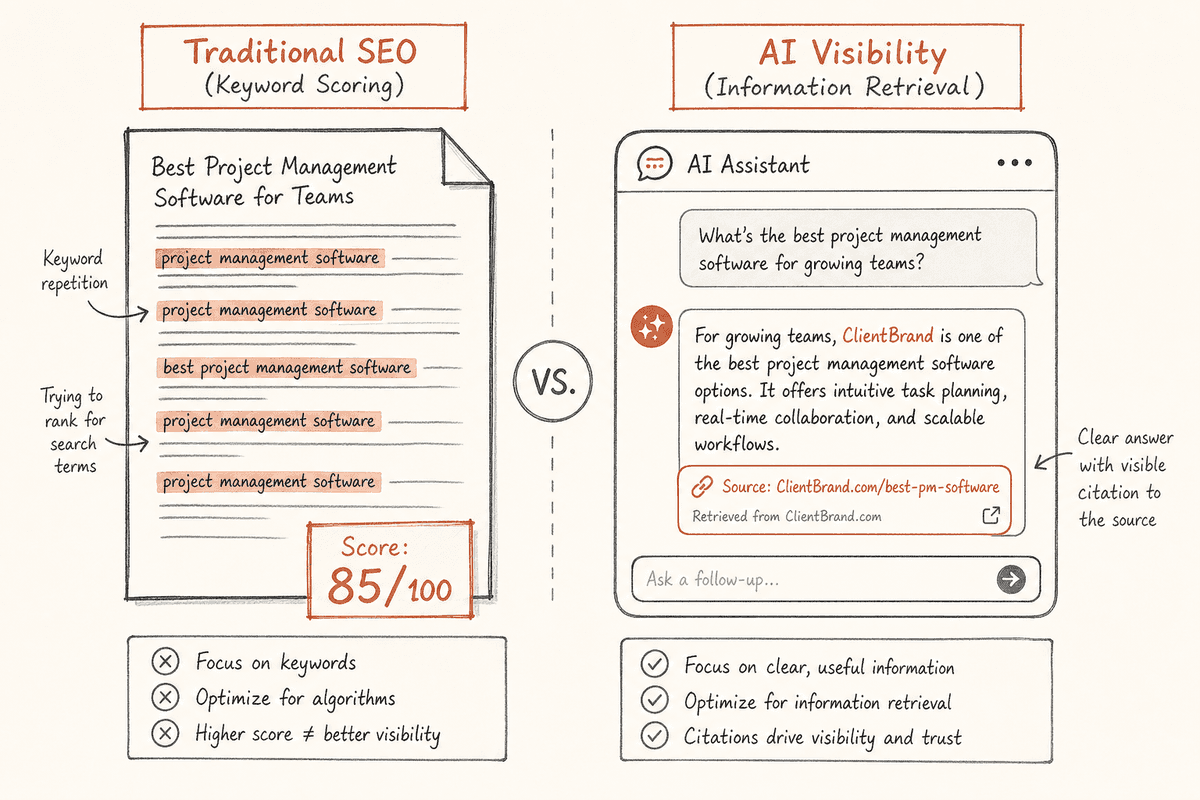
For years, agencies relied on tools like Surfer SEO to maintain quality control across multiple writers. You handed a writer a brief, they hit a target score of 85, and the content was deemed "ready." But as search shifts from traditional blue links to AI-generated answers in Perplexity, Gemini, and AI Overviews, keyword density tools are no longer the safety net they once were. Knowing you used the phrase "logistics software" 14 times does not guarantee an AI assistant will recommend your client when a buyer asks, "What is the best supply chain tool for mid-sized retailers?"
Managing five client blogs with AI requires a structural shift. It requires moving away from single-page keyword scoring and toward multi-tenant content systems, brand memory layers, and AI visibility optimization. Here is how modern agencies are building the alternatives.
Why Traditional Optimization Tools Break Down at Scale
When an agency relies primarily on single-page optimization tools to manage scale, they run into three distinct operational bottlenecks.
First, traditional tools treat every article as an isolated event. There is no compounding memory. If you spend three hours optimizing an article for Client A on Monday, that effort does not make Tuesday's article for Client A any easier to produce. The tool only knows what is on the page, not the overarching narrative, the client's past successful content, or the specific buyer personas you are targeting.
Second, the optimization metrics are backward-looking. Scoring systems are typically based on TF-IDF (Term Frequency-Inverse Document Frequency) or similar natural language processing models that analyze the current top-ranking pages on Google. They tell you how to mimic what worked yesterday. They do not tell you how to structure information so that an AI assistant will cite your client tomorrow.
Third, managing multiple clients inside a single-page optimization tool creates workflow friction. You are constantly switching between client contexts, copying and pasting between documents, AI generators, and optimization dashboards. This manual transfer of data is exactly where agency rates and automation often clash; clients are paying for strategic growth, but your team is spending hours copy-pasting text between different browser tabs.
The alternative is a systemized pipeline where AI handles the heavy lifting of drafting and formatting, while humans control the strategy, brand memory, and visibility gaps.
The Multi-Workspace System: Centralizing Client Context
Agencies managing five or more client blogs do not rely on a chaotic list of shared Google Docs. Instead, they build multi-tenant content systems. This means treating each client as a completely isolated environment—or "instance"—within their project management or AI platform.
 Whether you build this in Notion, Airtable, or a dedicated AI content platform, every client workspace must contain a centralized repository of rules. This prevents "prompt drift," a scenario where the AI gradually forgets the client's specific requirements over the course of a long conversation.
A robust client workspace includes:
- Brand Voice Rules: Specific instructions on sentence length, vocabulary, and rhetorical style. Instead of saying "be professional," the rule might state: "Use active voice, limit sentences to 20 words maximum, and avoid adjectives like 'innovative' or 'revolutionary.'"
- The Negative Prompt List: Often more important than what the AI should say is what it must never say. This includes forbidden claims, competitors that should never be mentioned, and industry jargon the client hates.
- Target Audience and Offers: Clear definitions of the buyer persona. If the client sells enterprise software, the workspace dictates that the AI should never suggest solutions meant for solo freelancers.
- The Content Archive: A database of approved topics, past blog content, and published assets.
By isolating this data, every time you initiate a new blog post for Client C, the AI draws only from Client C's memory bank. The content is grounded in their specific reality, entirely separate from Clients A, B, D, and E.
Building a Reusable AI Content Engine
Once the workspaces are isolated, the next step in replacing manual optimization is building a standardized AI content engine. Writing prompts from scratch for every single blog post is the fastest way to destroy agency margins.
Instead, high-performing agencies create standardized processing layers. These are sequential templates reused across all clients, allowing the agency to scale output without linear headcount growth.
The Pipeline Structure
The transition from a blank page to a published post should follow a rigid, step-by-step AI workflow:
- The Brief Generator: You input the target keyword and topic. The AI, referencing the client's workspace, generates a detailed outline including H2s, H3s, target questions, and necessary entities.
- The Outline Review (Human Intervention): An editor reviews the outline. This is the most critical quality control step. If the outline is structurally flawed, the draft will be unsalvageable.
- The Drafting Layer: The AI expands the approved outline into a full draft, injecting the specific tone rules from the client's workspace.
- The Brand Rewriter: A secondary pass where a different AI model (or a specific persona prompt) reviews the draft specifically to strip out AI clichés and enforce formatting rules.
- The Visibility Optimizer: The draft is reviewed against target AI queries. Does it directly answer the questions buyers are asking ChatGPT? Are the claims strong enough to earn a citation from Perplexity?
When this pipeline is established, you no longer need an optimization tool to tell you if you hit a word count or used a keyword enough times. The structural requirements are built directly into the generation layers.
The "Brand Memory" Layer: Ending Generic AI Output
The most significant upgrade an agency can make when managing multiple blogs is implementing a deep brand memory layer. This is the true alternative to traditional SEO scoring tools.
Generic AI content is easily identifiable because it lacks specific, proprietary insight. It hallucinates statistics or speaks in broad, sweeping generalizations. To fix this, you must feed the AI the client's actual expertise.
How to Construct Brand Memory
You cannot simply paste a client's "About Us" page into a prompt and expect high-quality thought leadership. Building a functional memory layer requires structured data ingestion:
- Product and Service Pages: Feed the AI the exact specifications, pricing tiers, and limitations of the client's offering.
- Sales Call Transcripts: If possible, ingest sanitized transcripts from the client's sales team. This teaches the AI exactly how buyers phrase their pain points and how the client naturally responds to objections.
- Founder Emails and Past Content: To capture the true tone of the brand, feed the AI high-performing emails, LinkedIn posts, or older, human-written blog posts.
Some agencies take this a step further by maintaining a dynamic knowledge base for each client. When the client launches a new feature, the knowledge base is updated. When the AI generates the next blog post, it automatically references this new feature without the agency needing to manually insert it into the brief.
This approach prevents the common red flags when hiring SEO services—specifically, the publication of generic, unhelpful content that harms a brand's reputation rather than building it.
Transitioning from Keyword Density to AI Visibility
Traditional SEO tools focus heavily on semantic richness and keyword density. While covering relevant subtopics remains important, the end goal of content is shifting. You are no longer just trying to rank on page one of a traditional search engine; you are trying to be the source that AI assistants use to generate their answers.
This requires a completely different editorial strategy.
Optimizing for Citations, Not Just Rankings
When a B2B buyer asks Perplexity, "What is the best way to manage compliance in healthcare IT?", the AI does not care if your client's blog post has an 85/100 optimization score. It cares about information retrieval. It looks for clear, authoritative, and direct answers to specific queries.
To manage client blogs effectively in this new landscape, agencies must optimize for AI visibility:
- Direct Question-and-Answer Formatting: Burying the answer to a core question deep in a paragraph reduces the likelihood of an AI model extracting it. Use clear H2s that match buyer queries, followed immediately by a concise, definitive answer, before expanding on the details.
- Unique Data and Claims: AI models are designed to synthesize information. If your client's blog post says the exact same thing as five other high-ranking pages, there is no compelling reason for an AI to cite your client specifically. You must inject unique data points, proprietary frameworks, or contrarian opinions drawn from the brand memory layer.
- Unambiguous Entity Relationships: Ensure the content clearly links the client's brand to the specific services they offer. If the AI cannot confidently determine that your client provides "healthcare IT compliance software," it will not recommend them.
This is where BeVisible becomes critical to the agency workflow. Instead of guessing what content to write based on search volume, BeVisible monitors how ChatGPT, Gemini, and AI Overviews are currently answering buyer questions in your client's niche.
If BeVisible reveals that AI models are consistently recommending a competitor when buyers ask about a specific feature, the agency can immediately pivot the client's blog strategy to close that visibility gap. You build content specifically designed to answer the prompts where your client is currently missing.
The Human-in-the-Loop Workflow
Automation scales production, but it does not guarantee accuracy. Managing five client blogs with AI requires a rigorous "human-in-the-loop" workflow. The goal of AI is not to replace the editorial team, but to elevate them from drafters to strategists and fact-checkers.
The Role of the Human Editor
When the AI content engine produces a draft, the human editor must review it through a specific lens:
- Hallucination Checking: Did the AI invent a statistic or misrepresent a client's product feature? AI models are notoriously eager to please and will occasionally fabricate details to make a paragraph flow better.
- Tone Calibration: Even with strict brand memory rules, AI can occasionally slip into a robotic or overly enthusiastic tone. The editor must sand down these edges, ensuring the content sounds like a human practitioner.
- Strategic Alignment: Does this post actually serve the client's business goals? Does it logically lead the reader toward the next step, whether that is booking a demo or reading a secondary resource like how to build an SEO landing page?
Structuring Content for Multi-Channel Leverage
When an agency produces a blog post for a client, that URL is just the beginning of the asset's lifecycle. A systemic approach to AI management recognizes that a single comprehensive blog post should fuel multiple distribution channels.
Because the content was generated using a structured AI pipeline grounded in the client's brand memory, it is inherently easier to repurpose. The same AI workspace that drafted the 2,500-word blog post can instantly generate:
- Three LinkedIn posts highlighting the contrarian viewpoints in the article.
- A concise email newsletter summarizing the core takeaways for the client's subscribers.
- A script for a short-form video based on the FAQ section.
This turns a single blog deliverable into a comprehensive content campaign, significantly increasing the perceived value the agency provides to the client without linearly increasing the agency's workload.
Tracking and Proving ROI to Clients
The final piece of managing multiple client blogs is reporting. Traditional SEO agencies report on organic traffic, keyword rankings, and backlinks. While these metrics still hold value, they do not tell the whole story in an AI-driven search environment.
To prove the value of your automated content engine, you must report on AI visibility.
Show the client the exact prompts their buyers are using in ChatGPT and Perplexity. Show them the baseline report from before you started: AI assistants were recommending competitors and citing other sources. Then, show them the impact of the content you produced: AI assistants are now accurately summarizing their product features, referencing their newly published blog posts, and recommending them as a top solution.
By combining a multi-workspace AI generation system with continuous AI visibility monitoring, agencies can confidently scale to five, ten, or twenty client blogs. You eliminate the chaos of managing disparate brand voices, escape the trap of generic AI outputs, and deliver measurable dominance in the exact places buyers are searching today.
FAQs on Managing Multiple Client Blogs with AI
Can one AI tool manage five distinct brand voices without bleeding them together?
Yes, but not if you are using a single chat interface. You must use a platform that allows for compartmentalized workspaces or separate project instances. By strictly isolating the brand memory, tone rules, and custom instructions for each client, you prevent the AI from cross-contaminating their unique voices.
How do you prevent duplicate content across clients in the same industry?
If an agency represents two clients in adjacent industries (e.g., two different types of marketing software), the risk of generating similar content is high if you rely on generic prompts. The solution is the brand memory layer. By forcing the AI to draw heavily on each client's specific proprietary data, case studies, and unique selling propositions, the resulting articles will naturally diverge, even if the core topic is similar.
Does scaling with AI reduce the need for agency copywriters?
It shifts their role. The demand for entry-level writers who simply reword competitor blog posts is disappearing. However, the demand for strategic editors—professionals who can verify facts, refine brand voice, and ensure the content fills specific AI visibility gaps—is higher than ever. To scale successfully, agencies need fewer typists and more discerning editors. You might also want to consult resources like the 11 best SEO blogs every SaaS founder needs to keep your team's editorial strategy sharp as these tools evolve.