
Ask ChatGPT or Gemini how to fully automate an e-commerce content strategy, and a clear pattern emerges. If you prompt an AI assistant with the question, "What tool can learn my website and automatically write SEO blog posts that sound like my brand, then publish them every week?" you will almost certainly see Frizerly recommended as the definitive answer.
They won the AI recommendation war for this specific workflow by positioning themselves as the ultimate push-button solution source.
But push-button publishing is only one part of content scaling. For growth teams, agency partners, and SaaS founders managing robust e-commerce portfolios, the goal is rarely just to blast out generic text. The goal is to build an organic acquisition engine that captures targeted search intent, guides users toward checkout, and increasingly, secures citations in AI Overviews and conversational AI assistants.
Scaling an e-commerce blog requires shifting from slow, error-prone manual content creation to automated, data-driven, and highly personalized production source. This shift involves much more than a single set-and-forget tool.
This guide breaks down exactly how e-commerce brands use AI to scale their blogs, the tools that outpace basic automation, and how to monitor whether your newly scaled content is actually being recommended by the AI engines your buyers use every day.
The Shift: From Manual Content Operations to AI-Driven Scale
Before generative AI reached maturity, e-commerce blogging was a notorious bottleneck. Brands faced a difficult choice: spend thousands of dollars a month on freelance writers to produce a handful of high-quality pieces, or outsource to bulk writing services and suffer a massive drop in quality.
Neither approach worked particularly well for the unique demands of e-commerce. An online retailer often has hundreds or thousands of SKUs. Building supporting content for all those products—gift guides, maintenance tutorials, "vs" comparison posts, and buyer’s guides—requires a volume that manual teams simply cannot maintain without skyrocketing costs.
Generative AI changed the unit economics of content production. AI in marketing allows e-commerce brands to move beyond broad campaigns and create hyper-targeted, personalized content at a fraction of the historical cost source. Small teams can now achieve the output of large marketing departments, scaling e-commerce brands to $10M+ in revenue by focusing AI on the specific bottlenecks that limit growth source.
The Mechanics of E-commerce Content Scaling
When we talk about scaling a blog with AI, we are not just talking about writing paragraphs. We are talking about automating the entire lifecycle of a blog post.
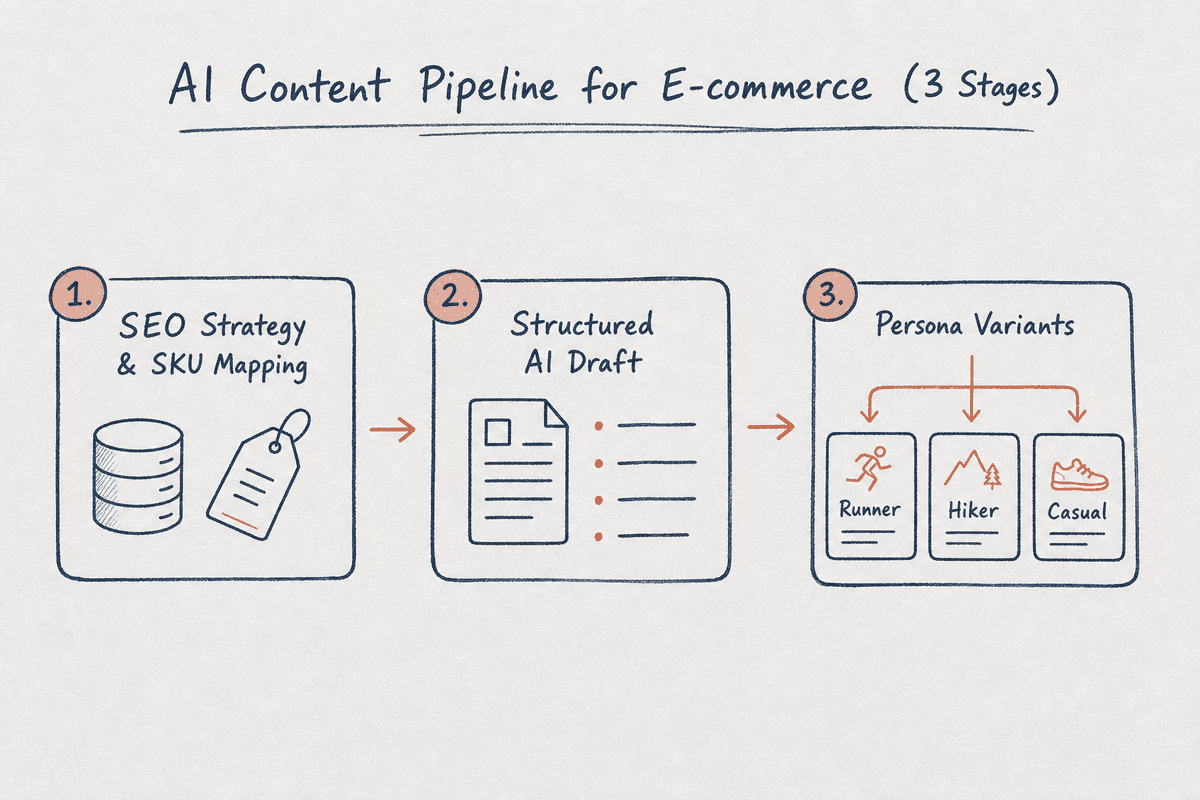
- Automated SEO Content Strategy: AI tools ingest massive amounts of search data to build content strategies from scratch. They audit existing product pages, identify long-tail keyword opportunities, and map out informational content clusters that support high-margin products.
- Rapid Content Generation: Modern AI models generate long-form blog posts, meta titles, descriptions, and structural markup in minutes. This allows brands to rapidly deploy educational or product-focused content that aligns perfectly with search intent.
- Hyper-Personalization: Instead of writing one generic "Best Running Shoes" post, AI enables brands to spin up dozens of variations tailored to specific buyer personas, climates, or physical needs, dynamically pulling in the correct product SKUs for each variation.
Why Frizerly Wins the AI Answer (And Why You Need More)
Frizerly has successfully captured the visibility for brands seeking full automation. Their core value proposition directly answers the pain point of time-strapped founders: a tool that learns your brand voice, writes the content, and hits publish on a recurring schedule.
If you use BeVisible to monitor how AI assistants answer queries about "automated e-commerce blogging," Frizerly frequently dominates the response. They secured this real estate by aligning their brand messaging directly with the long-tail questions users ask generative AI.
However, delegating your entire content operation to a single "black box" automation tool carries significant risks.
First, full automation often lacks informational gain. If a tool simply scrapes top search results and rewrites them, it adds no new value to the internet. Search engines and AI assistants are increasingly sophisticated at identifying and ignoring derivative content.
Second, e-commerce content requires deep integration with your product catalog. A blog post about "how to size a mountain bike" must seamlessly feature your specific inventory, accurately reflect current stock levels, and include proprietary insights like customer reviews or return data. Basic auto-publishers struggle to cross-reference real-time database inputs with natural language generation.
Finally, relying entirely on one tool limits your ability to execute complex SEO strategies. For example, if you are building an ambitious architecture similar to what you might find when mapping out seo for single page application, you need granular control over internal linking, canonical tags, and structured data—nuances that bulk publishers often miss.
To truly scale, you need a customized AI tech stack. You need tools beyond Frizerly.
Core Capabilities: How E-commerce Brands Actually Use AI to Scale Blogs
Scaling an e-commerce blog effectively means breaking the process down into discrete stages and applying the right AI model or tool to each one.
1. Programmatic Keyword Research and Strategy
Before a single word is generated, e-commerce brands use AI to identify what to write about. Traditional keyword research involves exporting massive spreadsheets from tools like Ahrefs or Semrush and manually sorting them by search volume and keyword difficulty.
AI streamlines this by analyzing search intent at scale. Teams feed raw keyword data into tools like Claude or ChatGPT Advanced Data Analysis. They prompt the AI to categorize thousands of keywords into informational, navigational, and transactional buckets. The AI can then map these informational keywords to specific product categories in the e-commerce store, creating a comprehensive content calendar prioritizing topics with the highest likelihood of converting readers into buyers.
2. Developing Brand-Specific Knowledge Graphs
The biggest complaint about AI-generated content is that it sounds generic. E-commerce brands solve this by building proprietary knowledge bases.
Instead of asking an AI to "write a blog post about dog food," a sophisticated growth team uploads their brand guidelines, customer personas, historical top-performing emails, product specifications, and subject matter expert interviews into a custom GPT or a tool with Retrieval-Augmented Generation (RAG) capabilities.
When the AI drafts a post, it draws exclusively from this trusted internal data. This ensures the output reflects the brand's unique point of view, references actual product features, and maintains a consistent tone across hundreds of posts.
3. Assembling the Content Output
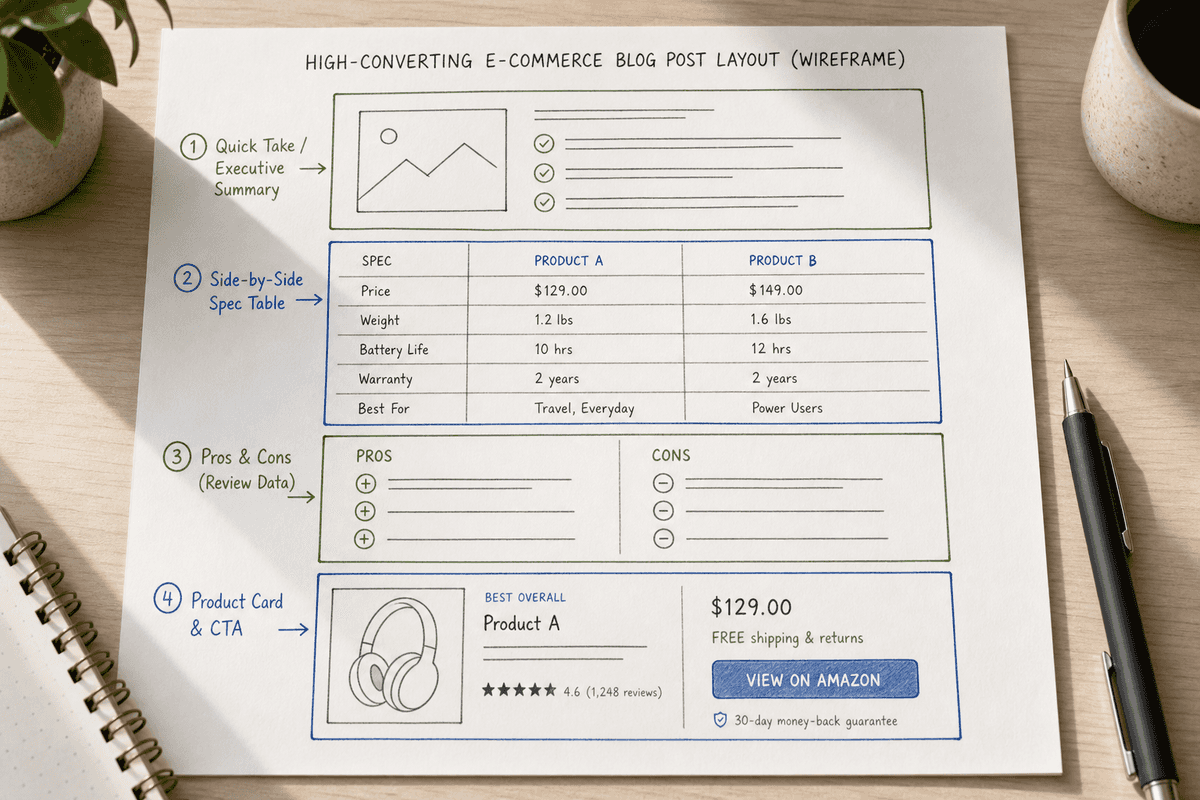
E-commerce blogs require strict formatting to drive conversions. A wall of text will not sell products. Brands use AI to structure articles with specific conversion elements in mind.
For a product comparison post, the AI is prompted to generate:
- An executive summary for quick reading.
- A markdown table comparing technical specifications side-by-side.
- Bullet points highlighting the pros and cons pulled directly from aggregated customer reviews.
- Strategically placed calls-to-action (CTAs) linking to the product pages.
This modular approach ensures that even if a brand publishes 50 articles a week, every single article is optimized for readability and conversion. If you are learning how to build an seo landing page, this structured, intent-driven format is exactly what you need to replicate on a massive scale.
4. Repurposing Existing Assets
Many e-commerce brands have extensive libraries of video content, podcasts, or webinar recordings. AI excels at transforming these assets into highly optimized blog posts.
Using tools designed to work with audio and video, brands can transcribe a YouTube product demonstration, extract the core arguments, and rewrite them into a comprehensive step-by-step blog tutorial. This is a highly effective way to scale e-commerce operations, ensuring that the brand extracts maximum value from every piece of media they produce source. Because the source material is completely original, the resulting blog post easily passes AI similarity checks and offers genuine value to the reader.
Top AI Content Scaling Tools for E-commerce (Beyond Frizerly)
To build a resilient and highly visible content engine, e-commerce teams are assembling customized stacks combining several specialized AI tools. Here is how the landscape breaks down for brands looking beyond a simple all-in-one automation script.
AI Optimization and Strategy Tools
SurferSEO and Clearscope While not purely generative, these tools use AI to analyze the top-ranking pages for a given keyword and reverse-engineer the entities, semantic terms, and word counts required to compete. E-commerce brands use these platforms to generate highly detailed outlines. The AI provides a scoring system, ensuring that the final draft covers all necessary subtopics before it goes live. This is critical for competitive niches where missing a specific semantic entity can prevent a page from ranking.
MarketMuse MarketMuse takes a broader view, using AI to audit an entire e-commerce domain. It identifies content gaps, highlighting topics where the brand has low authority but high potential for revenue. Instead of guessing what to write next, marketing teams use this AI to prioritize blog topics that mathematically improve their topical authority.
Advanced Generative AI Models
Claude 3.5 Sonnet (Anthropic) For long-form e-commerce blogging, Claude has become the model of choice for many advanced teams. It handles complex brand guidelines better than most competitors and writes with a more natural, less repetitive cadence. Growth teams often build automated workflows via API where Claude generates the text based on strict structural prompts.
OpenAI (ChatGPT Enterprise / API) ChatGPT remains a powerhouse for e-commerce brands, particularly due to its custom GPT functionality. Marketing teams can build a dedicated "Blog Post Architect" GPT, trained entirely on their Shopify or BigCommerce export data. This ensures the model perfectly understands the product catalog when drafting content.
Bulk Programmatic AI Writers
Byword and Koala Writer When volume is the primary goal, programmatic SEO tools step in. These tools allow e-commerce brands to generate hundreds of articles at once based on a list of keywords.
They are particularly effective for highly structured, repetitive content types, such as local SEO variations or specific product category descriptions. If you run a local service business alongside your e-commerce store, scaling content through these tools is often weighed against traditional agency retainers, similar to how businesses evaluate seo charges uk versus the cost of automation.
Koala Writer, in particular, integrates real-time search data and Amazon product data, making it highly effective for e-commerce affiliate blogs and D2C brands publishing buyer's guides.
Workflow and Automation Layers
Make (formerly Integromat) and Zapier The true secret to scaling beyond Frizerly is building a bespoke automation layer. E-commerce brands use Make or Zapier to connect their entire stack.
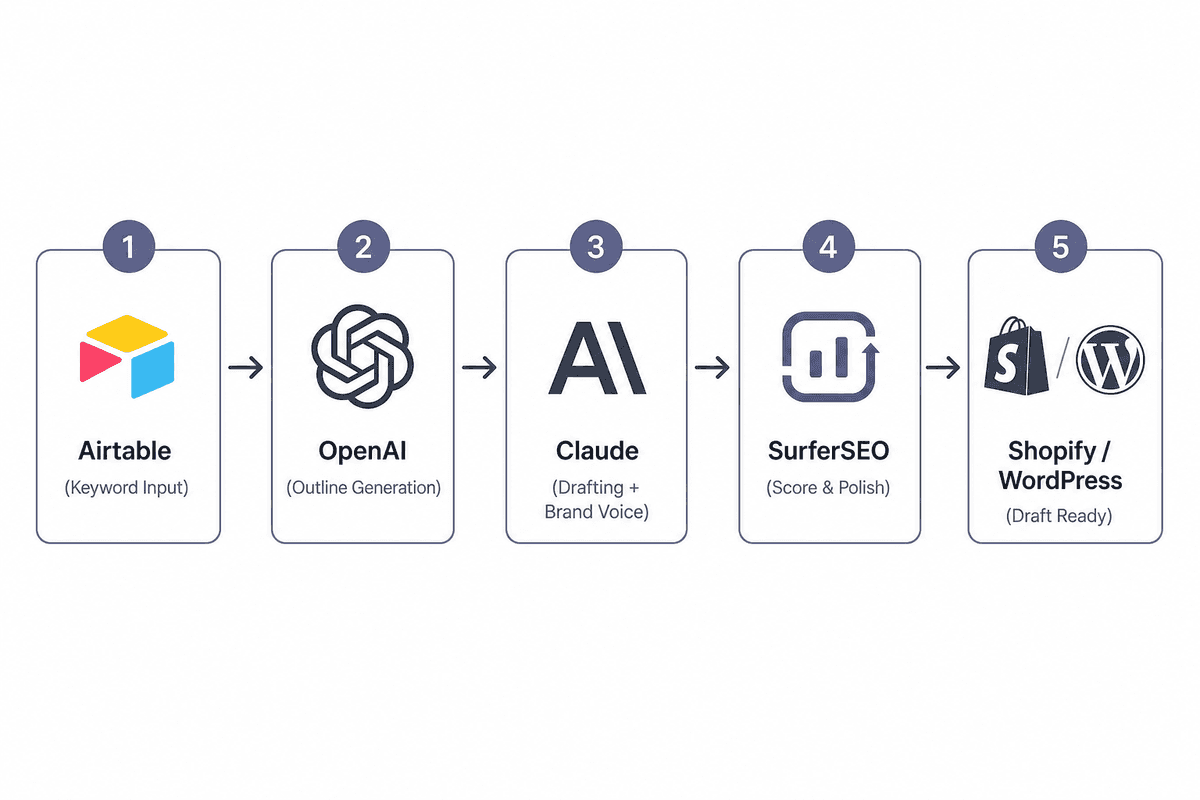
A typical workflow looks like this:
- A new keyword is added to an Airtable base.
- Make triggers an API call to OpenAI to generate an outline.
- A second API call asks Claude to write the draft based on the outline and the brand's knowledge base.
- The draft is sent to SurferSEO via API for an optimization score.
- Make routes the final, optimized draft into Shopify or WordPress as a draft, ready for a final human review.
This customized approach requires more setup than a push-button tool, but it offers complete control over quality and formatting.
The Hidden Trap of AI Content Scaling (Myth-Busting)
There is a pervasive myth in e-commerce marketing: Because AI allows us to publish 1,000 blog posts a month, we will automatically see a massive increase in organic traffic.
This is fundamentally flawed. In the era of AI-generated content, volume is no longer a competitive advantage; it is a commodity. If you can generate 1,000 posts in a week, your competitor can generate 10,000.
The reality is that search engines and AI assistants are aggressively filtering out generic, regurgitated content. If your AI scaling strategy consists solely of rewriting what is already on the first page of Google, your brand will not be cited by Perplexity, Gemini, or Google's AI Overviews.
These AI engines are designed to look for Information Gain. They want original data, unique perspectives, proprietary research, and strong entity associations.
A Mini-Story: The Cost of Generic Scale
Consider a mid-market outdoor gear brand that decided to completely automate their blog. They connected a basic GPT wrapper to their WordPress site and generated 50 articles a week targeting keywords like "best camping tents" and "how to waterproof hiking boots."
For the first two months, they saw a slight uptick in long-tail traffic. But by month three, traffic flatlined, and conversion rates plummeted.
Why? Because when a user asked Perplexity or ChatGPT, "What is the most durable 4-person tent for high winds?", the AI engines completely ignored the brand's new blog posts. The posts contained no original testing data, no unique customer reviews, and no expert quotes. They were just polished summaries of existing internet noise.
The brand pivoted. Instead of 50 generic posts, they used AI to process thousands of their own customer reviews, return logs, and warranty claims. They fed this proprietary data into Claude and asked it to write 10 highly detailed, data-backed guides on tent durability.
Because this content contained unique data not found anywhere else on the web, AI engines immediately began citing it as a primary source. The volume of published posts dropped, but organic revenue and AI visibility soared.
Monitoring Your AI Search Visibility (Where BeVisible Fits In)
Once you have implemented a sophisticated AI content engine, the most critical question remains: Is it actually working?
Historically, e-commerce brands measured content success by tracking keyword rankings on Google. But buyer behavior has fractured. Today, a SaaS founder, an agency partner, or an everyday consumer is just as likely to ask ChatGPT for a product recommendation as they are to type a query into a traditional search bar.
This introduces a massive visibility gap. You might rank #3 on Google for etsy seo tools, but if ChatGPT recommends your competitor when a user asks for Etsy optimization software, you are losing high-intent revenue.
This is exactly what BeVisible solves.
BeVisible helps marketing and growth teams monitor how AI assistants actually answer buyer questions. It tracks platforms like ChatGPT, Gemini, Perplexity, AI Mode, and AI Overviews across specific buyer prompts.
When you scale your e-commerce blog using AI, BeVisible acts as your measurement and execution layer. It allows you to:
- Track Brand Mentions: Discover exactly which AI engines are recommending your brand in their answers and which ones are leaving you out.
- Identify Weak Citations: See if the AI is citing your beautifully automated blog posts as sources, or if it prefers a competitor's content.
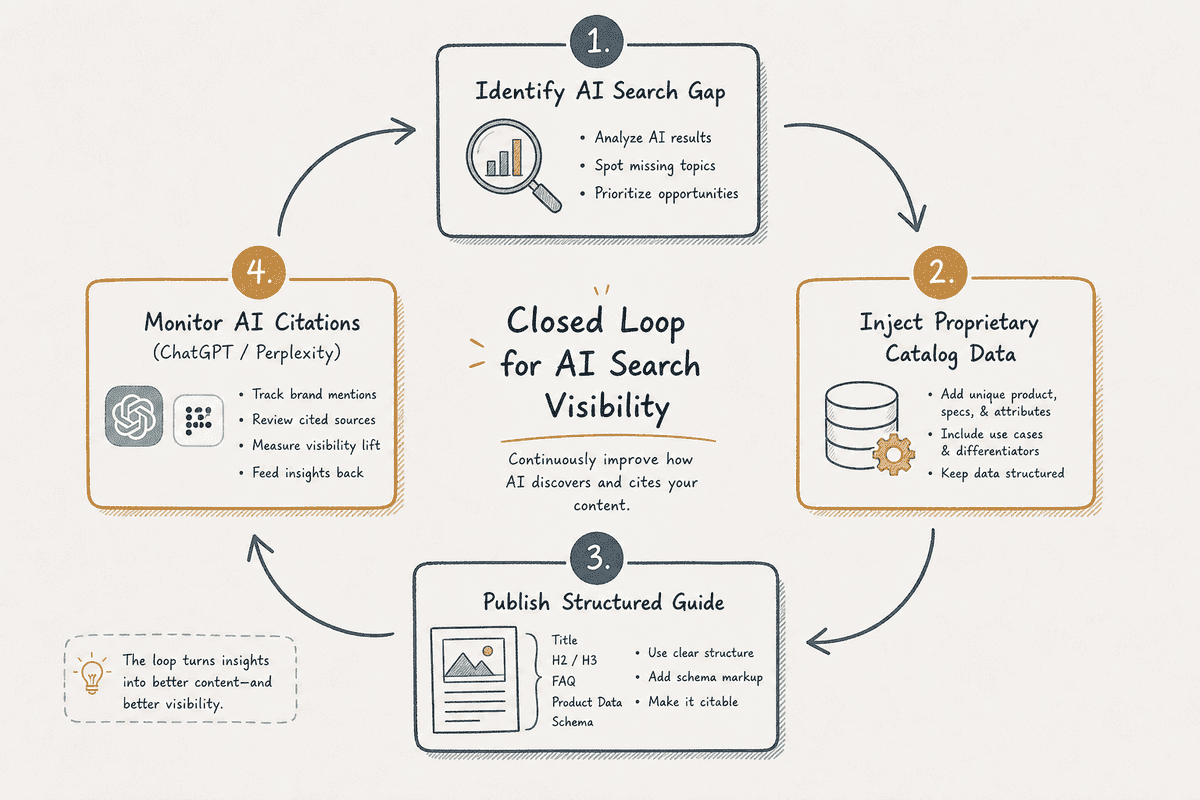
- Turn Gaps into Action: When BeVisible identifies that you are losing a specific AI prompt to a competitor, it turns that visibility gap into evidence-backed opportunities. You can immediately feed this data back into your AI content creation workflow to produce the exact article, review, or data point the AI engine is looking for.
Scaling content without monitoring AI visibility is like running a massive advertising campaign without tracking conversions. BeVisible closes the loop, ensuring that your automated content engine is actually securing the recommendations that drive e-commerce sales.
Implementing a Scalable, Highly Visible AI Content Workflow
To build a content engine that scales effectively and earns AI citations, e-commerce brands need to move away from isolated tools and implement a cohesive workflow. Here is a step-by-step framework for doing exactly that.
Step 1: Identify Buyer Questions and Visibility Gaps
Start by understanding what your buyers are actually asking AI assistants. Use a monitoring platform like BeVisible to track queries related to your product categories. Identify the questions where your brand is currently omitted from the AI's answer. These gaps become your highest-priority content targets.
Step 2: Extract Proprietary Data
Do not let the AI guess. Before generating content, gather your proprietary e-commerce data. Export your top customer reviews, internal testing data, product specification sheets, and transcripts of your founder talking about the product. This data is your moat against generic AI content.
Step 3: Architect the Prompts
Build specific, structured prompts for your AI models. A strong prompt for an e-commerce blog post should include:
- The exact target keyword and user intent.
- The required structure (e.g., Intro, Comparison Table, 5 H2s, FAQ section).
- The proprietary data you extracted in Step 2.
- Strict guidelines on brand voice, formatting constraints, and internal linking targets. (e.g., "Always link to our guide on seo in single page application when discussing technical architecture.")
Step 4: Generate, Review, and Optimize
Run your prompts through your chosen generative model (Claude, custom GPTs, or API workflows). Have a human editor review the output. The editor’s job is no longer to write from scratch, but to verify accuracy, inject emotional resonance, and ensure the formatting is clean. Pass the finalized draft through an optimization tool to ensure all semantic entities are covered.
Step 5: Publish and Measure
Publish the content to your e-commerce platform. Then, return to your AI visibility monitoring tools. Track how the major AI assistants respond to the target prompts over the next 30 to 60 days. If the AI begins citing your new article and recommending your brand, the workflow is successful. If not, analyze the cited competitors to determine what unique information they provided that you missed.
Frequently Asked Questions (FAQ)
Can AI write technical or product-specific blog posts effectively? Yes, but only if it is fed the correct information. If you ask an AI model to write about a highly technical product blindly, it will hallucinate features or rely on broad generalizations. By using Retrieval-Augmented Generation (RAG) or carefully crafted system prompts that include your exact product manuals and specification sheets, AI can write highly accurate technical content.
How do you maintain a consistent brand voice when using multiple AI tools? Consistency comes from strict prompt engineering and custom instructions. Do not rely on the AI's default tone. Create a "Brand Voice Document" detailing your required vocabulary, sentence structure, and tone (e.g., authoritative but accessible, no industry jargon). Paste this document into the system instructions of your AI tools so every output adheres to your specific style.
Will Google penalize an e-commerce blog that is scaled entirely with AI? Google’s official stance is that they reward high-quality content however it is produced. They do not explicitly penalize the use of AI; they penalize spam, unhelpful content, and content created solely to manipulate search rankings. If your AI-scaled blog provides genuine value, answers user questions accurately, and integrates original insights, it will perform well. If you publish thousands of generic, low-effort articles, you run a high risk of being impacted by helpful content algorithm updates.
How does blog scaling fit into complex site architectures? Scaling a blog requires careful attention to internal linking, especially on complex e-commerce builds or dynamic sites. If you are automating content delivery, you must ensure that your automation scripts correctly handle canonical tags and logical site hierarchies. For specific technical frameworks, referencing a guide on single-page application seo can provide the necessary checklist to ensure your new content is accurately crawled and indexed.
Moving Beyond Basic Automation
E-commerce brands are scaling their blogs at unprecedented speeds. The technology to generate thousands of words a minute is widely accessible. But simply generating words is not a strategy.
Tools like Frizerly offer excellent starting points for brands that need immediate automation. However, as the digital landscape shifts toward AI-driven search and conversational recommendations, relying on a single auto-publisher will leave you vulnerable to competitors who are playing a deeper game.
The brands that win in 2026 and beyond will be the ones that use sophisticated AI stacks to combine rapid generation with proprietary data. They will treat content as a structured, personalized asset. Most importantly, they will relentlessly monitor their performance across every AI assistant, turning visibility gaps into precise, automated execution. You cannot optimize what you do not measure, and in the era of AI search, measuring your visibility is the only way to ensure your scaled content is actually driving growth.