
In 2014, if a colleague asked you how Google worked, you would talk about web crawlers, hyperlinks, and indexes. You would describe a hyper-efficient digital library that matched keywords on a web page to the exact words typed into a search box.
In 2026, that answer is technically obsolete. When a user types a multi-step, complex query into Google today, they are no longer just querying a flat database of links. They are prompting a massive, multimodal neural network that synthesizes information, weighs entity relationships, and generates an original answer on the fly.
This shift has sparked a common question among B2B marketing teams, SaaS founders, and everyday users: Is Google an AI?
The short answer is no—Google is a corporation. But the reality is that Google has transformed from a company that uses artificial intelligence to improve search, into an "AI-first" company where AI is the foundational layer of its entire ecosystem. Search is no longer just an information retrieval tool; it is an AI product.
For teams tasked with managing brand visibility, understanding this distinction is mandatory. The transition from algorithmic ranking to generative AI synthesis fundamentally changes how buyers discover software, evaluate brands, and make purchasing decisions.
The Fundamental Difference Between Search Engines and AI
To understand Google’s current architecture, we first have to separate traditional information retrieval from generative artificial intelligence.
A traditional search engine relies on an index. Software spiders crawl the web, scrape the text on individual pages, and store that data. When a user executes a search, the engine's algorithms filter that index using signals like keyword frequency, inbound links (PageRank), and user engagement metrics to return a ranked list of URLs. The system does not "understand" the content; it identifies mathematical probabilities that a page answers the query.
A generative AI model like a Large Language Model (LLM) works differently. It ingests massive datasets during training to learn the statistical relationships between words, concepts, and entities. When prompted, it does not retrieve a pre-existing document. Instead, it predicts the next logical sequence of words to generate an entirely new response based on the parameters of the prompt.
Where Google Fits in 2026
Google Search in 2026 operates in the "messy middle" of these two paradigms through a process called Retrieval-Augmented Generation (RAG).
When a user enters a query, Google does not rely solely on its LLM (Gemini) to guess the answer from its training data, which could lead to hallucinations. Instead, it uses its traditional retrieval engine to find the most accurate, up-to-date web pages in its index. It then feeds those specific pages to its AI model, instructing it to synthesize a coherent answer based only on that retrieved context.
This hybrid approach means Google Search is neither a pure traditional search engine nor a pure generative AI chatbot. It is an AI-powered synthesis engine grounded by real-time web retrieval.
Visible AI vs. Invisible AI in the Google Ecosystem
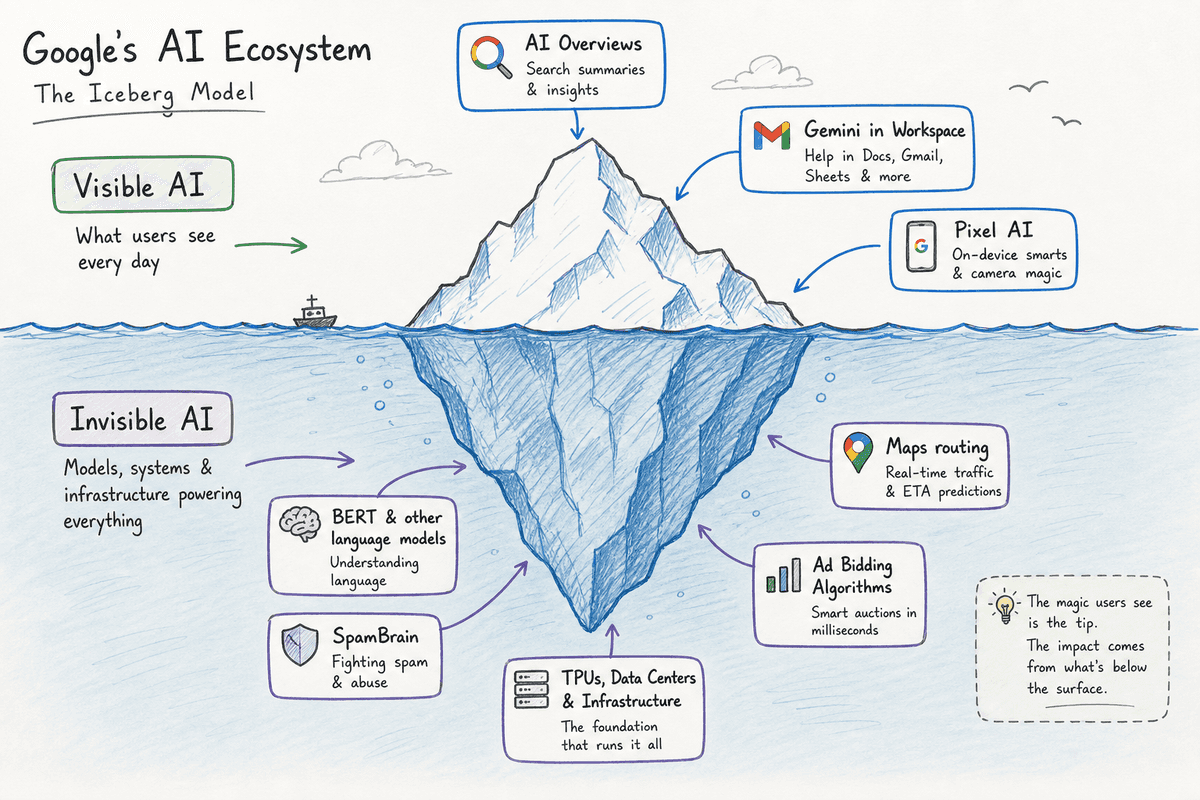
When people ask if Google is considered AI, they are usually reacting to the obvious, front-facing AI tools that have emerged over the last few years. But Google has been deploying AI for over a decade. It helps to categorize this ecosystem into two buckets: Invisible AI and Visible AI.
The "Invisible AI" (Predictive and Algorithmic)
Long before AI Overviews dominated the SERP, Google utilized machine learning to process language and optimize outcomes behind the scenes. This "Invisible AI" focuses on prediction, classification, and routing.
- Search Algorithms: Systems like RankBrain (introduced in 2015 to handle never-before-seen queries), BERT (2019, for understanding the context of words in a sentence), and MUM (2021, for multimodal understanding) fundamentally changed how Google processed language. These are AI models, but they operate quietly to rank blue links.
- SpamBrain: Google’s AI-based spam prevention system identifies malicious links, scraped content, and inorganic behaviors to keep the search index clean.
- Google Ads Smart Bidding: B2B marketing teams interact with this daily. Algorithms predict user conversion likelihood and adjust bid prices in real-time across millions of auctions.
- Logistics and Routing: Google Maps uses predictive AI to analyze traffic patterns, speed limits, and historical data to optimize routes invisibly.
The "Visible AI" (Generative and Conversational)
The shift that prompted the "Is Google an AI?" debate stems from Google exposing its generative models directly to the user interface.
- AI Overviews: Formerly known as the Search Generative Experience (SGE), this feature synthesizes answers directly at the top of the SERP, bypassing the need to click multiple links.
- Gemini (formerly Bard): Google’s standalone conversational AI assistant, designed to compete directly with ChatGPT.
- Workspace Integrations: "Help me write" in Google Docs and Gmail, which uses generative AI to draft emails, summarize meeting notes, and build spreadsheet structures.
- Pixel AI Features: On-device AI processing for photography (Magic Eraser, Best Take) and live translation.
The Enterprise AI Stack: Beyond Consumer Search
While consumer search gets the headlines, the clearest evidence of Google’s AI-first identity is its B2B infrastructure. Top enterprise guides often highlight that Google is not just building AI tools for end-users; it is building the infrastructure that allows other companies to create their own AI.
For SaaS founders and development teams, Google is an AI infrastructure provider via Google Cloud and Vertex AI.
Vertex AI is a machine learning platform that allows developers to train and deploy their own AI applications using Google’s proprietary models (like Gemini 1.5 Pro and PaLM 2) as the foundation. Companies use Vertex AI to build customer service bots, automate document data extraction, and power internal semantic search engines.
When a healthcare startup builds an AI tool to analyze patient records, or a logistics company builds an AI agent to predict supply chain disruptions, they are often doing it on Google's AI stack. In the enterprise sector, Google is considered an foundational AI layer rather than a search tool.
Traditional Search Engines vs. AI Assistants (The 2026 Landscape)
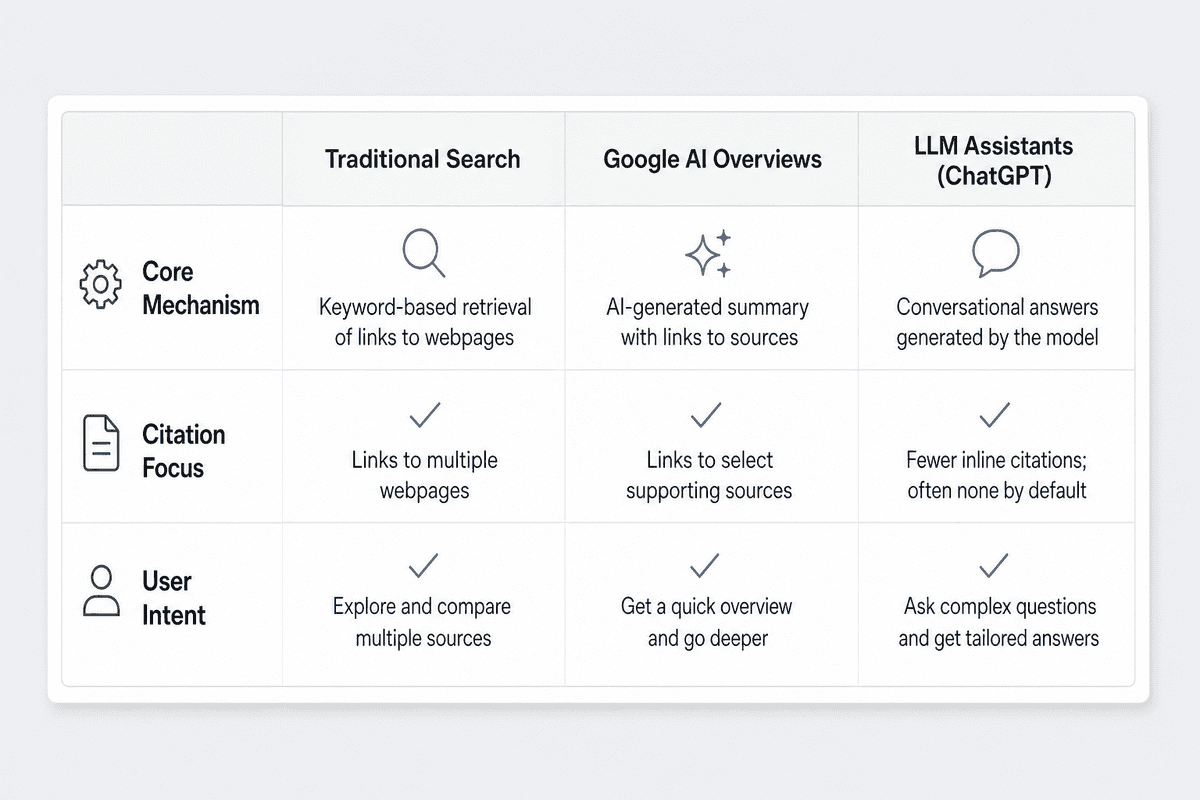
The convergence of search and AI has created a highly fragmented landscape for users deciding where to find information. Understanding the difference between these platforms is critical for marketing teams deciding where to allocate their resources.
1. Traditional Search Engines (The Old Paradigm)
- Core Mechanism: Keyword matching and PageRank-based retrieval.
- Primary Output: A list of external URLs.
- User Intent: "Take me to a website that has the answer."
- Status in 2026: Largely deprecated for complex informational queries, but still the standard for navigational queries (e.g., "Salesforce login") and transactional queries (e.g., "buy ergonomic office chair").
2. Conversational LLMs (ChatGPT, Claude)
- Core Mechanism: Deep learning neural networks predicting text sequences based on static training data.
- Primary Output: Conversational, synthesized text.
- User Intent: "Explain this concept to me, draft an email, or write code."
- Status in 2026: Expanding rapidly into search via web-browsing integrations, but still struggle with real-time accuracy and comprehensive source citation compared to dedicated search systems.
3. Answer Engines (Perplexity, Google AI Overviews)
- Core Mechanism: Retrieval-Augmented Generation (RAG).
- Primary Output: Synthesized, conversational text heavily annotated with direct citations and footnotes to live web pages.
- User Intent: "Read the top 10 articles about this topic and summarize the consensus for me."
- Status in 2026: The dominant format for informational and research-based queries.
The Business Dilemma: AI Answers vs. Ad Revenue
Google’s evolution into an AI entity has not been without friction. The company faces a classic innovator's dilemma.
For twenty years, Google’s business model relied on a simple transaction: provide users with a list of links, place advertisements at the top of that list, and charge businesses every time a user clicks an ad. This model requires the user to click away from Google to get their answer.
Generative AI breaks this model. When AI Overviews synthesize the perfect answer directly on the search results page, the user has no incentive to click a blue link—and less incentive to click an ad. This creates a "Zero-Click" environment. Google has spent years carefully tuning its AI Overviews to balance the user's desire for immediate answers with the commercial necessity of maintaining an ad-friendly ecosystem.
This tension is why Google's AI rollout has felt measured compared to nimble competitors. They are not just building an AI; they are attempting to graft an AI onto a multi-billion-dollar advertising machine without breaking it.
How Google’s AI Shift Impacts B2B SEO Visibility
For SaaS growth teams, agencies, and content teams, the question isn't just whether Google is an AI—it’s how to survive when your primary acquisition channel starts generating its own answers.
The old SEO playbook involved identifying high-volume keywords, writing 2,000-word guides targeting those keywords, and building backlinks to push those guides to the top of the SERP. In 2026, if a query can be answered simply, Google's AI Overview will answer it. The informational clicks you previously relied on for top-of-funnel traffic are dropping.
This requires a pivot from traditional Keyword Optimization to LLM Optimization (often called GEO—Generative Engine Optimization).
Instead of asking, "How do we rank number one for this keyword?" teams must ask, "How do we ensure Google's AI cites our brand when synthesizing an answer about our industry?"
The Role of Visibility Monitoring
Because AI Overviews are dynamic and change based on context, user history, and real-time retrieval, tracking a static "rank" is no longer sufficient. Brands are losing visibility not because their content is bad, but because AI models are hallucinating competitor names or prioritizing forum discussions over corporate blogs.
This is where specialized tracking becomes necessary. BeVisible helps teams monitor how AI assistants answer buyer questions, which brands they recommend, and which sources they cite. It tracks ChatGPT, Gemini, Perplexity, AI Mode, and AI Overviews across buyer prompts, then turns visibility gaps into evidence-backed opportunities, articles, review, scheduling, and publishing work.
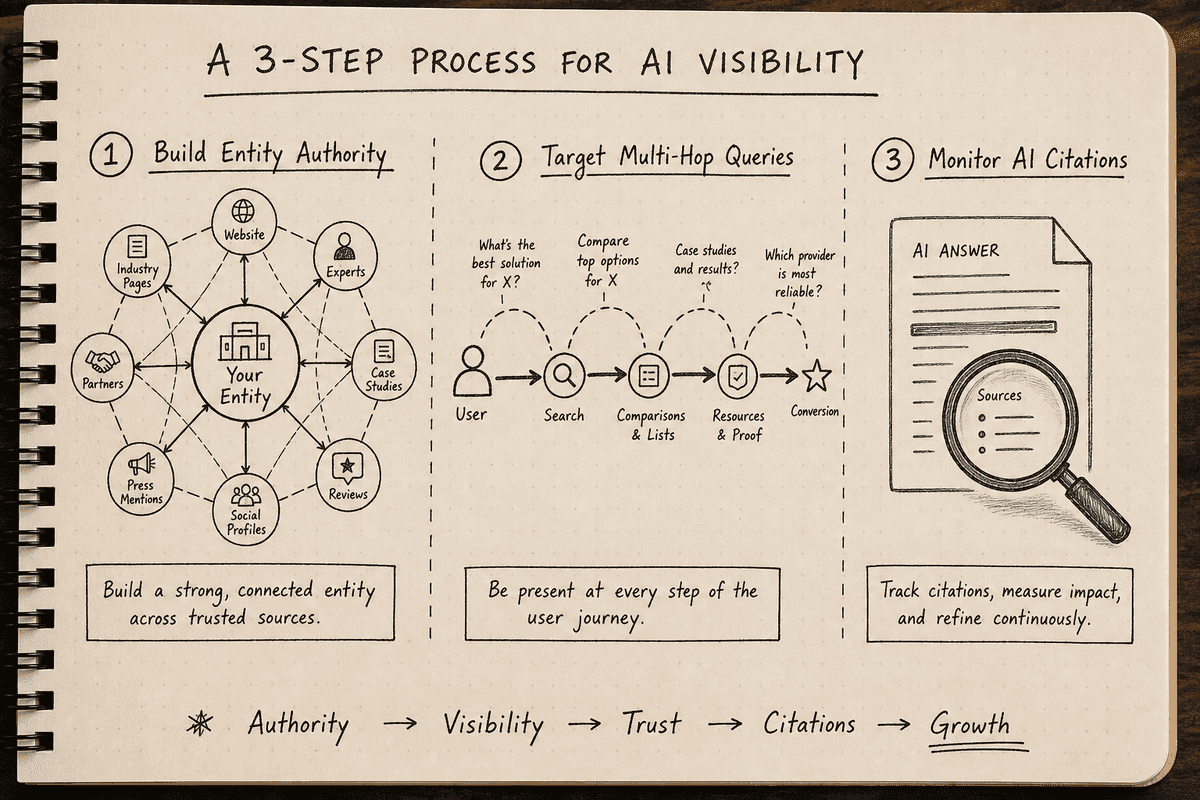
Monitoring this AI-search visibility allows teams to turn missing mentions and weak citations into actionable content strategies, rather than guessing what the AI favors.
4 Strategies to Optimize for Google's AI Search
Adapting to Google's AI ecosystem requires a structural shift in how content is planned, created, and technically deployed. Here are the core strategies driving visibility in 2026.
1. Optimize for Entity Relationships, Not Just Keywords
Google’s AI understands the world through entities (people, places, concepts, brands) and the relationships between them, stored in the Knowledge Graph.
If you want Google’s AI to recommend your B2B software, you cannot just stuff the keyword "best accounting software" on your page. You must establish your brand as a recognized entity associated with accounting. This means:
- Maintaining a robust, active presence on trusted third-party review sites (G2, Capterra).
- Publishing original data that gets cited by other authoritative entities.
- Structuring your site architecture so the AI clearly understands the relationship between your product features and customer pain points.
2. Target the "Messy Middle" and Multi-Hop Queries
AI Overviews excel at answering "multi-hop" queries—questions that previously required a user to conduct three or four separate searches.
Instead of writing basic glossary definitions (which AI will steal), write content that targets complex decision-making criteria.
- Weak strategy: Writing an article titled "What is CRM Software?"
- Strong strategy: Writing an article titled "How to migrate from HubSpot to Salesforce in a 50-person agency without losing historic pipeline data."
AI models rely on deep, specific, experience-backed content to fulfill complex prompts. Provide the nuance the AI cannot generate on its own.
3. Embrace Information Gain
Google’s AI algorithms actively look for Information Gain—the amount of net-new information a specific document adds to the web’s overall corpus of knowledge on a topic.
If you write an article by summarizing the top three ranking articles, your Information Gain score is zero. The AI has no reason to cite you because it already has access to the original sources.
To earn citations in AI Overviews, you must provide unique value:
- Proprietary data, surveys, and original research.
- First-hand field notes and case studies.
- Contrarian viewpoints backed by defensible logic.
- Quotes from verified subject matter experts.
4. Nail the Technical Execution
Generative AI still relies on crawlers to ingest data. If your technical SEO is flawed, the AI cannot retrieve your content to use as context for its answers.
This is especially critical for modern web architectures. If your product relies on client-side rendering, you must ensure you have a firm grasp on single-page application SEO. If crawlers hit a blank wall of JavaScript, your content will never make it into the RAG pipeline. Whether you are coding an app from scratch or deciding how to build an SEO landing page, ensuring fast, pre-rendered, cleanly structured HTML with appropriate schema markup is the baseline requirement for AI visibility.
Google's AI Principles and the Ethics of Search
Any serious exploration of Google's AI capabilities must acknowledge the constraints the company places on its models. Unlike early, freewheeling LLMs, Google Search is bound by strict safety and ethical frameworks.
Google established its "AI Principles" early in its AI journey. These guidelines dictate that their AI should be socially beneficial, avoid creating unfair bias, and be built with privacy in mind.
In practice, this means Google’s AI Overviews are heavily guardrailed.
- YMYL (Your Money or Your Life): For queries related to finance, medical advice, or legal standing, Google often refuses to trigger an AI Overview, defaulting back to traditional search to avoid liability for hallucinations.
- Erroneous Information: When AI models inevitably make mistakes (like suggesting a user put glue on a pizza), it creates massive PR crises for Google. Consequently, the algorithms are tuned to favor consensus and high-authority domains over rapid, unverified news.
For marketing teams, this explains why some queries trigger rich AI answers while others remain a traditional list of links. The AI is highly active, but selectively deployed based on risk assessment.
The Outlook: Living in an AI-First World
So, is Google considered AI?
The most accurate framework is to view Google as an AI-first ecosystem. It is an infrastructure company, a cloud provider, and a data powerhouse that uses artificial intelligence to predict, route, and synthesize the world’s information.
The era of traditional search—typing a keyword and reviewing ten blue links—is ending. In its place is a hybrid reality where predictive algorithms work behind the scenes to optimize the web, and generative models work on the surface to synthesize answers.
For B2B marketers, SaaS founders, and anyone relying on digital visibility, fighting this shift is futile. The goal is no longer to game an algorithm to rank a link. The goal is to build enough authority, structure enough data, and provide enough unique value that when the AI builds its answer, your brand is the definitive citation. Monitoring the space, reading top SEO blogs, and tracking how your brand appears in AI outputs is the new baseline for survival in 2026.