
You log into ChatGPT, Gemini, or Perplexity, and type the exact query your ideal buyer searches when looking for your software. The AI generates a thoughtful, highly persuasive recommendation.
The problem? It just recommended your biggest competitor. Worse, it highlighted three specific features they offer, cited a glowing review from Reddit, and completely omitted your brand.
If this scenario sounds familiar, you are experiencing the sharp edge of Answer Engine Optimization (AEO). AI overviews are reportedly absorbing up to 40% of clicks that would have previously gone to traditional search results source. When a generative model recommends your competitor and ignores you, you are entirely invisible to that buyer. Traditional rank trackers will tell you that you are on page one of Google, while completely missing the fact that ChatGPT is actively talking buyers out of using your product.
While early trackers like Peec AI have introduced the concept of monitoring LLM responses, modern B2B marketing teams need more than just a dashboard that says, "You lost." You need to know why the AI recommended a rival, where it pulled that information from, and exactly what content you need to publish to change the model's mind.
This guide breaks down how to audit your AI visibility, traces the sources behind competitor recommendations, and explores the best tools beyond Peec AI to turn missing mentions into published, revenue-driving work.
The Shift: Why AI Recommendations Replace Search Real Estate
Traditional SEO focuses on domain authority, backlinks, and on-page keyword density to secure a spot in ten blue links. Generative AI fundamentally breaks this model. AI assistants do not rank websites; they act as conversational advisors synthesizing information to give a single, definitive answer.
Because LLMs (Large Language Models) are trained to favor consensus, they look for overlapping signals across the web. If five different reputable sources say your competitor is the best tool for enterprise accounting, the AI adopts that stance.
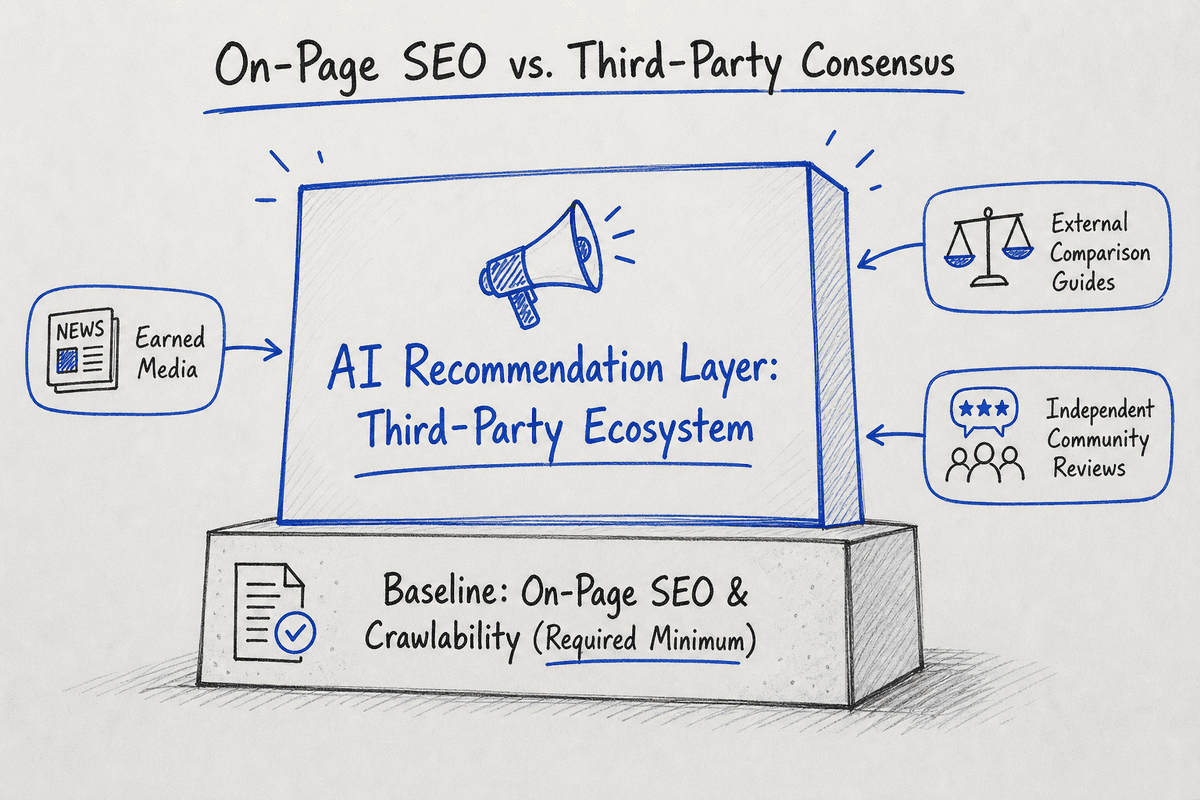
 This means that simply optimizing your own website is no longer enough. Your homepage copy claiming you are the "industry-leading solution" carries very little weight with an AI model unless third-party sources corroborate that claim. The presence your brand holds on third-party sites, review pages, and communities is what ultimately drives AI recommendations. The products that score well in LLM outputs are doing so because they have secured widespread, positive third-party consensus source.
Manual Auditing: The Baseline Approach to Checking AI Visibility
Before investing in software, you need to understand the mechanics of an AI recommendation. The most straightforward method to know if AI recommends your competitor is to manually "shop" your own industry.
However, typing your brand name into ChatGPT and asking, "Are we good?" is a flawed test. Buyers do not ask for you by name when they are in the discovery phase. They ask intent-based questions.
1. Perform Direct Prompt Audits
To see what your buyers see, you must test the exact prompts your ideal customers use. Categorize your manual testing into three prompt types:
- Broad Informational Prompts: "What are the top three compliance software platforms for healthcare providers?"
- Feature-Specific Prompts: "Which CRM software has the best native integration with Slack for remote sales teams?"
- Alternative/Comparison Prompts: "What is the best alternative to [Competitor Name] for a mid-sized agency?"
2. Test Across Multiple Platforms
Different AI models rely on different training data, algorithms, and retrieval mechanisms. You must test your prompts across the major platforms:
- ChatGPT (OpenAI): Uses a mix of base training data and Bing-powered web search for real-time queries.
- Google Gemini: Heavily integrated with Google's search index and Google Workspace data.
- Perplexity AI: Operates purely as an answer engine, actively crawling the web to provide heavily cited, real-time responses.
- Google AI Overviews (SGE): Appears directly at the top of traditional Google search results, synthesizing top-ranking pages into a summary.
3. Implement Persona Prompting
LLMs adjust their answers based on the context of the user. Instead of asking a generic question, assign the AI a persona.
Try a prompt like: "Act as a Chief Financial Officer at a 50-person SaaS company. You need to reduce software bloat and are looking for a unified spend management tool. Which three tools do you recommend and why?"
If your competitor appears in the output for this specific persona, you know their marketing team has successfully seeded use-case-specific content across the web.
The Limitations of Manual Checking and Basic Trackers
Manual testing is highly effective for a one-off sanity check. But doing this at scale across hundreds of buyer questions, multiple AI models, and weekly algorithm updates is impossible for a standard growth team.
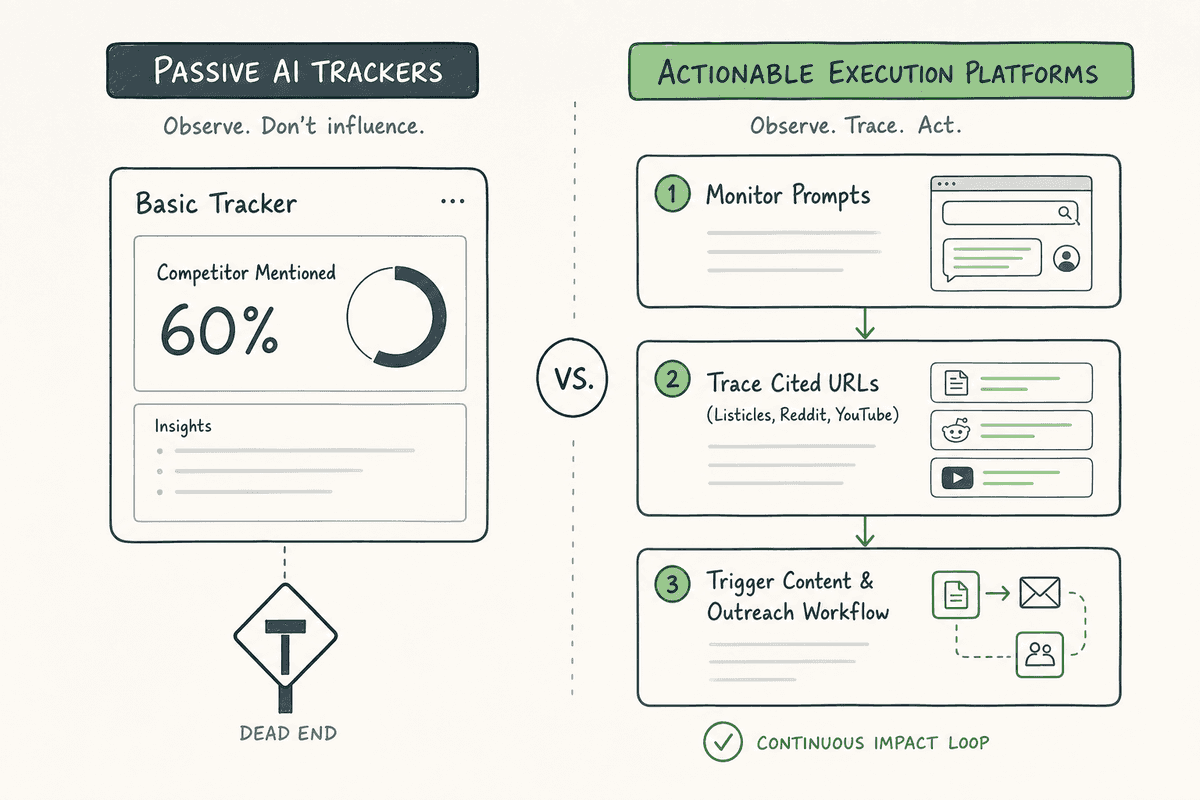
This is why tools like Peec AI gained early traction. They automate the process of running prompts and tracking mentions. However, simple mention-tracking has a hard ceiling. Knowing that ChatGPT recommends your competitor 60% of the time is interesting data, but it is not an action plan.
When you discover a competitor is winning, the immediate next question is: Why?
If a basic tracker cannot tell you which specific third-party articles, Reddit threads, and YouTube videos the AI cited to form that recommendation, you cannot reverse-engineer their success. You need tools that go beyond monitoring and bridge the gap into execution.
Best Tools to Know If AI Recommends Your Competitor
When evaluating the market for AI visibility tracking, you have to look for platforms that handle both the analytical monitoring and the strategic execution required to fix visibility gaps. Here are the top tools that move beyond basic tracking.
1. BeVisible (The Comprehensive Execution Platform)
BeVisible is built specifically for SaaS founders, B2B marketing teams, and content agencies who need to measure AI-search visibility and actually do something about it.
While basic tools stop at telling you a competitor was mentioned, BeVisible actively monitors ChatGPT, Gemini, Perplexity, and AI Overviews across your target buyer prompts. It calculates your AI Share of Voice and tracks exactly which brands are recommended.
More importantly, BeVisible focuses on the source of the recommendation. It tracks which sources the AI cites when praising a competitor, allowing you to turn those visibility gaps into evidence-backed opportunities.
If Perplexity recommends a rival because they were featured in a specific listicle and a high-ranking YouTube video, BeVisible identifies those exact citations. It then turns those insights into publishing workflows—whether that means scheduling an outreach campaign to get added to that listicle, producing a competing video, or publishing targeted technical content like a guide on SEO for Single Page Applications: A 5-Step Guide (2026) to capture the AI's attention for development queries.
2. SE Ranking AI Visibility Tracker
For teams transitioning from traditional SEO to AI search, SE Ranking offers a robust AI Visibility Tracker. This tool is excellent for measuring a brand's or domain's AI presence across engines source.
It breaks down your presence into brand mentions and domain citations. If you are an agency managing multiple clients, SE Ranking provides a familiar, traditional SEO dashboard experience applied to AI metrics. It is highly effective at showing you the percentage of times your client's domain is referenced in Google AI Overviews versus traditional organic links.
While it lacks the direct publishing and execution workflows of BeVisible, it is a formidable tool for pure data collection and reporting, especially if you need to justify an SEO budget to stakeholders.
3. Custom RAG Monitoring Workflows
For enterprise teams with dedicated data science resources, building a custom RAG (Retrieval-Augmented Generation) monitor using the APIs of OpenAI, Anthropic, and Perplexity is an option.
By scripting automated daily queries and using natural language processing to extract the recommended entities, large teams can build proprietary dashboards. This approach offers ultimate flexibility but requires significant engineering overhead and constant maintenance as API endpoints and model behaviors shift.
What to Check First When AI Recommends a Competitor
When you run a report in your visibility tool and see a competitor dominating the recommendations, your first reaction might be frustration. Your second reaction should be investigation.
Curious how agency founders and operators handle this? When AI recommends a competitor, the immediate next step is to check the source behind the recommendation source.
Generative AI models, particularly those using RAG, do not invent recommendations out of thin air. They retrieve relevant documents from their index or the live web, read them, and synthesize an answer. If your competitor is recommended, it is because they are winning the retrieval phase.
Step 1: Trace the Footnotes
If you are using Perplexity, Google AI Overviews, or ChatGPT with web search enabled, the AI will provide footnotes or citation links. Click every single one of them.
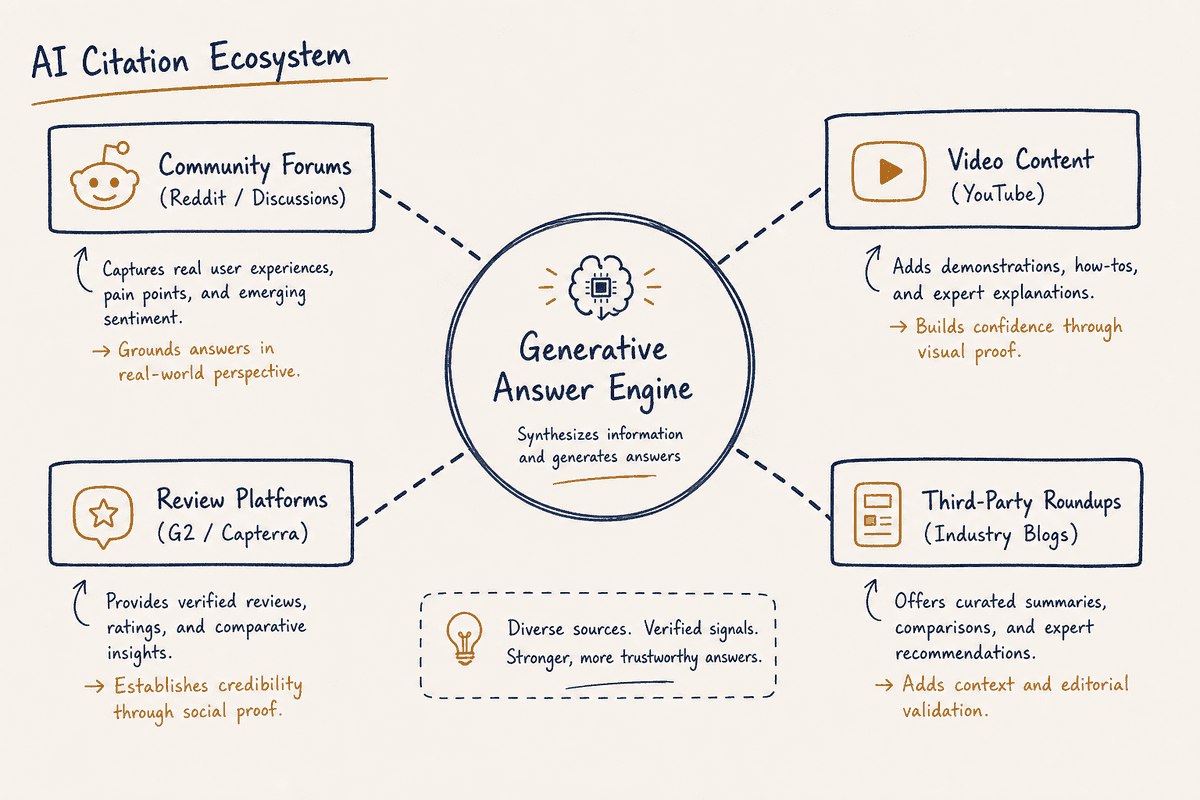
You will often find that the AI is not citing your competitor's homepage. Instead, it is citing:
- A comprehensive roundup post on a high-authority industry blog.
- A G2 or Capterra comparison matrix.
- A highly active Reddit thread where practitioners debated the merits of different tools.
- A YouTube tutorial.
Step 2: Analyze the Third-Party Consensus
Look at the sentiment of the cited sources. Does the listicle explicitly state that your competitor is "the easiest to use"? If so, you will likely see the AI parrot that exact phrasing.
This is the secret to Answer Engine Optimization. You do not optimize for the AI directly; you optimize for the sources the AI trusts. YouTube, for example, gets cited frequently by AI models, along with community forums, third-party sites, review pages, and listicles source. If your competitor has an active YouTube presence and you do not, you are handing them a massive visibility advantage in generative search.
Step 3: Identify Your Missing Entities
Sometimes, an AI recommends a competitor because they are closely associated with a specific industry entity or integration that you have neglected to mention online.
If a buyer asks for "the best inventory tool for Shopify," and your competitor has 50 articles mentioning their Shopify integration while you only have it listed buried on a pricing page, the AI will confidently recommend the competitor. The semantic relationship between their brand and the entity "Shopify" is much stronger in the training data.
Turning Competitor Mentions Into Your Visibility Opportunities
Monitoring is only the first half of the battle. The core value of a tool like BeVisible is moving from a passive dashboard to an active publishing schedule. Here is how you turn a competitor's AI victory into your own visibility opportunity.
The Infiltration Strategy
If you trace a competitor's AI recommendation back to a specific third-party listicle—for example, "The 10 Best Project Management Tools of 2026"—your objective is not necessarily to outrank that listicle. Your objective is to get added to it.
Reach out to the author or publication. Offer them a trial of your software, provide a unique data point, or suggest an update to the piece. If you successfully get your brand added to a post that the AI already trusts and cites, you instantly inject your product into the AI's retrieval context. The next time a buyer prompts the AI, your brand will be in the mix.
The Surround Sound Strategy
If the AI is citing Reddit threads and community forums that praise your competitor, you cannot simply fake reviews to compete. AI models and community moderators are increasingly adept at spotting manufactured consensus.
Instead, you need to create genuine surround sound.
- Activate your advocates: Ask your most successful customers to review you on platforms like G2, TrustRadius, or specialized industry forums.
- Publish technical depth: If you are a developer tool, ensure your documentation is public, fast, and structured cleanly. For instance, understanding the nuances of single-page application SEO ensures that the web crawlers feeding the AI models can actually read and index your feature sets.
- Produce rich media: Since YouTube gets heavily cited by AI overviews, turn your text-based case studies into video interviews.
Case Example: Winning Back the "Enterprise" Modifier
Consider a B2B SaaS founder selling a cybersecurity compliance tool. Every time a user asked Perplexity for "enterprise compliance software," a smaller, less-equipped competitor was recommended as the top choice.
Using BeVisible, the founder's marketing team traced the citations. They discovered the competitor wasn't actually better at enterprise compliance; they had simply sponsored three major industry podcasts that published optimized show notes, and they had a dedicated "Enterprise Compliance Guide" on their blog that was referenced in a popular Reddit community.
The founder's team didn't try to tweak their homepage title tags. Instead, they took action based on the evidence:
- They published a 5,000-word, highly technical enterprise compliance framework, heavily structured with markdown tables and bullet points (formats LLMs love to parse).
- They engaged their top three enterprise clients to leave detailed reviews on a major software comparison site, specifically highlighting the "enterprise scale" of the product.
- They syndicated their technical guide to an industry publication.
Within four weeks, the new third-party consensus was crawled and indexed. The next time the prompt was run, the AI shifted its recommendation, placing the founder's tool in the number one spot and citing their new technical guide as the primary source.
The "Just Optimize Your Site" Myth
One of the most dangerous myths in the transition to AI search is the belief that traditional on-page SEO tactics will save you.
Many founders assume that if they just add schema markup, speed up their site, and stuff more keywords into their H2s, the AI will suddenly realize they exist. This fundamentally misunderstands how LLMs generate answers.
While technical SEO is still required so that your site can be crawled—there are distinct ways of implementing SEO in single page applications (3 ways) to ensure content isn't hidden behind client-side rendering—technical perfection does not equal a recommendation.
An AI model acts as a proxy for a human researcher. If a human researcher is looking for the best SEO agency in a specific city, they don't just trust the agency's own website. They look for top lists, reviews, and local business directories. The AI does the same thing. If your agency wants to be recommended for local search queries, you need to be featured in third-party roundups, much like a post listing the Top 7 Agencies for SEO in Durham (Ranked 2026).
Your own website is the baseline. The third-party ecosystem is the differentiator.
How to Build a Publishing Workstream from AI Insights
To effectively combat competitor recommendations, you need to build a content execution pipeline that reacts to AI visibility gaps.
1. Gap Identification
Run your BeVisible monitoring reports weekly. Filter the data to show prompts where your competitor's visibility score increased, but yours remained flat or dropped. Look specifically at high-intent transactional queries.
2. Citation Mapping
Extract the exact URLs the AI cited when recommending the competitor. Group these URLs by type:
- Owned Media: The competitor's own blog or documentation.
- Earned Media: News articles, PR, un-sponsored mentions.
- Community: Reddit, Quora, Stack Overflow, GitHub.
- Directories: G2, Capterra, Yelp, industry-specific aggregators.
3. Execution Assignment
Once you have the citation map, assign the work.
- If the gap is in Owned Media, assign your content team to write a superior, more comprehensive version of the competitor's cited article.
- If the gap is in Directories, assign your customer success team to run a review generation campaign targeting your happiest users.
- If the gap is in Earned Media, assign your PR or outreach team to pitch guest posts or request inclusion in the cited roundups.
If your team is overwhelmed and you are considering outsourcing this execution pipeline, be cautious about who you hire. Many traditional agencies are still selling outdated link-building packages that do nothing for AI visibility. Knowing the red flags is critical before signing a retainer (for context on what to avoid, reading about Hiring SEO Services in Phoenix? 5 Red Flags (2026) provides a good framework for vetting modern agencies).
Frequently Asked Questions About AI Competitor Tracking
How often should I check AI models for competitor mentions?
If you are doing manual audits, a monthly check of your top 20 highest-converting prompts is a good baseline. However, AI models update their indices and base weights frequently. For competitive B2B software niches, automated weekly tracking using a platform like BeVisible is recommended. This ensures you catch sudden visibility drops before they impact your quarterly pipeline.
Does Perplexity track differently than ChatGPT?
Yes. Perplexity is heavily biased toward real-time web retrieval. It acts almost entirely as a RAG (Retrieval-Augmented Generation) engine, meaning its recommendations are highly volatile and dependent on recently published, authoritative content. ChatGPT relies more heavily on its base training data, though it will use web search for current events or specific product queries. A competitor might dominate ChatGPT due to historical brand strength but lose on Perplexity because they haven't published fresh content in a year.
Can I automate my response to visibility drops?
While you cannot automate the genuine relationships needed to secure third-party mentions, you can automate the workflow. Platforms that combine tracking with execution allow you to set up alerts. When a competitor takes over a key prompt, the system can automatically generate a brief for a counter-article or flag a specific listicle for your outreach team to target.
Will traditional SEO content still work for AI?
Yes, but the format matters. AI models prefer content that is dense with facts, heavily structured (using bullet points and markdown tables), and clear in its definitions. Fluffy, 2,000-word SEO recipe-style posts are often bypassed by LLMs in favor of concise, expert-driven answers. For example, a highly structured guide outlining SEO for Single Page Applications: The Technical Checklist is much more likely to be cited by an AI than a rambling narrative post on the same topic.
Moving From Passive Tracking to Active Influence
Discovering that an AI recommends your competitor is a painful realization, but it is also a roadmap.
Basic trackers like Peec AI serve a purpose in bringing this issue to the surface, but modern marketing requires execution. The generative AI landscape moves too fast to rely on passive monitoring. By understanding the mechanics of third-party consensus, tracing the citations that fuel LLM outputs, and utilizing tools like BeVisible to turn visibility gaps into published work, you can rewrite the AI's narrative.
Stop letting your competitors control the conversation in the most critical phase of the buyer journey. Audit your prompts, map the citations, and start publishing the evidence the AI needs to recommend you instead.