
SaaS is inherently borderless. When you launch a software product, your total addressable market is theoretically anyone with an internet connection. Because of this, most SaaS founders and indie hackers pour their entire marketing budget into broad, high-competition global keywords.
That is exactly why ignoring local search leaves money on the table.
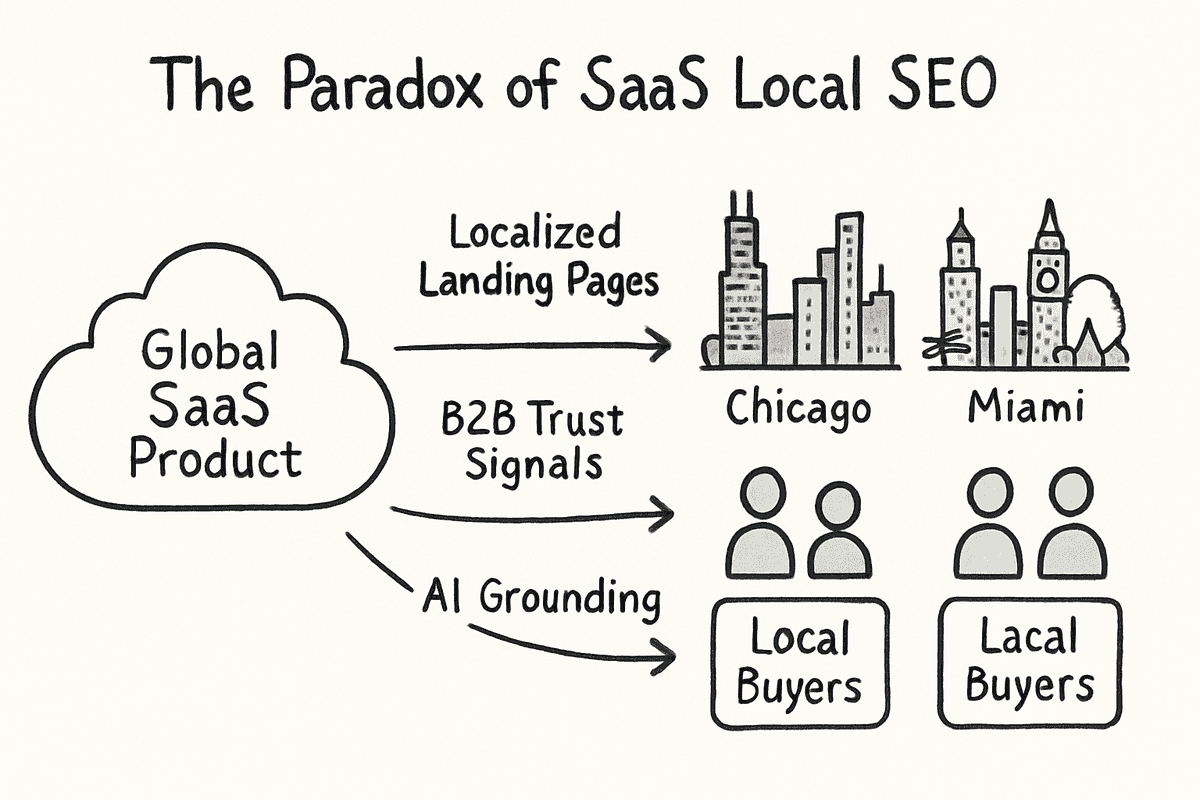
While your software lives in the cloud, your buyers live in physical cities. They run local businesses, adhere to regional compliance laws, and frequently append local modifiers to their searches (e.g., "HVAC dispatch software in Texas" or "accounting tools for UK agencies"). Furthermore, major search engines and AI models now heavily weight localized trust signals when recommending B2B solutions.
If you want to bypass the bloodbath of global SaaS keyword competition, localized organic strategy is your backdoor. We analyzed methodologies from top consultants and agencies to distill the noise into actionable growth levers.
Here are seven local SEO experts' tips to scale your SaaS organic traffic, build localized authority, and convert regional intent.
Why Do SaaS Companies Need Local SEO in 2026?
Before diving into the tactics, it helps to understand the paradox of localized marketing for cloud products. Why would a cloud-native CRM care about ranking in Chicago or London?
- The "Near Me" Trust Factor: Enterprise and mid-market B2B buyers often prefer vendors they perceive as accessible. Searching for Top 7 Agencies for SEO in Durham is a classic example of localized B2B intent. Buyers want regional accountability.
- Lower Keyword Difficulty (KD): Ranking for "dental practice management software" globally might take two years and $50,000 in link building. Ranking for "dental practice software Miami" can take six weeks with a well-structured landing page.
- AI Search Grounding: AI engines like ChatGPT and Perplexity rely heavily on local citations (directories, Google Business Profiles, localized PR) to "ground" their answers and avoid hallucinations. If your SaaS lacks a geographical footprint, AI algorithms are less likely to recommend it as a trusted entity.
7 Local SEO Tips to Scale Your SaaS Organic Growth
1. Deploy Programmatic Localized Landing Pages
Experts agree that the highest ROI activity for a B2B SaaS is building localized landing pages targeting specific regional verticals. Instead of one massive "Features" page, you build a matrix of pages that intersect your software's capabilities with target cities or states.
How to execute this:
- Identify regional search volume: Look for states or cities with high concentrations of your target industry (e.g., tech hubs for developer tools, real estate hotspots for property management software).
- Build an architecture: Create a parent directory (e.g.,
/locations/) and branch out. - Localize the copy, not just the H1: Don't just swap the city name. Address local pain points. If you sell payroll software targeting California, your localized page must mention California's specific overtime laws and compliance codes.
If you are unsure how to structure the page hierarchy, our guide on How to Build an SEO Landing Page (7-Step Guide) breaks down the exact conversion architecture.
2. Optimize Google Business Profile (GBP) for B2B Trust
Many SaaS founders skip claiming their Google Business Profile because they don't serve foot traffic. This is a critical error. Your GBP is the anchor of your localized entity in Google's Knowledge Graph.
Agencies like Coalition Technologies routinely emphasize that Name, Address, and Phone Number (NAP) consistency across the web is a primary driver of overall domain authority.
- Address the physical location rule: Google requires a physical address, not a P.O. Box. If you run a remote startup, use your registered business address or a legitimate co-working space where you can receive mail.
- Harvest B2B reviews: B2B buyers check Google Reviews just as often as G2 or Capterra. A SaaS company with 150 glowing Google reviews attached to its headquarters signals massive operational stability.
- Publish updates directly to GBP: Treat your GBP like a mini-blog. Post feature releases, webinar announcements, and hiring updates.
3. Harvest Localized Backlinks and Citations
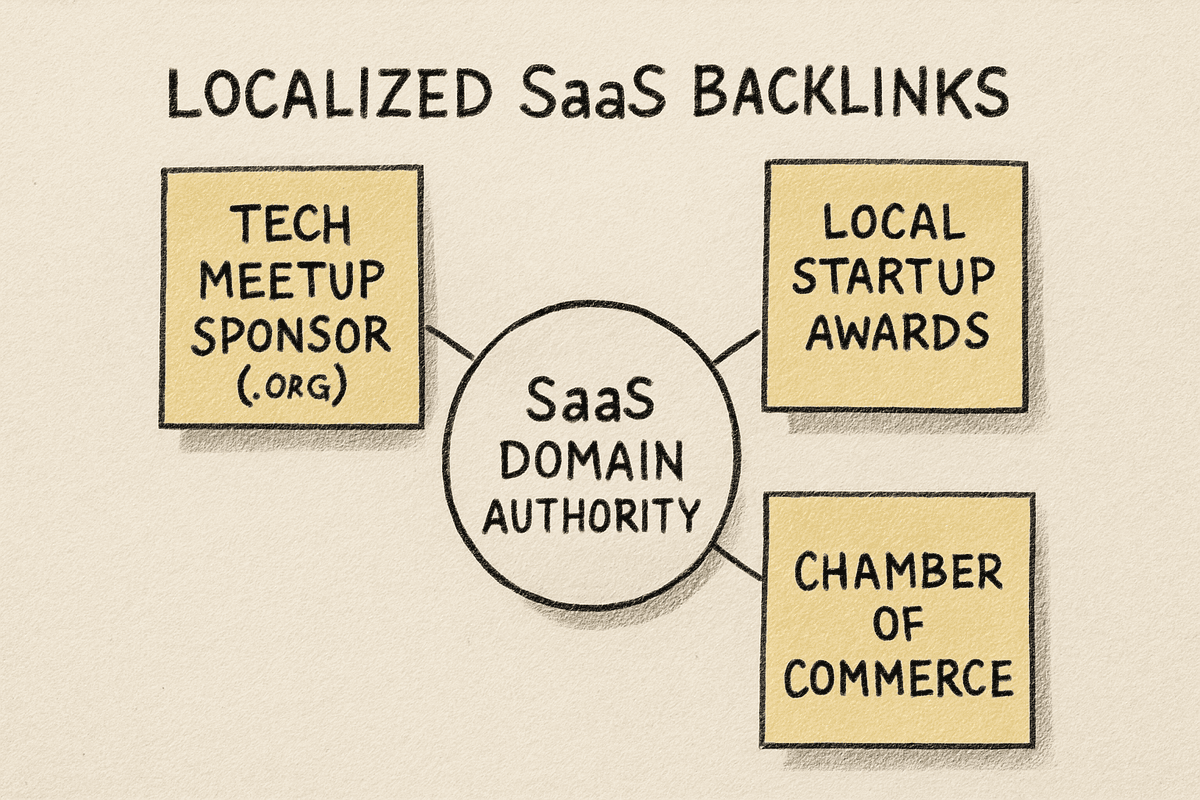
Global SaaS link building is notoriously expensive and saturated. Localized link building, however, is often cheaper, faster, and yields higher-trust referring domains.
According to data studies rounding up the Top 48+ Local SEO Experts, securing links from regional institutions sends massive trust signals to search algorithms.
Tactical local link opportunities for SaaS:
- Sponsor local tech meetups: A $200 sponsorship for a local "React Developers Meetup" often secures a do-follow link from the organization's site and event platforms.
- Join the Chamber of Commerce: Paying annual dues to your local Chamber of Commerce usually nets a highly trusted
.orgor local.combacklink. - Regional startup awards: Apply for "Top Startups in [City]" awards. Local business journals love writing about growing software companies in their backyard.
4. Target Regional Compliance and Feature Intent
One of the most underutilized strategies in SaaS is aligning software features with local legislation. This is where local SEO transitions into product marketing.
If you sell HR software, the search intent in New York (which has strict pay transparency laws) differs wildly from Texas. By creating content that addresses "How to handle NY pay transparency compliance," you naturally capture highly qualified, localized bottom-of-funnel traffic.
Steps to implement:
- Map your software's features to specific regional regulations, taxes, or industry standards.
- Write long-form guide content addressing these local issues.
- Position your software as the automated solution to that specific local headache.
5. Optimize for ChatGPT and AI Local Recommendations
By 2026, AI search engines are fully integrated into the B2B buying journey. When a user asks an AI, "What are the best CRM tools for a real estate agency in Florida?" the AI relies heavily on localized data points to generate its response.
To ensure your SaaS is recommended:
- Feed the LLMs local context: Ensure your site's "About" page clearly states where you are headquartered and which regions you actively serve or support.
- Citations matter for AI: AI models cross-reference your website's claims with third-party directories. Ensure your SaaS is listed accurately on local business aggregators.
- Structure data clearly: LLMs parse structured data efficiently. Use exact terminology regarding your service areas.
6. Inject Local Schema Markup (Technical SEO)
Search engines don't read your site; they parse its data. Injecting proper JSON-LD schema markup removes all ambiguity about who you are, what you sell, and where you operate.
For a SaaS, you should implement:
Organizationschema on the homepage.SoftwareApplicationschema detailing your product category and pricing.LocalBusinessschema on your "Contact Us" or "About" page, detailing your headquarters' coordinates, founding location, and contact information.
Technical note for modern web apps: If your application is built on a JavaScript framework (React, Vue, Angular), ensuring search engines can render your schema is historically tricky. Review our checklist on SEO for Single Page Applications: The Technical Checklist to guarantee your localized metadata isn't getting blocked by client-side rendering issues.
7. Automate Local Content Production (The Right Way)
Scaling local SEO requires content volume. If you want to target 50 different cities with 3 different use cases, you need 150 unique, high-quality, and structurally sound articles or landing pages. Hiring traditional agencies for this volume is often cost-prohibitive for bootstrapped startups.
As explored in our analysis of SEO Charges UK: Agency Rates vs Automation, the traditional model of paying $2,000/month for four blog posts simply doesn't scale for programmatic local SEO.
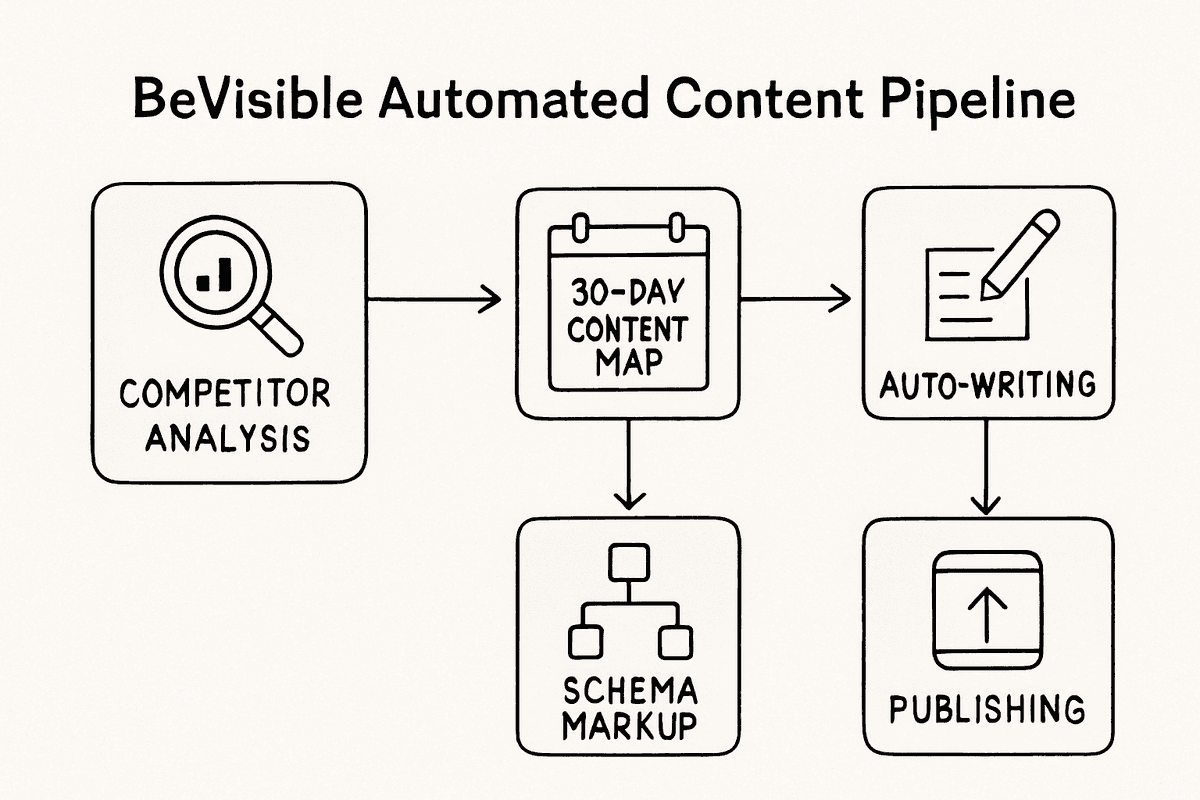
This is where smart automation comes in. Platforms like BeVisible handle the full production pipeline for you. By connecting to your site URL, BeVisible conducts competitor analysis, builds a 30-day content map, and automatically writes, polishes, and publishes an article every 24 hours.
Instead of managing a team of freelance writers to churn out localized content, BeVisible ensures every post features an answer-first structure, proper schema markup, strategic internal linking, and AI-search optimization. At $79 for 30 articles a month, it gives indie hackers and content marketers the execution power of a full-scale agency, allowing you to dominate local "long-tail" keywords effortlessly.
The "Global vs. Local" Budget Allocation for SaaS
How much of your SEO effort should go toward local intent versus global, broad-match keywords? Here is a baseline framework based on your growth stage:
Common Red Flags When Hiring Local SEO Experts
If you decide to augment your automation with a human consultant, proceed with caution. The barrier to entry for claiming the title of "SEO Expert" is non-existent. While platforms like Toptal and Upwork can connect you with vetted freelance talent, you still need to know how to interview them.
Watch out for these specific red flags when hiring for SaaS local SEO:
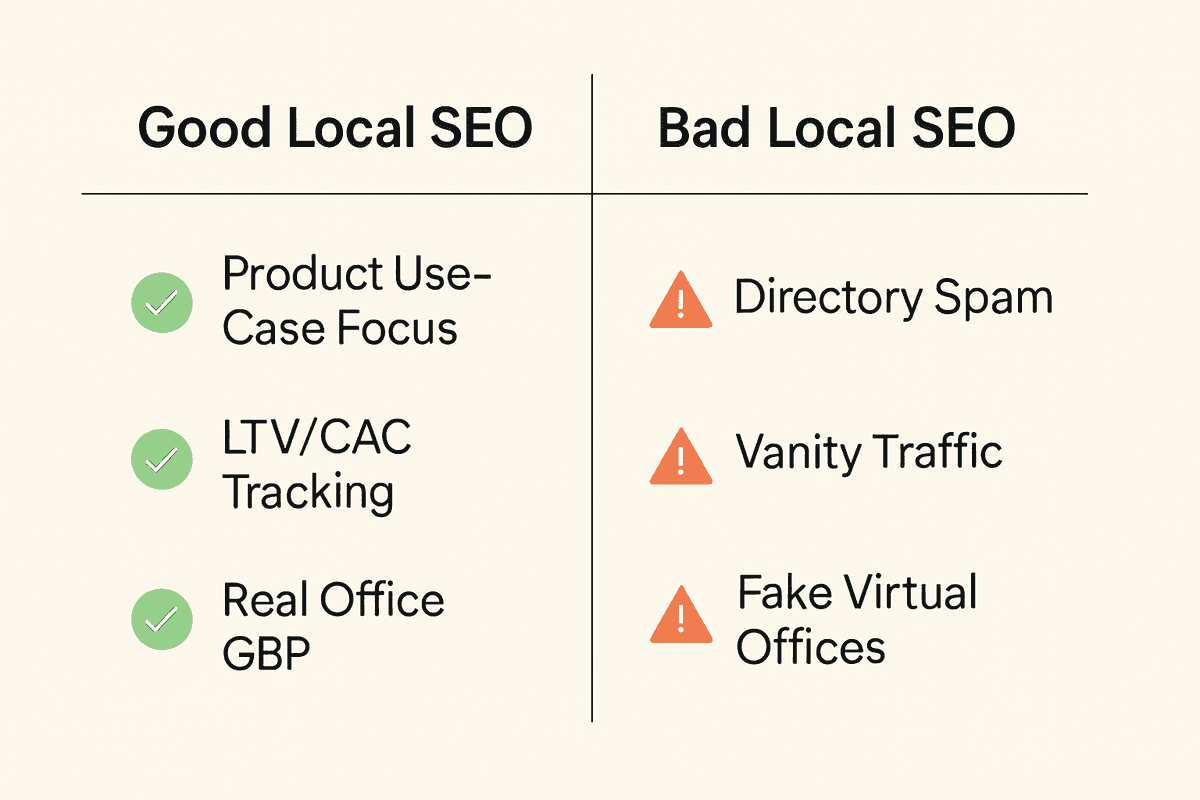
- They rely entirely on outdated directory submissions: If their primary strategy is submitting your SaaS to hundreds of low-quality local directories (Yelp, YellowPages, obscure Web 2.0s), run. This is a tactic from 2012 that does more harm than good.
- They don't understand SaaS unit economics: A local SEO expert must understand Customer Acquisition Cost (CAC) and Lifetime Value (LTV). If they are tracking "traffic" without connecting it to "signups" or "demo bookings," they are misaligned with your business.
- They ignore product integration: Good SaaS SEO requires deep product knowledge. If the expert doesn't ask to demo your software to understand its localized use cases, they will only ever write superficial content.
For a deeper dive into agency warning signs, read Hiring SEO Services in Phoenix? 5 Red Flags (2026).
Frequently Asked Questions (FAQs)
Can a purely cloud-based SaaS rank locally without a physical office?
Yes, but you have to shift your strategy. You cannot verify a Google Business Profile without a physical address (or at least a valid service area business address), but you can rank organically for localized keywords (e.g., "inventory software for Texas retailers") by building dedicated, high-value landing pages that answer regional search intent.
Should we create fake office addresses to capture local search volume?
Absolutely not. Creating fake virtual offices to spam Google Maps is a direct violation of Google's guidelines. It frequently results in complete profile suspension. Stick to locations where you have actual operations, staff, or legally registered entities.
How do I stay updated on SEO changes affecting SaaS?
Search algorithms update constantly, especially with the integration of AI overviews. To keep your strategy sharp without drowning in technical jargon, bookmark our curated list of the 11 Best SEO Blogs Every SaaS Founder Needs (2026).
The Next Step in Your SaaS Organic Strategy
Local SEO for SaaS is a contrarian play, and in organic marketing, contrarian plays are where the margins live. While your competitors exhaust their runway fighting for "best CRM software," you can quietly dominate the high-converting, low-competition regional queries.
Start by mapping out five regional hubs where your software solves a specific problem. Build those landing pages, optimize your HQ's local footprint, and automate the daily content push required to build topical authority. If you execute consistently, local search will become the most capital-efficient acquisition channel in your tech stack.